
 Member
 dmulder
How to write a Samba Winbind Group Policy Extension
This tutorial will explain how to write a Group Policy Extension for Samba’s Winbind. Group Policy is a delivery mechanism for distributing system settings and company policies to machines joined to an Active Directory domain. Unix/Linux machines running Samba’s Winbind can also deploy these policies. Read my previous post about which Client Side Extensions and Server Side Extensions currently exist in Winbind.
Creating the Server Side Extension
The first step to deploying Group Policy is to create a Server Side Extension (SSE). There are multiple ways to create an SSE, but here we’ll only discuss Administrative Templates (ADMX). The purpose of the SSE is to deploy policies to the SYSVOL share. Theoretically, you could manually deploy any file (even plain text) to the SYSVOL and then write a Client Side Extension that parses it, but ADMX can be read and modified by the Group Policy Management Editor, which makes administration of policies simpler.
ADMX files are simply XML files which explain to the Group Policy Management Console how to display and store a policy in the SYSVOL. AMDX files always store policies in Registry.pol files. Samba provides a mechanism for parsing these, which we’ll discuss later.
Below is a simple example of an ADMX template, and it’s corresponding ADML file.
samba.admx:
<policyDefinitions revision="1.0" schemaVersion="1.0">
  <policyNamespaces>
    <target prefix="fullarmor" namespace="FullArmor.Policies.98BB16AF_01EE_4D17_870D_A3311A44D6C2" />
    <using prefix="windows" namespace="Microsoft.Policies.Windows" />
  </policyNamespaces>
  <supersededAdm fileName="" />
  <resources minRequiredRevision="1.0" />
  <categories>
    <category name="CAT_3338C1DD_8A00_4273_8547_158D8B8C19E9" displayName="$(string.CAT_3338C1DD_8A00_4273_8547_158D8
B8C19E9)" />
    <category name="CAT_7D8D7DC8_5A9D_4BE1_8227_F09CDD5AFFC6" displayName="$(string.CAT_7D8D7DC8_5A9D_4BE1_8227_F09CD
D5AFFC6)">
      <parentCategory ref="CAT_3338C1DD_8A00_4273_8547_158D8B8C19E9" />
    </category>
  </categories>
  <policies>
    <policy name="POL_9320E11F_AC80_4A7D_A5C8_1C0F3F727061" class="Machine" displayName="$(string.POL_9320E11F_AC80_4A7D_A5C8_1C0F3F727061)" explainText="$(string.POL_9320E11F_AC80_4A7D_A5C8_1C0F3F727061_Help)" presentation="$(presentation.POL_9320E11F_AC80_4A7D_A5C8_1C0F3F727061)" key="Software\Policies\Samba\Unix Settings">
      <parentCategory ref="CAT_7D8D7DC8_5A9D_4BE1_8227_F09CDD5AFFC6" />
      <supportedOn ref="windows:SUPPORTED_WindowsVista" />
      <elements>
        <list id="LST_2E9A4684_3C0E_415B_8FD6_D4AF68BC8AC6" key="Software\Policies\Samba\Unix Settings\Daily Scripts" valueName="Daily Scripts" />
      </elements>
    </policy>
  </policies>
</policyDefinitions>
en-US/samba.adml:
<policyDefinitionResources revision="1.0" schemaVersion="1.0">
  <displayName>
  </displayName>
  <description>
  </description>
  <resources>
    <stringTable>
      <string id="CAT_3338C1DD_8A00_4273_8547_158D8B8C19E9">Samba</string>
      <string id="CAT_7D8D7DC8_5A9D_4BE1_8227_F09CDD5AFFC6">Unix Settings</string>
      <string id="POL_9320E11F_AC80_4A7D_A5C8_1C0F3F727061">Daily Scripts</string>
      <string id="POL_9320E11F_AC80_4A7D_A5C8_1C0F3F727061_Help">This policy setting allows you to execute commands,
either local or on remote storage, daily.</string>
    </stringTable>
    <presentationTable>
      <presentation id="POL_9320E11F_AC80_4A7D_A5C8_1C0F3F727061">
        <listBox refId="LST_2E9A4684_3C0E_415B_8FD6_D4AF68BC8AC6">Script and arguments</listBox>
      </presentation>
    </presentationTable>
  </resources>
</policyDefinitionResources>
The meaning of the various tags are explained in Microsoft’s Group Policy documentation. Before the endless documentation and confusing XML scares you away, be aware there is an easier way!
ADMX Migrator

FullArmor created the ADMX Migrator to simplify the shift for system administrators from the old ADM policy templates to ADMX. Fortunately, this tool also serves our purpose for assisting us in easily creating these templates for our SSE. Unfortunately, the tool hasn’t seen any development in the past 8 years, and wont run in Windows 10 (or any Unix/Linux platform, for that matter). I had to dredge up a Windows 7 VM in order to install and use the tool (supposedly Vista works as well, but who wants to install that?).
Creating the Administrative Template
- Open ADMX Migrator
- Right click on ADMX Templates in the left tree view, and click New Template.
- Give your template a name, and click OK.
- Right click on the new template in the left tree view, and click New Category.

- Give the Category a name. This name will be displayed in the Group Policy Management Editor under Administrative Templates. You can choose to nest template under an existing category, or simply add it as a new root.
Note: You can also add sub-categories under this category. After clicking OK, right click the category you created and select New Category. - Next, create your policy by right clicking on your new category, and selecting New Policy Setting.

- Because we’ll be applying these settings to a Linux machine, the Registry fields are mostly meaningless, but they are required. Your policies will be stored under these keys on the SYSVOL in the Registry.pol file. Choose some sensible Registry Key, such as ‘Software\Policies\Samba\Unix Settings’, and a Registry Value Name, such as ‘Daily Scripts’ (these are the values used for Samba’s cron.daily policy). The Display Name is the name that will be displayed for this policy in the Group Policy Management Editor. I usually make this the same as the Registry Value Name, but it doesn’t need to be.
- Select whether this policy will be applied to a Machine, a User, or to Both in the Class field. In our example, we could potentially set Both, then our Client Side Extension would need to handle both cron.daily scripts (the Machine) and also User crontab entries. Click OK for your policy to be created.
- Your new policy will appear in the middle list view. Highlight it, and you will see a number of tabs below for configuring the policy.

- Select the Values tab and set the Enabled Value Type. In this case, we’ll use String, since our cron commands will be saved to the Registry.pol as a string. In the Value field, you can set a default enabled value (this is optional).
- Select the Presentation tab, right click in the Elements view, and click New Element > ListBox (or a different presentation, depending on the policy). If you look at the samba.adml file from the previous section, you’ll notice that the presentationTable contains a listBox item. That’s what we’re creating here.
- Choose an element Label, this will be the name for the list displayed in the Group Policy Management Editor.
- Choose a Registry Key. This will be pre-populated with the parent Registry Key you gave when creating the policy. Append something to the key to make it unique. We’ll use ‘Software\Policies\Samba\Unix Settings\Daily Scripts’ for our cron.daily policy.
- Navigate to the Explain tab, and add an explanation of what this policy is and what it does. This will be displayed to users in the Group Policy Management Editor.
- Now right click on your template name in the left tree, and select Save As.
- Finally, you’ll need to deploy your new policy definition to the SYSVOL. It should be saved to the Policies\PolicyDefinitions (the Group Policy Central Store) directory. These instructions from Microsoft can assist you in setting up your Group Policy Central Store.


Creating the Client Side Extension
The Client Side Extension (CSE) is the code that will be called by Samba’s Winbind to deploy our newly created policy to a client machine. CSEs must be written in Python3, and are deployed using the register_gp_extension() and unregister_gp_extension() samba functions.
#!/usr/bin/python3
# gp_scripts_ext samba gpo policy
# Copyright (C) David Mulder <dmulder@suse.com> 2020
#
# This program is free software; you can redistribute it and/or modify
# it under the terms of the GNU General Public License as published by
# the Free Software Foundation; either version 3 of the License, or
# (at your option) any later version.
#
# This program is distributed in the hope that it will be useful,
# but WITHOUT ANY WARRANTY; without even the implied warranty of
# MERCHANTABILITY or FITNESS FOR A PARTICULAR PURPOSE.  See the
# GNU General Public License for more details.
#
# You should have received a copy of the GNU General Public License
# along with this program.  If not, see <http://www.gnu.org/licenses/>.

import os, re
from samba.gpclass import gp_pol_ext, register_gp_extension, \
    unregister_gp_extension, list_gp_extensions
from base64 import b64encode
from tempfile import NamedTemporaryFile
from samba import getopt as options
import optparse

intro = '''
### autogenerated by samba
#
# This file is generated by the gp_scripts_ext Group Policy
# Client Side Extension. To modify the contents of this file,
# modify the appropriate Group Policy objects which apply
# to this machine. DO NOT MODIFY THIS FILE DIRECTLY.
#

'''

class gp_scripts_ext(gp_pol_ext):
    def __str__(self):
        return 'Unix Settings/Scripts'

    def process_group_policy(self, deleted_gpo_list, changed_gpo_list):

        # Iterate over GPO guids and their previous settings, reverting
        # changes made by this GPO.
        for guid, settings in deleted_gpo_list:

            # Tell the Group Policy database which GPO we're working on
            self.gp_db.set_guid(guid)

            if str(self) in settings:
                for attribute, script in settings[str(self)].items():
                    # Delete the applied policy
                    if os.path.exists(script):
                        os.unlink(script)

                    # Remove the stored removal information
                    self.gp_db.delete(str(self), attribute)

            # Commit the changes to the Group Policy database
            self.gp_db.commit()

        # Iterate over GPO objects, applying new policies found in the SYSVOL
        for gpo in changed_gpo_list:
            if gpo.file_sys_path:
                reg_key = 'Software\\Policies\\Samba\\Unix Settings'
                sections = { '%s\\Daily Scripts' % reg_key : '/etc/cron.daily',
                             '%s\\Monthly Scripts' % reg_key : '/etc/cron.monthly',
                             '%s\\Weekly Scripts' % reg_key : '/etc/cron.weekly',
                             '%s\\Hourly Scripts' % reg_key : '/etc/cron.hourly' }

                # Tell the Group Policy database which GPO we're working on
                self.gp_db.set_guid(gpo.name)

                # Load the contents of the Registry.pol from the SYSVOL
                pol_file = 'MACHINE/Registry.pol'
                path = os.path.join(gpo.file_sys_path, pol_file)
                pol_conf = self.parse(path)
                if not pol_conf:
                    continue

                # For each policy in the Registry.pol, apply the settings
                for e in pol_conf.entries:
                    if e.keyname in sections.keys() and e.data.strip():
                        cron_dir = sections[e.keyname]
                        attribute = '%s:%s' % (e.keyname,
                                b64encode(e.data.encode()).decode())

                        # Check if this policy has already been applied in the
                        # Group Policy database. Skip the apply if it's already
                        # been installed.
                        old_val = self.gp_db.retrieve(str(self), attribute)

                        if not old_val:

                            # Create a temporary file and store policy in it,
                            # then move the file to the cron directory for
                            # execution.
                            with NamedTemporaryFile(prefix='gp_', mode="w+",
                                    delete=False, dir=cron_dir) as f:
                                contents = '#!/bin/sh\n%s' % intro
                                contents += '%s\n' % e.data
                                f.write(contents)
                                os.chmod(f.name, 0o700)

                                # Store the name of the applied file, so that
                                # we can remove it later on unapply (see the
                                # first loop in this function).
                                self.gp_db.store(str(self), attribute, f.name)

                        # Commit the changes to the Group Policy database
                        self.gp_db.commit()

    def rsop(self, gpo):
        output = {}
        pol_file = 'MACHINE/Registry.pol'
        if gpo.file_sys_path:
            path = os.path.join(gpo.file_sys_path, pol_file)
            pol_conf = self.parse(path)
            if not pol_conf:
                return output
            for e in pol_conf.entries:
                key = e.keyname.split('\\')[-1]
                if key.endswith('Scripts') and e.data.strip():
                    if key not in output.keys():
                        output[key] = []
                    output[key].append(e.data)
        return output

if __name__ == "__main__":
    parser = optparse.OptionParser('gp_scripts_ext.py [options]')
    sambaopts = options.SambaOptions(parser)
    parser.add_option_group(sambaopts)

    parser.add_option('--register', help='Register extension to Samba',
                      action='store_true')
    parser.add_option('--unregister', help='Unregister extension from Samba',
                      action='store_true')

    (opts, args) = parser.parse_args()

    # We're collecting the Samba loadparm simply to find our smb.conf file
    lp = sambaopts.get_loadparm()

    # This is a random unique GUID, which identifies this CSE.
    # Any random GUID will do.
    ext_guid = '{5930022C-94FF-4ED5-A403-CFB4549DB6F0}'
    if opts.register:
        # The extension path is the location of this file. This script
        # should be executed from a permanent location.
        ext_path = os.path.realpath(__file__)
        # The machine and user parameters tell Samba whether to apply this
        # extension to the computer, to individual users, or to both.
        register_gp_extension(ext_guid, 'gp_scripts_ext', ext_path,
                              smb_conf=lp.configfile, machine=True, user=False)
    elif opts.unregister:
        # Remove the extension and do not apply policy.
        unregister_gp_extension(ext_guid)

    # List the currently installed Group Policy Client Side Extensions
    exts = list_gp_extensions(lp.configfile)
    for guid, data in exts.items():
        print(guid)
        for k, v in data.items():
            print('\t%s: %s' % (k, v))
The gp_pol_ext/gp_inf_ext Python Classes
Your CSE must be a class that inherits from a subclass of gp_ext. The gp_pol_ext is a subclass of gp_ext that provides simplified parsing of Registry.pol files. If you choose to store your policies in ini/inf files in the SYSVOL (instead of using Administrative Templates), then you can inherit from the gp_inf_ext instead.
If your class inherits from either gp_pol_ext or gp_inf_ext, it has a parse() function defined, which takes a single filename. The parse() function will parse the contents of the policy file and return it in a sensible format.
If for some reason you choose to store data on the SYSVOL in some other format (such as in XML, etc), you’ll need to subclass gp_ext, then implement a read() function, like this:
import xml.etree.ElementTree
class gp_xml_ext(gp_ext):
    def read(self, data_file):
        return xml.etree.ElementTree.parse(data_file)
The read() function is called by parse(), passing it a local filename tied to the systems SYSVOL cache. Then within process_group_policy() you can call parse() to fetch the parsed data from the SYSVOL.
Process Group Policy
The process_group_policy() function serves two primary purposes; it applies new policy, and it removes old policy. In the example, you’ll notice there are two main loops. The first loop iterates over the deleted_gpo_list, which are all the policies that should be removed. The second loop iterates over the changed_gpo_list, which are new policies which must be applied.
Deleted GPOs
for guid, settings in deleted_gpo_list:
    self.gp_db.set_guid(guid)
    if str(self) in settings:
        for attribute, script in settings[str(self)].items():
            if os.path.exists(script):
                os.unlink(script)
            self.gp_db.delete(str(self), attribute)
    self.gp_db.commit()
The deleted_gpo_list is a dictionary which contains the guids of Group Policy Objects, with associated settings which were previously applied. This list of applied settings is generated by the second loop (changed_gpo_list) while it is applying policy. The self.gp_db object is a database handle which allows you to manipulate the Group Policy Database.
The Group Policy Database keeps track of all settings that have been applied, and info on how to revert those applied settings. For example, in the smb.conf CSE, the attribute stored in settings could be client max protocol and the stored value could be NT1. If our GPO has applied a client max protocol set to SMB3_11, the Group Policy database keeps track of the previous value of NT1 for when it’s time to remove the SMB3_11 policy.
In our example cron script policy above, you can see that the stored value is a filename (the script variable). This is actually the name of the script we’ve applied, which will allow us to delete it later (therefore removing the policy). The scripts CSE is a special case, where we don’t need to keep track of an old value to restore, instead we’re keeping track of files to delete (since the ‘old value’ is that the script didn’t exist).
Changed GPOs
for gpo in changed_gpo_list:
    if gpo.file_sys_path:
        reg_key = 'Software\\Policies\\Samba\\Unix Settings'
        sections = { '%s\\Daily Scripts' % reg_key : '/etc/cron.daily',
                     '%s\\Monthly Scripts' % reg_key : '/etc/cron.monthly',
                     '%s\\Weekly Scripts' % reg_key : '/etc/cron.weekly',
                     '%s\\Hourly Scripts' % reg_key : '/etc/cron.hourly' }
        self.gp_db.set_guid(gpo.name)
        pol_file = 'MACHINE/Registry.pol'
        path = os.path.join(gpo.file_sys_path, pol_file)
        pol_conf = self.parse(path)
        if not pol_conf:
            continue
        for e in pol_conf.entries:
            if e.keyname in sections.keys() and e.data.strip():
                cron_dir = sections[e.keyname]
                attribute = '%s:%s' % (e.keyname,
                        b64encode(e.data.encode()).decode())
                old_val = self.gp_db.retrieve(str(self), attribute)
                if not old_val:
                    with NamedTemporaryFile(prefix='gp_', mode="w+",
                            delete=False, dir=cron_dir) as f:
                        contents = '#!/bin/sh\n%s' % intro
                        contents += '%s\n' % e.data
                        f.write(contents)
                        os.chmod(f.name, 0o700)
                        self.gp_db.store(str(self), attribute, f.name)
                self.gp_db.commit()
The second loop is a little more involved. When we iterate over changed_gpo_list, we’re actually iterating over a list of GPO objects. The attributes of the object are:
-
gpo.name: The GUID of theGPO. -
gpo.file_sys_path: A physical path to a cache ofGPOon the local filesystem.
There are other methods and attributes, but these are the only ones important to a CSE.
The primary purpose of this loop is to iterate over the GPOs, read their policy in the SYSVOL, then check the sections for the Registry Key we created in our Server Side Extension. If our policy Registry Key exists, then we read the entry and apply the policy.
In our example, we find the ‘Software\Policies\Samba\Unix Settings\Daily Scripts’ policy, then read the script contents from Registry.pol entry and write the script to a local file. In the example code, we write the script to a temporary file, then move the file to it’s permanent location in /etc/cron.daily.
We also have to make sure we set the name of the new script in our self.gp_db (Group Policy Database). This ensures that we can remove the policy when we delete the GPO. At the beginning of our loop, we also need to ensure we call set_guid() on our Group Policy Database, so it knows which GPO we’re operating on.
Resultant Set of Policy
The rsop() function in the extension is optional. It should return a dictionary containing key/value pairs of what our current policy will or has applied. The function is passed a list of GPO objects (similar to our changed_gpo_list), and we should parse the list similar to how we did in our changed_gpo_list loop. The difference is that the rsop() function does not apply any policy. It only returns what will be applied. This function enables the samba-gpupdate --rsop command to report on applied, or soon to be applied policy.
Registering/Unregistering a Client Side Extension
The final step is to register an extension on the host. While the example code provides a detailed example of how to register an extension, the basic requirement is simply to call register_gp_extension().
ext_guid = '{5930022C-94FF-4ED5-A403-CFB4549DB6F0}'
ext_path = os.path.realpath(__file__)
register_gp_extension(ext_guid, 'gp_scripts_ext', ext_path,
    smb_conf='/etc/samba/smb.conf', machine=True, user=False)
The extension guid can be any random guid. It simply must be unique among all extensions that you register to the host. The extension path is literally just the path to the source file containing your CSE.
You must pass your smb.conf file to the extension, so it knows where to store the list of registered extensions. You also must specify whether to apply this extension to the machine, or to individual users (or to both).
Unregistering the extension is simple. You call the unregister_gp_extension() and pass it the unique guid you previously chose which represents this CSE.
Conclusion
I hope this tutorial proves useful. Please comment below if you have questions! You can also reach me on freenode in the samba-technical channel (nic: dmulder).

Send and Receive Text Messages SMS with Element

Shelved Wallpapers 2
Yet again the iterations to produce the default and complimentary wallpapers for 3.38 generated some variants that didn’t make the cut, but I’d like to share with fellow gnomies.

Element | Matrix Chat Client on openSUSE

Kraft Version 0.95 erschienen
Die Kraft Community freut sich, die neue Version 0.95 freizugeben.

Die neue Version kann über die Homepage heruntergeladen werden.
Weayprint als PDF Rendering Engine
Diese Version bedeutet einen großen Schritt vorwärts für Kraft. Die Art, wie die PDF Dokumente generiert werden, ändert sich grundlegend. Bis jetzt (und seit mehr als 15 Jahren!) hat Kraft ein Script auf Basis der Python Bibliothek ReportLab verwendet, um hochqualitative PDFs zu erzeugen.
Das hat uns weit gebracht, aber es war für Benutzer immer schwierig, das Aussehen der Ausgabedokumente an individuelle Bedürfnisse anzupassen, denn ReportLab benutzt ein XML-basiertes Quell-Format, das schwierig anzupassen ist.
Ab dieser Version wird zusätzlich das Projekt WeasyPrint zur Erzeugung der PDFs unterstützt. Das Prinzip ist das selbe geblieben: In ein Template werden die Dokumentdetails eingefüllt, und das Konvertierungsskript erzeugt daraus PDF. Jedoch verwendet WeasyPrint ein HTML basiertes Quellformat, und da viele ein bisschen HTML beherrschen und es viele Tutorials und Hilfen gibt, wird es sehr viel einfacher sein, die Dokumente anzupassen.
Abgesehen von der einfacheren Benutzung bietet WeasyPrint auch wesentlich mehr Möglichkeiten, die Dokumente zu gestalten. Beispiele dafür sind bessere tabellarische Gestaltung und Web Fonts.
Parallel zur Integration von WeasyPrint wurde auch die Text-Template Bibliothek ausgetauscht: Kraft verwendet jetzt auch Grantlee, den Standard in der KDE/Qt Welt.
Sowohl die ReportLab basierte PDF Erstellung als auch die ctemplate Templates sind in dieser Version von Kraft noch unterstützt, aber langfristig wird Weasyprint bevorzugt werden. Dann werden wir die Unterstützung von ReportLab aufgeben.
Ein neues Benutzerhandbuch
Eine weitere großartige Änderung ist, dass Kraft jetzt mit einem Benutzerhandbuch ausgestattet ist. Das Benutzerhandbuch wurde von einem Community-Mitglied angefangen und wird jetzt nach und nach erweitert und in weitere Sprachen übersetzt werden. Es soll neuen Anwendern helfen, schneller mit Kraft zum Ziel zu kommen.
Das Handbuch erscheint nach dem Klick auf den Eintrag im Hilfe-Menü im Webbrowser, ist aber auch ohne Netzverbindung verfügbar.
Mehr Neuerungen
Wie üblich bringt auch diese Version viele weitere Fixes und Verbesserungen, die im Changelog zu finden sind.
Wir freuen uns sehr über dieses neue Release, das Kraft ein gutes Stück voranbringt. Wie immer an dieser Stelle: Wir freuen uns über jede Art von Hilfe, in Form von Bug Reports und Verbesserungsvorschlägen, aber auch bei der Verbesserung von Code, Übersetzungen oder Dokumentation.
Danke allen, die bisher beigetragen haben!

Ritchie-CLI for openSUSE
Ritchie is an open source tool developed from ZUP Company that allows you to create, store and share automations securely. It also optimizes repetitive commands so you have more programming autonomy. As a member of the openSUSE community, I am working to add a new package to Factory and all help from the openSUSE community is welcome. The packages are currently in my OBS home project available to all openSUSE users interested in testing.
How does Ritchie work?
In a general context, the common process for executing a project is to create a whole previous infrastructure, defining a language in the system that will be programmed, downloading dependencies and defining the rules that should be used for the project.
With Ritchie, it’s possible to define this configuration using a formula, creating this infrastructure directly by a command line, which in this case will delivered all the structure of the project with all files automatically configured. That helps on avoiding an important time spent on infrastructure and configurations.
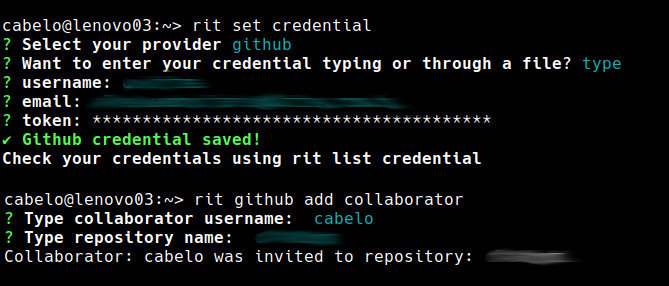
Less bureaucracy, more independence : Developers have more autonomy to work on their projects, with less interference from other areas. See an example in the illustration below:
For more information: https://docs.ritchiecli.io/

Stasiek Michalski wins the race for the openSUSE Board
The openSUSE Ad-hoc Board Election is now concluded.
Stasiek Michalski has been elected to join the openSUSE Board. The complete result is as follows:
- Stasiek Michalski — 160 votes
- Pierre Böckmann — 70 votes
234 out of 510 eligible members have cast their vote in this election. We recorded 4 blank votes.
We thank both of them for stepping up and running in this election and we congratulate Stasiek for his win.
Lastly, thanks to Edwin Zakaria and Ariez Vachha for their help in the planning of this election.
Samba Winbind Group Policy
Samba version 4.14 will ship with Group Policy for Winbind. The Group Policy offerings are made to be similar to what is offered by proprietary tools, such as Vintela’s and Centrify’s Group Policy.

Winbind Group Policy provides the ability to distribute smb.conf settings, Sudo Privileges, Message of the Day and Login Prompt messages, and daily, hourly, monthly, or weekly cron jobs.
To enable Group Policy in Winbind, set the apply group policies global smb.conf option to Yes. You can even deploy this setting from Group Policy smb.conf options, then running the apply command manually the first time with sudo samba-gpupate --force.
In order to use the Samba Administrative Templates in the Group Policy Management Console, you’ll need to install them first, using the command sudo samba-tool gpo admxload -UAdministrator. This will upload the samba.admx template to the joined domains SYSVOL share.
Resultant Set of Policy
To see what policies will apply to a machine before applying them (or to view what policies are already applied), run the command sudo samba-gpupdate --rsop.
linux-h7xz:~ # samba-gpupdate --rsop
Resultant Set of Policy
Computer Policy

GPO: Default Domain Policy
============================================================
  CSE: gp_sec_ext
  ------------------------------
  ------------------------------
  CSE: gp_sec_ext
  ------------------------------
  ------------------------------
  CSE: gp_scripts_ext
  ------------------------------
  ------------------------------
  CSE: gp_sudoers_ext
  ------------------------------
    Policy Type: Sudo Rights
    ------------------------------
    [ tux ALL=(ALL) NOPASSWD: ALL ]
    ------------------------------
  ------------------------------
  CSE: gp_smb_conf_ext
  ------------------------------
    Policy Type: smb.conf
    ------------------------------
    [ apply group policies ] = 1
    [ client max protocol ] = SMB2_02
    ------------------------------
  ------------------------------
  CSE: gp_msgs_ext
  ------------------------------
    Policy Type: /etc/motd
    ------------------------------
This message is distributed by Samba!
    ------------------------------
    Policy Type: /etc/issue
    ------------------------------
Samba Group Policy \s \r \l
    ------------------------------
  ------------------------------
============================================================
smb.conf Policies
smb.conf policies are found in Computer Configuration > Policies > Administrative Templates > Samba > smb.conf. These policies distribute smb.conf global options to the client. This policy is unable to apply idmap policies.
Password and Kerberos Policies
Password and Kerberos policies, found in Computer Configuration > Policies > OS Settings > Security Settings > Account Policy, are only applicable to Samba Domain Controllers.
The following password policies are applicable:
- Minimum password age
- Maximum password age
- Minimum password length
- Password must meet complexity requirements
And Kerberos policies:
- Maximum ticket age (Maximum lifetime for user ticket)
- Maximum service age (Maximum lifetime for service ticket)
- Maximum renew age (Maximum lifetime for user ticket renewal)
Script Policies
Script policies create cron jobs on client machines which execute the specified commands. Script policies are found in Computer Configuration > Policies > Administrative Templates > Samba > Unix Settings > Scripts.
To add a script policy, open the policy, enable it, and click Show. In the dialog that appears, add the command to execute on the client. Click OK, then Apply to save the policy.
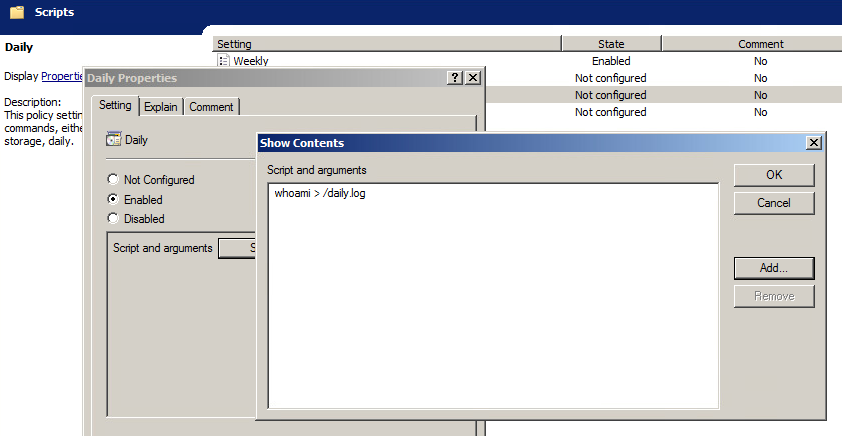
Script policies are applied as cron jobs on the winbind client.
linux-h7xz:~ # /usr/sbin/samba-gpupdate --force
linux-h7xz:~ # cat /etc/cron.daily/tmp6l0m809i
#!/bin/sh
whoami > /daily.log
Sudoers Policies
Sudoers policies add sudo rules to client machines. Sudoers policies are found in Computer Configuration > Policies > Administrative Templates > Samba > Unix Settings > Sudo Rights.
To add a sudo policy, open the policy, enable it, and click Show. In the dialog that appears, add the sudo rules to the list. Click OK, then Apply to save the policy.
linux-h7xz:~ # /usr/sbin/samba-gpupdate --force
linux-h7xz:~ # cat /etc/sudoers.d/gp_eockoryg

### autogenerated by samba
#
# This file is generated by the gp_sudoers_ext Group Policy
# Client Side Extension. To modify the contents of this file,
# modify the appropriate Group Policy objects which apply
# to this machine. DO NOT MODIFY THIS FILE DIRECTLY.
#

tux ALL=(ALL) NOPASSWD: ALL
Message Policies
Message policies set the contents of the /etc/motd and /etc/issue files on client machines. Message policies are found in Computer Configuration > Policies > Administrative Templates > Samba > Unix Settings > Messages.
To add a message of the day policy, for example, open the policy and enable it. In the text box provided, enter the message you’d like displayed after a successful login.
linux-h7xz:~ # samba-gpupdate
linux-h7xz:~ # cat /etc/motd
This message is distributed by Samba!
To add a login prompt policy, open the ‘Logon Prompt Message’ policy and enable it. In the text box provided, enter the message you’d like displayed before the login prompt. You can use escape sequences supported by the client /etc/issue file.
linux-h7xz:~ # samba-gpupdate
linux-h7xz:~ # cat /etc/issue
Samba Group Policy \s \r \l
For more information about Winbind Group Policy, see the Samba wiki.
openSUSE Tumbleweed – Review of the week 2020/35
Dear Tumbleweed users and hackers,
This week we have published a few snapshots less than normal. To ‘compensate’, the next one will be huge to download though. On August 25, I merged the change for libexecdir == /usr/libexec and since then I’m fighting to QA after effects to get you a snapshot out that won’t break in all corners. There will likely be some rough patches here and there though.
Anyway, let’s see what DID happen in week 35: three snapshots have been published (0821, 0823 and 0824) containing these changes:
- cURL 7.72.0
- NetworkManager 1.26.2
- fdupes 2.1.2 (upgraded from 1.61)
- systemd 245.7: NOTE: an issue with a dangling symlink in /etc/systemd/system/tmp.mount was identified. A fix for this is in the TW-Update channel
As mentioned earlier, the next snapshot to come out (currently testing 0826, but this could still be discarded too) will be ‘large’ with respect to download size, as literally all 15000 packages in Tumbleweed have been rebuilt. There were multiple reasons to trigger a full rebuild (and I intentionally collected them to have this done in one go)
- RPM: %{_libexecdir} changed to /usr/libexec. As this affects a lot of packages, and can change build results based on dependent packages file locations, a full rebuild was needed to be consistent in the end
- RPM: The compression payload of our packages has been changed to zstd compression. This generally should result in faster decompression (read: installation) of RPMs. Downside: These packages can only be read with Leap 15.2 (and future versions) and Tumbleweed (newer than 20190713).
- build: the build package was changed to also copy pkgconfig .pc files into the -devel-32bit package, if this is defined to be built in baselibs.conf.
- brp-check-suse: The symlinks pointing to /etc/alternatives are no longer converted to be relative symlinks, as update-alternatives did not really like that and kept on complaining to the users.
And besides all what has happened, the Stagings are still filled up with:
- Linux kernel 5.8.4
- Mozilla Firefox 80
- Chromium 85
- Boost 1.74.0
- Kubernetes 1.19
- systemd package drops the dependency on sysvinit-tools
- glibc 2.32
- binutils 2.35
- gettext 0.21
- bison 3.7.1
Kraft Version 0.95
The authors are happy to announce the new release 0.95 of Kraft. Kraft is free desktop software for managing office documents like quotes and invoices in the small enterprise for the Linux desktop.

Kraft Version 0.95
With version 0.95 we do a big step forward in the way of generating documents: Until now (more than fifteen years!) Kraft uses the ReportLab python library to create high quality PDF documents.
While this has served us well, it has always been cumbersome to adopt the template for users needs. ReportLab uses a XML format as the template which has a bit of a steep learning curve and is not really easy with syntax.
This changes now: From version 0.95, Kraft supports the cool project WeasyPrint. The principle remains the same: The document is built of a text based template which defines the look of the output document. That gets filled with the document data and gets converted to a PDF document. But unlike ReportLab, Weasyprint is HTML based. Many people know a bit of HTML and thus will have an way easier time to adopt the template to personal needs.
Apart from the ease of use, it is much more simple to do modern report design with Weasyprint, as it supports the wide range of CSS styling.
That is a great improvement, as adopting Krafts output to personal needs is much more intuitive now. For now, Kraft supports both rendering engines, but ReportLab based reports are deprecated now and support will end in future releases of Kraft.
Along with integration of Weasyprint the text templating library Grantlee was added, as it is the standard in the KDE/Qt world, well maintained and widely available. The ctemplate library which was used for that so far will also be deprecated.
The other great improvement in this release is that Kraft now has a user manual embedded which will give new users a guiding help. It will open in the browser once the user clicks on the menu entry in the help menu, also without internet connection. It was started by a community member and it will grow and improve over time.
As usual this new version also ships an amount of bug fixes and small improvements which can be found in the Changelog.
We wish all users big fun with this remarkable new version of Kraft.