
 Member
 DimStar
openSUSE Tumbleweed – Review of the week 2021/23
Dear Tumbleweed users and hackers,
Today, the weekly review reaches you a little bit late: I was out early yesterday to enjoy the weather. Here, the sun is finally coming out for more than just a few minutes. But, back to the important things that are the openSUSE Tumbleweed snapshots. Namely, we have released 6 snapshots (0603, 0604, 0605, 0606, 0609, and 0610) in the last week.
The major changes included:
- Linux kernel 5.12.9
- Mesa 21.1.2
- KDE Plasma 5.22.0
- libxml 2.9.12
- Apache 2.4.48
- PHP 7.4.20
- Chrony 4.1
- cURL 7.77.0
- Mozilla Thunderbird 78.11.0
- OpenSSH: move of the distro default config to /usr/etc. Admin config is supposed to be in /etc. Make sure to check the .rpmsave files after the update. Best to put config snippets in /etc/ssh/sshd_config.d/*.conf files to inherit distro config changes
The changes planned for the future snapshots include:
- python3x packages will no longer provide a python symbol. This caused some confusion in the past when people expected ‘python’ to be the legacy python2, but python3x provided it as well.
- Linux kernel 5.12.10
- GNOME 40.2
- systemd 248
- KDE Gear 21.04.2
- Cinnamon 5.0

Lists of Tiddlers using Multiple Tags | TiddlyWiki

Plasma, Mesa, curl Update in Tumbleweed
Three openSUSE Tumbleweed snapshots were released this week with the possibility of another snapshot being released over the weekend if it passes openQA testing.
The latest snapshot, 20210609, brought an update for KDE users; Plasma 5.22.0 was released just days ago and improves stability and usability across the board, according to the release announcement. Developers put in a lot of work on the aesthetics of the release. The big new feature in the release is called Adaptive Transparency, which provides a pleasant translucent panel and panel widgets that become entirely opaque if there are any maximized windows; this is done to avoid any visual distractions when users need to focus. The new version also opens up on a speed dial page in System Settings that gives users direct access to the most commonly used settings, as well as to the ones accessed the most. Mozilla Thunderbird renewed an expired keyring in the 78.11.0 version and fixed two Common Vulnerabilities and Exposures. Wireshark 3.4.6 fixed a display filter crash and macro filters’ handling of escaped characters. A major version update for the basic directory structure was made with the jump of the filesystem package from version 15.5 to 84.87. GNOME 40 also received some updates in the snapshot with an update of gnome-software to version 40.2; some crash fixes were made and an improvement in reporting errors low disk space for Flatpak were made. Other packages to update in the snapshot were git 2.32.0, powertop 2.14, xfce4-settings and nftables 0.9.9.
The 20210605 snapshot provided an update of curl 7.77.0, which fixed three CVEs; CVE-2021-22901 could be tricked into using already freed memory when a new TLS session is negotiated or a client certificate is requested on an existing connection using the curl library. Printing protocol cups-filters updated to version 1.28.8 and fixed several memory leaks and provided some fixes for grayscale mode. A major version update of chrony 4.1 arrived in the snapshot. The newer implementation for Network Time Protocol added support for Network Time Security (NTS) authentication and added support for Advanced Encryption Standard keys with the low-level cryptographic library Nettle. Multiple patches were added for the the Advanced Linux Sound Architecture package and the asla-plugins package in the update to versions 1.2.5. The command line utility package for container images and image repositories, Skopeo, updated to version 1.2.3 and added a fix for login and logout registry arguments. An update of yast2 version 4.4.9 disabled hibernation based on products and virtual machines. Other packages to update in the snapshot were libvirt 7.4.0, kmod 29, vim 8.2.2918 and more.
The 3D Mesa package and Mesa-drivers package updated to versions 21.1.2 in snapshot 20210604. Some flickering when rendering was fixed on Intel’s Tiger Lake chips with the Mesa update. Most of the updates included changes for AMD and Intel, but there was a decent amount of arm fixes. Multiple fixes were made in the update of apache2 2.4.48, which added SSL related inquiry functions to the server Application Programming Interface. The update of the Thunderbolt 3 device manager bolt updated to version 0.9.1, which fixes journal and now has a host identification for embedded thunderbolt controllers. Redis 6.2.4 fixed a few crashes and a CVE that exploited an integer overflow bug. The zypper package added hints to trust GPG key prompt in the version update to 1.14.45; the package also received a translation in Kabyle , which is a language spoken in north Africa. Other packages to update in the snapshot were remmina 1.4.18, xapps 2.2.0, hwdata 0.348 and more.

Using a custom Jitsi Meet room in a Matrix channel
In Element, you can create nice widgets on top of a channel that contain a Jitsi Meet video conference. However, these Widgets normally point to a Jitsi server from Element and to a random meeting ID. So, here is my step by step guide on how to create a widget with a custom Jitsi room.
- Open the room you want to have the widget in.
- Click on the room name and select the “Advanced” tab
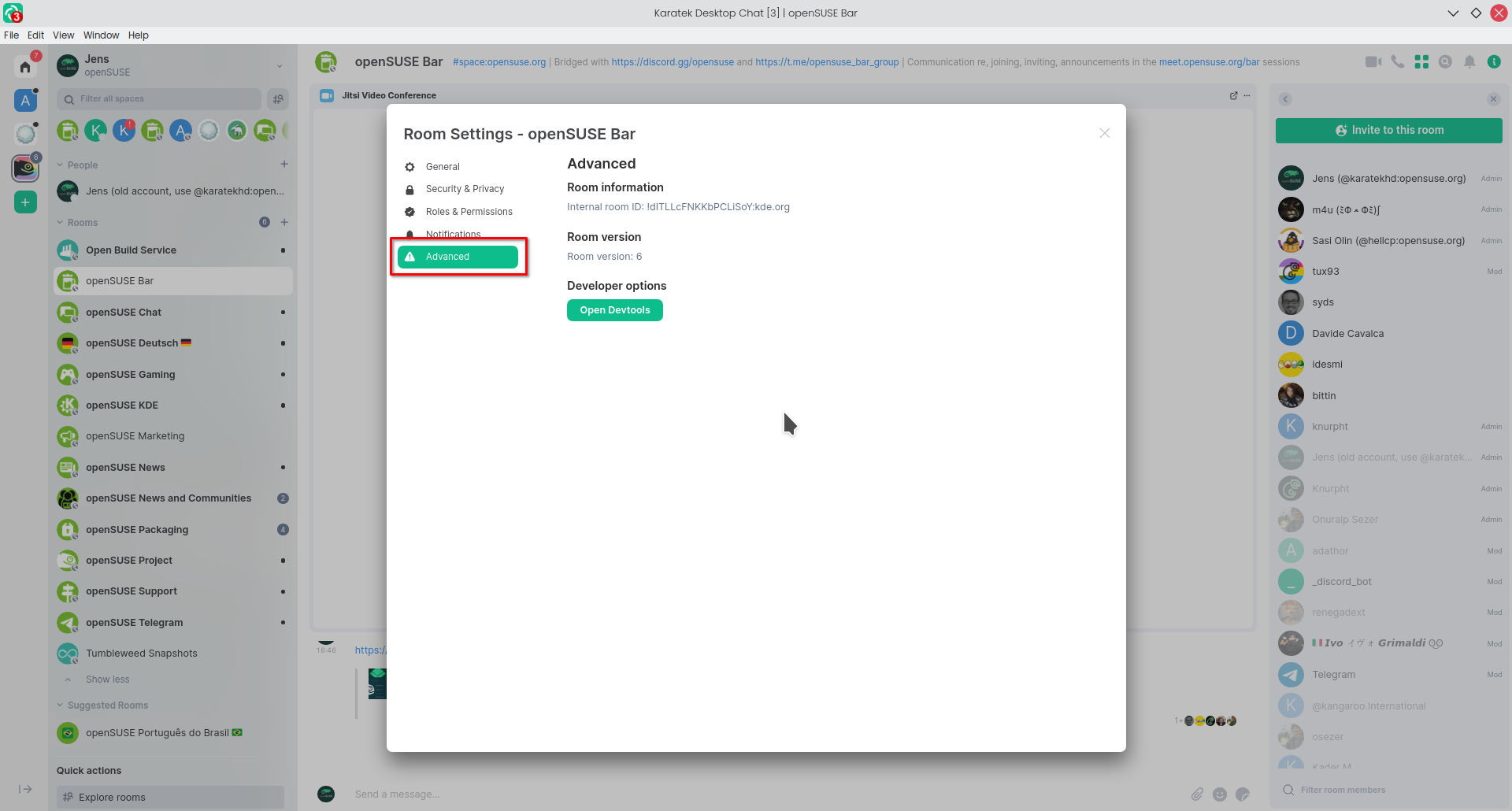
- Click on “Open Devtools”
- Select “Send Custom Event”
- Click on the red “Event” button. You should see something like this:

- In the “Event Type” text field, write this:
im.vector.modular.widgets - In the “State Key” text field, write this:
dimension-jitsi-1622722886114 - Fill the large text box with the following:
{
 "type": "jitsi",
 "url": "https://dimension.opensuse.org/widgets/jitsi?conferenceId=$conferenceId&domain=$domain&isAudioOnly=$isAudioOnly&displayName=$matrix_display_name&avatarUrl=$matrix_avatar_url&userId=$matrix_user_id",
 "name": "Jitsi Video Conference",
 "data": {
     "conferenceUrl": "<jitsi instance>/<jitsi room>",
     "domain": "<jitsi instance>",
     "conferenceId": "<jitsi room>",
     "isAudioOnly": false,
     "url": "https://dimension.opensuse.org/widgets/jitsi?conferenceId=$conferenceId&domain=$domain&isAudioOnly=$isAudioOnly&displayName=$matrix_display_name&avatarUrl=$matrix_avatar_url&userId=$matrix_user_id",
     "dimension:app:metadata": {
         "wrapperUrlBase": "",
         "wrapperId": "",
         "scalarWrapperId": null,
         "integration": {
             "category": "widget",
             "type": "jitsi"
         }
     }
 },
 "id": "dimension-jitsi-1622722886114"
}
Replace
<jitsi instance>with the URL of the Jitsi Server, e.g.https://meet.opensuse.organd replace<jitsi room>with the name of the Jitsi room, e.g.barA working example looks like this (it links to the openSUSE Bar):{ "type": "jitsi", "url": "https://dimension.opensuse.org/widgets/jitsi?conferenceId=$conferenceId&domain=$domain&isAudioOnly=$isAudioOnly&displayName=$matrix_display_name&avatarUrl=$matrix_avatar_url&userId=$matrix_user_id", "name": "Jitsi Video Conference", "data": { "conferenceUrl": "https://meet.opensuse.org/bar", "domain": "meet.opensuse.org", "conferenceId": "bar", "isAudioOnly": false, "url": "https://dimension.opensuse.org/widgets/jitsi?conferenceId=$conferenceId&domain=$domain&isAudioOnly=$isAudioOnly&displayName=$matrix_display_name&avatarUrl=$matrix_avatar_url&userId=$matrix_user_id", "dimension:app:metadata": { "wrapperUrlBase": "", "wrapperId": "", "scalarWrapperId": null, "integration": { "category": "widget", "type": "jitsi" } } }, "id": "dimension-jitsi-1622722886114" } - Click on the green “Send” button
- Have a lot of fun…

Foster openSUSE Leap 15.3 Growth
The release party in the openSUSE bar continues on more than a week after the release of openSUSE Leap 15.3, yet that’s not the only thing soaring for the project.
The adaptation of the new release continues to show a steady increase on metrics.opensuse.org as a pattern trends up and to the right with 40,000 installations a week after the release. Major increases in adaption traditionally happen within a few months after a release as users are expected to upgrade to the latest minor release within six months of its availability.
An area where the project can use help is with the promotion of openSUSE Leap 15.3. Users can find new Leap flyers in the github artwork repository along with updated banners and a new Leap image.

Community marketing has been emphasizing the use of Leap on servers, workstations, desktops and for virtualization and container use. Migration projects and user acceptance testing also benefit from the newest Leap. Large development teams can run and test workloads that can be lifted and shifted to SUSE Linux Enterprise Linux 15 Service Pack 3 for long-term maintenance if needed. The newest minor version is rock-solid and simple to upgrade from Leap 15.2. openSUSE Leap 15.3 is built with the exact same binary packages as SLE.
The community is supportive and engages with people who use Leap through community channels like the mailing lists, Matrix, Discord, Telegram and Facebook. Help to promote the release by giving a review on DistroWatch or do a review of the release through a video or blog.
The release team also wants users’ feedback and can take a survey about the release until June 16.
New Rebuilds Look to Advance New Hardware
Developers of the openSUSE community are making advances toward even broader hardware support through the FrontRunner project.
FrontRunner is a rebuild of SUSE Linux Enterprise from sources in the Open Build Service (OBS) that provides community collaboration through openSUSE’s Step effort. FrontRunner rebuilds all sources in one project that include and stage changes to advance architecture enablement for future Leap releases.
“I am excited how FrontRunner opens up a new approach for openSUSE and SUSE to jointly enable new hardware architectures for openSUSE Leap,” said Dr. Gerald Pfeifer, chair of the openSUSE Board and Chief Technical Officer at SUSE.
openSUSE Leap inherits its base from SUSE Linux Enterprise.
“FrontRunner provides a staging area to feed back into SUSE Linux Enterprise, allowing for new levels of collaboration,” Pfeifer said.
Step, which was started in February, is designed to expand more architecture availability for future openSUSE Leap and SLE releases. FrontRunner rebuilds were established within the Step effort under the openSUSE:Step:Frontrunner namespace in OBS.
FrontRunner seeks to fix the rebuild failures in older releases and make advances enough to the point where community suggestions can be staged to further the development platform. This benefits things like older armv7 hardware so that it is not blocked on processes and is open to pioneer advances with other architectures.
“FrontRunner is about well tested changes that we want to merge in the next Service Pack,” said Milisav Radmanic, SLE Engineering Director. “Getting these new platform and architecture developments are a game changer.”
Step can already stage agreed-upon fixes for reproducibility and cross architecture builds. FrontRunner will provide precursor testing to match with implementation challenges and the project’s goals.
FrontRunner aims to build all sources in a single layer, which includes patches that are meant to land in a service pack. This could then make it into a Leap point release or maintenance update. With FrontRunner’s rebuild of SLE sources and Step as an intermediate building block, the builds are expected to enable community distributions like openSUSE Leap or other community derivatives.
Unlike openSUSE Leap, openSUSE Step and FrontRunner are not intended to be end user distributions. They serve to advance SLE and Leap.
Troubled Minister

Another weekend arrangement made mostly in Polyend Tracker. Video footage assembled from my fpv flights around Liberec over the course of past few weeks.
Listen right here:
Watch a video:
openSUSE Tumbleweed – Review of the week 2021/22
Dear Tumbleweed users and hackers,
This week was definitively amongst the more interesting ones for Tumbleweed. There was a change of the basic filesystem layout called UsrMerge. Unfortunately, despite all planning and testing, some users still ran into issues. In some cases, it could be pointed to an ‘unexpected’ setup (root on zfs, /usr/lib/debug as sep mount point…) and in some cases, the reason for the failure is not yet fully understood. But this might sound scarier than it is: a lot of users have also reported that the process worked flawlessly on their systems. Together with a full rebuild using GCC 11 snapshot 0527 was definitively huge. Besides that, two more snapshots (0601, and 0602) were published.
The major changes in this week are:
- UsrMerge enabled (https://en.opensuse.org/openSUSE:Usr_merge – see also the section ‘Known issues’)
- Distribution rebuilt using gcc 11.1
- bind 9.16.16
- ghostscript 9.54.0
- elfutils 0.185
After having slowed down Tumbleweed a bit to settle the UsrMerge dust, we could catch up with the stagings projects and have not that many things left in the queue. But that is just today and things can change quickly there. The current plans for future snapshots include:
- Linux kernel 5.12.9
- systemd-experimental (pstore, repart, homed, userdb)
- Mesa 21.1.2
- libxml 2.9.12: http://xmlsoft.org/news.html
- Cinnamon 5.0
- curl 7.77.0
- systemd 248
- KDE Plasma 5.22.0
- python3x packages will no longer provide a python symbol. This caused some confusion in the past when people expected ‘python’ to be the legacy python2, but python3x provided it as well.

Bzip2's experimental repository is changing maintainership
Bzip2's stable repository is maintained at Sourceware by Mark Wielaard. In 2019 I started maintaining an experimental repository in GitLab, with the intention of updating the build system and starting a Rust port of bzip2. Unfortunately I have left this project slip by.
The new maintainer of the experimental repository for Bzip2 is Micah Snyder. Thanks, Micah, for picking it up!
Online Open House Goes Over openSUSE, Survey Opens
The openSUSE Project has a lot going on lately. The project just released Leap 15.3, had 24-hour release party in the openSUSE Bar and opened a survey to get feedback on the release of the new Leap version.
There are many other things happening and one of those is an online open house. Members of the community will have two sessions discussing openSUSE topics during SUSE Open House CZ 2021
The event will take place on June 15 from 13:00 UTC to 17:00 UTC. Leap release manager Lubos Kocman will give a talk about how openSUSE Leap 15.3 is made and community member Jason Evans will discuss how to contribute to openSUSE.
Participants must register for the event.
The project also has the openSUSE Conference coming up from June 18 - 19. There are several talks for the conference with topics about the community, open source, new technologies, cloud computing, containers, embedded software and much more.
Kocman will also give a talk at the conference about the survey results, which is open until June 16.