
 ximion
Introducing the MetaInfo Creator
 This year’s FOSDEM conference was a lot of fun – one of the things I always enjoy most about this particular conference (besides having some of the outstanding food you can get in Brussels and meeting with friends from the free software world) is the ability to meet a large range of new people who I wouldn’t usually have interacted with, or getting people from different communities together who otherwise would not meet in person as each bigger project has their own conference (for example, the amount of VideoLAN people is much lower at GUADEC and Akademy compared to FOSDEM). It’s also really neat to have GNOME and KDE developers within reach at the same place, as I care about both desktops a lot.
An unexpected issue
This blog post however is not about that. It’s about what I learned when talking to people there about AppStream, and the outcome of that. Especially when talking to application authors but also to people who deal with larger software repositories, it became apparent that many app authors don’t really want to deal with the extra effort of writing metadata at all. This was a bit of a surprise to me, as I thought that there would be a strong interest for application authors to make their apps look as good as possible in software catalogs.
A bit less surprising was the fact that people apparently don’t enjoy reading a large specification, reading a long-ish intro guide with lots of dos and don’ts or basically reading any longer text at all before being able to create an AppStream MetaInfo/AppData file describing their software.
Another common problem seems to be that people don’t immediately know what a “reverse-DNS ID” is, the format AppStream uses for uniquely identifying each software component. So naturally, people either have to read about it again (bah, reading!  ) or make something up, which occasionally is wrong and not the actual component-ID their software component should have.
The MetaInfo Creator
It was actually suggested to me twice that what people really would like to have is a simple tool to put together a MetaInfo file for their software. Basically a simple form with a few questions which produces the final file. I always considered this a “nice to have, but not essential” feature, but now I was convinced that this actually has a priority attached to it.
So, instead of jumping into my favourite editor and writing a bunch of C code to create this “make MetaInfo file” form as part of appstreamcli, this time I decided to try what the cool kids are doing and make a web application that runs in your browser and creates all metadata there.
So, behold the MetaInfo Creator! If you click this link, you will end up at an Angular-based web application that will let you generate MetaInfo/AppData files for a few component-types simply by answering a set of questions.
The intent was to make this tool as easy to use as possible for someone who basically doesn’t know anything about AppStream at all. Therefore, the tool will:
- Generate a rDNS component-ID suggestion automatically based on the software’s homepage and name
- Fill out default values for anything it thinks it has enough data for
- Show short hints for what values we expect for certain fields
- Interactively validate the entered value, so people know immediately when they have entered something invalid
- Produce a .desktop file as well for GUI applications, if people select the option for it
- Show additional hints about how to do more with the metadata
- Create some Meson snippets as pointers how people can integrate the MetaInfo files into projects using the Meson build system
For the Meson feature, the tool simply can not generate a “use this and be done” script, as each Meson snippet needs to be adjusted for the individual project. So this option is disabled by default, but when enabled, a few simple Meson snippets will be produced which can be easily adjusted to the project they should be part of.
The tool currently does not generate any release information for a MetaInfo file at all, This may be added in future. The initial goal was to have people create any MetaInfo file in the first place, having projects also ship release details would be the icing on the cake.
I hope people find this project useful and use it to create better MetaInfo files, so distribution repositories and Flatpak repos look better in software centers. Also, since MetaInfo files can be used to create an “inventory” of software and to install missing stuff as-needed, having more of them will help to build smarter software managers, create smaller OS base installations and introspect what software bundles are made of easily.
I welcome contributions to the MetaInfo Creator! You can find its source code on GitHub. This is my first web application ever, the first time I wrote TypeScript and the first time I used Angular, so I’d bet a veteran developer more familiar with these tools will cringe at what I produced. So, scratch that itch and submit a PR!  Also, if you want to create a form for a new component type, please submit a patch as well.
C developer’s experience notes for Angular, TypeScript, NodeJS
This section is just to ramble a bit about random things I found interesting as a developer who mostly works with C/C++ and Python and stepped into the web-application developer’s world for the first time.
For a project like this, I would usually have gone with my default way of developing something for the web: Creating a Flask-based application in Python. I really love Python and Flask, but of course using them would have meant that all processing would have had to be done on the server. One the one hand I could have used libappstream that way to create the XML, format it and validate it, but on the other hand I would have had to host the Python app on my own server, find a place at Purism/Debian/GNOME/KDE or get it housed at Freedesktop somehow (which would have taken a while to arrange) – and I really wanted to have a permanent location for this application immediately. Additionally, I didn’t want people to send the details of new unpublished software to my server.
TypeScript
I must say that I really like TypeScript as a language compared to JavaScript. It is not really revolutionary (I looked into Dart and other ways to compile $stuff to JavaScript first), but it removes just enough JavaScript weirdness to be pleasant to use. At the same time, since TS is a superset of JS, JavaScript code is valid TypeScript code, so you can integrate with existing JS code easily. Picking TS up took me much less than an hour, and most of its features you learn organically when working on a project. The optional type-safety is a blessing and actually helped me a few times to find an issue. It being so close to JS is both a strength and weakness: On the one hand you have all the JS oddities in the language (implicit type conversion is really weird sometimes) and have to basically refrain from using them or count on the linter to spot them, but on the other hand you can immediately use the massive amount of JavaScript code available on the web.
Angular
The Angular web framework took a few hours to pick up – there are a lot of concepts to understand. But ultimately, it’s manageable and pretty nice to use. When working at the system level, a lot of complexity is in understanding how the CPU is processing data, managing memory and using the low-level APIs the operating system provides. With the web application stuff, a lot of the complexity for me was in learning about all the moving parts the system is comprised of, what their names are, what they are, and what works with which. And that is not a flat learning curve at all. As C developer, you need to know how the computer works to be efficient, as web developer you need to know a bunch of different tools really well to be productive.
One thing I am still a bit puzzled about is the amount of duplicated HTML templates my project has. I haven’t found a way to reuse template blocks in multiple components with Angular, like I would with Jinja2. The documentation suggests this feature does not exist, but maybe I simply can’t find it or there is a completely different way to achieve the same result.
NPM Ecosystem
The MetaInfo Creator application ultimately doesn’t do much. But according to GitHub, it has 985 (!!!) dependencies in NPM/NodeJS. And that is the bare minimum! I only added one dependency myself to it. I feel really uneasy about this, as I prefer the Python approach of having a rich standard library instead of billions of small modules scattered across the web. If there is a bug in one of the standard library functions, I can submit a patch to Python where some core developer is there to review it. In NodeJS, I imagine fixing some module is much harder.
That being said though, using npm is actually pretty nice – there is a module available for most things, and adding a new dependency is easy. NPM will also manage all the details of your dependency chain, GitHub will warn about security issues in modules you depend on, etc. So, from a usability perspective, there isn’t much to complain about (unlike with Python, where creating or using a module ends up as a “fight the system” event way too often and the question “which random file do I need to create now to achieve what I want?” always exists. Fortunately, Poetry made this a bit more pleasant for me recently).
So, tl;dr for this section: The web application development excursion was actually a lot of fun, and I may make more of those in future, now that I learned more about how to write web applications. Ultimately though, I enjoy the lower-level software development and backend development a bit more.
Summary
Check out the MetaInfo Creator and its source code, if you want to create MetaInfo files for a GUI application, console application, addon or service component quickly.

openSUSE Summit Dublin Canceled
The openSUSE Summit Dublin has been canceled due to the cancellation of some talks and the cancellation of the in-person SUSECON 2020 in Dublin.
Concerns over the developing situation of COVID-19 coronavirus lead to the decision to cancel the openSUSE Summit Dublin as the venue would have been shared with SUSECON and is no longer available for the summit.
Contact ddemaio (@) opensuse.org if you have any questions concerning the summit.
 Member
openSUSE Tumbleweed – Review of the week 2020/10
Dear Tumbleweed users and hackers,
Tumbleweed – full steam ahead! There have been 6 snapshots in the last week, some with quite some changes. The snapshots were 0227, 0228, 0229, 0301, 0303 and 0304.
The changes include:
- Zypper 1.14.34: beware! This version no longer supports abbreviated command line parameters (e.g
zypper install --no-ris no longer accepted, you need to spell--no-recommendsout) - GCC 10 is available and provides base libraries to the system
- KDE Plasma 5.18.2
- Linux kernel 5.5.6
- Many changes in various YaST modules
- gimp 2.10.18
The future will bring those changes, sooner or later:
- Python 3.8: The latest fixes should be there. IF nothing new shows up, this will ship next week
- binutils 2.34
- Qt 5.15.0 (currently betas being tested)
- Ruby 2.7 – possibly paired with the removal of Ruby 2.6
- GCC 10 as the default compiler
- Removal of Python 2
- GNU Make 4.3
- RPM: change of database format to ndb

Highlights of YaST Development Sprint 94
The Contents
After some time of silent work (our previous blog post was published a month ago), the YaST Team is back with some news about the latest development sprint and some Hack Week experiments. Those news include:
- Enabling YaST on the Windows Subsystem for Linux
- Usability improvements for the Online Search, the Partitioner and the Kdump module
- Better control of overridden
sysctlconfiguration values - Improvements in the default selections of the upcoming SLE 15 SP2 installer
- New features for zSeries mainframes like Secure Boot and I/O devices auto-configuration
- And, as a bonus, a couple of Hack Week projects related to YaST, Ruby and Crystal
So, as you can see, we have a little bit of everything in the menu, from WSL to mainframes, from new features to small usability improvements, from installation to system fine-tuning… So let’s dive into the details!
Improved compatibility with WSL
Have you ever heard about WSL, the Windows Subsystem for Linux? To be honest, before this sprint we haven’t payed much attention to it either. But as both openSUSE Leap and SUSE Linux Enterprise (SLE) are available to Windows users via WSL images and the 15.2 releases of both distributions are approaching, we decided it was time to dive into WSL to research how it works and how can YaST be useful there.
Setting up an (open)SUSE test system inside a WSL environment was a piece of cake thanks to the excellent documentation at the openSUSE Wiki.
Many components of YaST are useless in WSL because not everything can actually be configured from the Linux system itself and because systemd is not available (we are talking exclusively about WSL1 here). But YaST is still very useful for the initial setup of the system when running the (open)SUSE image for the first time. It can be used to setup the first user, to confirm the license and, in the SLE case, also to register the system. The YaST modules for software management can also be very handy to customize the image at any point after that initial setup.
So far, we have done three changes to improve the experience of executing YaST within WSL.
- We increased the speed of the initial boot by removing calls to systemd when it is not available.
- We fixed the registration process for YaST Firstboot.
- We implemented a feature to explicitly mark YaST modules that work in WSL and show only those modules in the YaST control center.
We also documented all our findings about WSL in this document.
As always, we are hungry for feedback. Please reach out to us and tell us what’s your experience using YaST inside WSL and which modules do you miss the most.
Improving the UX of the Online Search
As we announced one month ago, YaST will offer a mechanism to
search for packages through all SUSE Linux Enterprise modules, even if
they are not registered. This feature, known as package online search,
was already available using zypper’s search-packages command or
through the SCC web interface.
After gathering some feedback during the sprint review meeting, we decided to invest some time improving the overall UX experience. Perhaps the most relevant change is the new summary screen, which shows the list of modules to activate and packages to install.

Additionally, we improved error handling and, by the way, we fixed the case sensitive filter.
…And the Partitioner as Well
The online search is not the only part of YaST that has received some love in the UX area. We also tried to improve a bit the usability of the Partitioner. In this occasion, based on the feedback coming from our users via openSUSE’s Bugzilla.
On one hand, we got a report about this dialog been too long to properly fit in low screen resolutions.

The result was even worse in a text console with a resolution of 80 columns and 24 lines, which is the minimum size we design all YaST screens to work on.

So we dropped some obsolete options and made others more compact. Now the dialog fits in 24 lines again.

And, as you can see below, it looks also nicer (or at least less overwhelming) in graphical mode as well. It’s worth mentioning we also took the opportunity to fix other related dialogs that had similar problems.

On the other hand, we also got a report about how inconvenient was to always jump to the first tab when a device was selected in the devices tree at the left of the Partitioner, forcing the user to click in the “Partitions” tab (or any other desired one) over and over.
In that regard and as you may remember, a couple of sprints ago we made the overview screen actionable, avoiding the navigation to the device page just to perform a simple action over it. But navigating through the different devices back and forth is still possible and useful. Now such navigation has been improved by remembering the last tab and row selected per section or device whenever possible, which will save you a bunch of clicks when working with multiple devices.
Related to this, we started a public discussion about what should be the default tab the first time a device is visited. Once again, we are looking for opinions. So we would be grateful if you read the thread and contribute to the discussion.
Showing Suggested Values for Kdump Configuration
But the Partitioner was not the only YaST module for which our users pointed usability problems via Bugzilla. After some changes in how Kdump works after the migration from openSUSE Leap 42.3 to 15.0, it turned out that using YaST to re-adjust the values was not as helpful as it should be. YaST Kdump displayed the current size of the memory reservations, as well as the min and max margins. But it did not show the recommended default values for the current system, so if the user has adjusted the limits in the past it was impossible to get an up-to-date proposal from YaST calculated for the current system.
We have adapted the dialog to show those suggested values. As you can see below, we also took the opportunity to extend the help text to explain the meaning of the different values.

Better Control of Overridden Kernel Parameter Values
And talking about YaST pieces we are improving step by step, you may
remember from our report of sprint 86 that we are adapting YaST to
deal with the new structure of the sysctl configuration.
Up to now YaST has stored sysctl values mainly in /etc/sysctl.conf
and /etc/sysctl.d/70-yast.conf. But this reflects only a part of the
possibilities for storing those values. The truth is that there are many
more locations where these settings can be stored: /run/sysctl.d,
/etc/sysctl.d, /usr/local/lib/sysctl.d, /usr/lib/sysctl.d,
/lib/sysctl.d, /etc/sysctl.conf…
Now YaST also takes care of these locations and informs the user if there are some conflicting values, as you can see in the following screenshot.

The Default Pre-selected SLE Modules
We have also invested some time smoothing some rough edges off the installation process for the upcoming openSUSE 15.2 and SLE 15 SP2. For example, if you register your SLE 15 product during installation you will see the available modules and extensions in the following dialog. Some of them are by default pre-selected because they either contain the base system components (kernel, glibc,…) or the product specific packages (e.g. GNOME for SLE Desktop).

However, if you skip the registration and use the packages from the DVD medium there were no modules or extension pre-selected. The problem is that the information about the default modules was only available in the SCC data which obviously is not available in an offline installation.
In SLE 15 SP2 we added this extra information to the installer configuration files so now also in an offline installation YaST can preselect the default modules for each product.
Proposing NTP Servers During Installation
And talking about offering sensible defaults for installation, we also
improved the situation regarding the configuration of the NTP server.
For openSUSE based systems (including Kubic) and a few SUSE products,
like CaaSP or SLE High Performance Computing, YaST sets up the NTP
daemon during installation. YaST tries to determine which server to use
through the DHCP information but, when it is not available, it will
propose one from openSUSE and SUSE pools (e.g.,
n.opensuse.pool.ntp.org where n is a number between 0 and 3).
However, we still were using the novell.pool.ntp.org pool for SUSE
based products. During this sprint, we have switched to the
suse.pool.ntp.org pool of servers and, additionally, we have
refactored some code in order to reduce duplication and improve
testability.
Secure Boot Support for IBM zSeries
You may have noticed by the recent sprint reports that we are improving several aspects related to the installation and configuration of zSeries mainframes. This sprint was not an exception… and will certainly not be the last one in that regard.
As a result of that effort, YaST now supports the Secure Boot feature found on the latest zSeries machines. It’s rather similar to the existing UEFI Secure Boot so we took the opportunity to unify the Secure Boot handling found on different architectures.
This means you get this checkbox if your zSeries machine does have Secure Boot support.

In addition, we added a shortcut link on the installation summary screen that lets you enable Secure Boot with just a click.

As mentioned, we took the opportunity to unify the management of Secure Boot in all platforms, so this new shortcut link is also available in x86_64 or aarch64 machines that have UEFI Secure Boot.
Automatic Configuration of I/O Devices in zSeries
And talking about zSeries mainframes, anyone having used Linux in one of those systems know that input/output devices, like disks or network cards, must be configured and activated before they can be detected and used normally by the operating system.
But thanks to the new I/O device auto-configuration mechanism, users can now specify IDs and settings of I/O devices that should be automatically enabled in Linux. We modified the installer to detect such configuration and trigger the corresponding configuration actions, removing the need of manually activating disks and network devices during the installation process.
This is still an experimental feature and we are waiting for feedback to make sure the current implementation works in all the desired scenarios. If everything goes as expected, the feature will debut in SLE 15 SP2.
Hack Week
As said at the beginning of the post, the main reason for spending almost a month without publishing any report was that the whole YaST Team at SUSE was diving into completely different topics due to Hack Week 19, which theme was “Simplify, Modernize and Accelerate”.
There were not many projects related to YaST in this edition of Hack Week, but there are at least two that could be interesting for YaST fans and contributors. Fortunately, we have published reports for both of them in the yast-devel mailing list. So check out the results of “Learn Crystal by Porting Part of YaST to that Language” and “YaST Logs Analyzer“.
More to come
Now that we are back to our usual development pace, we should have more news about YaST development in a couple of weeks. The plan is to focus on fixing bugs for the upcoming releases of openSUSE Leap and SUSE Enterprise Linux, but we are pretty sure we will still find interesting bits of information for you.
Meanwhile, keep in touch through the usual channels and have a lot of fun!

CLI Tools
I am quite happy with my zsh and its various plugins (git, kubernetes, docker, etc). Since in $DAYJOB I work with kubernetes a lot, I heavily use kubectl, kubectx, kubens etc. in combination with grep, jq, pipes, etc. and prefer these CLI tools always over clicking buttons or scrolling long pages in browser.
All these got me into thinking, if I were to write a command line application today (March 2020), which language / frameworks should I use ? Some self-imposed constraints:
- The CLI application will be short-lived and will be invoked multiple times everyday by developers/users (such as grep, ls, cat, sed, etc.) and not daemons or long running processes. It won't matter if they leak memory too ;-)
- It needs to be fast. Lightning speed.
- The tool development may also be split into two parts, a library and a binary, if it could help in developing parallel client implementations (may be in future a GUI tool)
- The tool is going to be a FOSS tool and would need some community presence in future.
- Tool needs to be cross platform (Mac, Linux, Windows)
This post is a summary of various candidates and their current strengths and weaknesses in my perspective.
C
+ Probably the language that will guarantee the fastest tool.+ Easy to write wrapper libraries/bindings for any language
+ There are libraries like glib which might help with achieving better platform portability than the default language.
- Manual memory management, crash prone
- Most young programmers of today may not bother contributing, even if they use. Heck, most do not even learn this language in most colleges anymore.
- If the tool has to work with network services, JSON etc., library support is not going to be easily available.
- i18n, Unicode support etc. may not be great out of the box
Note: C++ is just a more complicated and painful C in my personal experience. Even though I have heard nice things about SmartPointers etc., I am not really convinced that learning C++ is going to be beneficial in the long run and never really bothered to master it, after learning it at college. This is an intentional miss.
Java
+ Rich and mature libraries and ecosystem+ Complete platform independence and is guaranteed to run on Linux, Macs or Windows alike. Datatypes, Files etc. behave properly everywhere.
- Perception of slowness. There may be some JVM tweaking etc. needed and that is an extra effort. IIUC this would be a non-issue for long running processes.
- Unclear licensing: may require to pay money to Oracle
Special mention: Kotlin is a humongously better language than the Java 8 (with lambdas) that I recently used. It has been mentioned that future releases of Java would incorporate sexy aspects of Kotlin. Related talk. (Ignore the clickbait title, excellent talk really, strongly recommended).
Python
+ Good library support and hopefully all will migrate to Python 3- Not a fan of the language for various reasons. Whitespace for scope identification, Lack of static typing out of the box, type unsafety for variables, etc.
Javascript (With Typescript/Electron, etc)
+ The language with the most number of developers in today's scenario (biased as per my sample set)+ Excellent support for multiple natural languages, glyphs, diacritics, etc. Mature frameworks, processes for i18n, l10n, etc.
- Slow and hungry for memory/cpu
- Using nodejs for CLI applications though not unheard of, is not popular either (compared to the adoption of GUI applications via Electron)
D / Haskell / Rust / C#
These languages may be great but these are niche and are not widely used by a large number of programmers in my circle.Rust although is claimed to be gaining momentum for a long time now, I cannot recollect any popular application that I use everyday done with Rust. I have stopped using Firefox (in favor of Brave) and so not really sure what the current performance status of Rust is. I will however, keep a watch on Rust and would try to learn at some point of time, in near future.
Golang
+ Almost every new CLI tool that I have used fresh in the last 5 years or so, is done in Golang (docker, kube*, hugo, helm, etc)+ Excellent libraries: Cobra and Viper (Thanks to spf13)
+ Super simple to distribute. Static binaries.
+ Automatic memory management and highly performant.
+ Strong community presence
- Lack of generics is a pain. It is not a problem when developing HTTP servers, REST services etc. but definitely irritates when writing libraries
- Platform independence may be questionable. If the CLI tool is for something mission critical (a large number of users, lives depend on it, etc.), some of the discrepancies mentioned here may be dangerous.
Conclusion
I will choose Golang if it is for dayjob. I would however choose Kotlin if the development is for a hobby/pet project to learn.What will you choose, What merits/demerits do you see for these (or other) languages ? Also what libraries/frameworks will you choose for your language(s) of choice ?
Plasma, VIM, Wireshark update in Tumbleweed
A total of five openSUSE Tumbleweed snapshots were released this week that provided updates for YaST, KDE’s Long Term Support version of Plasma and the open source printing system CUPS.
The latest snapshot, 20200301, updated a few libraries like libstorage-ng, which updated to version 4.2.65; the low-level storage library’s newer version added support for btrfs RAID1C, added being and end functions to ProbeCallbacks, and updated translations. The update of libyui to 3.9.3 removed obsolete RPM group tags. A check to make sure the network is working before starting the initialization scripts was made with the autoyast2 4.2.28 update. Support was added for IBM’s S390 secure boot with the yast2-firstboot package update. The update of yast2 4.2.67 made a change to show capable modules in the control center for Windows Subsystem for Linux and a jump from yast2-network 4.2.47 to 4.2.58 added a class to represent NTP servers. The snapshot is currently trending at a stable rating of 98, according to the Tumbleweed snapshot reviewer.
The KDE community provided multiple package updates in the Plasma 5.18.2 version, which arrived in snapshot 20200229. The libkscreen2 package in the 5.18.2 version fixed a kwayland bug and it will wait longer for a connection timeout and retry. There were also a handful of fixes for Flatpak in KDE’s application and addon package discover. Packet analyzer Wireshark 3.2.2 made some Common Vulnerabilities and Exposure fixes for wireless broadband communication for LTE and WiMax crashes as well as a CVE fix for WireGuard. The XFS file system had its first minor version update in the snapshot from xfsprogs 5.0.0 to 5.4.0, which provided multiple fixes, refactoring and a removal of unnecessary functions, and the 0.85.4 sysconfig package created a symlink, in ypbind, that allows for the bots to work properly. The snapshot is trending at a stable rating of 95, according to the Tumbleweed snapshot reviewer.
The cross-distro package AppStream, which is used for enhancing the metadata about software components, updated to 0.12.10 in snapshot 20200228 and it provides a few patches in the update; one of which restores compatibility with GLib. KDE’s music app Amarok fixed the loading of lyrics from lyrics.wikia.com. The search entry and exit behaviour were improved in the 3.34.0 gnome-characters update and krb5 1.18 removed support for single-DES encryption. The snapshot is also trending at a stable rating of 98,
Snapshot 20200227 updated dracut tool and added a warning when including unsupported modules and added Peripheral Component Interconnect (PCI) host controller modules. The Linux Kernel was also updated to version 5.5.6 in the snapshot, which included some Device Tree Source (DTS) fixes for dwmmc clock in a couple Rockchip products. The snapshot is trending at a stable rating of 97.
The snapshot from 20200226 had quite a few important package updates for users like ImageMagick 7.0.9.25 that adapt a change in command-line options in the SVG Inkscape delegate. Mozilla Firefox 73.0.1 fixed an unexpected exit when leaving Print Preview mode and resolved problems when connecting to the Royal Bank of Canada website (for those of you wanting to check out a cool game made on the Bank of Canada’s website, click on spin the $10 bill multiple times and see what happens). The cups-filters 1.27.1 package added support for Chinese/Japanese/Korean (CJK) fonts. The wayland 1.18.0 added an Application Programming Interface (API) to tag proxy objects to allow applications and toolkits to share the same Wayland connection. Other package updates in the snapshot were made to text editor vim , xen, mariadb 10.4.12, gegl 0.4.22 and ibus 1.5.22. The snapshot recorded a stable rating of 93.
GNU Compiler Collection 10 should arrive in the next Tumbleweed snapshot and it will be used as a library provider but not as the default compiler yet.

My Toolbelt
Here is my personal hardware & software stack. The things I use and enjoy on a daily basis since a long time. The software is pretty much the standard in Free Software development stack. Don't expect to find anything you don't know here. I write this because people keep asking me, especially in mentoring situations.
Operating System: openSUSE Tumbleweed
It's my Linux of choice. Why? Because it's the German Engineering version of Linux: Long heritage, a certain kind of stiffness and it's super tidy. The rolling nature of Tumbleweed gives me the stability and the velocity I need. It brings all the standard Linux tools through a kick ass package manager (zypper). And it embodies what makes the Free Software eco system great: software diversity. openSUSE tries very hard to treat all software as first class citizen of the distribution.
Okay I admit it, I have been involved in making this Linux distribution for decades. So take this as pure bragging on my part. What it also means for me is that it's super easy to "scratch my itch" a.k.a. understand things, fix bugs, implement features and find the right people to poke. I can only recommend this to you, find a Linux home, help to maintain it and make it your own.
Desktop Environment: GNOME
The thing I like most about GNOME is that it get's out of my way. It's restraint, simplistic, straight forward. And yet, if I want to do a thing I have never done before, it'll have an opinion on how to do it. I also dig the esthetics, I think I actually switched to it because it's soo damn beautiful to look at.
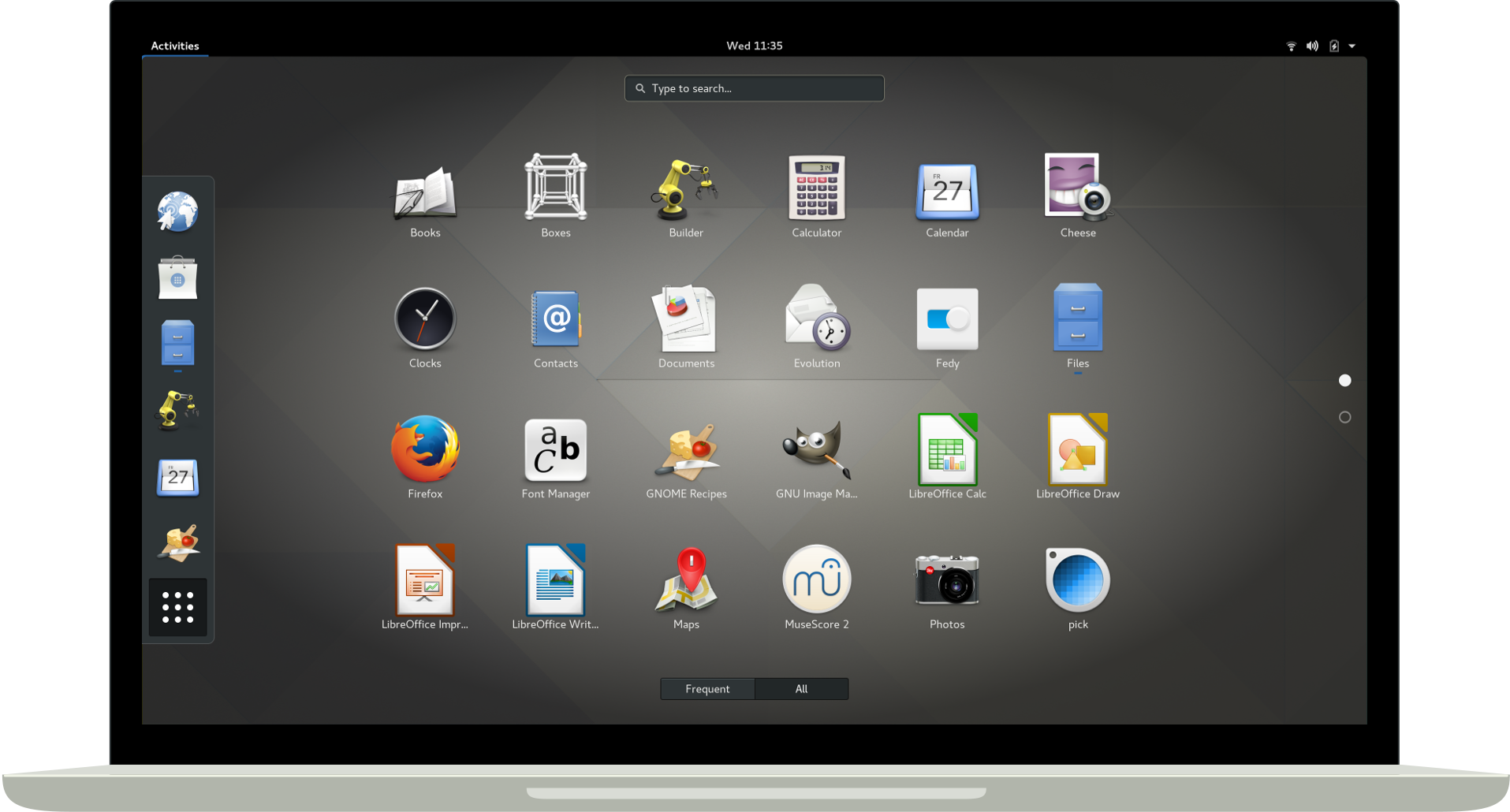
GNOME 3 Desktop by gnome.org
Shell: zsh
Well, any shell. I couldn't live without all those glorious one-liners like
for i in *; do echo mv $i `echo $i |sed 's/.rb/_spec.rb/'`; done or
history | awk '{print $2}' | sort | uniq -c | sort -nr |head -n 20. Utilizing all those
programs that do only one thing, but one thing well. cp, mv, echo, grep, cat, awk, sed, find,
head, tail, curl, test, sleep and so on and so on. What a wonderful chest of lego bricks, ready for you to plug
together your own world. Also, I literally grew up in bash. It was shell scripting that introduced
me to software development. And I will forever be fascinated by it, despite all the sneeze from the more
sophisticated languages. Shell scripting is messy, raw, dangerous. Shell scripting is beautifully punk!
Browser: Mozilla Firefox
I think, not counting the Linux kernel, Firefox is the only piece of software I used all my life (if you think of netscape communicator as ancestor). It's because the single most important quality of Firefox is progress. Tabs, add-ons, session restore, firebug, sync, mobile version and now built in privacy. Mozilla has been steadily pushing it's flagship product forward. It might not always be the first to market, it might not always be perfect from the start but it is always moving forward relentlessly. That is a rare quality. We all should pray that Mozilla continues this despite the google browser monopoly. BTW how the flying f**k is that monopoly OK with 65% of you? Don't you remember any computing history? </rant>
Source Code Management: git
In the meanwhile all projects I contribute to use git. I like git for being the right amount of clever CLI.
That opens the pager only in the right moment, corrects me if I typo or let's me extend it, just by nameing a
command git-diff-to-deploy. And I really dig the file based approach which means that I can often recover my idiot mistakes by nervously mocking around in .git. It shows that the people maintaining this are seriously dog-fooding their own product day in and day out.
Source Code Collaboration: github
With github I have a love-hate relationship. I admire the idea, the product and many of the people who build it. I build a tool in the same space of the industry (developer tooling) using the same technology (Ruby on Rails) and github people set the gold standard in collaboration workflows since years. I only humbly follow their set out examples.
But I really don't like them riding and emphasizing the network effect. And I flat out hate that such a large piece of software in my stack is closed source. Quite frankly I do not understand how anyone at Microsoft can justify to their mirror that github is not Free Software. It's not like anyone will ever be able to take any business away from github.com which value is the number of people using it. As you can see with me and my projects, that ship has sailed a long time ago. Why do you have to deny me my software freedoms if I can't use them to hurt you in any way?
I am a Ruby on Rails developer, I know a thing or two about collaborating on software. I want to send a pull-requests fixing gripes or missing functionality I have with github itself. Why the hell can't I do that? Why do people have to resort to write browser extensions to be able to collaborate on github functionality. This is insane! </rant>
Mailer: Mozilla Thunderbird
Thunderbird is the only piece of software in this list I'm not very passionate about. It helps me reading, finding and writing mail from my four imap accounts in one single interface. It does so better than any mail user agent, web mailer or mobile app I have tried so far. Yet I have the feeling there should be something better. Can't seem to find it though, despite really searching. Guess Churchill was right: Thunderbird is the worst MUA, except for all the others.
Editor: Visual Studio Code and vim
I fire up vim when I need to do a quick script, jog down a note, edit configuration files or for a quick
fix. Visual Studio Code is what I use for deep dive bug fixes or feature development. About vim I like most
the raw power that comes with it. Doing something like gqaw or v<end>~ is gold.
But I have a problem with vim: I easily remember a small set of things for a long time, but I have not much capacity
to remember 50 keyboad shortcuts forever ¯\_(ツ)_/¯ That's why I need a user interface that guides me and offers
me a place to search visually for what I want to do. CTRL+p+fold level+click is exactly that.
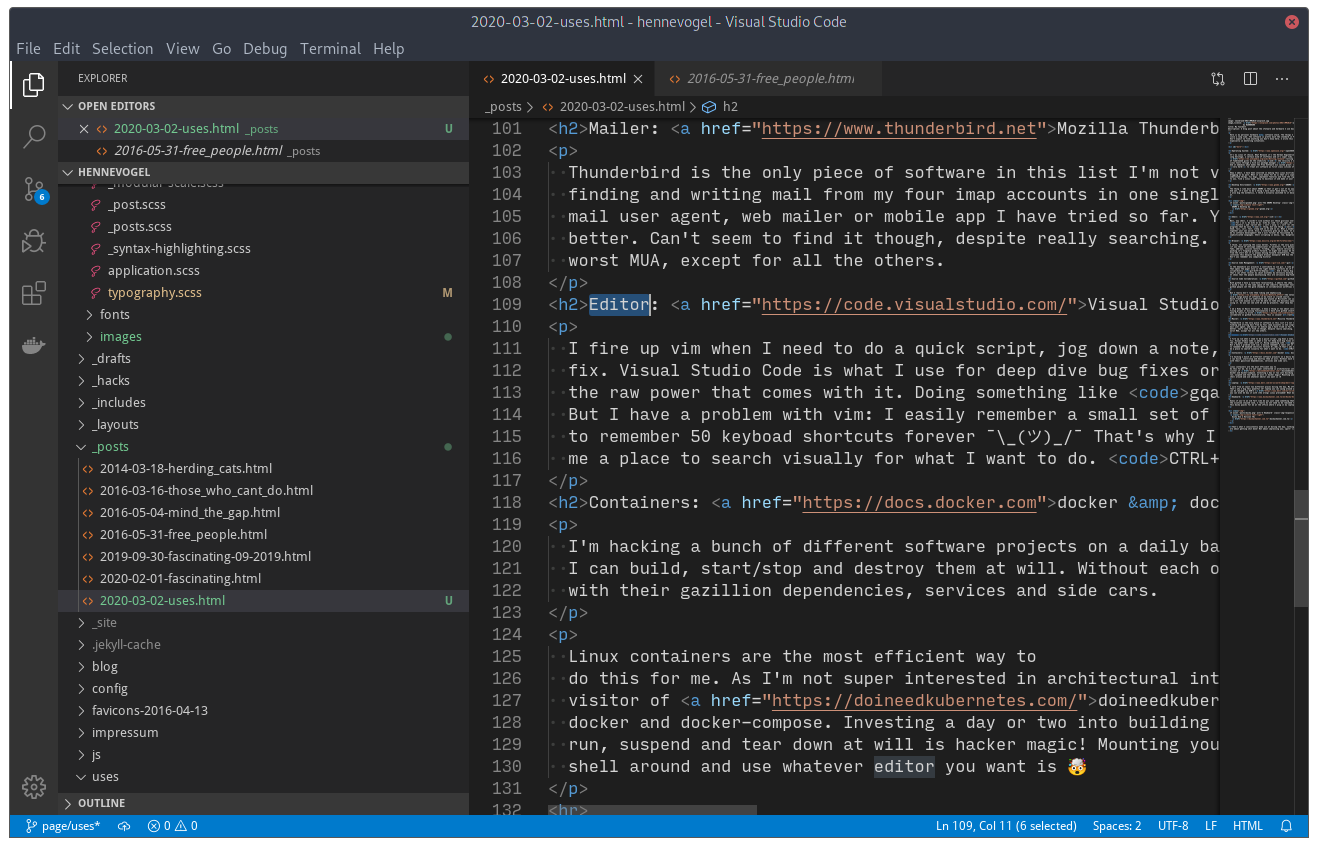
Visual Studio Code by Henne Vogelsang licensed CC BY 4.0
Containers: docker & docker-compose
I'm hacking a bunch of different software projects on a daily basis. I need them compartmentalized so I can build, start/stop and destroy them at will. Without each of them compromising the other, or my system, with their gazillion dependencies, services and side cars.
Linux containers are the most efficient way to do this for me. As I'm not super interested in architectural intricacies of container runtimes and a frequent visitor of doineedkubernetes.com, I'm kind of habituated to docker and docker-compose. Investing a day or two into building a development environment that you can set up, run, suspend and tear down at will is hacker magic! Mounting your local file system into it, so your can shell around and use whatever editor you want is 🤯
Laptop: Dell XPS 13 (9380)
I work from at least two different places during the day. My office, meeting room, home office etc. That's why I dig this powerful 13" laptop you can swing around with ease. It also features a nice enough keyboard, can be charged via USB-C (power bank ready) and you can even be buy it with (the wrong) Linux preloaded! What more can you ask from hardware?
Keyboard: Ducky One 2 Horizon TKL
Guess if you're an old fart like me you just need something that feels a bit like a model M keyboard. But please without the nicotine stained look. This ducky quacks for me at the office where I plug in my laptop into a docking station.
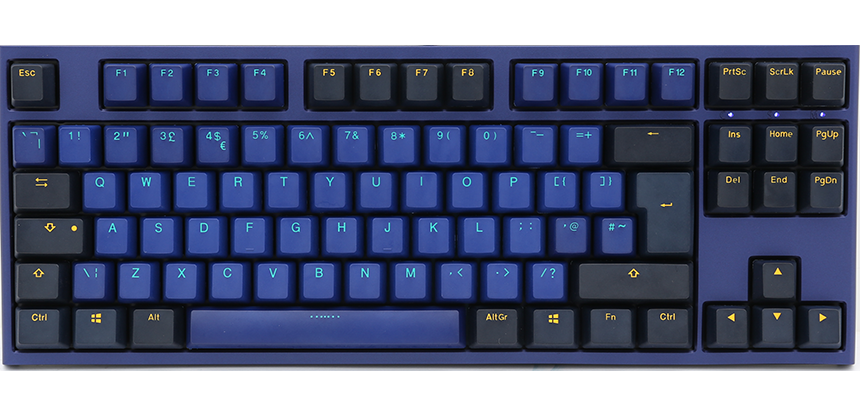
Ducky One 2 Horizon TKL duckychannel.com.tw
That's what I consistently make use of during the day, nothing spectacular right? Of course not, those things are about getting shit done! Not about impressing you, sport! 😜

openSUSE community welcomes new board member
The results of the openSUSE Board election were published on 1 February 2020. The community welcomed Sarah Julia Kriesch and Simon Lees as they started their new term.
However, ten days later, Sarah stepped down, leaving a vacant seat on the board. Under such circumstance and the board election rules, the sitting board may appoint someone until the next board election.
On 27 February 2020, openSUSE Chairman Gerald Pfeifer, announced the appointment of Vinzenz Vietzke as board member. His appointment was unanimously supported by the Board and the openSUSE Election Officials.
The appointment of Vinzenz, aka Vinz, on the Board was welcomed by the community.

KDE Plasma 5.18 on openSUSE Tumbleweed | Awesome-Sauce
Fascinating! February 2020
The universe is full of captivating, compelling and exquisite things. The internet, the most complete representation of humanity, is no different in that regard. Both are vast, seemingly endless and full of places you should know about. Let me share content that has moved me, in some way, in the last month. February was mostly inter-personal stuff like ethics, hiring or collaborating remote. Enjoy.
YubiKey 5C Nano a product by yubico
Some collegue of mine mentioned andOTP and good Free Software citizen I am, moved all of my 2FA to it. Doing so made me think of checking support for hardware security modules on Linux again. Ordered this YubiKey, now I'm off 2FA with my phone and just touch my laptop when asked. Thanks WebAuthn! One of those "Why they heck did I not do this earlier?" moments.
A student guide for navigating ethical issues in the tech industry by Mozilla
I have no idea why Mozilla says this is for students? Clearly this is for everybody! Be it people considering going into the tech industry (like students), people already in it or even people who just want to know what it going on in this cesspool.
Especially if you are in this industry already: Read this, think about it, talk about it with your peers, dive deeper into this topic. Do this so you can help to save the environment you probably planed to work the rest of your life in. Ethics help them who help themselves!
git sparse-checkout a post by Derrick Stolee
An experimental git command that allows you to checkout one or more sub-directories of a repo. Primarily meant for monorepos with gazillion of projects in it. But I think this could also turn out to be usefull for other situations. Like skipping large infrequently used directories etc. Check it out!
The 2020 State of Remote Work a survey by Buffer.com
No real shockers this year, the concept of distributed teams is humming along. One thing I find interesting about this is how much the top challenges are also the top challenges of (larger) Free Software communities. If you reach a certain size your community fractures because people start their own communication neighborhoods. Mailing lists, forums, IRC etc. Each group get's enough information about the community (mostly from wanderers between the neighborhoods) so they feel they don't miss out. Yet, some important things fall through the cracks. Frequent cries for unification of groups are either ignored or end up in XKCD#927. In the end, you just live with it and realize that you can't streamline a large amount of people to this degree.
And I think loneliness is also at the root of many of the problems that Free Software communities face. Especially I suspect this to be the top reason for contributor churn. You can't vent at the time you're angry about something in the code base. You don't have anyone to share your joy with, at the time you finally feel confident enough to open this super cool feature pull request. You have to context switch to something else because no one is around at the time you need to know why this code behaves like it behaves. Those situations are just a little less fulfilling than they are if you're together with people. And this will bite at your willingness to continue, one at a time. And that's how you can eat an elephant.
Often I'd wish we would not have been such punks in the Free Software movement. That we instead collectively focused some of the time and energy we've spend on creating software on figuring out what happened to us and between us. We made collaboration among free equals into a viable option to be creative. But we were to lazy to write the documentation how to organize people doing it...
The Horrifically Dystopian World of Software Engineering Interviews a post by Jared Nelsen
One persons odyssey through many of the ridicolous hiring practices in play today. And the best analysis of why this is like it is I have read to today.
We are being consumed by our own mythology. We all know algorithm challenges are a contrived game. Why are we measuring people and not learning about people?
I start to feel bad for the nail, as much as this hits it on the head. Or as Chelsea puts it “Smart” is Not a Hiring Criterion.
Tools I found interesting
- flameshot · A screenshot tool
- scc · Fastest LOC counter possible
-
Browser Lazy Load · Coming to a browser near you
<img src="image.png" loading="lazy"> - Git Command Explorer · Interactive git documentation
- explorabl.es · A hub for learning through play!
- hackertyper · A neat way to show non-nerds what you do for a living
- capycorder · Generating capybara request specs by clicking in your browser
Talks I enjoyed
- Compassionate—Yet Candid—Code Reviews by April Wensel
- Salary Negotiation Workshop by Josh Doody
- Implementing a Strong Code-Review Culture by Derek Prior
- Single-Vendor Open Source Firms by Prof. Dr. Dirk Riehle
- Vom Ich zum Wir by maha and Kai Biermann
Neat stuff! Hope some of it makes you think/act in new ways, as it has me.