
Announce: LDTP 3.0 - Linux GUI test automation tool
Highlights:
* Java / C# / VB.NET / PowerShell / Ruby are now officially supported LDTP scripting languages other than Python
New Features:
* Firefox have check / uncheck as actions for check box
New APIs:
* selectpanel
* selectpanelname
* selectpanelindex
Bug fix:
* Simplified the implementation verifyselect for combobox menuitem
* Fix QT related accessibility issue
* Bug#673931 - Python-ldtp has issues if the application calls an env or other program to run
Credit:
* Ubuntu QA team members (Dave Morley, Ara Pulido)
* VMware desktop QA team members
* Kartik Mistry (Debian package maintainer)
* Thanks to all others who have reported bugs through forum / email / in-person / IRC
Please spread the word and also share your feedback with us.
About LDTP:
Cross Platform GUI Automation tool Linux version is LDTP, Windows version is Cobra and Mac version is PyATOM (Work in progress).
* Linux version is known to work on GNOME / KDE (QT >= 4.8) / Java Swing / LibreOffice / Mozilla application on all major Linux distribution.
* Windows version is known to work on application written in .NET / C++ / Java / QT on Windows XP SP3 / Windows 7 / Windows 8 development version.
* Mac version is currently under development and verified only on OS X Lion. Where ever PyATOM runs, LDTP should work on it.
Download source / binary (RPM / DEB)
Documentation references: For detailed information on LDTP framework and latest updates visit
LDTP API doc / Java doc
Report bugs

KDE SC 4.9 packages for openSUSE
The KR49 repo holds KDE SC 4.9 packages for openSUSE users. For information on how to update please refer to the openSUSE wiki.
UPnP support was disable for the KR49 packages since it causes lots of crashes (if Windows shares are present on the network) and seems unmaintained within KDE, i.e. no fix to look forward to.
Kudos
Packaging-wise kudos go to Todd, Nico and everybody else doing the packaging in KR49. If you find any packages missing in KR49 compared to KR48 please submit them via the buildservice or drop a note on the opensuse-kde mailinglist.
KDE-wise I would like to thank especially Laurent Montel who contributes a lot to fixing-up kmail2, including adding email backup and import functionality. András Manţia is another developer who helps to get kmail2 into shape and re-worked the filtering for 4.9. (There are of course many more who contribute to KDE!) Since AFAIK both work for KDAB, it is good to see that there are still developers payed to work on KDE while most distros seem to overload their so called KDE-team with non-KDE stuff, resulting in little or no contribution to KDE and just enough time to get packaging done, if at all.
Things I noticed with KDE SC 4.9 so far
In dolphin one can now add extra information to the main view, i.e. next to each item. Actually a nice feature. The sad thing is that it only works for indexed folders. The user cannot know about this and is presented with lots of “-” below each icon instead of just not showing anything if there is nothing to show. Enabling the additional information will block dolphin’s GUI for some time proportional to the amount of items in the current folder. Indexing still has some issues, e.g. nepomuk re-indexes movie and some sound files after every log-in. On top of that instead of just checking the length etc. it reads the whole file, i.e. hundreds of MB just to start all over again after the next log-in.
The places pane presents some new items, i.e. you can add searches to it. While some default searches do not seem to be of any use, i.e. e.g. just list all audio files or pictures from all over the computer, the time-related queries can be quite useful if you are willing to invest the GB needed to build up an index for 70 000 files.
Regarding mail loss, the bugs were unfortunately not fixed yet for online IMAP. There are two issues. a) You lose email if you move it to a local folder and the internet connection breaks down while kmail2 is still downloading the message. b) You also lose email if you pipe the emails in your imap folders through external apps such as bogofilter. For the latter a workaround exists. If you open the properties of the imap folders and enable “always retrieve full message” you will not lose emails because of piping unless a) kicks in.
Apper seems to become more stable. While it still suffers from a – let’s say – incomplete zypper backend for PackageKit on openSUSE, it lets PackageKit processes die within reasonable time and does not block zypper forever anymore.

Karma rewards Wiki Edits
This my report of the work done in the past few days.
Another feature that has been added to the karma plugin is rewarding people on making Wiki edits. Karma fetches all wiki edits made by each user on Connect using their username and rewards them. Starting from the last 10 wiki edits, all are rewarded. For now there isn't any criteria to judge the significance of each wiki edit, because since openSUSE wiki is aimed at providing information regarding openSUSE and its distribution so each one is important to openSUSE and deserves to be rewarded.
During the past few days I also played with the existing karma widget a little, now it gives more information regarding the user's score, why a certain badge is awarded to you and what percentage of the maximum score is your score. I realized all these details wouldn't be of any use to others who are viewing your profile so I have segregated who sees what and made these details available only to the owner of the Karma.
After my mentor reviews the work done till now, next I'll work on documentation and allow karma statistics to be available through Connect's API.
Announce: Cobra 2.0 - Windows GUI test automation tool
Highlights:
* Java / C# / VB.NET / PowerShell / Ruby are now officially supported LDTP scripting languages other than Python
* Approximately 130 APIs are compatible with Linux version of LDTP
* C# client is compatible with Mono .NET framework and we have tested it on Linux/Mac
* Identify object name based on automation id (window id, as per SilkTest users)
* i18n support
* CPU / Memory logging
* Remote test execution
New features:
* List / Tree item API's are added
* Scroll to the element if the respective pattern is enabled
* Added new characters in keyboard input
* Object lookup based on wildcard("?")
* Double click on allowed object's
* Added hyper link widget type under known objects
New APIs:
* getwindowsize
* simulatemousemove
* gettablerowindex
* getobjectnameatcoords
* onwindowcreate (Java/C# client)
* removecallback (Java/C# client)
* mouserightclick
Bug fixes:
* Taskbar is now identified as pane, rather than ukn
* generatemouseevent API now takes the optional argument, compatible with Linux
* Fixed a crash, if the window title has back slash
* Grabing focus on combobox element fails the object selection, removed the respective code
* Ignore special characters while searching object name
* Fix regexp in object lookup
* getcellvalue API now takes the optional argument, compatible with Linux
* Handle task manager menuitem, which worked slightly different than other menu
* Fixed listing sub-menus with a simplified method
* getcellvalue API now as the Linux version
* getchild API now returns appropriate output
* Fixed *window APIs to work with different types of window
* Fixed mouse left click on a text widget
Credit:
* John Yingjun Li (VMware) have contributed most of the code in this release. I really appreciate all his effort
* VMware colleagues
* Thanks to all others who have reported bugs through forum / email / in-person / IRC
Please spread the word and also share your feedback with us.
About LDTP:
Cross Platform GUI Automation tool Linux version is LDTP, Windows version is Cobra and Mac version is PyATOM (Work in progress).
* Linux version is known to work on GNOME / KDE (QT >= 4.8) / Java Swing / LibreOffice / Mozilla application on all major Linux distribution.
* Windows version is known to work on application written in .NET / C++ / Java / QT on Windows XP SP3 / Windows 7 / Windows 8 development version.
* Mac version is currently under development and verified only on OS X Lion. Where ever PyATOM runs, LDTP should work on it.
Download source / binary (Windows XP / Windows 7 / Windows 8)
System requirement: .NET 3.5, refer README.txt after installation
Documentation references: For detailed information on LDTP framework and latest updates visit http://ldtp.freedesktop.org
LDTP API doc / Java doc
Report bugs

 toscalix
openSUSE Team at SUSE: we have an opening
To achieve this task, we want a senior developer to join us.
openSUSE Team at SUSE is a multidisciplinary group of professionals that works in many different areas in constant evolution so learning is part of our natural process. We have a clear R & D focus. We will work in projects covering several different technologies, so we are looking for somebody that is open minded, not afraid to work with a wide range of tools.
The position involves mentoring. It won't be just about designing solutions, solving problems and delivering, but also about engaging new developers and motivate them. Our team have high exposure to the openSUSE community and internally at SUSE. We also work with other communities and companies. Therefor communication skills (with other engineers) is a relevant skill for this position.
openSUSE Team has members in other parts of the world so having experience working remotely will be a plus. The team is based in Nuremberg. So the new member will be located there and will travel to events a few times per year.
SUSE is now operating as an independent business unit of The Attachmate Group, it is growing and profitable. At openSUSE Team we are defining our action plan for the near future and we want this person to get involved in this process. So I think it is a great moment for joining us.
If you are a senior developer, care about Free Software, are a team player willing to help openSUSE and want to work in the open in projects with a great potential impact, getting a lot of exposure, consider applying to our opening.
Robustness principle, blah
Did you hear somebody whining that min and max might be commonly used macros in various code-bases? No, me neither. They deserve to suffer anyway.
 Member
Optimizing a boot time, aka 2 second boot (part 2)
Changes for upcoming openSUSE
As a result of my previous 2 second post I have submitted few changes to openSUSE to be included in a next release.
-
purge-kernels.servicepatch has been accepted by our brave mkinitrd package maintainer -
requested a split of mkinitrd setup script from
splashypackage, so users can freely remove the initrd integration without breaking resume et al - I opened feature 313851 to make NM the default network tool at least for laptops, because this expects a little more changes than add a package to laptop pattern
Run NetworkManager on demand
That is very uncommon user-case for *nix machines, but makes a perfect sense for consumer devices. My Amazon Kindle or today’s smartphone or tables works in the same way – device starts without a network connection and there’s a button or magic tap enabling it. On my laptop I already have such button – it is the Fn+F2 with a antenna symbol printed. This is the rfkill button turns my wlan card on and off.
So what I want is once I turn wifi on, NetworkManager should start and work. With systemd and it’s udev integration this is so simple, that I was not able to find a good howto for it. So here we are with a small howto for udev/systemd newbiew like me.
We need to know a sysfs name of wlan0 – simple find /sys/ -name 'wlan0' will say us all we need. Then udevadm info will tell you more
udevadm info --path=/sys/class/net/wlan0 --attribute-walk | less
...
  looking at device '/devices/pci0000:00/0000:00:1c.2/0000:01:00.0/net/wlan0':
    KERNEL=="wlan0"
    SUBSYSTEM=="net"
    DRIVER==""
That is all you need to know how to write a rule will match for all wlan cards.
# cat /etc/udev/rules.d/95-start-nm-on-wlan.rules
SUBSYSTEM=="net", NAME=="wlan?", TAG+="systemd", ACTION=="add", ENV{SYSTEMD_WANTS}="NetworkManager.service"
To explain it – SUBSYSTEM and NAME are taken from previous output and means that following rule matches for all devices in net subsystem named wlan-something. We should append tag systemd, because systemd sees tagged devices only. The ACTION=="add" says the rule will be evaluated only in case device will be added and the last part says to systemd which service should be started.
In case you will want to stop NM, the
SUBSYSTEM=="net", NAME=="wlan?", TAG+="systemd", ACTION=="remove", ENV{SYSTEMD_WANTS}="NetworkManager-stop.service"
# cat /etc/systemd/system/NetworkManager-stop.service
[Unit]
Description=Stops NetworkManager
Conflicts=NetworkManager.service

[Service]
ExecStart=/bin/true
WLAN cards
For onboard wlan cards following thing won’t work as they appear in a tree from early phase. Unfortunately I’ve found only one way how kernel exports the fact cable is plugged in and that’s changed /sys/class/net/eth0/carrier. But inotify does not work with a quantum-like fs like sysfs is. The trouble is values appears in time of read, but inotify react on writes, which never appear.
How much the removal of getting IP address from boot saved the time?
# systemd-analyze
Startup finished in 2719ms (kernel) + 4333ms (userspace) = 7052ms
which is about half of second.
Too much mounts in a parallel
The one thing surprised me was a long time until trivial mounts like debugfs were finished. The reason is that systemd (at least 44, recent version use generator+ .mount units) behaves differently to .mount units and things in /etc/fstab. In the first case, it executes the /bin/mount. Which means a lot of ld, stats, mmap, and the big delay of the system start.
So move things to fstab, or disable the systemd mount unit (I did that for sys-kernel-debug.mount and sys-kernel-security.mount). I already masked the remount-rootfs.mount, which calls /bin/mount -o remount /< only. That seems to me like a barrier for other mount units – iow this will be done as a last one. But who cares with a fast boot we have?
Way more changes
Then the systemd-modules-load.service delay a boot as it block sysinit.service, when basic boot ends. I read strace carefully, but it only load microcode_ctl module, but that took few seconds to be done. Thus I gently masked it.
The next change is backport from Factory package – this reduce the delay caused by all those tty devices to appear. Fortunately this will be part of next openSUSE as it is an upstream patch.
And as a last thing I wrote a simple xdm.service, instead of a big xdm init script. It will definitely need more love, but for me just works 
cat /etc/systemd/system/xdm.service
[Unit]
Description=X Display Manager
After=dbus.socket

[Service]
Type=simple
ExecStart=/usr/bin/xdm -nodaemon
Restart=always

[Install]
WantedBy=graphical.target
Voilà!
#systemd-analyze
Startup finished in 2698ms (kernel) + 1513ms (userspace) = 4212ms
Using dracut
Because our brave systemd maintainer, Fréderic Crozat, chooses dracut as his hackweek project, I was curious if dracut can make some gain for me. I installed dracut and rebuilt and installed hardlink from his branches and try to investigate it. I would say the biggest advantage over mkinitrd is that dracut is configurable from command line. This is in a contrast with mkinitrd, where you have mostly no way how to exclude something – at least I did not find anything.
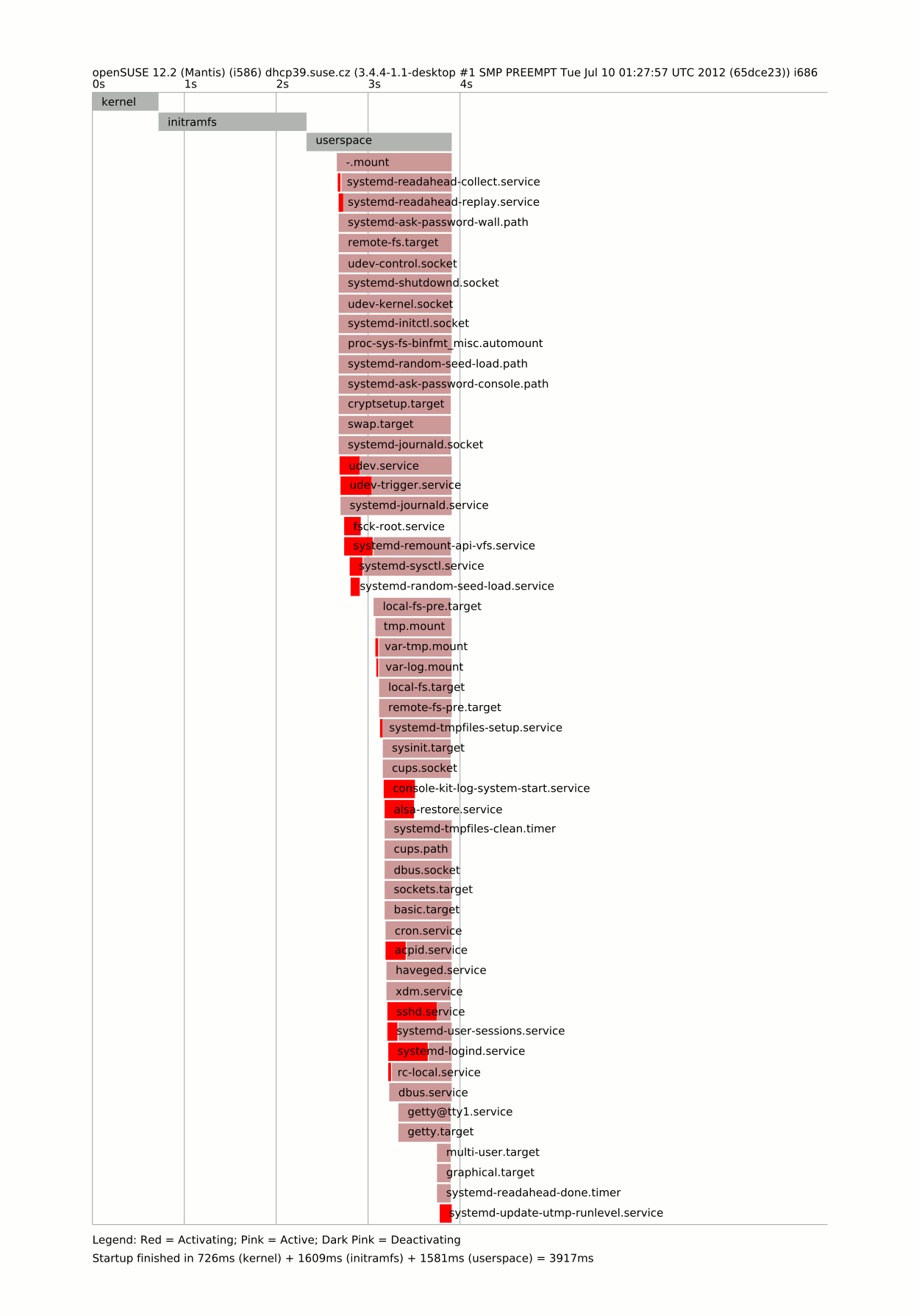
As Fréderic also pointed me, there is a --hostonly switch, which include only things needed for boot of current machine only. For instance dracut module kernel-modules will pull only things needed to mount rootfs (and if usrmount is included, then it will add things for /usr as well). Then I have excluded at least everything I can to have a working initramfs via -o, --nofsck and --strip. And that is the resulting time
# systemd-analyze
Startup finished in 726ms (kernel) + 1609ms (initramfs) + 1581ms (userspace) = 3917ms
Disabling way more things
As we are now versed in a looking at diagrams, there are still few ms we can save, even those changes are not sane ;-). The first one follows the NetworkManager.service – now sshd.service delays the boot a lot, because it systemd-update-utmp-level.service waits on it’s finish. So let’s start it on demand
# cat /etc/udev/rules.d/95-start-nm-on-wlan.rules
SUBSYSTEM=="net", NAME=="wlan?", TAG+="systemd", ACTION=="add", ENV{SYSTEMD_WANTS}="NetworkManager.service sshd.service"
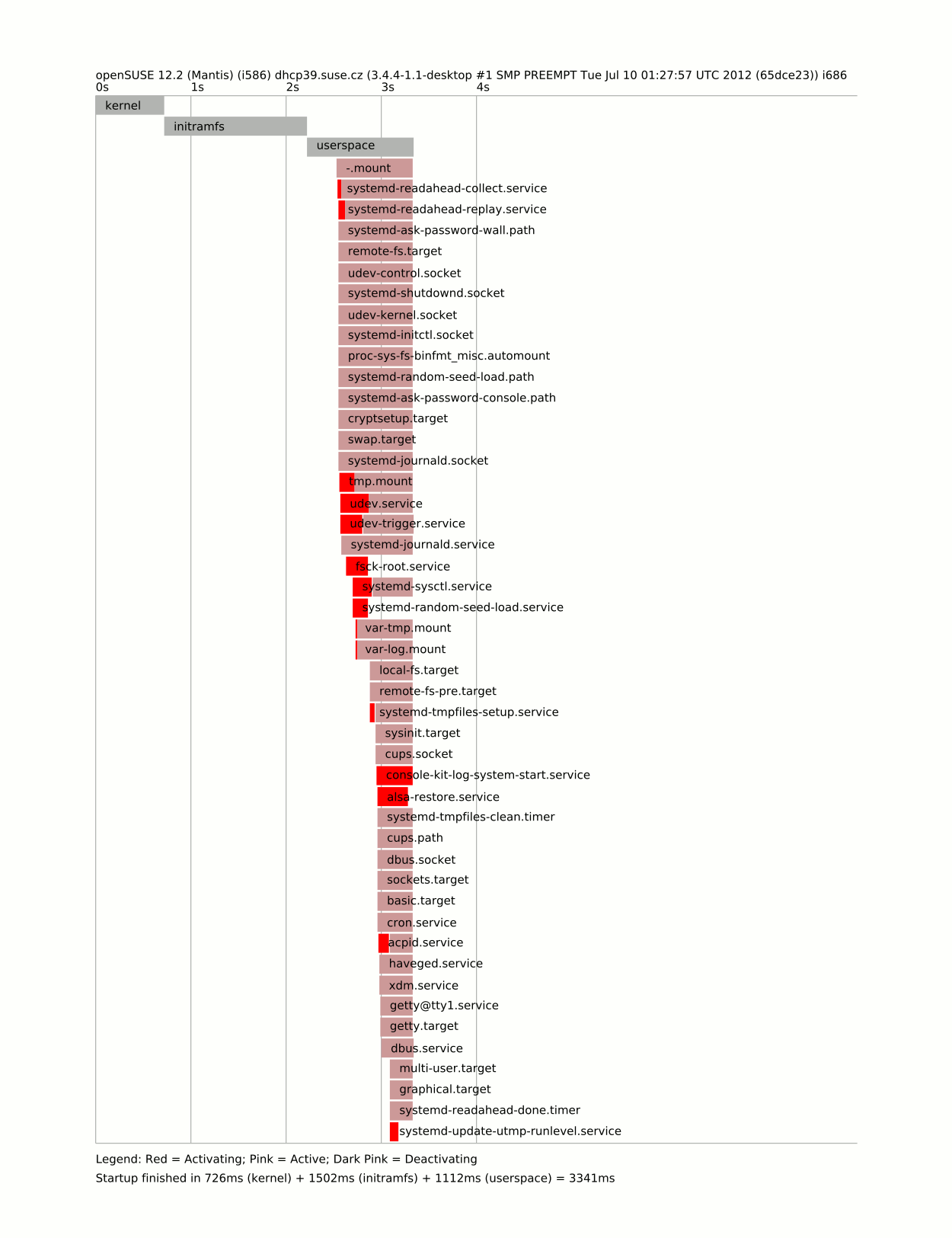
and disable it. Then mask all few remaining things – systemd-login.service, systemd-remount-api-vfs.service, systemd-user-session.service and rc-local.service. But only in case you are pretty sure what you are doing, because you might loose an important functionality, especially if you use a DE expected such things.
And that is the last time I will post
# systemd-analyze
Startup finished in 726ms (kernel) + 1502ms (initramfs) + 1112ms (userspace) = 3341ms
With a kernel with SATA+ext support builtin, I would reach the two second goal – 1839ms. Of course on a system, which functionality was extremely cut down, but my goal was to boot as fast as possible. In reality, hunting of ms does not makes your feeling better a lot (until you will type systemd-analyze, of course)
This is the diagram of the really fast boot
[gsoc] osc2 client – summary of week 10
Hi,
here’s a small summary of the 10th (coding) week. Last week I worked
mostly on the new fetcher code which I finally pushed into the git
repo. Apart from this I did some refactoring here and there.
The todo for this and the next week is to start with the new osc
user interface (that is the client code). As I already wrote in the
proposal the new osc client will be based on python’s argparse module
and the Jinja2 template engine.
Marcus

My hackweek8 project: dracut

I've worked on dracut (a mkinitrd replacement), to see if it works nicely on openSUSE (with the hope to replace the three different initrd we have in openSUSE, main one created by mkinitrd, the one used by YaST installer and a third one in kiwi).
Fortunately, I was not alone working on dracut for openSUSE. Thomas Renniger had started packaging dracut for openSUSE and I was able to reuse his work and improve it. Moreover, Mike Gorse uses his hackweek to also improve dracut (adding support for CIFS for instance).
- Day 1:
- cleaned up dracut package (done by trenn), to meet openSUSE standard, remove any Fedora specific stuff in it and update it to latest dracut package, available
at https://build.opensuse.org/package/show?package=dracut&project=home%3Afcrozat%3Abranches%3ABase%3ASystemin openSUSE:Factory.
- update hardlink package (available atm in Java:base, will move it to Base:System), needed for dracut at runtime. Available
at https://build.opensuse.org/package/show?package=hardlink&project=home%3Afcrozat%3Abranches%3AJava%3Abasein openSUSE:Factory too.
- modified my own grub2 configuration to add a additional dracut menu entry (hard coded atm)
- succesfully booted a 12.2 VM with dracut image !
- Day 2:
- discussed with upstream if they would accept "compatibility" patches to team dracut about openSUSE / SLE own initrd command line and got no as an answer, because they don't want to maintain compability cruft on their own side.
- worked on a separate module which is able to convert at boot time SUSE initrd commands into dracut one (when they are available). Works fine for "shell=1" "linuxrc=trace" and "sysrq". Upstream proposed to review the module for mistake when we are done with it
- asked upstream if they were interested in "sysrq" feature for dracut. No response yet
- worked on separate journal (reiserfs / XFS). Need to create VM to test it and ask upstream if they want to integrate it
- Day 3:
- got trenn cflags patch merged upstream
- continue digging into dracut internals
- journaldev is working on boot command line (tested with XFS)
- need improvement to configure initrd with system fstab value, when available and try to use a more generic term (root.journaldev)
- Day 4:
- subscribed to initramfs mailing list
- got my first patch merged upstream (journaldev support)
- added cmdline support for mduuid and isci (TargetAddress / TargetPort / TargetName), untested (don't have the right setup)
- ran test suite, found some issues: some in dracut upstream (fixed immediatly by upstream), some in our package (fixed mdadm and device-mapper to not call blkid binary but use udev builtin-blkid, will be faster and we save some fork ;)
- Day 5:
- sr mdadm and device-mapper fixes
- tried to get all test suite to pass
- some fixes were made to dracut, with more test passing
- still getting issue with network based test (NFS, iSCSI, etc..). Partially working (DHCP server is working now in test suite), partially not (impossible to mount stuff in server test image, getting "EUID=1000" for root, even when booting the image with init=/bin/sh .. No clue to fix that and upstream never got this issue either, if you have an idea, I'm all ears..)
In short, this hackweek worked well for me, even if I didn't finished all I wanted to do. I'll make sure everything is pushed in Factory soon, so we could try (maybe) to switch openSUSE 12.3 to dracut.
"Create PDFs in One Click"

A very cliché slogan, right? But wait, notice anything odd? Click, on a tablet?