
 Member
 wstephenson
api.kde.org down! so what?
KDE Developers may have noticed that the developer documentation server at api.kde.org is down. This is due to a hardware failure which will be recovered next week. That need not put the brakes on your work though, since if you have the source code on your system you can build the API docu locally yourself, as HTML, as man pages, or as Qt Assistant help files to view in Qt Assistant or Qt Creator.
Read all about it on techbase: http://techbase.kde.org/Development/Tools/apidox

Call for testing: unzip feature
Hello Planet!
Have you ever faced a bug like this bnc#540598 ?
When you create zip archive with non-English filenames and try to unpack it on openSUSE, filenames within archive become unreadable. It can irritate, isn’t it?
It seems as if we found a solution for Russian language. We tested it and it works for us.
It would be helpful if some of you could test your local language. And check whether core functionality still works 
Here is a list of languages that are potentially affected by this bug: Ukrainian,Belorussian, Bulgarian, Croatian, Czech, Estonian, French, German,Hungarian, Italian, Lithuanian, Latvian, Polish, Slovak, Spanish,Slovenian, Swedish.
So it is worth to test them in the first place.
The reproducer is pretty simple:
- create zip archive on windows with file named in you local language
- transfer archive to openSUSE system
- unpack it
- see if filenames are readable
What needs to be tested:
- if this bug applicable to you language
- if core functionality of unzip still works
Please share your experience by commenting on bug.
Package to test located in Lazy_Kent home project
Thanks in advance
Installing Ruby 1.9 on openSUSE 11.2
It’s been a while since I’ve posted or been active in the community, so I thought I’d toss an update out there. I’ll cross post this on my personal blog and on Cool Solutions (modified for SLEx 10). This is a pretty rudimentary post as installation from source is pretty straightforward, but perhaps it’ll be useful to someone.
The only requirements for this build that I’m aware of at this time are make, gcc, and the openssl/openssl-devel packages.
The default Ruby distribution in 11.2 is 1.8.7, contrasting the current stable release of 1.9.1. If you already have Ruby installed via zypper, you’ll need to uninstall it (‘sudo zypper rm ruby’), otherwise the first step is to grab the latest release from http://www.ruby-lang.org/en/downloads/.
Next, unpack your release (replacing 1.9.1-p376 with the build you downloaded):
tar xfvz ruby-1.9.1-p376.tar.gz
Change to the extracted directory and run the config script:
cd ruby-1.9.1-p376 && ./configure
Build the release: Note that you can allow jobs to run simultaneously with the -j switch, see make (1) for further details.
make
Install the release as root:
sudo make install
To verify that 1.9 is indeed installed, issue:
ruby --version

Community Discussion - Part 4
Who is Linux?
I spent only few minutes. I think it is quiet OK, given its very low production value. I am not trying to win, but just like I send crappy patches to Linux and waste kernel developers time, I uploaded it to waste 43 seconds of your time.

Beautiful Evidence of Committers
A couple years ago I got turned on to Edward Tufte's books about visualizing data. It's inspiring work, showing the value and beauty of data-rich visualizations that work at multiple levels. Since then, I have wanted to apply the principles he espouses in my own work, leveraging software for data processing and interactivity.
This is my first attempt. I wanted to visualize who contributes to a given project and how long they've been involved. I knew I had speedy access to the commit logs via git, but the choice of tools or languages to process and generate the display was harder to make. I opted to try using Perl (a language ingrained in my memory from using it at the LJ World) and HTML/CSS (ingrained from numerous projects and jobs).
The EvidenceI'm happy with the result. You can quickly see when people started contributing, and the changing rate at which they joined. And you can see how long any given contributor stayed involved. I generated charts for a few git repos I already had checked out, including Banshee.
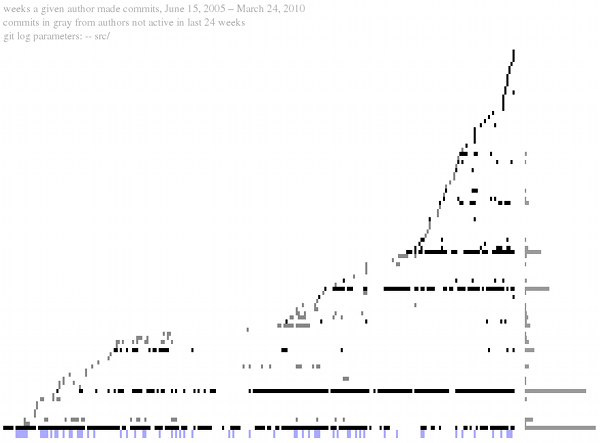
This is a scaled screenshot of the rendered HTML output, which I encourage you to click through to since it has tooltips and is zoomable in your browser. The script is available, and barring bugs should work on any git repo.
Evolution 2.30 released!!
This is one of the memorable releases of evolution considering the amount of work which has gone into this release. We could consider this as a preview for GNOME 3.0. To provide a snapshot of the major changes in this release,
- Diligent UI re-architecture to give farewell to bonobo.
- Improved imap implementation with live view updates, non-blocking operations and IDLE support, IMAPX.
- DBus transport replacing bonobo for address-book and calendar.
- GNOME 3.0 cleanup tasks. Gets rid of LibGnome, LibGnomeUi, LibArtLgpl, LibGLade.
- Evolution-mapi with push mail support and reduced memory footprint.
- Contacts map plugin.
Getting rid of bonobo from evolution was not only a cleanup work, but it enables evolution to shed off lot of weight to get flying. This has provided a lot of positive side-effects, one of the best which needs to be quoted is the startup speed of preference dialog. Evolution is now sleak and fast. If one has used the previous versions of evolution, no one needs to explain for appreciating the work. All credits goes to Matthew Barnes who has done an extra-ordinary job here.
We also have the new imap implementation IMAPX, which provides substantial performance improvements over the old imap provider making all the operations non-blocking in nature.
Credits to Ross Burton for replacing bonobo with dbus transport in EDS. This would pave way for us to fix some out-standing issues which had been put aside waiting for this change to dbus. There is also some work-in-progress for making this extremely stable in threaded environment.
We have listed the probable tasks which would be taken up for the future releases at http://live.gnome.org/Evolution/PlanningFuture. We would be picking up some tasks from there for Evolution 3.0 depending on the effort available. If you have suggestions feel free to get in touch with us to get it added..
Thanks to Akhil Laddha (bug master), Milan Crha (patch master), Johnny Jacob, Bharath Acharya and all others (many to list everyone here.. ) who have made significant contributions for making this release successful. Thanks to all the contributors, translators, distributors and users!!
Banshee 1.6!
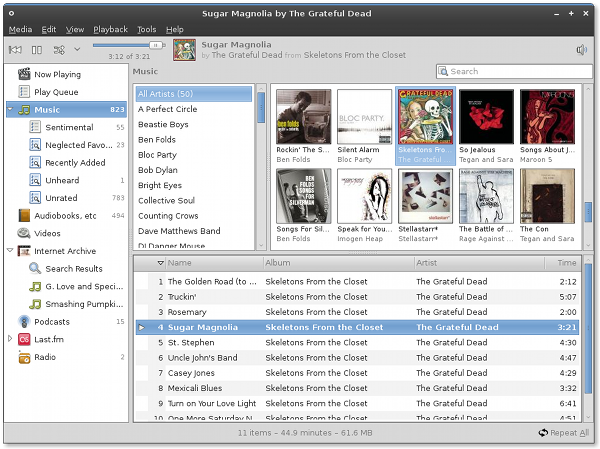
As scheduled, we just released Banshee 1.6.0! This release has been a long time coming, and we're really proud of it.
A more detailed backstory
We originally intended to release 1.6 last fall, but we got caught short on time, and ended up calling 1.5.1 a stable release so distros would feel comfortable picking it up, but of course the weird versioning has caused quite some confusion.
We continued the 1.5 series with 1.5.2 though 1.5.7 betas, leading up to this release: 1.6.0. The process really started 14 months ago when we branched off 1.4, and master became the workplace for 1.5. It wasn't even until after we branched that Alexander Kojevnikov, now one our most prolific contributors and a maintainer of the project, got involved!
Beautiful numbers53 programmers contributed to Banshee 1.6 just since 1.5.1, and over Banshee's full history, 142 programmers have contributed. I think these are astounding numbers. And these don't include Banshee Community Extensions, which started two months ago today and already includes 15 extensions and 19 maintainers.
We fixed 265 bugs since 1.5.1 as well (over 500 since 1.4), added dozens of new features and enhancements, and had over 2,000 beta users opt-in to report anonymous usage data that we will use to make Banshee better.
Banshee 1.6Here are some of the new features in Banshee 1.6. Read the Release Notes for more detail, screenshots, and enhancements not listed here.
- Play Queue Auto DJ
- Sync Device From Playlist
- Grid View
- Type-ahead Find in Track, Artist, and Album Lists
- Automatic Scoring
- New Shuffle Modes
- Audiobooks Library
- Library-folder Watcher
- eMusic Importer/Downloader
- Internet Archive Extension
- YouTube Extension
- Improved Metadata Handling
Thanks to everybody who has helped make Banshee such a success! Tremendous thanks go to Bertrand Lortentz and Alexander Kojevnikov, who over the last year in particular have contributed countless hours writing their own patches and reviewing others', triaging bugzilla, being active on IRC and the list, and generally being great maintainers of the project. They have invested in Banshee, and the effect on Banshee's quality and the community's growth is evident.
You can tap into the Banshee community and energy in many ways – read Planet Banshee, follow us on Twitter, lurk in the #banshee chat room, subscribe to banshee-list, monitor bug activity, and keep up with the latest code. We're a friendly, productive bunch, so stop by if you have a question or idea, if you want to contribute or you just want to learn how you can make your own project better.
Russian openSUSE community
Hello everybody,
I want to share some ideas about the success of the Russian openSUSE community, and try to answer the question about its popularity. As you can see it is one of the top places:
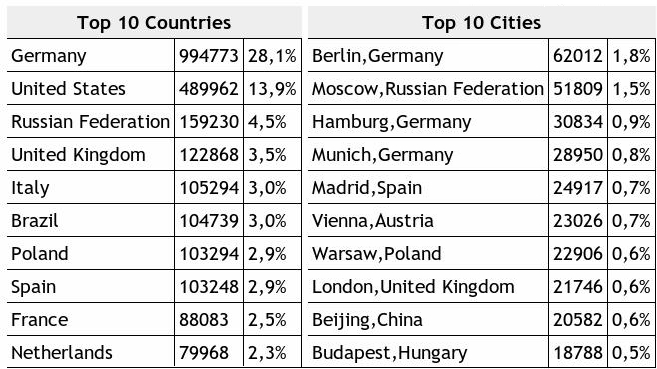
The reason for the high popularity of this distribution in Germany is of course the fact that the German SuSE distribution and the main branch of development is located in Nuremberg. Popularity in the U.S. is due Novell – an American company, and of course the language is English. But why are so many people in Russia choosing openSUSE?
Good question. One of the main things that influence the choice of distribution – the quality and localization. The global community plays a top role for quality of distribution and local make it appropriate for Russian language users (of course a local community can be as part of a global community).

Perhaps most important is the documentation. And of course, not everyone wants (or can) read the documentation in English. Everyone wants to read the documentation in their native language. The distribution may be in a good shape and stable, nice and convenient, but without documentation it will use very few. Translated documentation is very important to the community. The translation must have a high quality, understandable, and as it must be kept up to date.
For the community its also profitable that 2 guys from the community working for Novell (in Nuremberg and in Prague). This provides better communication between “developers – community”. It helps to be closer to the project. This allows you to always be aware of all the major news of the project. And of course the translation is much better if they are engaged not just as a translator, but the employee who works on the distribution.
Of course this also applys for software. Although it is not as important as documentation, it still makes an impression on the quality of distribution. Everyone wants to work with the software in their native language %)
A successful community is a group of people who love openSUSE, who understands why the software should be free, who wants to make openSUSE better and better… every day.