
 Member
 Bubli
BubliCustomize your partitioner (+ let's go graphical)
As you probably noticed, for openSUSE 11.2 our goal is to significantly improve usability of YaST partitioner. I want to show you a feature that is in partitioner for quite some time already, yet it is quite little known. It helps you to customize the partitioner to best suit your needs.
One of the frequent complaints about partitioner was that it is "overengineered" and it presents so much information that it is really confusing for the (home) user i.e. the "1 laptop, 1 hard disk" usecase. While there are some other problematic areas, this particular one can be fixed rather quickly and in a simple way. And by "fixed" I of course do not mean that from now on, we will tailor the partitioner only to the needs of Aunt Tillie (Oma Krause), leaving the power users high and dry. Let's have a look at partitioner settings (that is, we'll switch to the branch labeled "Settings" in the left tree panel), especially at "visible fields" selection box:
Here you can set which information on storage devices you want to see, that is, how many columns the tables are going to have and how much details the overviews are going to contain. The less boxes you tick, the less details that only uselessly fill up the screen you'll see. For example, if you use neither LVM nor RAID setup, seeing "used-by" field is probably of no use to you. Similarly, if you have laptop with one hard disk, you don't need fiber channel ID bits of information. And since these settings are written to sysconfig, they are persistent. This is the default sysconfig configuration shipped with openSUSE 11.1 (and SLES11):
Too detailed and not much home-user friendly, now is it? This is the new, simplified default for openSUSE 11.2:
If you are a power user who uses advanced setup and wants to see more detailed information, you now know where to go and make it visible again :) Besides data presentation details, you can also pick a default filesystem or default mount-by method for newly created devices here.
Everybody else is doing it, so why can't we?
If you have ever used partitioning GUI tools in other distribution, even on other operating systems (GParted, PartitionMagic, DiskDruid,...), you have noticed that almost every one of those has some graphical representation of how the disk is partitioned. From now on, even YaST partitioner does:However, compared to other partitioners, our bar graph is rather dumb. It is not interactive (if you click on a partition in graph, nothing happens) and it does not even highlight current partition as one scrolls down the table. At least a tiny little improvement is that it can do tooltips now, so if the partition description text is too wide it does not fit the graph segment, the text is still replicated in a tooltip.
Do you like the graph? Do you want to have it improved? If so, please vote for feature 303534 in openFATE. I'd really like to have at least highlighting the current partition implemented (preferably, by thick pink border :) :D

rockmarble: how to follow your favourite artists tour with Marble
During the last weekend I wanted to have some fun with QJson. So I came out with this idea: retrieve from last.fm the tour dates of my favourite artists and display the locations using Marble.
After some hacking I created this small application: rockmarble…
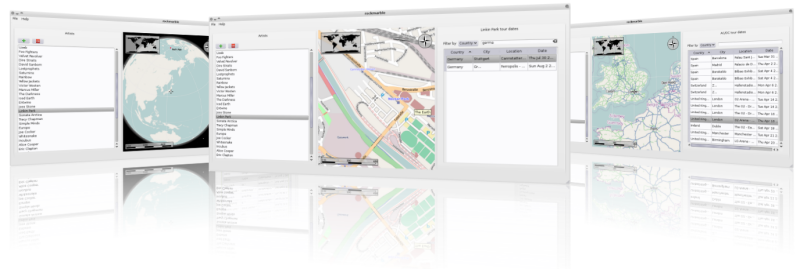
If you have a last.fm account rockmarble will import your favourite artist list. Otherwise you can add one artists at a time.
The tour location will be displayed inside Marble, using openstreetmap.
Requirements
In order to build/run it you will need:
Installation
You can grab the source code of rockmarble here.
If you are an openSUSE user you can use 1click install:

Issues
Geolocalization
The geolocalization data are given by last.fm, so if you discover that Metallica are going to give a concert in the middle of the Pacific Ocean please don’t bother me :)
Special names
It seems that QJson doesn’t handle properly special characters. Maybe you will some artist with a blank name. I’m going to fix this issue asap.
More details
Visit rockmarble website
Future
Who wants to integrate it into amarok’s context view? ;)

New YaST-Web released 1.0.1
We have released a new version of Web-YaST with following changes:
- Added translation support on the client side.
- Added ruby-gettext
- Split off ruby-rpam and ruby-polkit in single packages.
- Switch off IPv6 in lighttpd cause it has produced some undefined errors. (esp. on 64bit)
- Added package dependencies concerning rails. The last few weeks have shown that RAILS versions are not really compatible. So many problems have been happened due different RAILS versions on the systems where YaST-Web has been installed. Please use RAILS 2.1
- Cleanup code.
The newest packages can be found here:
https://build.opensuse.org/project/show?project=home:schubi2
Or
https://build.opensuse.org/project/show?project=YaST:Web
It would be nice to get some feedback. Bugzilla would be a nice option 
Thank you !
New KDE Live-CD Release Brings Back Desktop Functionality
KDE Project:
There have been endless complaints about the KDE4 desktop shell missing certain functionalities like being able to have different wallpapers on each virtual desktop. The openSUSE KDE team has now listened and worked hard to bring back all desktop functionality as you know it from KDE2. A technical preview in form of a Live-CD (for i686 only) is now available. As additional bonus, Time Machine functionality was included too.
Type checking macros
#define to_cpumask(bitmap)                                              \
     ((struct cpumask *)(1 ? (bitmap)                                \
                         : (void *)sizeof(__check_is_bitmap(bitmap))))
static inline int __check_is_bitmap(const unsigned long *bitmap)
{
     return 1;
}


The above macro is nothing but just
#define to_cpumask(bitmap) (struct cpumask *)(bitmap)

But it also does a compile-time checking that the parameter passed is of type
(const unsigned long *). If it is defined as an function all these ugly magic is not
needed. But a function cannot be used as a static initializer. Try declaring a variable,
static int a = printf("ok");
and one would get an error, "Initializer element is not constant".

I really wonder whether gcc might one day optimize out your type-checking call to the unused
function in tha above macro?! A solution could be providing an official gcc extension to assert types?!
Also the above code compiles fine without sizeof constification as well i.e., just return a void * from the
__check_is_bitmap() and remove the sizeof and casting.

I found the above code in the linux kernel. See http://lkml.org/lkml/2009/3/25/22
for the discussion. Even the ubiquitous printf, printk or any vararg code does not check for types. So
I wonder whether kernel developers need such tricky^Wugly code just for type checking, given that
the callers would likely read the definition of the macro as well. It is not a closed api.

Any other project uses such type-checking macros?
The *real* antidote to Conficker…
I’m almost as sick of this Conficker stuff as I am going to be sick of April Fools Day stuff when I wake up tomorrow (not to mention I think this is a big promotional stunt for a movie called ‘Conficker’ coming out soon. You watch!), but I have to laugh when I see all these mainstream news organizations falling all over themselves to tell people how to get rid of this malware. In reality, all you have to tell your friends and family is to use one product that will protect them from Conficker and future viruses:
No joke. Happy April Fools Day, I guess.
YaST and Compiz during Installation
We (Thomas Göttlicher, J. Daniel Schmidt and Arvin Schnell) have use all our
remaining ITO for this really cool feature.
Normally compiz (more precisely the cube module) shows each desktop on the
surface of a cuboid. Since we don’t have several desktops during installation
we decided to show the “wizard” steps on the cuboid. Pressing “Next” or “Back”
rotates the cuboid around the y-axis:
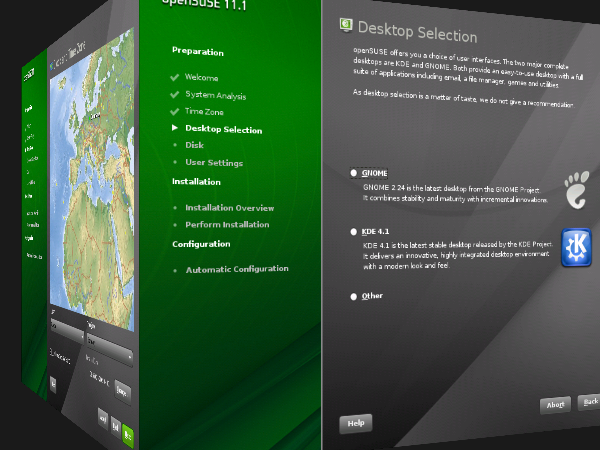
Entering a “subwizard” rotates the cuboid around the x-axis:
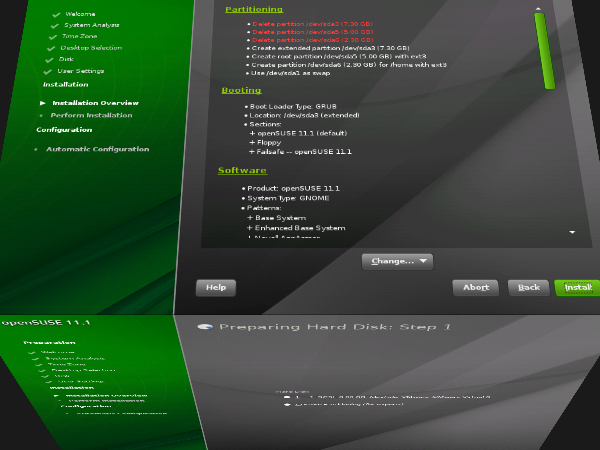
Fortunately most computers are fast enough to render the 3D-scene even without
special hardware support that we lack during installation.
Will be available in Factory within the next weeks. Comments are welcome.

I14Y happens
Some months later I came to know the new term 'a11y', and I started to see it in a lot of places. By that time, I only associated it with the web development world. Terms like "Unobstrusive JavaScript" were very related to it (and I even created an "AJAXy" library called AMUSE for this purpose).
Now let's talk about the next one: I14Y. This concept is present when things like this happen: "I can open an (Microsoft's)OpenXML file with some (Novell's) edition of (Sun's)OpenOffice". Or even more weird things: "I can manage my (Apple's)IPod thanks to a (Microsoft's).NET-powered application called (Novell's)Banshee". Or even more awesome ones: "I can use (Sun?'s)Orca screen reader to control my (Microsoft's)Windows.Forms-powered applications in my (Novell's)SUSE Linux Box!".
So, yeah, we made it! Along with the awesome releases of Mono 2.4 and MonoDevelop 2.0.
Now, guess what's the word?
tiny.url Breaks My Security Model
What is really needed is for the shortener service to show you what site you're about to visit first, so you can make a more informed decision about whether to visit the site or not. Hmm, maybe I should be sending this as a feature request to those sites instead of randomly blogging about it...
Encrypting External HDD with LUKS
I am using OpenSUSE on my main computers, so LUKS is a good option to encrypt my external hdd. I can use Truecrypt if I want to use the hdd with mac or windows, but here is not the case. You can also use LUKS under windows with FreeOTFE.
Here are the steps to encrypt the hdd:
1. be sure that the device is not part of filesystem
umount /dev/sdd1
2. Option 1: write some random data on hdd if you had critical files before
#slow method to fill hdd with semi-random data
dd if=/dev/urandom of=/dev/sdd1
3. Option 2:
#use next two commands to fill the hdd with "zero" data, much faster
dd if=/dev/urandom of=/dev/sdd1 count=2 bs=1M
dd if=/dev/zero of=/dev/sdd1
3. start the encryption setup
cryptsetup -v --key-size 256 luksFormat /dev/sdd1
cryptsetup luksDump /dev/sdd1  #details for encrypted partition
cryptsetup luksOpen /dev/sdd1 buffalo
4. format hdd as ext3
/sbin/mkfs.ext3 /dev/mapper/buffalo
5. mount the encrypted hdd
mount /dev/mapper/buffalo /mnt/buffalo
6. add the entry in /etc/fstab
/dev/mapper/buffalo /mnt/buffalo ext3 acl,user_xattr 1 2
7. Optional step: try tune2fs -L MYLABEL /dev/mapper/buffalo if you want a nice label for your hdd.
Enjoy!