
 schiele
Mail data recovery successful
All mail data got now recovered successfully. So I am completely back again.
Evolution Exchange Performance Series - Chapter 1 - Folder Loading

It clearly shows most of time is spent in constructing folder objects. The sample size used to generate this graph is two folders with 210 and 50 mails repectively. Patch extends Federico's sample code and implements different levels of checkpoints. Graph on the left hand side is generated using a E2K_LOG_LEVEL=1.
As I mentioned in my previous blog, this is the customized plot-timeline script that generated this image.
Mail System Failure
Due to a system failure of a central mail processing machine I currently don't have regular access to all mails sent to me via mailing lists or that were sent to me at 2006-08-10 from about 00:00 GMT to 04:11 GMT. All mails sent to my mail address after 04:11 GMT were handled correctly by an automatic service recovery system. A data recovery process will try to recover the data at 2006-08-11 03:45 GMT. If this fails I will read your mail not before 2006-08-21.
Thus if you have sent me an important mail just within the critical four hours please send it again.
Evolution Exchange Connector
Took the sample code from Federico's blog and extended it a little bit to have different levels to avoid too many messages and included thread-ids to group the messages. I have also customized the plot-timeline script to group by thread-id. Will upload the patch and the graph, generated by the script, later.

 Member
Streaming Full Movie The Domestics (2018) Online

THE DOMESTICS

Available on:

YOU MAY ALSO LIKE


Incoming search terms : film The Domestics 2018 online streaming, download The Domestics movie, download movie The Domestics now, Watch The Domestics 2018 Online 123movie, The Domestics film download, Watch The Domestics 2018 Online Free Putlocker, Watch The Domestics 2018 Online Megashare, Watch The Domestics 2018 Online Free 123movie, Streaming The Domestics 2018 Online Free Megashare, download film The Domestics now, Watch The Domestics 2018 Online Free megashare, The Domestics 2018 Watch Online, Watch The Domestics 2018 Online Viooz, Watch The Domestics 2018 Online Free netflix, download full movie The Domestics 2018, watch The Domestics movie now, The Domestics film trailer, download The Domestics 2018 movie now, Watch The Domestics 2018 Online Free hulu, Watch The Domestics 2018 For Free online, movie The Domestics 2018 download, The Domestics 2018 live streaming film, Watch The Domestics 2018 Online Putlocker, Watch The Domestics 2018 Online Free, The Domestics movie download, Watch The Domestics 2018 Online 123movies, film The Domestics streaming, The Domestics movie trailer, Watch The Domestics 2018 Online Free Viooz, Streaming The Domestics 2018 For Free Online, The Domestics live streaming film online.

My second level thesis
Months passed in silence and now you publish two news in a couple of minutes!? yep, tonight I just want to go over internet and write something here… Wink It’s time to talk about my second level thesis…
Kat
A couple of months passed since I started seeking something interesting to challenge with. I found kat, an open-source information retrieval program for KDE. If you don’t know what’s an information retrieval program you’ve just to think about a local google. It’s simply a program that let you search through your local files like google. Other information retrieval programs are beagle and google desktop. I started to study kat’s code and I also discovered that its mantainer is a nice italian guy. Unfortunately kat have some ugly problems and Roberto (the manteiner) can’t fix them because now he’s really busy. I was going to investigate over these problems for fixing them when I discovered a similar project: strigi.
Strigi
strigi is a really young project created by Jos van den Oever. It’s written in C++ using STL and other external libraries. It runs as a daemon listening over a socket. In this way you’ve just to write your custom gui using your favorite language, nice isn’t it? I’ve contacted Jos and I began to send patches and add new features to strigi, committing them straight into kde subversion repository (cool, I’m a bit excited about it :) ). Recently I added the support for the linux kernel inotify interface, an essential component for strigi.
I really prefer strigi over kat because:
- it works
- it can be run under different window manager
- in the near future it’ll run also under different OS (windows by now, maybe I’ll port it to macos)
- it’s highly under development
You can find more informations about strigi here.
QShapes: a process modeling tool
A lot of time passed since my last post. As usually I’ve been too busy to keep the site updated, forgive me! Last time I let fall something about one of my university projects: qshapes. Now it’s time to tell you something more… QShapes is a process modeling tool, in short words a kind of 2D CAD.
I’m going to release it under GPL over berlios site. Actually I I’ve registered the project (see http://developer.berlios.de/projects/qshapes/ ), committed some code on the svn repository and uploaded some screenshot). The program is “quite” stable (there’re yet some crashes) and can run under linux, macos and windows. It’s written in C++ using Qt for the gui so it’s really portable. I think I’ll use this program as a starting point for one of my dreams: a multiplatform open-source diagram creation tool like dia, kivio or Microsoft visio®. I like dia and kivio but both lacks of some components / features. Since I don’t like too much “gnomish” software I’ll never improve dia. On the other hand kivio is quite pretty but poor than dia in some situations. Especially kivio isn’t multiplatform and this’s a great problem for a me.
But now I’m really busy so I’ll start working on this project after my second level thesis (I’ll tell you something about it really soon).
Grouse Mountain
Yesterday I decided to hike Grouse Mountain in the evening. I set up my GPS receiver to head to Grouse Mountain. To see what happens when you select a destination that is not reachable by car I selected the peak. This was not a wise idea because where a car navigation system would have just said that this is not reachable my system with a full topographic card loaded just said: Well, if we can't reach it on public roads then let's continue on some trails and thus wanted to send me up the Old Grouse Mountain Highway. Unfortunately I didn't inspect this any further and started to move the car with the intention just to drive as long as it is possible and allowed to use the car. The result was that I didn't reach the Grouse Grind hiking trail and had to drive around half of the mountain again.
Finally I reached the right place a short time before the trail closed and I can say that the navigation system is really helpful if you have no clue about the street system of an area. The first thing I saw was a number of warning signs about the trail being dangerous and about a black bear in the area. I started going upwards. The first part was stressful but comfortable to walk. After some time of sweating I reached a point that claimed itself as being the 1/4 mark and informed that nobody will take any responsibility if you continue. And it mentioned that it will become steep now and one might consider to return. I continued and found again a sign warning of the black bear. Actually this sign was customizable for various sorts of bears. I climbed and climbed and I found what they meant with steep. There were some areas where it was more comfortable to make use of your hands while climbing. After about 75 minutes and 800 meters in height I reached the platform of the Skyride mountain station. The people there are really funny: They have placed a sign that the ground might be wet. I suppose if you manage to slip on their wet ground you shouldn't have climbed the trail at all.
From this point I could see the peak:

You could also see Vancouver:

And I finally found the bear!

Then I decided to go down again here:

Actually I used a cabin like this:

"Und wer hat's erfunden?"

Reaching the base again I found that the bear didn't take my car and I could drive home again.

SeaBus, North Vancouver, Lions' Gate Bridge, and Stanley Park
Yesterday evening I was using SeaBus to North Vancouver. Vancouver seen from there looks like this:
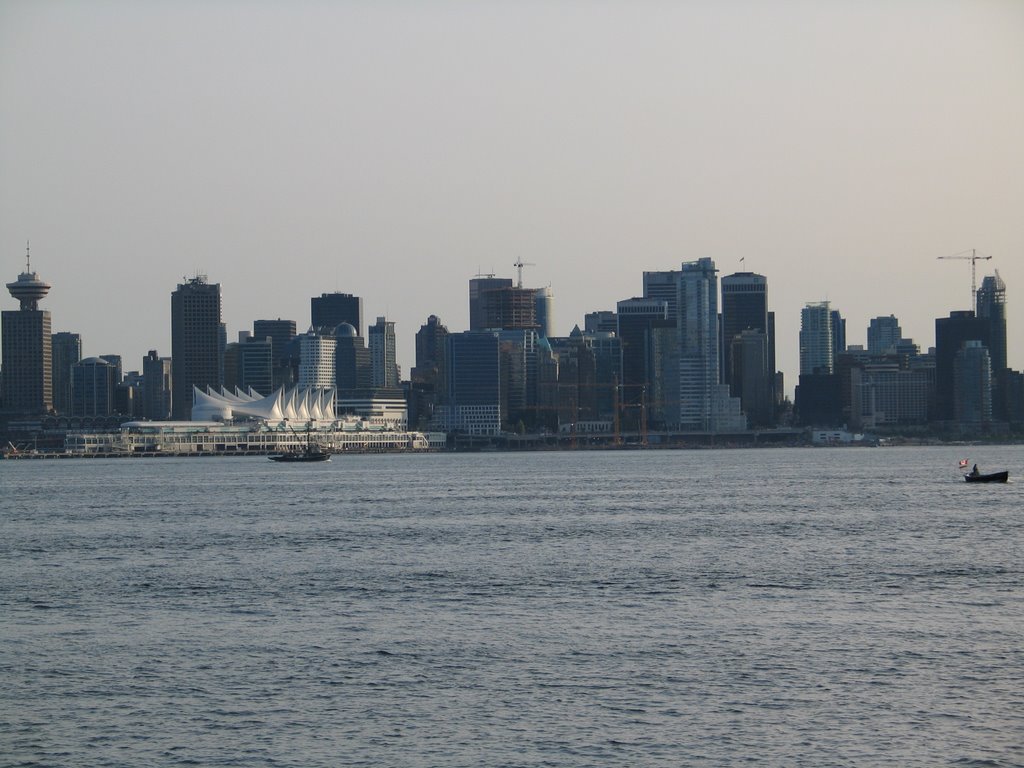
Having reached Lion's Gate Bridge after about 4km from the SeaBus terminal I was reaching Stanley Park:
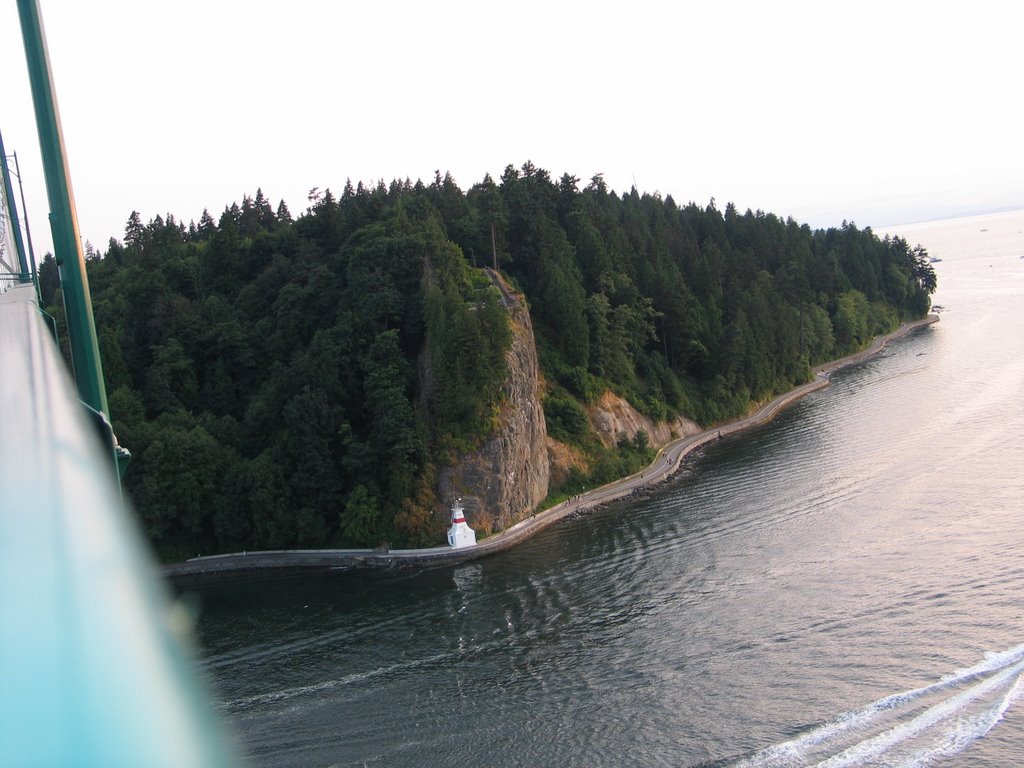
Unfortunately I decided for the wrong side to walk on the bridge thus this picture has too much bridge included in the spectacular view to Vancouver Downtown:

In Stanley Park there was someone else inspecting the area. But most likely he just inspected whether there are tourists to feed him.

Finally a look back to the bridge

I was walking some dark paths through the park back to Vancouver. The wood is really making everything dark there. In the evening you feel that sun has already set because it is so dark but when reaching an area with less trees you find that this is definitely not true.
