
 hpj
hpjChafa 1.14: All-singing, all-dancing
Dear friends, comrades, partners in crime and moderate profit! I am pleased to announce the immediate availability of Chafa 1.14.0. There are release notes, but who's got time for that? All the fun stuff is in this post. You should be reading it instead.
Pixel perfection
Images can now be padded instead of stretched to fit their cell extent exactly –

– so I'll no longer have to explain why our 50kLOC monstrosity couldn't do pixel-perfect output, while sixcat (300LOC) did so effortlessly. Naturally, I had to make this as hard as possible for myself by splicing in padding before and after each row as they're processed for channel reordering and such, but on the plus side, this maximizes cache friendliness and parallelism behind a nice and homogeneous internal API.
You can get the old behavior back with --exact-size off. It defaults to auto, which will do the right thing (i.e. pad if image fits in viewport without scaling and scaling wasn't explicitly requested).
Another improvement in this vein is that sRGB is properly linearized in scaling operations now. This is pipelined along with everything else, and should be suitably fast.
Multiplexer passthrough
Previously, it was impossible to do better than character art inside multiplexers like tmux and GNU Screen. This is no longer the case; kitty has a new trick that allows for persistent raster image placement in these, which we implement. The above mentioned multiplexers have slight differences in their passthrough protocols; we support both with the new --passthrough argument.
We also support sixel passthrough. Sixels will be wrecked by multiplexer updates, so this is off by default. You can enable it with e.g. -f sixel --passthrough screen. tmux tends to dispose of the image immediately after we exit, so it may be a good idea to use --passthrough tmux -d 5 there so you get a chance to look at it first.
To my knowledge, Chafa is the only terminal graphics toolkit to offer passthrough for all four combinations of sixel/kitty and tmux/screen. I think the iTerm2 protocol would be doable too, if only.
MS Windows compatibility
It runs pretty well on Windows. You can use it in PowerShell. @oshaboy added support for ConHost, so it can technically be used on very old Windows versions – although this hasn't gotten much testing yet.
Python bindings
Erica Ferrua Edwardsdóttir's amazing Python bindings have been around for a while now, yet nary a peep from me on my blag. This shameful deficit stands in contrast to the stunning professionalism of her work. You need to do this:
pip install chafa.pyDo it now. Everything's well structured, the documentation is entertaining and well written, and there's even a tutorial. It's rare to see a project that simultaneously delivers and channels the spirit of F/OSS this well. You'll also find it on GitHub.
JavaScript enablement
Héctor Molinero Fernández started doing WebAssembly builds, which means you can now use the Chafa API from JavaScript. Like so:
npm install chafa-wasmHe also made a cool web app to show off all the bells and whistles!
Cheerleading aside, I've had no hand in either of these projects. The glory belongs to their respective maintainers, along with all of the praise, stars, code submissions and issue reports, heh heh.
Art!
@clort81 sent me this picture:
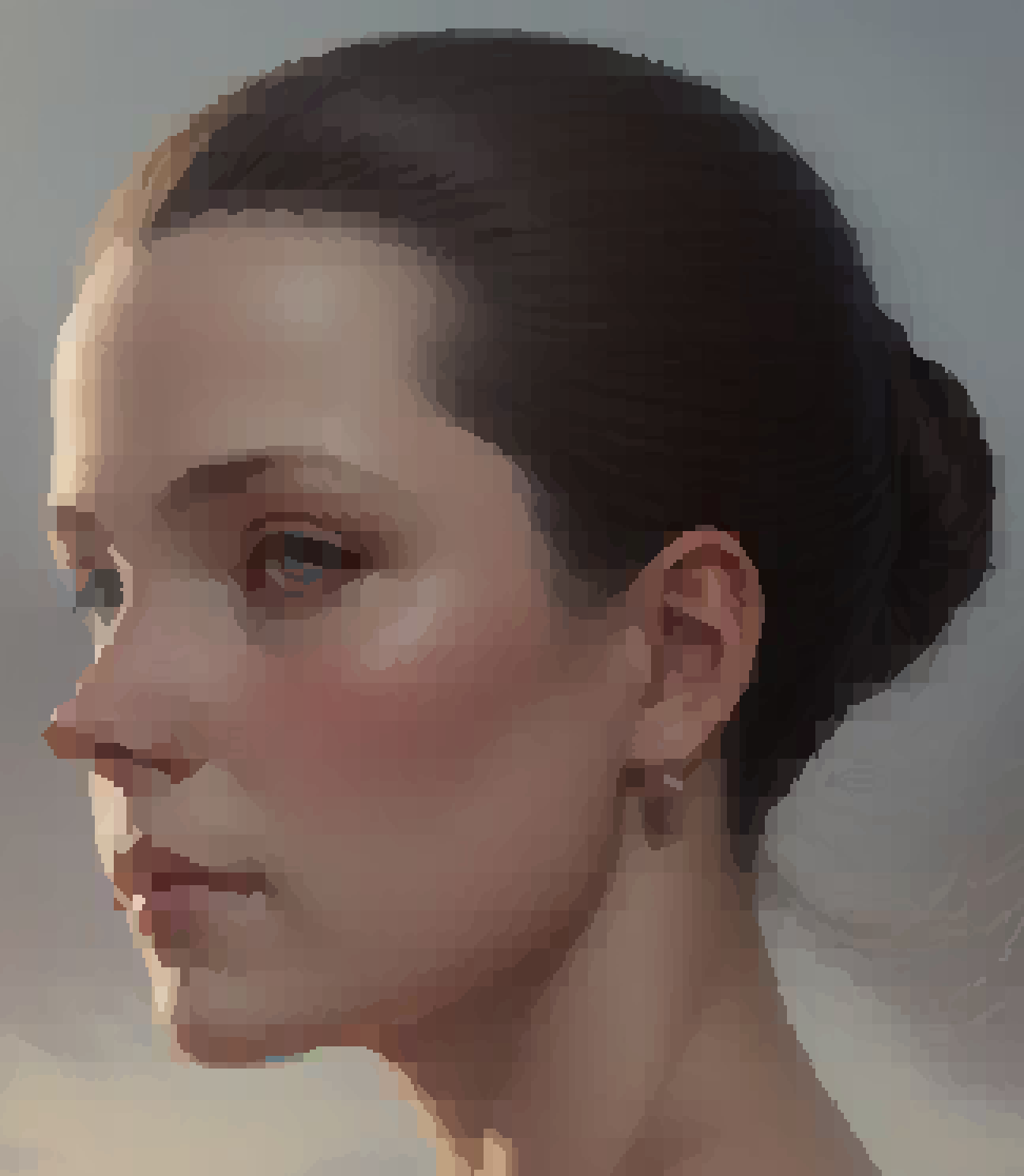
What's special about it? Well, it's character art!
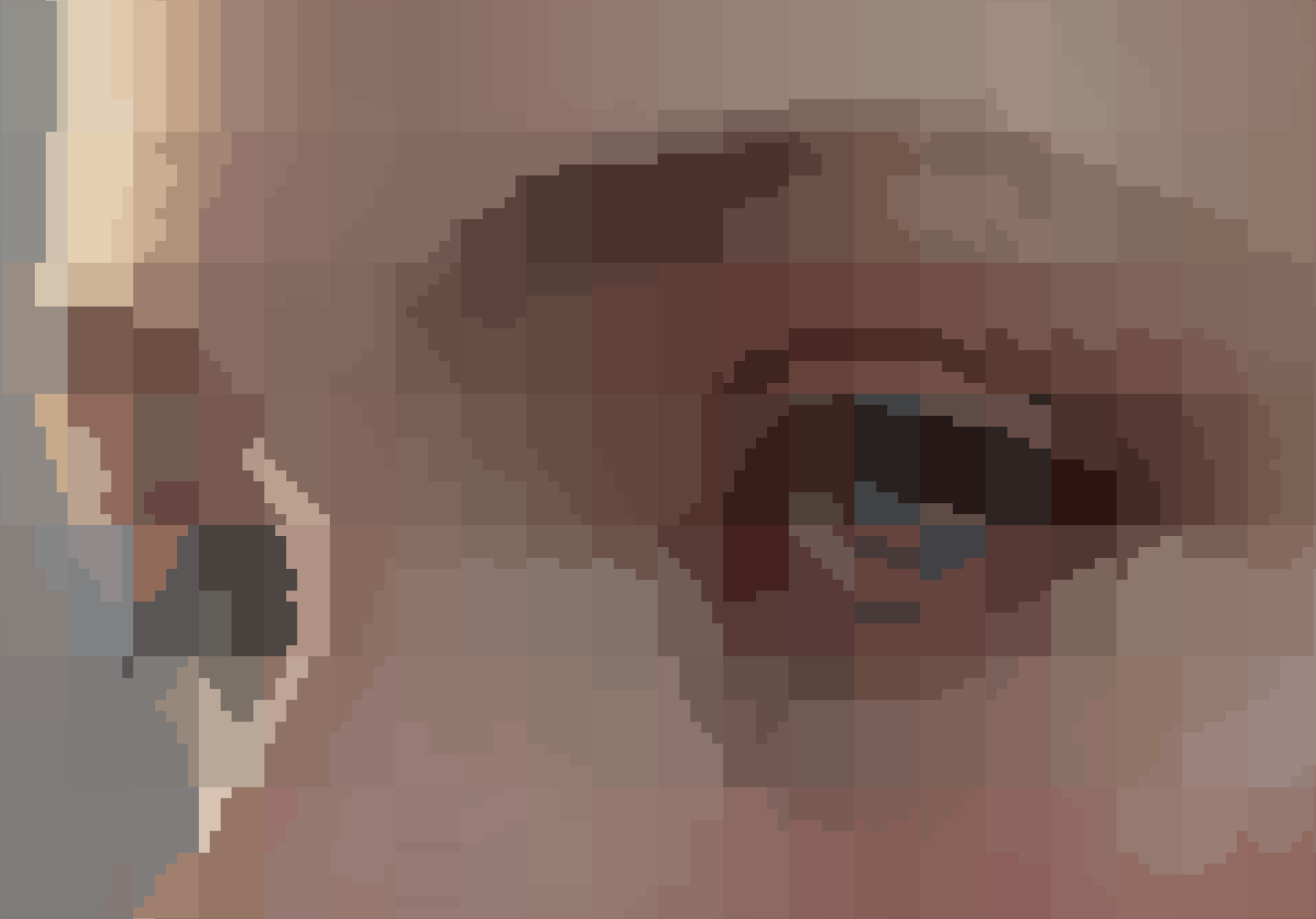
You have to zoom in a bit before it becomes obvious; there're only two colors per character cell.
The glyphs are something else, though. You see, @clort81 wasn't happy with the limited offering of block drawing symbols in Unicode, and set out to create Blapinus, a 6125-glyph (!) hand-pixeled 6×12 PCF font with all the shapes you could ever want.
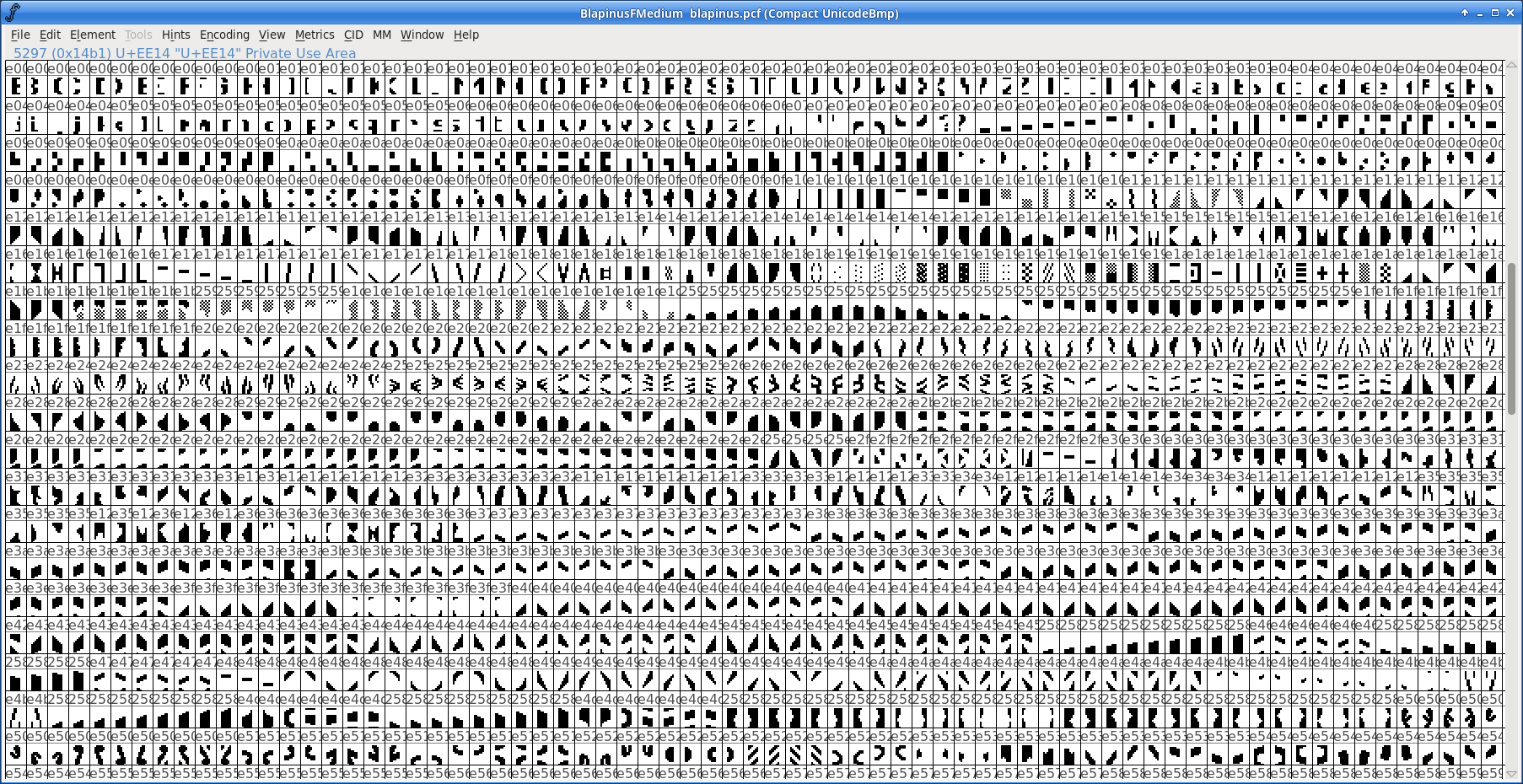
Plug that into your terminal (and Chafa), et voilà:
sudo cp blapinus.pcf.gz /usr/share/fonts/misc/
xterm -font -blap-*
Note that your fonts may live somewhere else, so relocate accordingly. Then inside XTerm, run:
chafa -f symbols --glyph-file blapinus.pcf.gz --symbols imported hello.pngIf you see strange symbols in your output, you can try excluding some wide and ambiguous code points, e.g. --symbols imported-wide-ued00..uffff.
You can probably set this up in other terminals and display servers too, but know that it could be a long and winding path you're going down. Traveler beware. Or push the pedal to the metal and write a trip report. I'd love to read it.
If your terminal renders the font correctly, this can even have somewhat practical qualities:
First, it integrates perfectly with tmux and GNU Screen. Redraw, scrollback and editing just works, no passthrough tricks required.
Second, albeit lossy, the compression ratio is surprisingly good. Assuming four bytes per pixel, a 6×12 cell is 288 bytes uncompressed. We turn this into 39 bytes at most (a maximum of 36 bytes for the direct color sequence plus 3 bytes for the UTF-8 character), or an 86% reduction. Not bad, considering the compression dictionary is a 100kB font file.
Deflate will further compress this kind of data by 3/4, so if you're running this in a compressed ssh session, you can expect the total gain to be about 95%.
Prior art!
I've mentioned Mo Zhou's work before, but I'd be remiss not to bring it up here; they focused their considerable ML skills on a generator that takes a lot of the pain out of the font creation process. Just point it at an image collection, and by the magic of k-means clustering and a minimal increase in your carbon footprint, out pops a new font brimming with delectable puzzle pieces. You get scalable TTF, with SVG as an intermediate format, which is more agreeable with modern rendering stacks. Here it is in VTE:
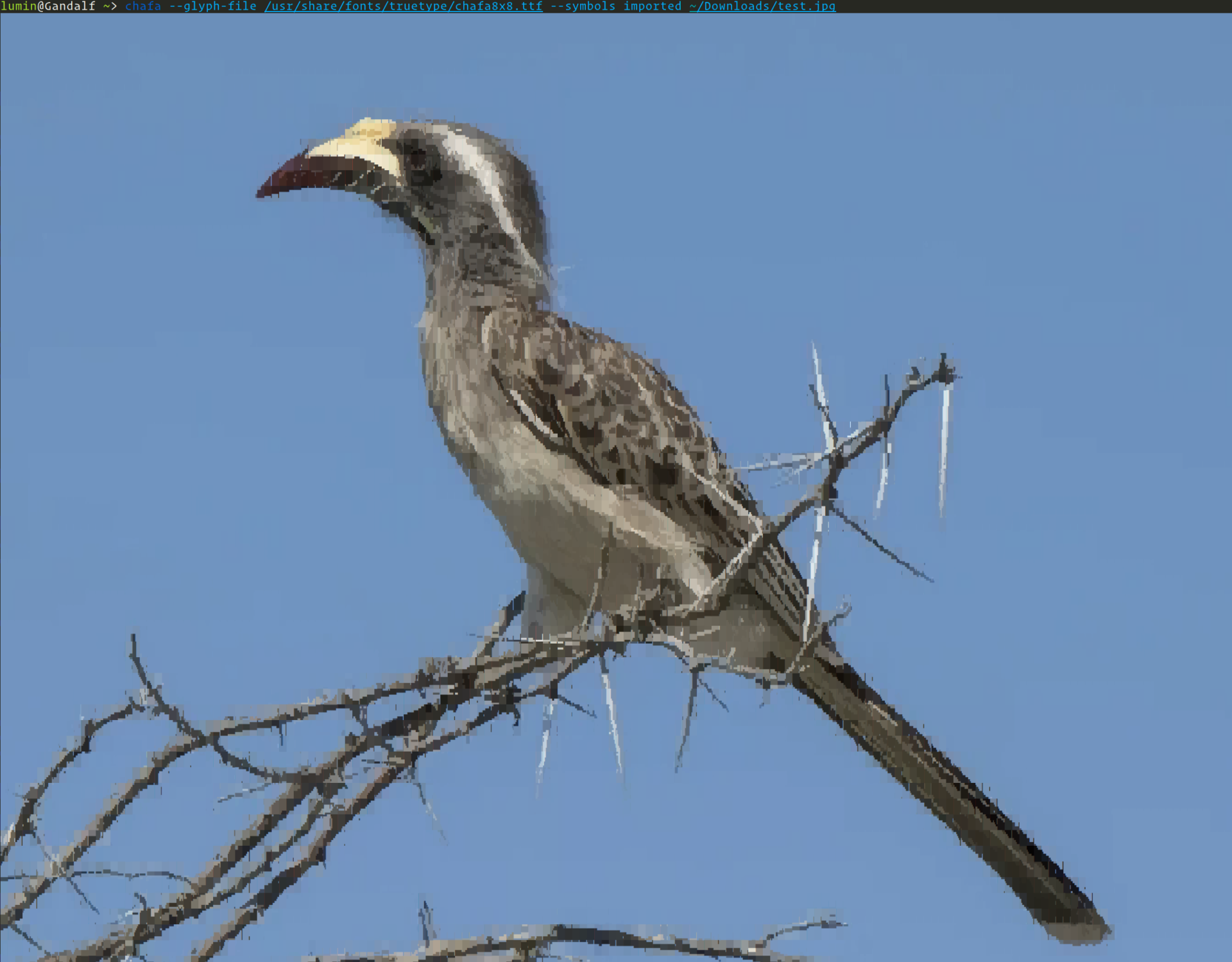
This ML-generated font makes for a more organic look. There are unfortunately still some artifacts caused – presumably – by VTE's cell padding. The generator has offset hacks to work around it, but it's hard to make custom connective glyphs look perfect in every terminal.
You can read more about it in one of our longest-running GitHub issues. We're taking it all the way.
Cool applications
Chafa's found its way into the nooks and crannies of many a sweet application by now. I'd especially like to mention these three here:

ANSIWAVE BBS, the brainchild of Zach Oakes, is written in Nim and contains an embedded build of Chafa for character graphics generation. As a one-time (and sometimes) BBS sysop and denizen, this hits me right in the feels.
Felix is a nice file browser by Kyohei Uto written in Rust. It uses Chafa as an external image previewer.
kew, a terminal music player by the mysterious @ravachol, is written in C and uses the native Chafa API to generate cover previews. Development on this has been moving very quickly.
A laid-back place to chat about all this stuff
Issue trackers are formal and supposedly high-SNR. If you'd like a more relaxed place to chat about Chafa, your own programs, terminal graphics (modern or ancient), graphics programming in general or artistic expression related to any of these, drop by our secret business Matrix channel, #chafa:matrix.org. We'll be waiting.

I'm also enjoying Mastodon these days. Occasional announcements and amusements go there. It's good.
Thanks
Last, but not least: a big thank you to everyone who wrote code, reported bugs, filed suggestions and helped test this time around. And an extra big thanks to all the packagers and distributors who make the F/OSS world turn. You're the best.

Clear Course is Set for openSUSE Leap
The openSUSE release team confirms there will be a successor to Leap 15 and it’s a numerical leap forward.
As many eagerly await the arrival of Leap 15.6 this year, a path for Leap 16 as a successor awaits. Based on SUSE’s new Adaptable Linux Platform (ALP) codebase, openSUSE Leap 16 will combine the benefits of an advanced enterprise server distribution and user-friendly maintenance and security that is a hallmark of the Leap series.
Leap 16 is aiming to strike a balance between a cutting-edge and a traditional Linux operating system emerging from SUSE’s development of ALP and initiatives to effectively integrate community packages.
The transition to Leap 16 is not just a numerical step-up but symbolizes a significant path forward in technology and user experiences. The future of openSUSE Leap is based on the innovative concept of SUSE’s Adaptable Linux Platform.
The Adaptable Linux Platform powers the next-generation openSUSE Leap, Leap Micro, and SUSE solutions. It makes distributions more adaptable and suitable for cloud-native workloads while also being capable of handling a rapid pace of innovation.
There are no plans to drop the classical (non-immutable) option for Leap; both non-immutable or immutable installation variants are available for Leap 15 and are planned for Leap 16. This is set to remain the preferred way for people to deploy Leap.
Everyone is encouraged to engage in the development of these new platforms by providing feedback, packaging, testing, documenting and any other way.
Leap will continue to follow the openSUSE factory development model.
The development process will involve gathering requirements, including those from community workshops, to ensure that Leap 16.0 meets the evolving needs of its users. The openSUSE community is already eyeing the horizon with the anticipated introduction of Leap 16.
Alongside Leap 16, Leap Micro 6.0 will succeed the Leap Micro 5 series. It’s based on SUSE Linux Enterprise Micro 6.0, which focuses on containerized and virtualized workloads.
Leap and Leap Micro will both provide users with clear migration paths and sufficient time to upgrade. In case of Leap 16 delays, the release team may extend the life cycle of Leap 15.6 or, as a last resort, release Leap 15.7 to ensure sufficient overlap. Leap 16 will ensure there is no gap between the release and Leap 15’s End of Life cycle.
People can find information updates about Leap 16 on the project’s roadmap page. The release team will share when Leap 16 development starts and how to get involved through official openSUSE channels.

 Member
openSUSE.Asia Summit 2023
openSUSE.Asia Summit 2023

openSUSE.Asia summit 2023 hosted in Chongqing, China.
This is our first face to face summit after COVID 19.
It's great to see old friends and meet new friends in openSUSE.Asia summit.
Thanks again for local committee to host this summit, we saw many students and friends interested with openSUSE and open source.

In openSUSE.Asia summit - I share " Using openSUSE in the Public Cloud "

Slide link
Smile and fun to share - I think that is the most important factor in community.


I had lots gift from summit 🙂

openSUSE Asia photo albums still travel in different community zones.


Let's wait for the openSUSE.Asia summit 2024 and meet old friends and new friends again.
Thanks again for openSUSE / SUSE / Sponsor support for our summit.
Thanks to the local community for organizing this great event.
“All the honor belong to our strong local committee and staff”

openSUSE Tumbleweed – Review of the week 2024/02
Dear Tumbleweed users and hackers,
Tumbleweed is back at full speed – with seven snapshots released in as many days. The release team could again not let their hands off the system even on the weekend and delivered all the changes as fast as possible.
The most relevant changes in those seven snapshots were:
- Bind 9.18.21
- GStreamer 1.22.8
- SELinux 3.6
- firewalls 2.1.0
- Linux kernel 6.6.10
- GNOME 45.3
- Node.js 21.5.0
- Grub 2.12
- Meson 1.3.1
While looking at the staging projects, there has been some progress, but the list of older requests is mostly unchanged. With the holiday period over, we can all expect changes there relatively soon. Currently, we have these changes staged:
- Linux kernel 6.6.11
- systemd 254.8
- RPM 4.19: all fixes have arrived, and the final phase has started. We expect openQA runs over the weekend and will likely ship it soon. With RPM 4.19, we will have to promote cmake to ring0
- Ruby 3.3: yast failures are being debugged and worked on
- libxml 2.12.x: slow progress
- openSSL 3.2.0
- c-ares 1.21.0: nodejs build fails have been resolved, but a new cycle has formed: appstream-glib, c-ares, curl, googletest, nghttp2, python311
- dbus-broker: no progress: openQA fails to launch the network stack in the installer
Conference Adds Business Focused Networking Event
The openSUSE Project is excited to announce the Open 4 Business networking event, a collaborative initiative launched by the DORS/CLUC organization, scheduled for June 26 from 2 to 6 p.m. at the Franken Campus in Nuremberg, Germany.
This event, which will be held in conjunction with openSUSE Conference 2024 (oSC24), is dedicated to fostering connections in the open-source business community.
The event seeks to help establish a business landscape to help align small and medium-sized enterprises (SMEs) who hold similar values in open-source ethics and technology. The Open 4 Business event aims to serve as a bridge to connect open-source enthusiasts. This event will help people from the business world engage and collaborate effectively.
The key objectives Open 4 Business aims to achieve are:
- Emphasize that the business world shares bonds with open-source communities
- Provide a platform for making sustainable and open business happen
- Promote business collaboration with open source projects
- Promote networking and partnerships amongst SMEs, freelancers and corporations
This event is an opportunity for anyone eager to expand their business network, discover new projects and engage with fellow experts. The project invites you to participate in the Open 4 Business event.
The openSUSE Project would like to extend our gratitude to the DORS/CLUC organization for their role in launching the #open4business networking event and aim to help extend this business networking event to other community-driven open-source technology conferences.
To participate, email ddemaio@opensuse.org with the subject “open4business” or submit a proposal under the 4-hour Open 4 Business selection. Talks for the Open 4 Business event will take place within a 4-hour window on June 26 with each talk lasting no more than 15 minutes per presenter. Please note that talks for this event will be under the business networking track and is distinct from the conference’s technical tracks taking place from June 27 - 29. The event will take place at Katzwanger Str. 130, which is on the bottom floor next to SUSE’s offices in Nuremberg.
Submitting a proposal for the oSC24 is open until April 15. The conference will take place at the Z-Bau, which is down the street from SUSE’s offices in Nuremberg.

Wayland really breaks things… Just for now?
This post is in part a response to an aspect of Nate’s post “Does Wayland really break everything?“, but also my reflection on discussing Wayland protocol additions, a unique pleasure that I have been involved with for the past months1.
Some facts
Before I start I want to make a few things clear: The Linux desktop will be moving to Wayland2 – this is a fact at this point (and has been for a while), sticking to X11 makes no sense for future projects. From reading Wayland protocols and working with it at a much lower level than I ever wanted to, it is also very clear to me that Wayland is an exceptionally well-designed core protocol, and so are the additional extension protocols (xdg-shell & Co.). The modularity of Wayland is great, it gives it incredible flexibility and will for sure turn out to be good for the long-term viability of this project (and also provides a path to correct protocol issues in future, if one is found). In other words: Wayland is an amazing foundation to build on, and a lot of its design decisions make a lot of sense!
The shift towards people seeing “Linux” more as an application developer platform, and taking PipeWire and XDG Portals into account when designing for Wayland is also an amazing development and I love to see this – this holistic approach is something I always wanted!
Furthermore, I think Wayland removes a lot of functionality that shouldn’t exist in a modern compositor – and that’s a good thing too! Some of X11’s features and design decisions had clear drawbacks that we shouldn’t replicate. I highly recommend to read Nate’s blog post, it’s very good and goes into more detail. And due to all of this, I firmly believe that any advancement in the Wayland space must come from within the project.
But!
But! Of course there was a “but” coming  – I think while developing Wayland-as-an-ecosystem we are now entrenched into narrow concepts of how a desktop should work. While discussing Wayland protocol additions, a lot of concepts clash, people from different desktops with different design philosophies debate the merits of those over and over again never reaching any conclusion (just as you will never get an answer out of humans whether sushi or pizza is the clearly superior food, or whether CSD or SSD is better). Some people want to use Wayland as a vehicle to force applications to submit to their desktop’s design philosophies, others prefer the smallest and leanest protocol possible, other developers want the most elegant behavior possible. To be clear, I think those are all very valid approaches.
But this also creates problems: By switching to Wayland compositors, we are already forcing a lot of porting work onto toolkit developers and application developers. This is annoying, but just work that has to be done. It becomes frustrating though if Wayland provides toolkits with absolutely no way to reach their goal in any reasonable way. For Nate’s Photoshop analogy: Of course Linux does not break Photoshop, it is Adobe’s responsibility to port it. But what if Linux was missing a crucial syscall that Photoshop needed for proper functionality and Adobe couldn’t port it without that? In that case it becomes much less clear on who is to blame for Photoshop not being available.
A lot of Wayland protocol work is focused on the environment and design, while applications and work to port them often is considered less. I think this happens because the overlap between application developers and developers of the desktop environments is not necessarily large, and the overlap with people willing to engage with Wayland upstream is even smaller. The combination of Windows developers porting apps to Linux and having involvement with toolkits or Wayland is pretty much nonexistent. So they have less of a voice.
A quick detour through the neuroscience research lab
I have been involved with Freedesktop, GNOME and KDE for an incredibly long time now (more than a decade), but my actual job (besides consulting for Purism) is that of a PhD candidate in a neuroscience research lab (working on the morphology of biological neurons and its relation to behavior). I am mostly involved with three research groups in our institute, which is about 35 people. Most of us do all our data analysis on powerful servers which we connect to using RDP (with KDE Plasma as desktop). Since I joined, I have been pushing the envelope a bit to extend Linux usage to data acquisition and regular clients, and to have our data acquisition hardware interface well with it. Linux brings some unique advantages for use in research, besides the obvious one of having every step of your data management platform introspectable with no black boxes left, a goal I value very highly in research (but this would be its own blogpost).
In terms of operating system usage though, most systems are still Windows-based. Windows is what companies develop for, and what people use by default and are familiar with. The choice of operating system is very strongly driven by application availability, and WSL being really good makes this somewhat worse, as it removes the need for people to switch to a real Linux system entirely if there is the occasional software requiring it. Yet, we have a lot more Linux users than before, and use it in many places where it makes sense. I also developed a novel data acquisition software that even runs on Linux-only and uses the abilities of the platform to its fullest extent. All of this resulted in me asking existing software and hardware vendors for Linux support a lot more often. Vendor-customer relationship in science is usually pretty good, and vendors do usually want to help out. Same for open source projects, especially if you offer to do Linux porting work for them… But overall, the ease of use and availability of required applications and their usability rules supreme. Most people are not technically knowledgeable and just want to get their research done in the best way possible, getting the best results with the least amount of friction.
Back to the point
The point of that story is this: GNOME, KDE, RHEL, Debian or Ubuntu: They all do not matter if the necessary applications are not available for them. And as soon as they are, the easiest-to-use solution wins. There are many facets of “easiest”: In many cases this is RHEL due to Red Hat support contracts being available, in many other cases it is Ubuntu due to its mindshare and ease of use. KDE Plasma is also frequently seen, as it is perceived a bit easier to onboard Windows users with it (among other benefits). Ultimately, it comes down to applications and 3rd-party support though.
Here’s a dirty secret: In many cases, porting an application to Linux is not that difficult. The thing that companies (and FLOSS projects too!) struggle with and will calculate the merits of carefully in advance is whether it is worth the support cost as well as continuous QA/testing. Their staff will have to do all of that work, and they could spend that time on other tasks after all.
So if they learn that “porting to Linux” not only means added testing and support, but also means to choose between the legacy X11 display server that allows for 1:1 porting from Windows or the “new” Wayland compositors that do not support the same features they need, they will quickly consider it not worth the effort at all. I have seen this happen.
Of course many apps use a cross-platform toolkit like Qt, which greatly simplifies porting. But this just moves the issue one layer down, as now the toolkit needs to abstract Windows, macOS and Wayland. And Wayland does not contain features to do certain things or does them very differently from e.g. Windows, so toolkits have no way to actually implement the existing functionality in a way that works on all platforms. So in Qt’s documentation you will often find texts like “works everywhere except for on Wayland compositors or mobile”4.
Many missing bits or altered behavior are just papercuts, but those add up. And if users will have a worse experience, this will translate to more support work, or people not wanting to use the software on the respective platform.
What’s missing?
Window positioning
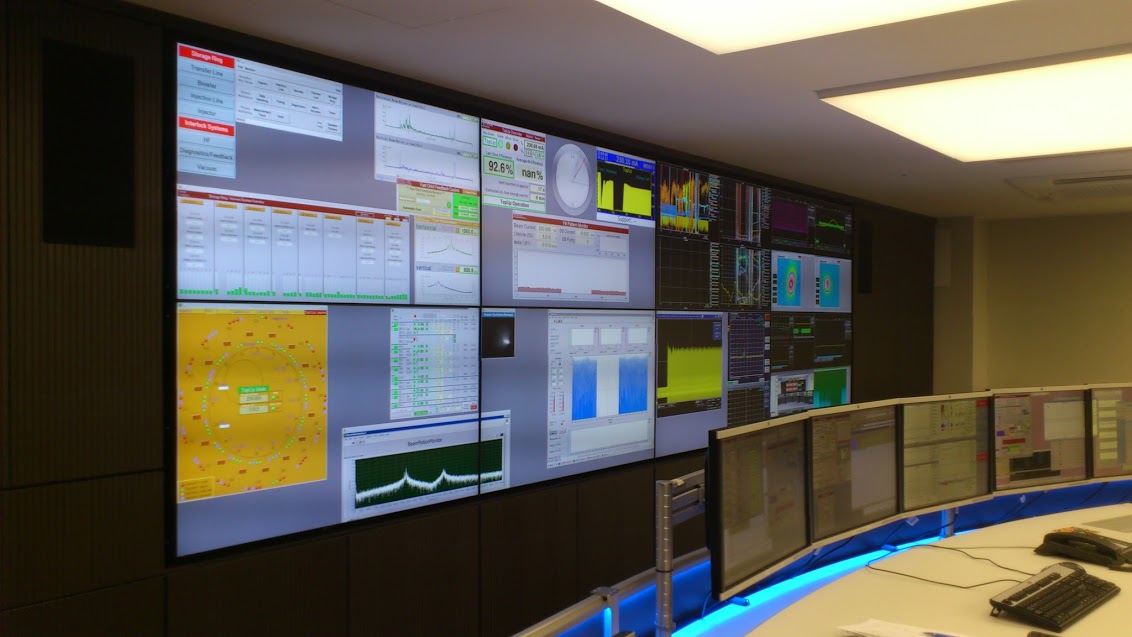
SDI applications with multiple windows are very popular in the scientific world. For data acquisition (for example with microscopes) we often have one monitor with control elements and one larger one with the recorded image. There is also other configurations where multiple signal modalities are acquired, and the experimenter aligns windows exactly in the way they want and expects the layout to be stored and to be loaded upon reopening the application. Even in the image from Adlershof Technology Park above you can see this style of UI design, at mega-scale. Being able to pop-out elements as windows from a single-window application to move them around freely is another frequently used paradigm, and immensely useful with these complex apps.
It is important to note that this is not a legacy design, but in many cases an intentional choice – these kinds of apps work incredibly well on larger screens or many screens and are very flexible (you can have any window configuration you want, and switch between them using the (usually) great window management abilities of your desktop).
Of course, these apps will work terribly on tablets and small form factors, but that is not the purpose they were designed for and nobody would use them that way.
I assumed for sure these features would be implemented at some point, but when it became clear that that would not happen, I created the ext-placement protocol which had some good discussion but was ultimately rejected from the xdg namespace. I then tried another solution based on feedback, which turned out not to work for most apps, and now proposed xdg-placement (v2) in an attempt to maybe still get some protocol done that we can agree on, exploring more options before pushing the existing protocol for inclusion into the ext Wayland protocol namespace. Meanwhile though, we can not port any application that needs this feature, while at the same time we are switching desktops and distributions to Wayland by default.
Window position restoration
Similarly, a protocol to save & restore window positions was already proposed in 2018, 6 years ago now, but it has still not been agreed upon, and may not even help multiwindow apps in its current form. The absence of this protocol means that applications can not restore their former window positions, and the user has to move them to their previous place again and again.
Meanwhile, toolkits can not adopt these protocols and applications can not use them and can not be ported to Wayland without introducing papercuts.
Window icons
Similarly, individual windows can not set their own icons, and not-installed applications can not have an icon at all because there is no desktop-entry file to load the icon from and no icon in the theme for them. You would think this is a niche issue, but for applications that create many windows, providing icons for them so the user can find them is fairly important. Of course it’s not the end of the world if every window has the same icon, but it’s one of those papercuts that make the software slightly less user-friendly. Even applications with fewer windows like LibrePCB are affected, so much so that they rather run their app through Xwayland for now.
I decided to address this after I was working on data analysis of image data in a Python virtualenv, where my code and the Python libraries used created lots of windows all with the default yellow “W” icon, making it impossible to distinguish them at a glance. This is xdg-toplevel-icon now, but of course it is an uphill battle where the very premise of needing this is questioned. So applications can not use it yet.
Limited window abilities requiring specialized protocols
Firefox has a picture-in-picture feature, allowing it to pop out media from a mediaplayer as separate floating window so the user can watch the media while doing other things. On X11 this is easily realized, but on Wayland the restrictions posed on windows necessitate a different solution. The xdg-pip protocol was proposed for this specialized usecase, but it is also not merged yet. So this feature does not work as well on Wayland.
Automated GUI testing / accessibility / automation
Automation of GUI tasks is a powerful feature, so is the ability to auto-test GUIs. This is being worked on, with libei and wlheadless-run (and stuff like ydotool exists too), but we’re not fully there yet.
Wayland is frustrating for (some) application authors
As you see, there is valid applications and valid usecases that can not be ported yet to Wayland with the same feature range they enjoyed on X11, Windows or macOS. So, from an application author’s perspective, Wayland does break things quite significantly, because things that worked before can no longer work and Wayland (the whole stack) does not provide any avenue to achieve the same result.
Wayland does “break” screen sharing, global hotkeys, gaming latency (via “no tearing”) etc, however for all of these there are solutions available that application authors can port to. And most developers will gladly do that work, especially since the newer APIs are usually a lot better and more robust. But if you give application authors no path forward except “use Xwayland and be on emulation as second-class citizen forever”, it just results in very frustrated application developers.
For some application developers, switching to a Wayland compositor is like buying a canvas from the Linux shop that forces your brush to only draw triangles. But maybe for your avant-garde art, you need to draw a circle. You can approximate one with triangles, but it will never be as good as the artwork of your friends who got their canvases from the Windows or macOS art supply shop and have more freedom to create their art.
Triangles are proven to be the best shape! If you are drawing circles you are creating bad art!
Wayland, via its protocol limitations, forces a certain way to build application UX – often for the better, but also sometimes to the detriment of users and applications. The protocols are often fairly opinionated, a result of the lessons learned from X11. In any case though, it is the odd one out – Windows and macOS do not pose the same limitations (for better or worse!), and the effort to port to Wayland is orders of magnitude bigger, or sometimes in case of the multiwindow UI paradigm impossible to achieve to the same level of polish. Desktop environments of course have a design philosophy that they want to push, and want applications to integrate as much as possible (same as macOS and Windows!). However, there are many applications out there, and pushing a design via protocol limitations will likely just result in fewer apps.
The porting dilemma
I spent probably way too much time looking into how to get applications cross-platform and running on Linux, often talking to vendors (FLOSS and proprietary) as well. Wayland limitations aren’t the biggest issue by far, but they do start to come come up now, especially in the scientific space with Ubuntu having switched to Wayland by default. For application authors there is often no way to address these issues. Many scientists do not even understand why their Python script that creates some GUIs suddenly behaves weirdly because Qt is now using the Wayland backend on Ubuntu instead of X11. They do not know the difference and also do not want to deal with these details – even though they may be programmers as well, the real goal is not to fiddle with the display server, but to get to a scientific result somehow.
Another issue is portability layers like Wine which need to run Windows applications as-is on Wayland. Apparently Wine’s Wayland driver has some heuristics to make window positioning work (and I am amazed by the work done on this!), but that can only go so far.
A way out?
So, how would we actually solve this? Fundamentally, this excessively long blog post boils down to just one essential question:
Do we want to force applications to submit to a UX paradigm unconditionally, potentially loosing out on application ports or keeping apps on X11 eternally, or do we want to throw them some rope to get as many applications ported over to Wayland, even through we might sacrifice some protocol purity?
I think we really have to answer that to make the discussions on wayland-protocols a lot less grueling. This question can be answered at the wayland-protocols level, but even more so it must be answered by the individual desktops and compositors.
If the answer for your environment turns out to be “Yes, we want the Wayland protocol to be more opinionated and will not make any compromises for application portability”, then your desktop/compositor should just immediately NACK protocols that add something like this and you simply shouldn’t engage in the discussion, as you reject the very premise of the new protocol: That it has any merit to exist and is needed in the first place. In this case contributors to Wayland and application authors also know where you stand, and a lot of debate is skipped. Of course, if application authors want to support your environment, you are basically asking them now to rewrite their UI, which they may or may not do. But at least they know what to expect and how to target your environment.
If the answer turns out to be “We do want some portability”, the next question obviously becomes where the line should be drawn and which changes are acceptable and which aren’t. We can’t blindly copy all X11 behavior, some porting work to Wayland is simply inevitable. Some written rules for that might be nice, but probably more importantly, if you agree fundamentally that there is an issue to be fixed, please engage in the discussions for the respective MRs! We for sure do not want to repeat X11 mistakes, and I am certain that we can implement protocols which provide the required functionality in a way that is a nice compromise in allowing applications a path forward into the Wayland future, while also being as good as possible and improving upon X11. For example, the toplevel-icon proposal is already a lot better than anything X11 ever had. Relaxing ACK requirements for the ext namespace is also a good proposed administrative change, as it allows some compositors to add features they want to support to the shared repository easier, while also not mandating them for others. In my opinion, it would allow for a lot less friction between the two different ideas of how Wayland protocol development should work. Some compositors could move forward and support more protocol extensions, while more restrictive compositors could support less things. Applications can detect supported protocols at launch and change their behavior accordingly (ideally even abstracted by toolkits).
You may now say that a lot of apps are ported, so surely this issue can not be that bad. And yes, what Wayland provides today may be enough for 80-90% of all apps. But what I hope the detour into the research lab has done is convince you that this smaller percentage of apps matters. A lot. And that it may be worthwhile to support them.
To end on a positive note: When it came to porting concrete apps over to Wayland, the only real showstoppers so far5 were the missing window-positioning and window-position-restore features. I encountered them when porting my own software, and I got the issue as feedback from colleagues and fellow engineers. In second place was UI testing and automation support, the window-icon issue was mentioned twice, but being a cosmetic issue it likely simply hurts people less and they can ignore it easier.
What this means is that the majority of apps are already fine, and many others are very, very close! A Wayland future for everyone is within our grasp! 
I will also bring my two protocol MRs to their conclusion for sure, because as application developers we need clarity on what the platform (either all desktops or even just a few) supports and will or will not support in future. And the only way to get something good done is by contribution and friendly discussion.
Footnotes
- Apologies for the clickbait-y title – it comes with the subject

 ︎
︎
- When I talk about “Wayland” I mean the combined set of display server protocols and accepted protocol extensions, unless otherwise clarified. ︎
- I would have picked a picture from our lab, but that would have needed permission first ︎
- Qt has awesome “platform issues” pages, like for macOS and Linux/X11 which help with porting efforts, but Qt doesn’t even list Linux/Wayland as supported platform. There is some information though, like window geometry peculiarities, which aren’t particularly helpful when porting (but still essential to know). ︎
- Besides issues with Nvidia hardware – CUDA for simulations and machine-learning is pretty much everywhere, so Nvidia cards are common, which causes trouble on Wayland still. It is improving though. ︎
 ︎
︎
Music of the week: five albums to bring with me to the desert island
I love music. My family, friends, colleagues love music. I am in quite a few music-related Facebook groups. A returning question everywhere in the past couple of weeks in various wordings was: what are the five albums you would bring to a desert island? This list is of course changing almost each and every year. And also depends on the number of albums, and if live concert recordings, “best of”, etc. albums can be included. So, this is the 2024 January edition with just studio albums :-)

You are what you listen to. I read several articles with this or similar titles. Well, almost all focused on the lyrics of music, and how that is related to the personality of the listener. This approach has multiple problems with me. The majority of music I listen to does not have any lyrics. I prefer instrumental music. And even if a music has a lyrics, I do not care. I can turn of interpreting English almost completely, and even my native Hungarian to a degree. To me the human voice is just yet another instrument. Probably the only exception is The War of the Worlds, but that’s another story.
The first album on my list comes from Vangelis. “Chariots of Fire” was the first CD I ever bought, and it is one of my favorite albums ever since. There were times when I listened to it almost daily. Nowadays I listen to it a few times in a year. I learned only years later that it is a film soundtrack. I also watched the movie. Not bad at all, but its soundtrack is much better :-) After 32 years I still have the CD, and it plays perfectly well.
TIDAL: https://listen.tidal.com/album/103208768
The second album comes from Pink Floyd. Many say that the album “Atom Heart Mother” is the odd one out in the Pink Floyd discography. Probably they are right, but that’s why I love this album. The first song, the “Atom Heart Mother Suite” almost sounds like classical music. Oh, and it’s definitely the odd one out on my list: the only album with lyrics. Not that I have any idea what is it about, I just enjoy the music. The last song begins with a couple of sound effects. Listening to those on a quality pair of headphones or speakers can be scary :-)
TIDAL: https://listen.tidal.com/album/7909666
If you take a look at my CDs, you will see that the largest collection is from Mike Oldfield. The various Tubular Bells albums are among my favorites. Of course I like the original version the most. But not the original recording. “Tubular Bells 2003” is a rerecording of the original version, and sounds much better than the original recording. It was not always this way. For many years the original recording was so much in my ears that I could hear all the little changes. It took some time before I could really enjoy the added quality of the new recording.
TIDAL: https://listen.tidal.com/album/2115739
The most recent album on my list comes from Japan. “Spectrum” by Hiromi is a solo piano jazz album. Most songs are her originals, and show off her virtuosity on the keyboard. The only exception is the song “Rhapsody in various shades of blue”. I hope you can guess from the title where the main motives of this song are coming from :-)
TIDAL: https://listen.tidal.com/album/119047902
Last but not least, an album from Hungary. To quote myself from a month ago: “One of my favorite albums is Vedres Csaba és a Kairosz kvartett – Áldott Idő / Blessed Time. It was made by Hungarian pianist Csaba Vedres, who worked together with a string quartet. Their music taught me that string quartets playing alone, with a piano, or with any other instrument can do some fantastic music.”
TIDAL: https://listen.tidal.com/album/27780222
You can also find the CD at the publisher http://perifericrecords.com/hun/catalogue.php?cont=artist&artist_id=1002, together with other albums from Csaba Vedres.
Obviously, this selection is just the tip of the iceberg. With more than five possible albums I would add many others: Philip Glass, King Crimson, ELP, Jean Michel Jarre, Kitaro, Kraftwerk and Rick Wakeman from abroad, or Solaris and After Crying from Hungary. These are just my most listened music, and we did not even mention classical music.
Finally, a question to all the amateur psychologists out there. If the statement “You are what you listen to” is true, what does this selection of music show about me? Am I a scary person or I’m a lovely person? Or both? :-) You can share your opinion with me on LinkedIn, Twitter or Mastodon. My accounts are listed in the top right corner of my blog.
How build services make life easier for upstream developers
Many Linux distributions provide build services under various names: openSUSE Build Service (OBS), Fedora Copr, and so on. These resources are indispensable for upstream developers, and also for their users. I will demonstrate this through some examples from the syslog-ng project.
Note: this blog is loosely based on a talk idea I had for the FOSDEM Distributions Devroom. There is no deep technical information about syslog-ng in this blog. This is more like a history of syslog-ng packaging, and how the fantastic tools by openSUSE and Fedora made it a lot easier and made me an active part of these communities.
Read more at https://www.syslog-ng.com/community/b/blog/posts/how-build-services-make-life-easier-for-upstream-developers

syslog-ng logo
Project to have Workshop for Mentorship Application
The openSUSE Project will have a workshop on Jan. 16 at 15:30 UTC on meet.opensuse.org/meeting that will focus on this year’s Google Summer of Code application and mentorship efforts.
The openSUSE Project has a long tradition of participating in GSoC and community members that want to participate as a mentor should attend or update their project they want listed on 101.opensuse.org by opening up an issue on openSUSE’s GitHub Mentoring project.
The workshop will follow the openSUSE community meeting to determine the amount of projects can be listed for this year’s application, which is open between Jan. 22 and Feb 6.
The workshop will give mentors and people who would like to get involved with mentoring enough time to describe several project ideas before the administrators submit the GSoC application.
Participants are encouraged to create an outline of some project ideas before the workshop on the event’s etherpad.
Mentors and administrators who participated in previous Google Summer of Code programs will attend the workshop.
