
 Member
 IonutVan
What Does It Mean To Be A Blackbelt?
{% youtube fUuIoxsm9p8 [560] [315] %}
Thanks Roy Dean !!! Great martial artist, great teacher and great inspiration. I would like to have the opportunity to train with you.

Help yourselves to our low hanging fruit!
An update on what we’re doing and a call for help!
openQAv2
What was going on
From our previous posts you probably know what do we do these days. We are working on our goal to make Factory more stable by using staging projects and openQA. Both projects are close to reaching important milestones. Regarding the osc plugin that is helping out with staging, we are in the state that coolo and scarabeus can manage Factory and staging projects using it. We did some work on covering it with tests and currently we are somewhere half-way there. Yes, there is a room for improvement (patches are welcome), but it is good enough for now. We are missing integration with OBS, automation and much more. But as the most important part of all this is integration with openQA, we decided to put this sprint on hold and focus even more on openQA.
How to play with it and help move this forward?
During our work, we found some tasks that are not blocking us but would be nice to have. Some of these are quite easy for people interested in diving in and making a difference in these projects. We put them aside in progress.opensuse.org to make it easilly recognizable that these tasks can be taken and are relatively easy. Let’s take a closer look at what tasks are there to play with. Of course – it would be very cool if, through using the new tools, you find out other things that improve the work flow!
- Helping staging. I already mentioned one way you can help our factory staging plugin.
-
Improving test coverage. It might sound boring at first, but is a quite entertaining task. We have a short documentation explaining how tests work. In summary, we have a class simulating a limited subset of OBS and we just run commands and wait whether our fake OBS ends up in correct state. This makes writing tests much easier. To make it more interesting, we use Travis CI and Coveralls. Big advantage of those is that it does a test run on every pull request and shows you how you improved the test coverage. It also shows what is not covered yet. In other words, it shows what should be covered next

- What else needs to be done to make staging project more reliable is to fix all packages that are randomly failing. This is mostly packaging/obs debugging task. So doesn’t require any python and can be done package by package.
- Last thing on the staging projects todo list for now is making the staging api class into singletons. For those who know python this is actually really easy. But while at it, you will be taking a look at the rest of our code and we will definitely not mind anybody polishing it or removing bugs!
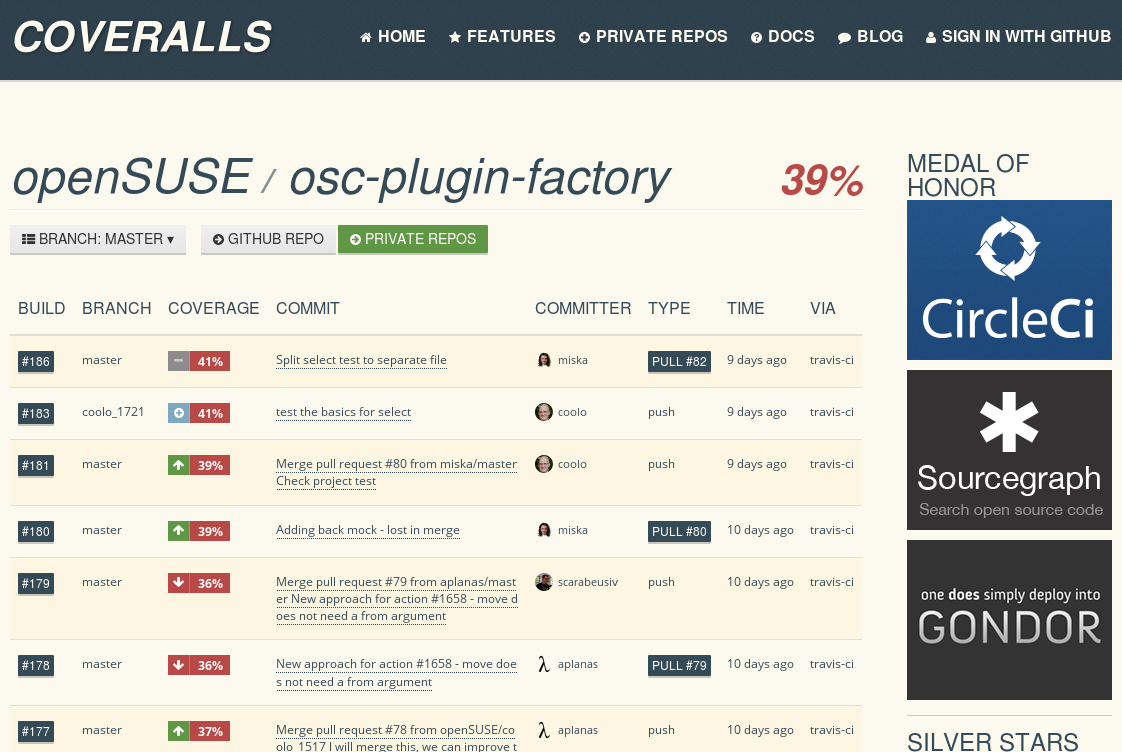
coveralls in action
Helping openQA
In openQA, currently we have code cleaning tasks. It’s about polishing the code we have – like removing useless index controller and fixing code highlighting. Or doing simple optimizations – like caching image thumbnails.
In case of openQA, you might be a little confused where to send your code. We have been doing some short and mid term planning with Bernhard M. Wiedemann, the man behind openqa.opensuse.org and one of the original openQA developers, together with Dominik Heidler. Now the code considered to be ‘upstream’ have been moved to several repositories under the os-autoinst organization in github. This code contains all the improvements introduced to extensivelly test our beloved openSUSE 13.1. The next generation of the tool is being developed right now in a separate repository and will be merged into upstream as soon as we feel confident enough, which means more automated testing, more staging deployments and more code revisions and audits. If you want to help us, you are welcome to send pull requests to either of those repositories and someone will take a look at them.
What next?
As we wrote, we are currently putting all our effort into openQA. We already have basic authentication and authorization, we are working on tests, fixing bugs and making sure the service in general is easy to deploy. And of course we are working toward our main goal – having a new openQA instance with all cool features available in public. Currently it is already kind of easy to get your own instance running, so if you are web or perl developer, nothing should stop you from playing with it and making it more awesome!

sudo authentication across sessions
Since I've been asked this recently, if you want to avoid typing your sudo password again after opening up another shell session (with konsole, gnome-terminal, screen or whatever), simply add the following to /etc/sudoers (use sudo visudo to modify the file): Read http://www.sudo.ws/sudoers.man.html for the details.

GMime gets a Speed Boost
In addition to other fixes that were in the queue, GMime 2.6.20 includes the "SIMD" optimization hack that I blogged about doing for MimeKit and I wanted to share the results. Below is a comparison of GMime 2.6.19 and 2.6.20 parsing the same 2GB mbox file on my 2011 Core-i5 iMac with the "persistent stream" option enabled on the GMimeParser:
[fejj@localhost gmime-2.6.19]$ ./gmime-mbox-parser really-big.mbox
Parsed 29792 messages in 5.15 seconds.
[fejj@localhost gmime-2.6.20]$ ./gmime-mbox-parser really-big.mbox
Parsed 29792 messages in 4.70 seconds.
That's a pretty respectable improvement. Interestingly, though, it's still not as fast as MimeKit utilizing Mono's LLVM backend:
[fejj@localhost MimeKit]$ mono --llvm ./mbox-parser.exe really-big.mbox
Parsed 29792 messages in 4.52 seconds.
Of course, to be fair, without the --llvm option, MimeKit doesn't fare quite so well:
[fejj@localhost MimeKit]$ mono ./mbox-parser.exe really-big.mbox
Parsed 29792 messages in 5.54 seconds.
I'm not sure what kind of optimizations LLVM utilizes when used from Mono vs clang (used to compile GMime via homebrew, which I suspect uses -O2), but nevertheless, it's still very impressive.
After talking with Rodrigo Kumpera from the Mono runtime team, it sounds like the --llvm option is essentially the -O2 optimizations minus a few of the options that cause problems with the Mono runtime, so effectively somewhere between -O1 and -O2.
I'd love to find out why MimeKit with the LLVM optimizer is faster than GMime compiled with clang (which also makes use of LLVM) with the same optimizations, but I think it'll be pretty hard to narrow down exactly because MimeKit isn't really a straight port of GMime (they are similar, but a lot of MimeKit is all-new in design and implementation).

GNOME.Asia summit 2014 - Call for The T-shirt Design Contest

The T-shirt Design Contest
Prizes
- Winner: A Special gift from local team and two t-shirts with your winning design
4.13 Beta 1 Workspaces, Platform and Applications for openSUSE: start the testing engines!
Yesterday KDE released their first beta of the upcoming 4.13 version of Workspaces, Applications and Development platform. As usual with the major releases from KDE, it’s packed with a lot of “good stuff”. Giving a list of all the improvements is daunting, however there are some key points that stand out:
-
Searching: KDE’s next generation semantic search is a prominent feature of this release. It’s several orders of magnitude faster, much leaner on memory and generally is a great improvement from the previous situation (this writer has been testing it for the past months and he’s absolutely delighted about it).
-
PIM: Aside with tight integration with the new search feature, KMail gained a new quick filter bar and search, many fixes in IMAP support (also thanks to the recent PIM sprint) and a brand new sieve editor.
-
Okular has a lot of new features (tabs, media handling and a magnifier)
-
A lot more ;)
Given all of this, could the openSUSE KDE team stay still? Of course not! Packages are available in the KDE:Distro:Factory repository (for openSUSE 13.1 and openSUSE Factory) as there are lot of changes and need more testing. The final release will be provided also in the KDE:Relase413 repository (which will be created then).
Some notes on the search changes: you will need to migrate existing data from Nepomuk (should you want to: it’s optional). You can do that by running “nepomukbaloomigrator” when Nepomuk is running: it will automatically migrate your data and switch off the old system (virtuoso-t included). Also bear in mind that since the old Nepomuk support is considered “legacy” (but still provided), the programs that have not yet been ported to the new architecture have their Nepomuk integration disabled. One significant regression is file-activity linking, which will not work.
As usual, this is an unstable release and it is only meant for testing. Don’t use this in production environments! If you encounter a bug, if it is packaging related use Novell’s Bugzilla, otherwise head to bugs.kde.org. Also, before reporting anything, please check out the Beta section of the KDE Community Forums first.
That’s all, enjoy this new release!
Short report from Installfest 2014 Prague
 This week, Michal and Tomáš write about their visit of the Installfest 2014 in Prague.
Installfest Prague is a local conference that despite it’s name has talk tracks and sometime even quite technical topics. We, Michal Hrušecký and Tomáš Chvátal, attended this event and spread the Geeko News around…
Linux for beginners workshop
Tomáš worked with local community member Amy Winston to show that our lovely openSUSE 13.1 is great for day-to-day usage, even (or especially) for people migrating from windows. We demonstrated KDE’s Plasma Desktop, how to use YaST to achieve common tasks and then asked the audience for specific requests about things to demonstrate. We can tell you the participants liked Steam a lot! Apart from the talking about and demonstrating openSUSE we also explained people that SUSE is selling SLE and they can buy it in the store if they want a rock-solid stable OS.
The workshop setup was a bit tricky because the machines didn’t have optical drives and we didn’t have enough usb sticks to work around the issue. Our solution was to boot up the ISO directly from PXE server and force NetworkManager to not start during the boot because it happily overwrote the network configuration and thus loosing the ISO it was booting from.
Factory workflow presentation
Over the last months, our team has been working on improving the way we develop openSUSE: theF Factory Workflow. You can read up on it in earlier blogs here. During the Installfest, we showcased our new workflow which uses openQA and staging projects. We discussed what we try to achieve what we can already do right now with osc/obs/openQA combo. People were quite enthusiastic and two people in the audience already used Factory!
As always we mentioned that we have Easy hacks and we really really want people to work on them.
Overall SUSE presence
openSUSE/SUSE presence was as usual high on this event so we tried our best to let people know that we are cool as project and great as company. We shared with everyone our openSUSE/SLE dvds, posters, stickers, … During the talks/workshops we also gave out SUSE swag as presents to people who answered some tricky questions.
Job offerings
We let everyone know that we are looking for plenty of new people in various departements. Namely QA/QAM to which few people got interested and took the printed out prospects. So hopefully our teams will grow 
Dynamic iptables port-forwarding for NAT-ed libvirt networks
Libvirt is particularly awesome when it comes to managing virtual machines, their underlying storage and networks. However, if you happen to use NAT-ed networking and want to allow external access to services offered by your VMs, you've got to do some manual work. The simplest way to get access is to set up some iptables … Continue reading Dynamic iptables port-forwarding for NAT-ed libvirt networks
The Raspberry Pi, en route to becoming a proper open platform.
Given that I was the one to poke a rather big hole in the Raspberry Pi image a year and a half ago, and since i have been playing a bit of a role in freeing ARM GPUs these last few years, I thought I'd say a few words on how I see things, and why I said what I said back then, and why I didn't say other things.
It has become a bit of a long read, but this it's a eventful story that spans about two years.
Getting acquainted.
I talked about the lima driver at linuxtag in may 2012. As my contract work wasn't going any where real, I spent two weeks of codethink time (well, it's not as if I ever did spent just 8h per day working on lima) on getting the next step working with lima, so I had something nice to demo at Linuxtag. During that bringup, I got asked to form a plan of attack for freeing the Raspberry Pi GPU, for a big potential customer. Just after my lima talk at the conference, I downloaded some code and images through the linuxtag wifi, and set about finding the shader compiler on the train on the way back.I am not one for big micro-managed teams where constant communication is required. I am very big on structure and on finding natural boundaries (which is why you have the term modesetting and the structured approach to developing display drivers today). I tend to split up a massive task along those natural boundaries, and then have clued folks take full control and responsibility of those big tough subtasks. This is why I split the massive task of REing a GPU between the command stream side and the shader compiler. This is the plan of attack that I had formed in the first half of 2011 for Mali (which we are still sticking to today), and I was of course looking to repeat that for the RPi.
On the train, I disassembled glCompileShader from the VideoCore userspace binary, and found the code to be doing surprisingly little. It quickly went down to some routines which were used by pretty much all gl and egl calls. And those lower routines were basically taking in some ids and some data, and then passing it to the kernel. A look at the kernel code then told me that there was nothing but passing data through happening at that side...
There was nothing real going on, as all the nifty bits were running somewhere else.
In the next few days, I talked to some advanced RPi users on IRC, and we figured out that even the bootloader runs on the Videocore and that that brings up the ARM core. A look at the 3 different binary blobs, for 3 different memory divisions between the ARM and the VideoCore, revealed that they were raw blobs, running directly on the videocore. Strings were very clearly visible, and what was immediately clear is that it was mostly differences in addresses between the 3 blobs. Apart from the addresses, nothing was immediately apparent, apart from the fact that even display code was done by the Videocore. I confirmed with Ben Brewer, who was then working on the shaders for Lima, and who has a processor design background.
The news therefor wasn't good. The Raspberry Pi is a completely closed system with a massive black box pulling all the strings. But at least it is consistently closed, and there is only limited scope for making userspace and 'The Blob' getting out of sync, unlike the PowerVR, where userspace, kernel and microcode are almost impossible to keep in sync.
So I wrote up the proposal for the potential customer (you know who you are), basically a few manmonths of busywork (my optimistic estimate doubled, and then doubled again, as I never do manage to keep my own optimistic timelines) to free the userspace shim, and a potential month for Ben for poking at the videocore blobs. Of course, I never heard back from codethink sales, which was expected with news that was this bad.
I decided to stay silent about the Raspberry Pi being such a closed system, at least for a few weeks. For once, this customer was trying to do The Right Thing by talking to the right people, instead of just making big statements, no matter what damage they cause or what morals they breach. I ended up being quite busy in the next few months and I kind of forgot about making some noise. This came back to haunt me later on.
The noise.
So on oktober 24th of 2012, the big announcement came. Here is the excerpt that I find striking:"[...] the Raspberry Pi is the first ARM-based multimedia SoC with fully-functional, vendor-provided (as opposed to partial, reverse engineered) fully open-source drivers, and that Broadcom is the first vendor to open their mobile GPU drivers up in this way. We at the Raspberry Pi Foundation hope to see others follow."While the text of the announcement judiciously talks about "userland" and "VideoCore driver code which runs on the ARM", it all goes massively downhill with the above excerpt. Together wit the massive cheering coming from the seemingly very religious RPi community, the fact that the RPis SoC was a massively closed system was completely drowned out.
Sure, this release was a very good step in the right direction. It allowed people to port and properly maintain the RPi userspace drivers, and took away a lot of the overhead for integration. But the above statement very deliberately brushed the truth about the BCM2835 SoC under the carpet, and then went on to brashly call for other vendors to follow suit, even though those others had chosen very different paths in their system design, and did not depend on a massive all-controlling black box.
I was appalled. Why was this message so deliberately crafted in what should be a very open project? How could people be so shortsighted and not see the truth, even with the sourcecode available?
What was even worse was the secondary message here. To me, it stated "we are perfectly happy with the big binary blob pulling the strings in the background". And with their call to other vendors, they pretty much told them: "keep the real work closed, but create an artificial shim to aid porting!". Not good.
So I went and talked to the other guys on the #lima channel on irc. The feeling amongst the folks in our channel was pretty uniform one of disgust. At first glance, this post looked as a clear and loud message to support open drivers, it only looked like that on the absolute surface. Anyone who would dig slightly deeper would soon see the truth, and the message would turn into "Keep the blob guys!".
It was clear that this message from the RPi foundation was not helping the cause of freeing ARM GPUs at all. So I decided to react to this announcement.
The shouting
So I decided to go post in the broadcom forums, and this is what I wrote:Erm… Isn’t all the magic in the videocore blob? Isn’t the userland code you just made available the simple shim that passes messages and data back and forth to the huge blob running on the highly proprietary videocore dsp? – the developer of the lima driver.Given the specific way in which the original RPI foundation announcement was written, i had expected all from the RPI foundation itself to know quite clearly that this was indeed just the shim driver. The reminder of me being the lima driver developer, should've taken away any doubt about me actually knowing what i was talking about. But sadly, these assumptions were proven quite wrong when Liz Upton replied:
No.

There’s some microcode in the Videocore – not something you should confuse with an
ARM-side blob, which could actually prevent you from understanding or modifying
anything that your computer does. That microcode is effectively firmware.
She really had no idea to what extent the videocore was running the show, and then happily went and argued with someone whom most people would label an industry expert. Quite astounding.
Things of course went further downhill from there, with several RPI users showing themselves from their best side. Although I did like the comment about ATI and ATOMBIOS, some people at least hadn't forgotten that nasty story.
All-in-all, this was truly astounding stuff, and it didn't help my feeling that the RPI foundation was not really intending to do The Right Thing, but instead was more about making noise, under the guise of marketing. None of this was helping ARM GPUs or ARM userspace blobs in any way.
More shouting
What happened next was also bad. Instead of sticking to the facts, Dave Airlie went and posted this blog entry, reducing himself to the level of Miss Upton.A few excerpts:
"Why is this not like other firmware (AMD/NVIDIA etc)?
The firmware we ship on AMD and nvidia via nouveau isn't directly controlling the GPU
shader cores. It mostly does ancillary tasks like power management and CPU offloading.
There are some firmwares for video decoding that would start to fall into the same
category as this stuff. So if you want to add a new 3D feature to the AMD gpu driver
you can just write code to do it, not so with the rPI driver stack."
"Will this mean the broadcom kernel driver will get merged?
No.

This is like Ethernet cards with TCP offload, where the full TCP/IP stack is run on the
Ethernet card firmware. These cards seem like a good plan until you find bugs in their
firmware stack or find out their TCP/IP implementation isn't actually any good. The same
problem will occur with this. I would take bets the GLES implementation sucks, because
they all do, but the whole point of open sourcing something is to allow other to improve
it something that can't be done in this case."
Amazing stuff.
First of all, with the videocore being responsible for booting the bcm2835, and the bcm2835 already being a supported platform in the linux kernel (as of version 3.7), all the damage had been done already. Refusing yet another tiny message passing driver, which has a massive user-base and which will see a lot of testing, then is rather short-sighted. Especially since this would have made it much easier for the massive RPI userbase to use the upstream kernel.
Then there is the fact that this supposed kernel driver would not be a drm driver. It's simply not up to the self-appointed drm maintainer to either accept or refuse this.
And to finish off, a few years ago, Dave forked RadeonHD driver code to create a driver that did things the ATI way (read: much less free, much more dependent on bios bytecode, and with many other corners being implemented the broken ATI way), wasted loads of AMD money, stopped register documentation from coming out, and generally made sure that fglrx still rules supreme today. And all of this for just "marketing reasons", namely the ability to make trump SuSE with noise. With a history like that, you just cannot go and claim the moral high ground on anything anymore.
Like I've stated before, open source software is about making noise, and Dave his blog entry was nothing more and nothing less. Noise breeds more noise in our parts. This is why I decided to not provide a full and proper analysis of the situation back then, as we had lowered ourselves to the level that the RPI foundation had chosen, and nothing I could have said would've improved on that.
Redemption
I received an email from Eben Upton last friday, where he pointed out the big news. I replied that I would have to take a thorough look first, but then also stated that I didn't expect Eben to email me if this hadn't been the real thing. I then congratulated him extensively.And congratulations really are in order here.
The Raspberry PI is a global sales phenomenon. It created a whole new market, a space where devices like the Cubieboard and Olimex boards also are in now. It made ARM development boards accessible and affordable, and put a linux on ARM in the hands of 2.5 million people. It is so big that the original goal of the Raspberry Pi, namely that of education, is kind of drowned out. But just the fact that so many of these devices were sold already, will have a bigger educational impact than any direct action towards that goal. This gives the RPI foundation a massive amount of power, so much so, that even the most closed SoC around is being opened now.
But in Oktober of 2012, my understanding was that the RPI foundation wasn't interested in wielding that power to reach those goals which I and many others hold dear. And I was really surprised when it now was revealed that they did, as I had personally given up on this ever happening, and I had assumed that the RPI foundation was not intending to go all the way.
What's there?
After the email from Eben, I joined the #raspberrypi-internals channel on freenode to ask the guys who are REing the VideoCore, to get an expert opinion from those actually working on the hardware.So what has appeared:
* A user manual for the 3D core.
* Some sample code for a different SoC, but code which which runs on the ARM core and not on the videocore.
* This sample code includes some interesting headers which helps the guys who are REing the Videocore.
* There's a big promise of releasing more about the Videocore and at least providing a properly free bootloader.
These GPU docs and code not only means that Broadcom has beaten ARM, Qualcomm, Nvidia, Vivante and Imagination technologies to the post, it also makes broadcom second only to Intel. (yes, in front of AMD, or should I say ATI, as ATI has run most of the show since 2008).
Then there is the extra info on the videocore and the promise of a fully free bootloader. Yes, there still is the massive dependance on the VideoCore for doing all sorts of important SoC things, but releasing this information takes time, especially since this was not part of the original SoC release process and it has to be made up for afterwards. The future is looking bright for this SoC though, and we really might get to a point where the heavily VideoCore based BCM2835 SoC becomes one of the most open SoCs around.
Today though, the BCM2835 still doesn't hold a candle to the likes of the Allwinner A10 with regards to openness. But the mid to long term difference is that most of Allwinners openness so far was accidental (they are just now starting to directly cooperate with the linux-sunxi community), and Allwinner doesn't own all the IP used in their SoC (ARM owns the GPU for instance, and it is being a big old embedded dinosaur about it too). The RPI SoC not only has very active backing from the SoC vendor, that SoC vendor also happens to be the full owner of the IP at the same time.
The RPI future looks really bright!
Whining.
I do not like the 10k bounty on getting Q3A going with the freshly released code. I do not think this is the best way to get a solid gpu driver out, as it mostly encourages a single person to make a quick and dirty port of the freshly released code. I would've preferred to have seen someone from the RPI foundation create a kanban with clearly defined goals, and then let the community work off the different work items, after which those work-items are graded and rewarded. But then, it's the RPI foundations money, and this bounty is a positive action overall.I am more worried about something else. With the bounty and with the promise of a free bootloader, the crazy guys who are REing the VideoCore get demotivated twice. This 10k bounty rules them out, as it calls for someone to do a quick and dirty hack, and not for long hard labour towards The Right Thing. The promise of a free bootloader might make their current work superfluous, and has the potential to halt REing work altogether. These guys are working on something which is or was at least an order of magnitude harder than what the normal GPU REing projects have or had to deal with. I truly hope that they get some direct encouragement and support from the RPI foundation, and that both parties work together on getting the rest of the VideoCore free.
All in all, this Broadcom release is the best news I have heard since I started on the open ARM GPU path, it actually is the best news I've had since AMD accepted our proposal to free the ATI Radeon (back in june 2007). This release fully makes up for the bad communication of Oktober 2012, and has opened the door to making the BCM2835 the most free SoC out there.
So to Eben and the rest of the guys from the RPI Foundation: Well done! You made us all very happy and proud.
Monitor large file transfers with iostat
# iostat -mx 1
It will show you I/O performance statistics for your box, updated approximately once per second.