
openSUSE Asia Summit Pre-Schedule Is Now Available
openSUSE.Asia Summit 2026 Pre-Schedule Is Now Available
Hello Geeko!
After a long selection process, the openSUSE.Asia Summit 2026 Organizing Committee is pleased to announce that the Pre-Schedule is now available!
This year, we received 114 proposals from 85 speakers, making the selection process both exciting and challenging. We are grateful to everyone who shared their ideas and contributed to the program.
Curious about what will be presented at the summit? Explore the sessions and start planning which talks and workshops you would like to attend.
View the openSUSE.Asia Summit 2026 Schedule
Important Note
This is a preliminary schedule. Some changes to session times, rooms, speakers, or the overall program may still occur before the conference. We will share further updates as the schedule is finalized.
We look forward to welcoming the openSUSE and open source communities to Yogyakarta, Indonesia, on 3–4 October 2026.
See you at the summit!

 Member
 Futureboy
Linux Saloon 216 | Open Mic Night
openSUSE Kudos Recognitions for July 2026
Welcome to our monthly report from the openSUSE Kudos recognition platform, where we take a moment to put a spotlight on the people who stepped up, helped others, and made this community a little brighter.
During 1-31 July 2026, 4 users received 4 kudos, and 4 badges were awarded to 3 contributors.
Badges
- Got First Kudo: @bmwiedemann, @dgarcia, @voztuzun
- First Kudos Given: @voztuzun
Congrats on your badges!
Kudos
@lkocman -> @bmwiedemann for Code & Engineering “Thank you for your quick help with Leap 16.0 respin torrents Bernhard! strong” (view recognition)
@lkocman -> @dgarcia for Code & Engineering “Many thanks for your work and creativity at fixing the beets CVE. Thanks to your extra steps we could avoid update of the problematic python-numpy. Community really appreciates your help Daniel!” (view recognition)
@lkocman -> @voztuzun for Code & Engineering “Many thanks for helping me out with the cecpes and python-requests-gssapi updates Volkan! Your quick help was very much appreciated!” (view recognition)
@voztuzun -> @lkocman for Code & Engineering “Thank you Lubos!!!! Please come to the next concert!” (view recognition)
Thank you to everyone who made this period so active and welcoming. The community is strongest when we notice each other’s work and celebrate it openly.
Generated by kudos-bot-news-o-o from https://kudos.opensuse.org/api/reports/monthly for the period 1-31 July 2026.

GSoC 2026 Final Report: Enhancing openSUSE Git Workflow
- Student: Mario Marín Hinojosa (GitHub • openSUSE Gitea • LinkedIn)
- Organization: openSUSE Project (Large, ~350h)
- Mentor: Daniel García Moreno (@dgarcia)
-
Repository:
git-workflow/autogits(Proposal #253)
1. Project Overview & Objectives
In openSUSE, package maintainers rely on the Open Build Service (OBS) to build software packages across multiple distributions and architectures. The autogits repository hosts core automation services for openSUSE’s Gitea forge (src.opensuse.org), including obs-status-service, a Go service deployed at br.opensuse.org that renders build results as SVG badges and matrices for repository READMEs and pull requests.
Proposal Goals & Evolution
The main goal of the proposal was to modernize obs-status-service to make OBS build results more accessible and visually integrated into Gitea.
During the coding period, together with my mentor, we prioritized:
-
Refactoring the core engine: Replacing legacy manual XML/SVG string concatenation with modular Go
text/templatearchitecture. - Modern UI & Theming: Incorporating native Gitea light/dark CSS variables and responsive dimensions.
-
Scalability & Performance: Optimizing rendering for large distributions with thousands of packages like
openSUSE:Factoryby introducing aggregated Repository Summaries (?mode=repos) and Project Progress Bars (?mode=bars). - Real-time Interactivity: Investigating browser SVG execution environments and creating a client-side polling prototype.
- Ecosystem & Upstream Work: Contributing UI improvements directly to upstream Gitea.
2. Deliverables & Technical Achievements
Pre-GSoC Tooling & Developer Experience
-
Offline Mock Test Mode (PR #118 - Merged): Created a
RedisClientinterface mocking strategy loading compressed OBS data (factory.results.json.bz2), enabling offline local testing via the--test-runflag. - Interactive Link Builder (PR #119 - Merged): Replaced the root 404 handler with an interactive Pico CSS web UI that generates direct badge URLs, live SVG previews, and ready-to-copy Markdown snippets.
Core Architecture & Template Engine
-
Go
text/template&go:embed(PR #364 - Merged): Replaced manual string formatting with modular, embedded templates (shared.tmpl,status-badge.tmpl,package-summary.tmpl,project-summary.tmpl,project-matrix.tmpl) with explicit XML data escaping and matrix integration tests.
Theming, Responsiveness & Scalability
-
Native Gitea Theming (PR #402 - Merged): Extracted official Gitea light/dark theme CSS variables and resolved
:rootselector styling bugs inside SVG containers. -
Responsive Compact Mode (PR #402 - Merged): Added
?compact=true|false|autowith 90° rotated headers and square indicator cells for wide matrices. -
Repository Summary View (PR #451 - Merged): Implemented
?mode=reposto aggregate builds by repository and architecture, providing a fast and lightweight overview for large distributions likeopenSUSE:Factory. -
Project Progress Bars & Unified API (PR #462 - Merged): Added
?mode=barsand unified visualization query endpoints under a clean?mode=parameter (repos,bars,compact,matrix). Fixed link targets withtarget="_top".
Before (Legacy String Concatenation):

After (Go Templates & Native Gitea Theme):

Real-Time SVG Interactivity & Polling
-
Browser Security & Execution Research (
test-js): Tested SVG script execution across browser contexts (<img>sandboxes scripts, while<object>tags execute JavaScript in trusted Gitea contexts). -
Throttled Polling Prototype (PR #487 - In Review): Embedded client-side JavaScript in SVG templates that uses throttled
setTimeoutpolling against JSON endpoints (Accept: application/json) to update badge text and CSS classes in real time without page reloads.
Upstream Gitea Contributions
-
Reputation Labels Frontend (Commit 1e5a39c - Proposal / Initial Implementation): Implemented an initial proposal and frontend implementation for user and organization reputation badges across profile headers and explore pages (
/explore/users,/explore/organizations).
3. Pull Requests & Code Contributions
Primary Repository (git-workflow/autogits)
| PR | Title | Status | Description |
|---|---|---|---|
| #118 | Implement initial test-run option (#113) |
Merged | Mock Redis client and --test-run mode with realistic test data. |
| #119 | Add default landing page with link builder (#114) |
Merged | Root / interactive badge builder UI and Markdown generator. |
| #364 | refactor(obs-status-service): migrate SVG rendering to templates |
Merged | Migration to Go text/template architecture with go:embed. |
| #402 | feat: responsive compact mode, layout fixes & Gitea theming |
Merged | Gitea light/dark colors, dynamic column sizing, and compact view. |
| #451 | feat: Restore Project Matrix SVGs and fix bugs |
Merged | SVG CSS selector fixes, link targets, and repository summaries. |
| #455 | svg_fixes |
In Review | SVG fixes and enhancements branch consolidating recent updates. |
| #462 | feat: Use '?mode=' param for SVG visualizations |
Merged | Unified ?mode= API (repos, bars, compact, matrix). |
| #487 | feat: dynamic SVG status badge polling and DOM updates |
In Review | Real-time client-side polling with throttled setTimeout. |
Upstream & Research Repositories
| Item | Repository | Status | Description |
|---|---|---|---|
| Commit 1e5a39c | mmarhin/gitea |
Proposal | Initial implementation of frontend reputation labels in profiles and explore views. |
| test-js | mmarhin/test-js |
Completed | SVG JavaScript execution testbed across browser contexts. |
4. openSUSE Conference 2026 Presentation
During the program, I was invited to attend the openSUSE Conference 2026 (oSC26) in Nuremberg. I delivered a 4-minute lightning talk showcasing the project architecture, SVG modernization, and real-time status updates, and had the chance to meet and connect in personal with the openSUSE team and community.
- Talk Recording: Watch the Lightning Talk on YouTube (4:02 mark)

Lightning talk at openSUSE Conference 2026

openSUSE Conference 2026 group photo in Nuremberg
5. Current State & Future Work
-
Current Status: All primary milestones are completed, tested, and deployed in production on
br.opensuse.org, rendering live template-based SVG build status and repository matrices across openSUSE repositories. The consolidated enhancements are merged, alongside the dynamic polling prototype (PR #487). -
Next Steps:
- Extend real-time client-side polling to project matrix and repository summary views.
- Integrate structured build status summaries into automated Gitea PR comment bots.
- Explore Log Detective integration for automated build failure triage in pull requests.
6. Acknowledgments
I would like to express my deepest gratitude to my mentor Daniel García Moreno (@dgarcia) for his constant mentorship, code reviews, and architectural guidance throughout the summer.
A special thanks to Adam (@adamm), maintainer of the autogits repository, for his valuable feedback and insights on scaling the service for large OBS distributions like openSUSE:Factory.
Finally, thank you to the openSUSE Community and Google Summer of Code for this incredible opportunity.
Tumbleweed – Review of the week 2026/33
Dear Tumbleweed users and hackers,
This week saw the release of 4 snapshots (0806, 0809, 0811, and 0812).
Notable updates include the release of KDE Plasma 6.7.4 in snapshot 0809, delivering the latest bugfix release. In the same snapshot, GDM 50.2 was delivered to address security concerns, including a path traversal vulnerability where a compromised greeter could load arbitrary .desktop files via SelectSession, and an autologin bypass.
For system libraries and services, Mesa 26.2.0 was delivered in snapshot 0812. OpenSSH 10.5p1 also arrived in 0812, which now requires ECC (Elliptic Curve Cryptography) support in libcrypto for its portable build. Meanwhile, snapshot 0811 delivered OpenVPN 2.7.5 with multiple security fixes and built-in Data Channel Offload (DCO) support.
Several other critical security fixes were integrated this week. Dracut was updated to version 112+suse.29.gc0c5e1d to patch a root code execution vulnerability (CVE-2026-15816) in the emergency hook script path. Python-cryptography 50.0.0 also landed in snapshot 0806 to resolve an RSA decryption vulnerability (CVE-2026-69247). Additionally, the toolchain was updated with GCC 16.2.0, and the Linux kernel moved from 7.1.7 in snapshot 0809 to 7.1.8 in snapshot 0812.
These 4 snapshots delivered the following updates:
- aws-lc 5.5.0
- dracut 112+suse.29.gc0c5e1d
- gcc16 16.2.0
- gdm 50.2
- gnome-control-center 50.4
- gnome-shell 50.4
- gstreamer 1.28.6
- harfbuzz 14.3.0
- KDE Plasma 6.7.4
- libadwaita 1.9.3
- libostree 2026.3
- libpsl 0.23.2
- LibreOffice 26.2.5.2
- Linux kernel 7.1.7 & 7.1.8
- Mesa 26.2.0
- mutter 50.4
- ncurses 6.6.20260808
- openssh 10.5p1
- openvpn 2.7.5
- python-anyio 4.14.2
- python-charset-normalizer 3.4.9
- python-cryptography 50.0.0
- python-pyOpenSSL 26.4.0
- shadow 4.20.2
- suitesparse 7.13.0
- udisks2 2.11.2
- usbredir 0.15.0
Looking beyond these releases, here is what is currently working its way through our staging areas as we look to the next week:
- glibc 2.44: Still progressing in staging with integration issues like rpmlint test failures (boo#1273686) and python-scipy build issues (boo#1273688) under active investigation.
- libnettle 4.0.0: Currently breaking libzypp’s test suite.
- Swig 4.5.0
- icewm 4.0: Undergoing testing, but currently experiencing redraw issues in combination with the YaST installer.
Planet News Roundup
This is a roundup of articles from the openSUSE community listed on planet.opensuse.org. This community blog feed aggregator lists the featured highlights below from August 7 to 13.
This week highlights Tumbleweed’s five snapshots. Podman 6.0.0, which now defaults rootless networking to pasta and drops legacy components like slirp4netns and CNI, was a key change. On the KDE side, registration opened for Akademy-es 2026 in Madrid and KStars 3.8.4 arrived with what the project calls the world’s first AI-powered guiding assistant. The openSUSE.Asia Summit 2026 also announced a change of venue in Yogyakarta, and the Agama Installer showed how any distribution can restyle the installer without touching a line of its code.
Here is a summary and links for each post:
A Mix of New Features in Plasma 6.7
The KDE Blog closes out its Plasma 6.7 series with the traditional grab-bag of smaller changes that never got their own post. Highlights include duplicating network connections, syncing mouse and stylus pointers, setting a preferred calendar application, shortcuts for push-to-talk mic muting, and mixed skin-tone emoji selection.
Qwen3.8-2.4T-A95B: Raising the Stakes in Frontier AI
Alessandro examines Alibaba’s newly released open-weights model, which pairs 2.4 trillion total parameters with roughly 95 billion active per token thanks to a Mixture of Experts design. His conclusion is that the real contest is shifting from who builds the biggest model to who turns that capacity into efficient, private, genuinely useful systems.
Registration Opens for Akademy-es 2026 in Madrid
The KDE Blog announces that free but mandatory registration is now open for Akademy-es 2026, held Oct. 23–25 at Camping Arco Iris in Villaviciosa de Odón. Key deadlines include Sept. 5 for accommodation assistance requests, Sept. 30 for booking a spot at the campsite, and Oct. 20 for general registration. The Call for Papers is still open until Sept. 3.
Help Number Research Find Numbers With This Bash Script
Victorhck shares a Bash script he wrote to automate submissions to Number Research Inc., a site attempting to catalogue every positive integer. The script asks where to start, submits numbers sequentially, skips ahead by 100 when a number is already claimed, and saves your position and statistics when you stop it with Ctrl+C.
KStars 3.8.4 Arrives With an AI Guiding Assistant
The KDE Blog covers the latest release of KDE’s planetarium and astrophotography suite, which introduces what the project calls the world’s first AI-powered guiding. The release also adds an MCP server for connecting any large language model to KStars, though currently with a limited subset of functions.
H.264 Playback Works, but CPU Usage Is High
The Geeko Blog of the Japanese openSUSE user group explains why high-resolution, high-framerate H.264 video can pin a CPU at 100 percent on a default install. openSUSE ships OpenH264, but the official gstreamer and VLC packages are built with x264 and hardware-decoder paths for H.264 disabled to avoid patent-related IP risk.
Get Agama Dressed for Success
The Agama Installer blog explains how any distribution can restyle the whole installer without touching a line of Agama code. A single CSS file named after the product id, plus logos, is enough to apply your colors, typeface and other styles across light and dark schemes while keeping the accessibility floor intact.
Venue Update for openSUSE.Asia Summit 2026
openSUSE News announces that the summit moves to the Convention Hall at Universitas Islam Negeri Sunan Kalijaga in Yogyakarta, replacing the previously announced TILC venue at Universitas Gadjah Mada. The change was made for technical and logistical reasons, and the same hall hosted the very first openSUSE.Asia Summit in Indonesia back in 2016. Dates remain Oct. 3–4, 2026, and already-registered participants need to take no action.
How to Blur Your Wallpaper in Plasma
The KDE Blog walks through blurred wallpaper by 2N-r, a wallpaper plugin that blurs or dims the desktop background whenever an application is not fullscreen. Options cover blur radius, dimming color, transition time, and disabling the effect for slideshows, and installation is a matter of picking Active Blur from Get New Stuff in the wallpaper settings.
An Alternative Taskbar for Your Desktop, Punchi Dock – Plasmoids for Plasma 6 (37)
The KDE Blog reaches widget number 37 in its plasmoid series with Punchi Dock by punchipunchi, a native launcher and task dock for Plasma 6 aimed primarily at Wayland. It works either as a floating dock or integrated into a Plasma panel, and offers window cards, live thumbnails, configurable folders, MPRIS media cards, and an optional PipeWire audio visualizer.
Linux Saloon 215 | Odyssey Linux
CubicleNate recaps another community episode of Linux Saloon, with participants trading experiences and opinions on various distributions, Void Linux in particular. The post gathers links to the resources mentioned during the stream. It also points to upcoming events such as Open Mic Night and to participant project links.
Linux Saloon 214 | Early Edition August
CubicleNate covers an early-edition episode ranging over hardware projects like the War Thunder sim rig and the perennial question of font management on Linux. News topics included the retirement of the “Father of the Internet,” Firefox updates, and the Steam Machine launch. Fedora governance changes also came up, alongside the usual list of resources and upcoming events.
UI Improvements Galore – This Week in Plasma
The KDE Blog translates Nate Graham’s weekly Plasma report, which this time leans heavily on usability polish. Plasma 6.8 now tells you when you try to print to an unavailable printer instead of silently doing nothing, and new user account creation warns clearly about invalid username characters.
Measuring Binary Function Coverage of openSUSE Integration Tests
Zoltán Balogh opens by being explicit about what his measurement is and is not. A typical Tumbleweed install carries roughly 2,600 ELF executables in /usr/bin and /usr/sbin, while the test repository holds 2,343 test modules. Coverage is measured on 141 of those binaries using 98 test modules, which he stresses is a fraction of the picture rather than the distribution’s total test coverage.
Diagonal Icons for Your PC
The KDE Blog presents Diagonal Icon theme by tamascsabi, a colourful set built around two-tone backgrounds split by a diagonal line. The design takes inspiration from popular sets such as Yaru, Evolvere and WhiteSur. It ships with an interactive POSIX-compliant installer that auto-detects distribution and window manager, works on Linux and BSD, supports customisable folder colours, and includes matching light and dark cursor themes.
Tumbleweed – Review of the Week 2026/32
Dominique Leuenberger and Victorhck report on five snapshots (0731, 0802, 0803, 0804, 0805), headlined by Podman 6.0.0 defaulting rootless networking to pasta and dropping cgroups v1, slirp4netns and CNI. shadow 4.20.0 removed the PASS_MIN_DAYS setting and the associated –mindays flags outright, so automated user-management scripts relying on them will now fail intentionally. Plasma 6 Workspace also switched SDDM to default to the Wayland session, while glibc 2.44, LibreOffice 20.2.5.2 and kernel 7.1.7 wait in staging.
Tiny Wins for Packagers: End-of-Week Update (2026-08-07)
The Open Build Service team publishes its weekly roundup of fixed issues, small features and minor releases. Shipped last week were OBS 2.10.34 with two security updates and osc 1.27.3, along with a long-awaited move to Rails 8.0.5.1. Other changes include dropping the updating and deleting BsRequest API, a fix to the /trigger API, and osc now erroring out on the deprecated apisrv option.
View more blogs or learn to publish your own on planet.opensuse.org.

Tiny Wins for Packagers: End-of-Week Update (2026-08-14)
Get Agama dressed for success
The announcement of Agama 22 described some of the novelties regarding the visual appearance and contained a sentence you may have overlooked. Along with new functionality like the dark mode, it came the machinery that lets any distribution ("product" in Agama's jargon) restyle the whole installer without touching a single line of Agama code. If you always wanted Agama to look a bit more like your favorite distribution, keep reading.
Customizing the Agama appearance is as easy as dropping in the right directories a single CSS file named after your product id and the corresponding logos. That is it. The installer picks that up and wears your colors, your logo, your typography and other styles. Including light and dark scheme and with the accessibility floor kept intact.
Describing that takes a paragraph, and we just spent it. So instead of describing it further, let's see it in action in two fully fictional scenarios.
A tale of two distros
Meet Lucie, a contributor to a Linux distribution that uses a color palette based on a nice shade of light blue and that is somehow related to another distribution that uses a nice hat as logo. Of course, any resemblance to reality is pure coincidence. 😉
Lucie wants to see how an Agama-based installation could look for her beloved distribution. One afternoon, she spends a few minutes creating a simple skin that defines the primary colors.
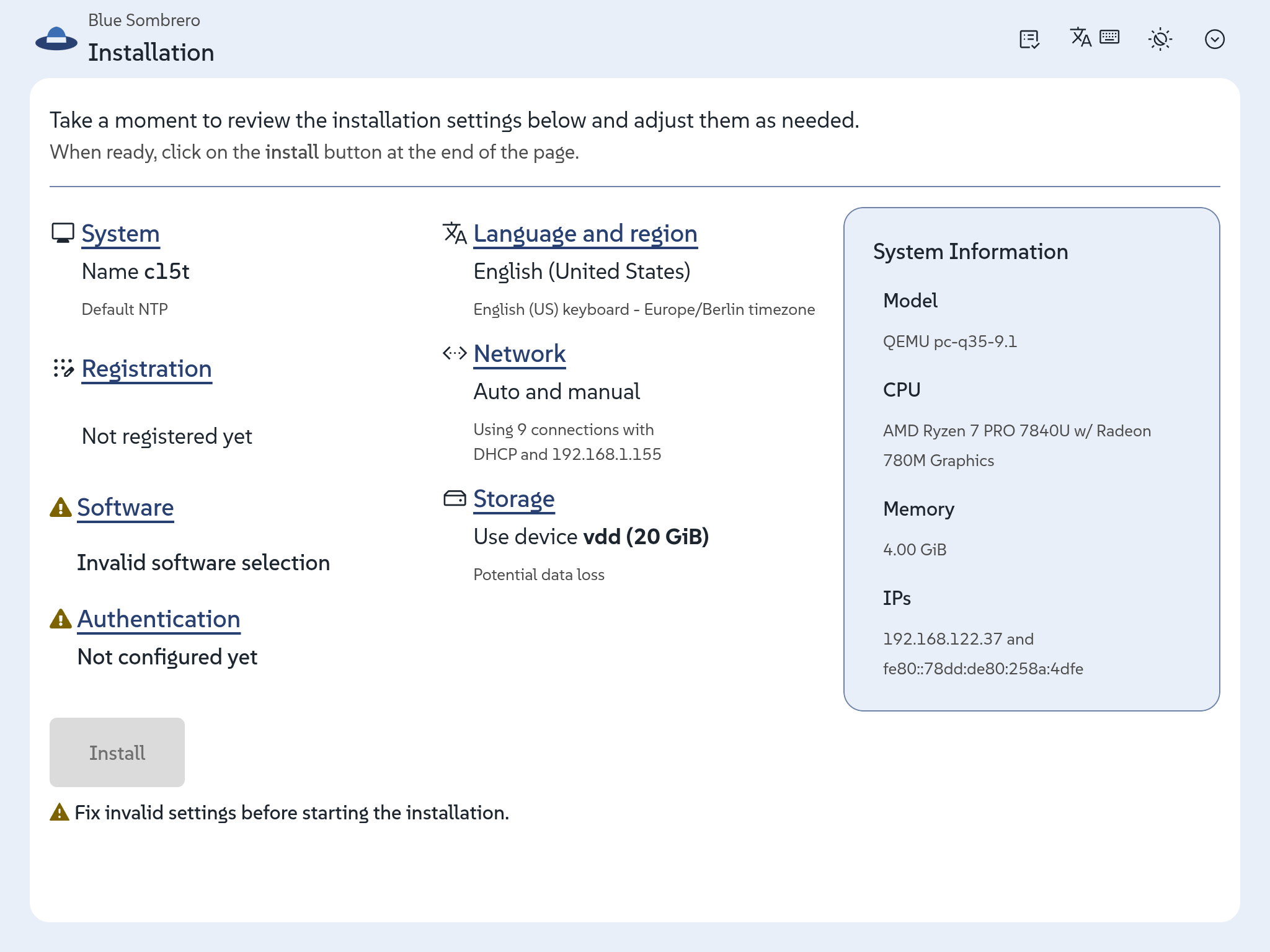
Then she realizes she also needs to adapt those colors for the dark scheme.
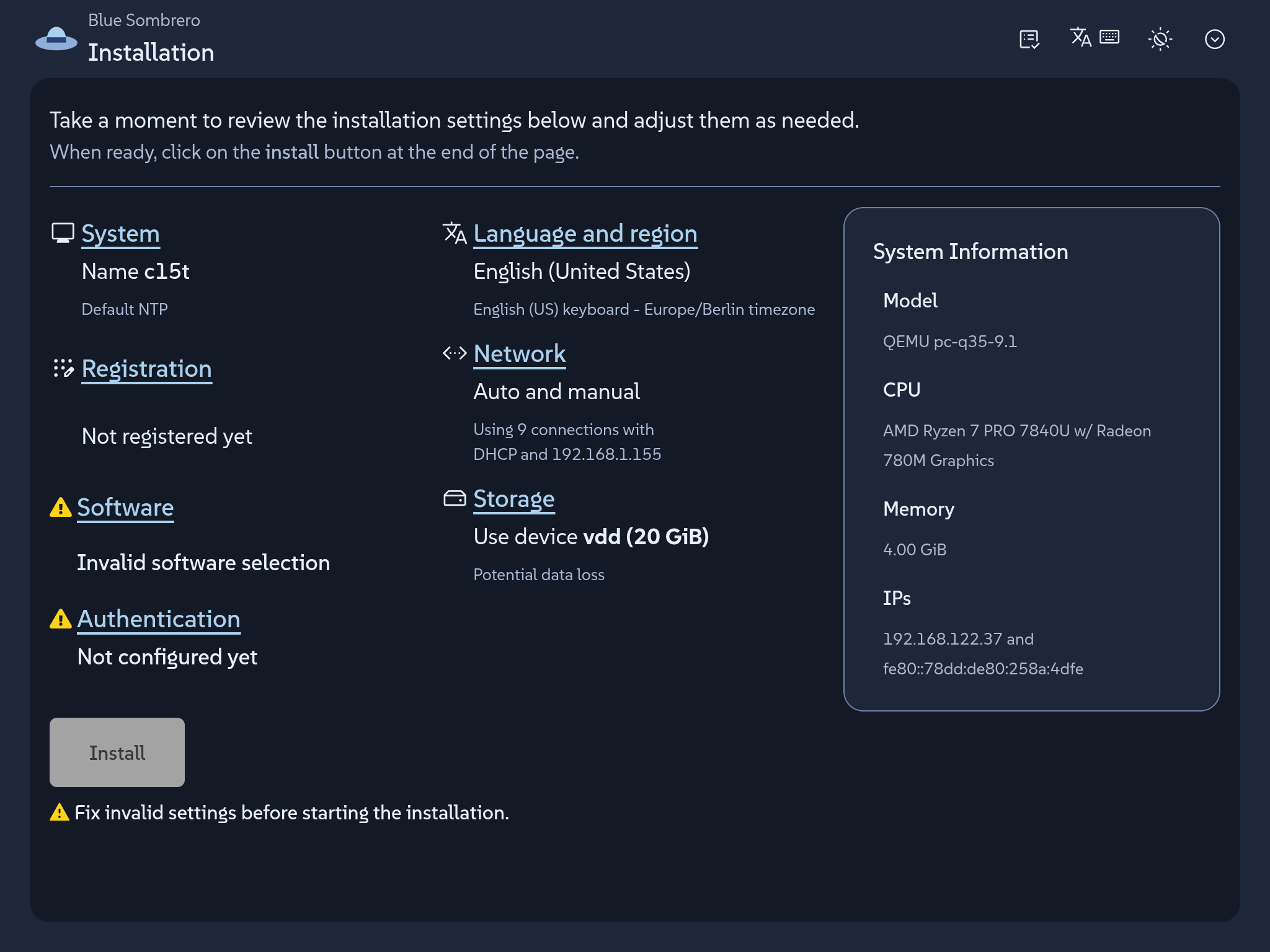
And that is. No need to define typeface, sizes, corners, etc. All of that stays at Agama's values, which still results in a quite nice installer that looks as a fully coherent product. Agama ships no product skin on its own, so Lucie's CSS file is not overriding anything; it is filling a gap that was intentional left for each product.
Now meet Charles. He develops his own respin of openSUSE Leap just for fun and he wants to see how far he can go in customizing Agama to his very own personal taste. What about some '80s vibe with big phosphor green letters on charcoal, a pixel typeface, every corner square, and a prompt caret for a logo?
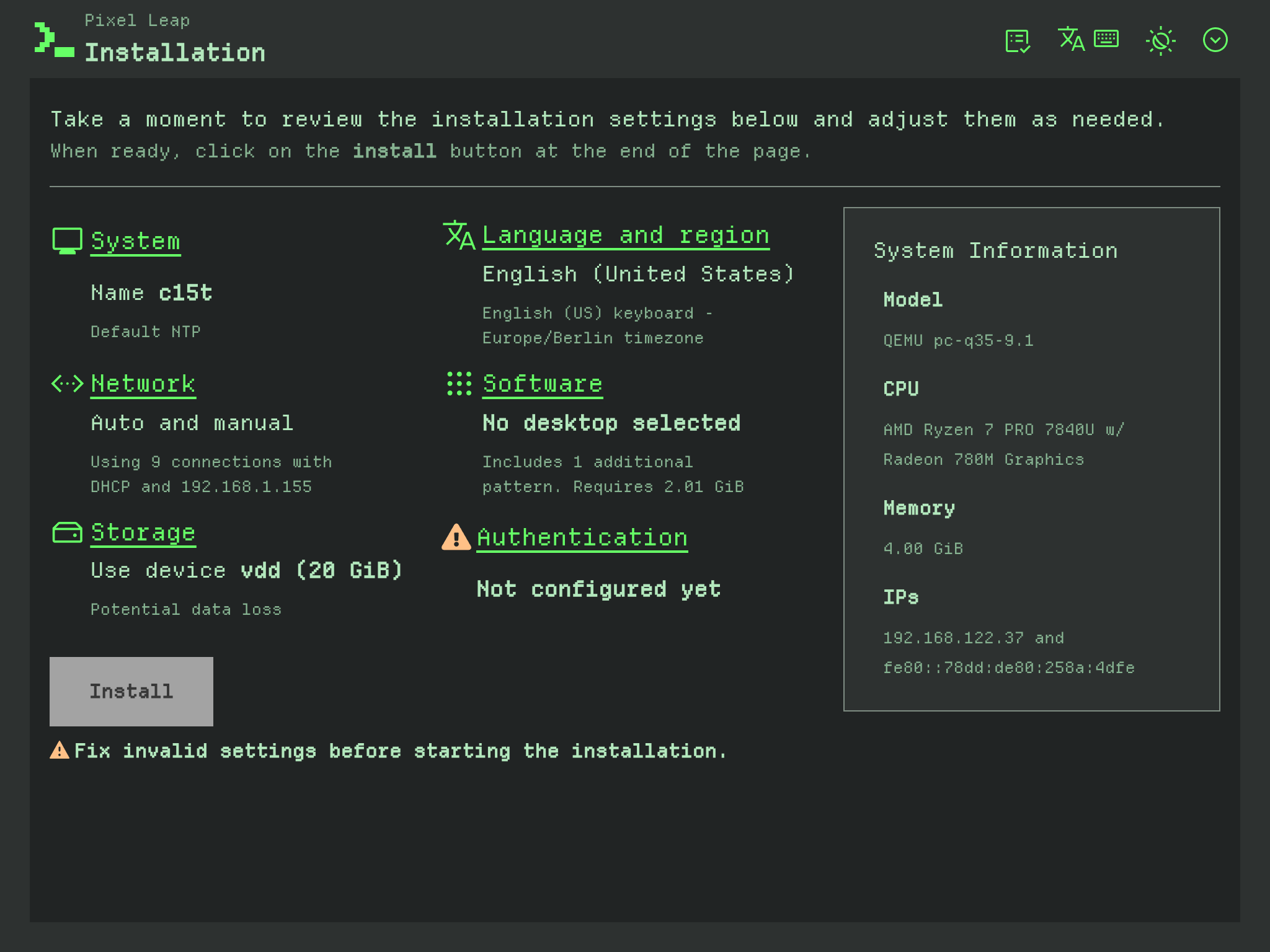
That is exactly how Charles envisioned the dark mode. But a proper skin also needs to take care of the light scheme. So after adjusting some colors he also comes with the following combination.
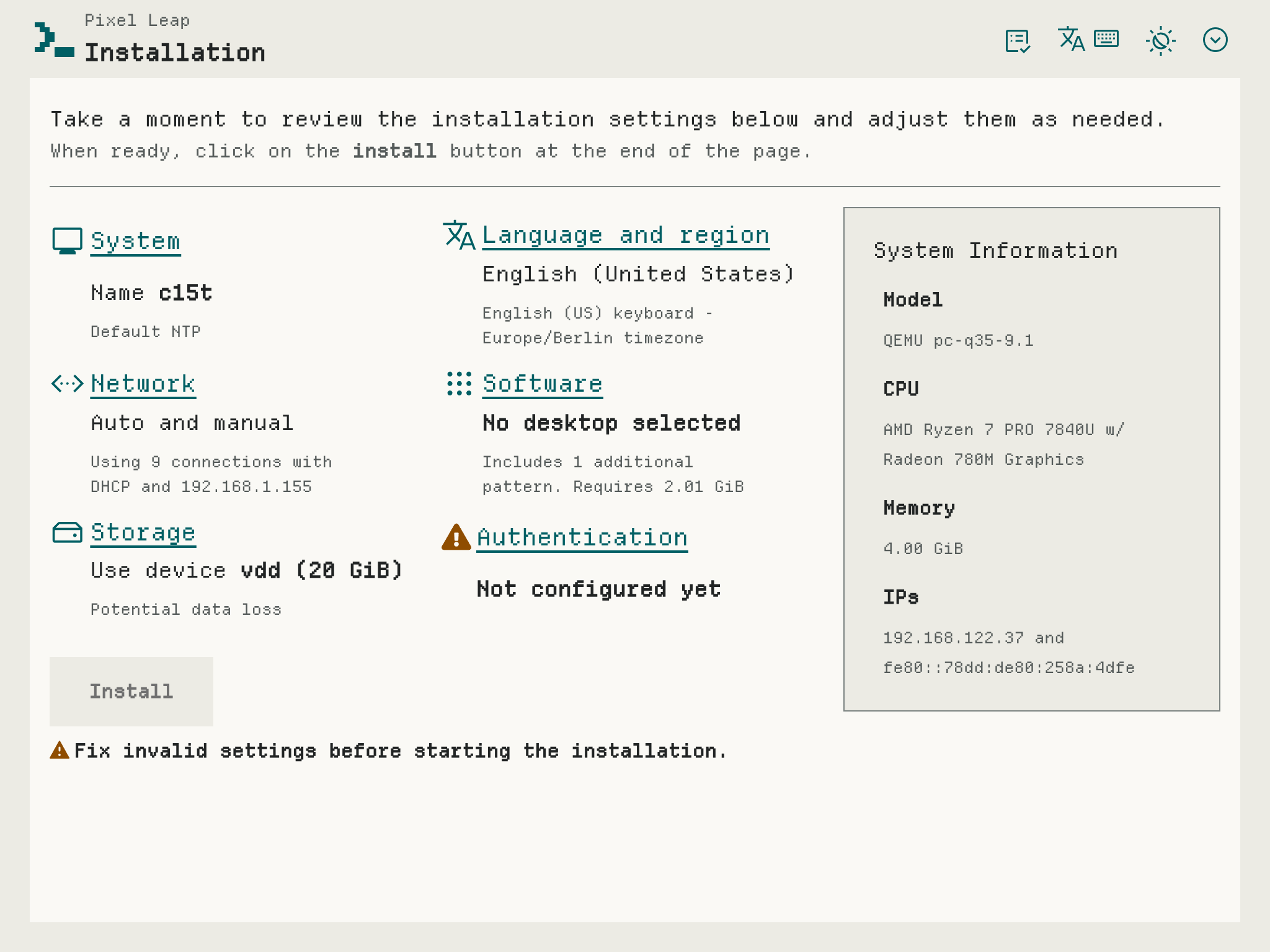
Two products, one shared set of customizable visual roles, and not a line of Agama code touched.
Learn how to do it
The work that matters happens before the CSS file is written: choosing the colors, deciding what each scheme should look like, checking that every pair actually reads on screen. Once those decisions exist, putting them in is the short part... no matter whether you are Lucie setting a few roles or Charles configuring every possible one.
But what "role" means in this context? A product stylesheet sets only properties named
--agm-t--something. Those are the so-called roles, named after what they mean in an installer: the
brand color, the page surface, the danger status, the focus ring.
/* Light theme. */


:root:where(:not(.pf-v6-theme-dark)) {


  --agm-t--brand--color: #3c6eb4;


  --agm-t--brand--text--color: #fff;


  --agm-t--link--color: #294172;


  --agm-t--surface--color--raised: #e8eff8;


  --agm-t--status--danger--color: #c42366;


}
There are relatively few roles to set, which is actually a very intentional feature. Instead of customizing any occurrence of a certain color in the UI, just say once "this is my brand color" and buttons, toggles, progress bars, selected rows and focus rings follow along.
All that is explained in the theming guide, that comes along with two ready-to-copy examples similar to the ones described above and even with a draft AI prompt in case you want to outsource the fun.
Then you only need to add a your logos, stylesheet and eventually fonts to the installer medium.
Those files travel to the medium in your own package, which is the part we like best: your branding
stays in your repository, versioned with the rest of your distribution, and ships on your schedule
rather than waiting for an Agama release. The
packaging guide walks
through it. It also includes a few things you may want to know, like how to make your installer
start in dark mode or how to preview the result without packaging anything by just copying two files
into a running installer (eg. over scp) and reloading the browser.
Have a lot of fun
We know that regular users do not usually create their own installable distributions, so the audience of this blog post may be a bit more restricted than those posts announcing new Agama versions. Nevertheless, we welcome any feedback including any personal exercise just for fun!
Meanwhile we will keep working on improving several aspects of the installer. As usual you can reach
out to us at the #yast channel at Libera.chat or the
Agama project at GitHub.
Venue Update for openSUSE.Asia Summit 2026
The openSUSE.Asia Summit 2026 Organizing Committee would like to announce an important update regarding the summit venue.
After careful consideration, openSUSE.Asia Summit 2026 will now take place at:
Convention Hall Universitas Islam Negeri (UIN) Sunan Kalijaga Yogyakarta, Special Region of Yogyakarta, Indonesia
This replaces the previously announced venue at the Teaching Industry Learning Center (TILC), Vocational School, Universitas Gadjah Mada (UGM).
This change has been made due to technical considerations identified during the event preparation process. Our priority is to ensure the summit runs smoothly and provides the best possible experience for attendees, speakers, sponsors, exhibitors, and volunteers.
We would like to express our sincere appreciation to Universitas Gadjah Mada for their support and cooperation throughout the planning process. The venue change was made solely due to technical and logistical considerations as we worked to ensure the best possible experience for all participants.
Interestingly, the Convention Hall at UIN Sunan Kalijaga also hosted the very first openSUSE.Asia Summit in Indonesia back in 2016. We are excited to return to a venue that has become part of the summit’s history.
The summit dates remain unchanged:
- October 3-4 2026 - Yogyakarta, Indonesia
The new venue provides the facilities needed to accommodate summit sessions, sponsor exhibitions, community activities, and networking opportunities throughout the two-day event.
Participants who have already registered do not need to take any action. Registration, tickets, and all scheduled activities will continue as planned, with only the venue being updated.
We would also like to express our sincere gratitude to Universitas Islam Negeri Sunan Kalijaga for welcoming openSUSE.Asia Summit 2026 and supporting this year’s summit.
Thank you for your continued support. We look forward to welcoming the openSUSE community from across Asia to Yogyakarta this October.
Planet News Roundup
This is a roundup of articles from the openSUSE community listed on planet.opensuse.org.
The community blog feed aggregator lists the featured highlights below from July 31 to August 6. This week highlights the winner of the openSUSE.Asia Summit 2026 logo competition ahead of the October summit in Yogyakarta, and Tumbleweed reached a major milestone with GCC 16 becoming the default system compiler. On the KDE side, Plasma 6.7.4 arrived as the fourth bugfix release, work moved forward on making KIO dramatically faster at copying small files, and the Call for Papers opened for Akademy-es 2026 in Madrid.
Here is a summary and links for each post:
3 Native Platformer Games for Linux
The KDE Blog continues its series on native Linux games with three platformers highlighted by the Planeta Tecno channel. The picks are Cow’s Revenge, a comedic run about a genetically enhanced cow taking revenge on butchers, Cave Story, an RPG-flavoured classic of the genre, and Frogatto & Friends, praised for its polished art and quest-driven story.
Submit Your Talk to Akademy-es 2026 in Madrid
The KDE Blog announces that the Call for Papers is open for Akademy-es 2026, held Oct. 23–25 at Camping Arco Iris in Villaviciosa de Odón, Madrid. The venue was chosen deliberately to emphasise the community side of KDE, marking both KDE’s 30th and Akademy-es’s 20th anniversary. Proposals for 45-minute talks or 10-minute lightning talks are accepted until September 3 at akademy-es-org@kde-espana.org.
openSUSE Asia Summit 2026 Logo Competition Winner Announced
openSUSE News reveals that A. Thalida won the openSUSE.Asia Summit 2026 logo competition. The design becomes the official visual identity of this year’s conference. Nine entries arrived from contributors across several countries. The winner was chosen by a vote of the openSUSE.Asia Committee and the local organising team. The summit takes place Oct. 3–4, 2026 in Yogyakarta, Indonesia.
Fourth Plasma 6.7 Update
The KDE Blog covers the fourth bugfix release of Plasma 6.7. The post also recaps the headline features of the 6.7 series, including per-screen virtual desktops, a microphone volume test, and a quick light/dark theme switcher.
KDE Will Be Faster at Copying Small Files
The KDE Blog reports on Méven Car’s work fixing a long-standing KIO slowdown when copying thousands of small files. The bug was first filed back in 2014. The fix replaces the socket pair still used between KIO workers and applications with a zero-copy in-memory transport, and cuts redundant filesystem checks on the destination.
Free Software Foundation Newsletter Roundup – August 2026
Victorhck translates and summaries the FSF’s monthly supporter bulletin for August. Highlights include a call to oppose the GUARD Act and age-verification laws that could make anonymous use of machine learning tools impossible, and news that the German state of Mecklenburg-Vorpommern has moved around 5,000 employees to Nextcloud.
Geeko Magazine 2026 Summer Edition Announced
The Geeko Blog of the Japanese openSUSE user group announces the Summer 2026 special edition. Articles cover upgrading to Leap 16.0, making Samba servers browsable, terminal-based Linux desktops with bcon, KDE Plasma, and building with the Open Build Service.
This July in KDE Linux
The KDE Blog has a July report that highlights the community’s immutable “OS of the future”. New this month is an integrated QA system that catches critical performance and login regressions before they reach users, alongside kernel security tweaks, faster boot from trimmed modules, and on-demand CUPS.
Emoji Resizing – This Week in Plasma
The KDE Blog looks at Plasma 6.8 and the ability to make emojis in the picker larger or smaller. Other changes include pixel-by-pixel screen positioning with arrow keys in Display Configuration, QR code detection in Spectacle, and a modernised system tray widget.
Linux Saloon 213 | News Flight Night
CubicleNate recaps a wide-ranging community episode of Linux Saloon covering VPN usage and how people manage user accounts on their machines. News topics included Arch Linux disabling AUR package adoption as a countermeasure against malware and upcoming features in Ubuntu 26.10.
How Extremadura Changed Free Software Forever – Episode 2 of “La era de las distros”
The KDE Blog promotes the second episode of Lorenzo Carbonell’s podcast on Spain’s regional educational distributions, this time telling the story of LinEx. Guest Jesús Rubio, joined by Jesús González Barahona, explains how a largely rural region took on Microsoft in the early 2000s and turned technological sovereignty into something actually installed on thousands of machines.
openSUSE Tumbleweed Review of Week 31
Victorhck and Dominique Leuenberger report on the five snapshots released this week, headlined by GCC 16 landing as Tumbleweed’s new default system compiler in snapshot 0726. The full-repository rebuild made that snapshot exceptionally large, and linux-glibc-devel 7.1 followed in 0728 alongside the return of multipath-tools 0.15~1 after last week’s revert.
My Plasma Desktop for July 2026 #viernesdeescritorio
The KDE Blog shares the 74th installment of its monthly desktop showcase. This time on a new Slimbook Evo ultrabook running KDE Neon with Plasma 6.7.3 on Wayland. The vertical left-hand panel holds a digital clock, virtual desktop switcher, icons-only task manager, system tray, desktop view and application launcher.
Creating the Ultimate Vertical Monitor Workspace
CubicleNate chronicles a home office upgrade that began with a six-monitor rig built from inadequate screens. An LG DualUP monitor proved a step forward, which led to settling on a dual INNOCN display setup aimed at maximising productivity. Despite some connection trouble and mismatched pixel density, the new vertical layout markedly improved both usability and desk efficiency.
Tiny Wins for Packagers: End-of-Week Update (2026-07-31)
The Open Build Service team publishes its weekly roundup of small fixes, minor features and new external contributions. Shipped items include de-grouping when filter_search_text sits on top of filter_labels, fixed overlapping labels on image template radio buttons, clearer visual cues that attributes are expandable, and rejection of release targets pointing back at the same repository.
View more blogs or learn to publish your own on planet.opensuse.org.