
Tomboy 0.15.6 Released, ~/.tomboy is no more
 "Light Hearts", Copyright Ellery Armstrong, Milk Teeth Photography, Used With Permission
Yesterday I released Tomboy 0.15.6 on Linux, Mac OS X, and Windows. The biggest change is invisible to most users: we've gotten rid of ~/.tomboy.
Anybody who's backed up their notes or created Rube Goldberg-esque sync solutions is familiar with this hidden directory holding note files, user-installed add-ins, and various bits of configuration. As of today, ~/.tomboy is no more. We've separated out notes, configuration, temporary files, and even the log, and relocated them according to FreeDesktop.org standards on Linux, and appropriate conventions on Mac OS X and Windows. Everything will be automatically be moved. Details available on this wiki page.
The benefits of this move to users are:
- Users who are already trained to back up directories like ~/.config and ~/.local won't have to remember to add ~/.tomboy to that list (same argument for ~/Library on Mac OS X)
- Folks who want to set up their own ad-hoc note sync will now have a much easier time, because they can just sync the notes folder. Use any popular method of synchronizing a directory (rsync, iFolder, UbuntuOne, Dropbox, whatever), and combine that with our NoteDirectoryWatcher add-in, and you should be good to go. You'll miss some benefits of our sync infrastructure, like conflict handling, but you'll gain one big feature missing from Tomboy: automatic synchronization.
If you maintain some tool that expects Tomboy note files to live in ~/.tomboy, please update it to also look in (by default) ~/.local/share/tomboy. Thanks!
In the previous release I cleaned up the Search UI according to input from Andreas and Kalle at GCDS:
 The original Search UI: Pretty with a lot of wasted space and one useless feature (click for full window)
 The updated Search UI: Cleaner, lest wasted space (click for full window)
Other changes since the last time I blogged:
- New underline formatting add-in from Mark Wakim
- Keyboard shortcuts for changing font size
- Improvements to HTML export
- Less command line output unless you run Tomboy with --debug (this actually has a positive impact on performance, by the way)
- Add "Get More Add-Ins..." button in the Preferences UI
- In SSH sync, we no longer force port 22 if no port is specified
This post brought to you by the Tomboy Blogposter add-in.

 SLEducator
Education Team Meeting 2009-08-26
We would like to announce, The Education team is meeting on 2009-08-26,
14:30 UTC. We would like to invite all interested parties to join us in
discussing what this years openSUSE for Education group will focus on.
Switching distros
Switching from Ubuntu to OpenSuse .
How many people annoyed with bugs in distro that they used for a while finally give up and go elsewhere ?
I know that is not many, as it involves some time to learn new one, but I know one that moved in opposite direction and few more that have some sort of plan B that include some other distro as an option.

 Member
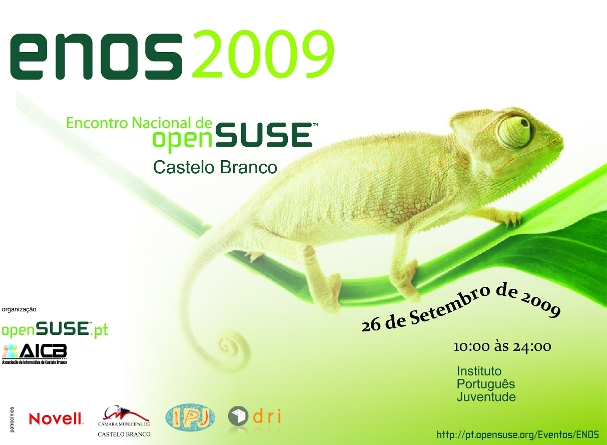
Announcing ENOS 2009

Pelo terceiro ano consecutivo, toda a comunidade portuguesa de openSUSE reúne-se num só espaço com o intuito de dinamizar o projecto openSUSE em Portugal.
O ENOS 2009 (acrónimo para "Encontro Nacional de openSUSE 2009"), organizado pela comunidade portuguesa de openSUSE e pela Associação de Informática de Castelo Branco, decorrerá na magnífica cidade de Castelo Branco, Sábado 26 de Setembro, tendo como ponto de encontro o Instituto Português da Juventude de Castelo Branco pelas 10 horas.
O objectivo do ENOS é dar a oportunidade aos utilizadores portugueses de openSUSE de se juntarem assim como dar aos participantes uma visão introspectiva dos últimos desenvolvimentos do projecto openSUSE e estimulá-los a participarem na comunidade, tudo num ambiente bastante informal e aberto.
Para além do convívio, troca de ideias e discussões dos mais diversificados temas possíveis, também decorreram durante o dia apresentações e BoF's tais como:
- O projecto openSUSE desde à 365 dias (Carlos Gonçalves, openSUSE)
- Integração de Open Source vs Software Proprietário (Engº João Batista, Novell Portugal)
- Linux na pós-produção áudio (Ricardo Antunes, UrbanaFM)
- BoF: Moonlight (Andreia Gaita)
- BoF: Packaging com o Build Service (Carlos Gonçalves)
Também este ano será possível submeter-se aos exames de certificação LPI, através da empresa nacional DRI, Master Affiliate do LPI em Portugal, com um desconto de 50% nas certificações - os interessados deveram informar a organização com pelo menos 8 dias de antecedência da sua intenção.
Assim, convidam-se todas as comunidades, associações e instituições, empresas e individuais a participarem.
Embora o encontro seja totalmente livre, agradece-se o registo na página do evento ou por email para eventos () opensusept () org por forma a ter uma ideia do número expectável de participantes.
Para informação mais detalhada, queira por favor consultar a página oficial do evento em http://pt.opensuse.org/Eventos/ENOS
Com os melhores cumprimentos,
A organização do ENOS 2009
English Version (note: it differs slightly from the above in Portuguese)
For the third consecutive year, all the Portuguese openSUSE community users will be meeting will the main goal of boosting the openSUSE project in Portugal.
ENOS 2009 is the third yearly edition of the event and will be held in the Institudo Português da Juventude (IPJ), Castelo Branco, Portugal on Saturday, 26 September.
- About
- Schedule
- 10:00 - Gathering at Institudo Português da Juventude
- 11:00 - ENOS kicks off
- 11:15 - 11:50 - The openSUSE project since 365 days ago (Carlos Gonçalves)
- 11:50 - 12:00 - Coffe Break
- 12:00 - 12:45 - Open Source vs Proprietary Software Integration (Eng. João Batista) Batista)
- 13:00 - 14:30 - Lunch
- 14:30 - 17:00 - IPJ
- 14:30 - 16:00 - Audio post production on Linux (Ricardo Antunes)
- 16:00 - 16:30 - (pending talk)
- 16:30 - 16:45 - Coffe Break
- 16:45 - 17:30 - Birds of a Feather
- 16:45 - 17:10 - BoF: Moonlight (Andreia Gaita)
- 17:10 - 17:30 - BoF: Packaging with Build Service (Carlos Gonçalves)
- 17:30 - 18:30 - Activity (suprise)
- 18:30 - 19:30 - Ideas & Discussion ; openSUSE Install Party ; LPI Certification
- +19:30 - Castelo Branco at night


- LPI
The ENOS organization has the pleasure to announce that we agreed with the LPI Master Affiliate DRI to allow interested people to certificate themselves with the LPI certification during the ENOS meeting (50% discount), which is a really good opportunity to everyone get their own LPI certification!
- Invitation
 ).
).For more detailed and up-to-date information please see the official event page.
- The Community
- Mailing list: opensuse-pt@opensuse.org
- IRC: #opensuse-pt on irc.freenode.net
- Web: http://opensusept.org
- Thanks To
Looking forward to see you there!
1-Click Bug Reporting?
First off, let me blow the dust off of my Lizards blog account 
Now that 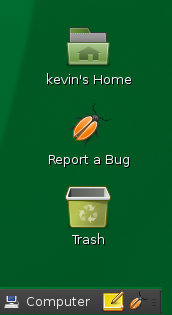 work and school has started to settle down, I’ve gotten back in to testing openSUSE’s newest version, 11.2. One of the things that annoyed me a little, though, was having to open Firefox to report or search for a bug in Bugzilla. So with a little inspiration from the Windows 7 beta’s links to “report a problem” everywhere, I created a desktop icon and panel launcher to automatically launch Firefox and open the “enter new bug” page on our Bugzilla.
You can download this icon here (right-click and Save Link As). Perhaps this is something that should be included with the pre-release versions of the OS starting in 11.3? What do ya’ll think?
Update: Due to a suggestion by Pavol Rusnak, it’s now in openFATE – #307492

Sesame backend for soprano on openSUSE
Second note: I'm really happy that openSUSE is a community based distro and is (again) selecting KDE as the default while installation. Gnome is still at the top of the list but it's a great sign. If you are not an openSUSE user you might give it a try.
new twitter account
My old account was suspended as it was hacked and spammed. Created a new one after waiting for it to be re-activated,
Good that twitter allowed me to update my email id in old account, so I could use my old email id for the new account. Liked the way twitter handles captcha now. I did not have to re-enter the new words again if there was an error while creating the account.
Have used a better password for the new account, lets see how far its secure 
Final Report
I would like to report my works done till the "firm" pen (or pencil) down date - 17/08/2009. The code and other things can be accessed at http://code.google.com/p/vaani
As mentioned in the proposal, the softwar consists primarily of two parts-
*Part 1: The text NLP part - which analyzes text inputs and tries to find common desktop activities that the user might be trying to convey through it.
*Part 2: The speech analyzer part - which converts an audio input to text, and lets the first part complete the rest of the process.
Part 1 (mostly present in vaani.shabd package) is fairly complete, currently it has the following plugins -
1. Instant message plugin - analyzes purple buddy list information, and uses dbus to open new chat windows in Pidgin (an Empathy plugin can be extended easily).
2. Application plugin - which right now collects information from the .Desktop files, and tries to find the required application based on the text.
3. Search plugin - this performs searches using the beagle-query command (to be upgraded to use beagle-dbus soon).
The framework is fairly clean, and new plugins can be added easily.
About the 2nd part (vaani.swar package), the approach was to have a grammar for each plugin, and then the Recognizer would use all of these grammars to convert speech commands to text. Right now, grammars for the instant message and application plugin are ready, however the 2nd part isn't functional yet, owing to some problems with grammar compilation by the sphinx system. Effort is currently been put into making it work asap.
The 0.1 release can be downloaded from here, although checking out from svn would be a better option. Also, we need to package the code soon, currently the best way to hack it is by opening the project in an IDE (I wrote in Netbeans) Please try, suggestions/contributions/criticism are always welcome.

PDF Mod 0.6
 Features
- Open in Viewer action that launches the default app (usually Evince)
- Remembers last folder a doc was opened from
- Remembers if the toolbar was hidden
- Remember accelerator customizations
- Uses the XDG cache dir for storing tmp files
- Does a better job of cleaning up tmp files
- Fix bug with installing to custom prefix
- Fix some zoom inconsistencies
- Got rid of bundled binaries; Hyena is needed at build-time

Words, words, words
Back in the times of KDE3, I used to find the fact that I can search KCM modules by keywords (that is, in addition to module names, it looked for a match also in groups of tags, describing the function of the module in detail) rather handy. My colleague Pavol, the user of Most Awesome Computer OS X, seemingly appreciates that Apple's System Preferences (equivalent of YaST) can do the same, so he requested feature #305845. It was then a matter of one afternoon to teach Qt4 Control Centre to do the same.
Now let's have a look at some real example. I want to share my vacation photos with the others by exporting the folder, so that they can mount it (or alternatively, I want to mount somebody else's shared folder with photos). After typing 'share' keyword, I can see a selection of YaST modules which I can possibly use:
Now I can choose between samba and NFS server if I want to export my shared folder, or NFS client if I want to mount somebody else's one.
Contribution needed
To make the search effective (better, to make it find at least something ;)), it is necessary to assign sets of suitable keywords to as many YaST modules as possible and this is exactly the place where community contribution will be useful.So - if you feel that certain YaST module does not match the keyword even though it should, please do one of the following:
- Use bugzilla to file an enhancement request and assign it to the mainteiner of that module
- For that particular YaST package, do a Factory submit request, extending its .desktop file with the keyword(s)
X-SuSE-YaST-Keywords = disk, partition, LVM, RAID, NFS, mount,format, encrypt, fstab(guessing which module this could belong to is an exercise for the reader :) ) Anyway, any help will be appreciated ...