
 Member
 baltolkien
KDE estará mañana en 42 Madrid
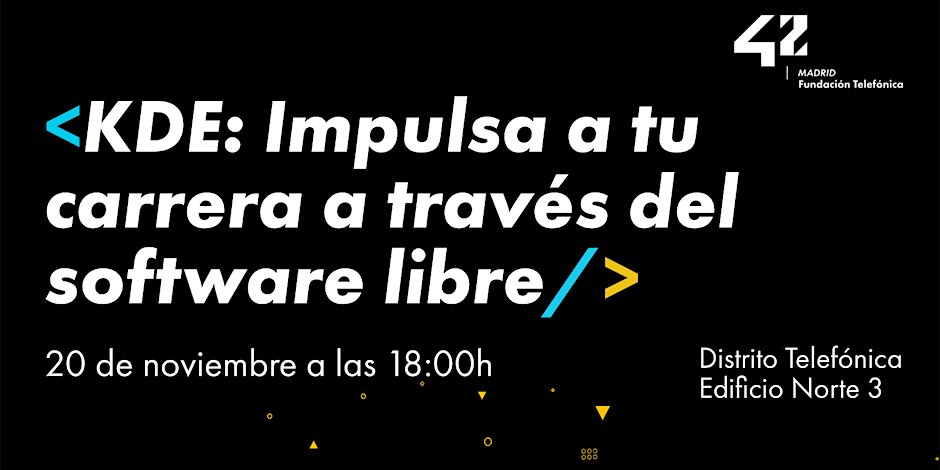
Con el ánimo de estar presentes cada vez en más sitios me complace anunciar que KDE estará mañana en 42 Madrid, ya que de la mano de Agustín Benito Bethencourt (toscalix), miembro fundador de KDE España realizará una charla con el objetivo de mostrar cómo se aprende sobre software libre con KDE.
KDE estará mañana en 42 Madrid
Con el título «KDE – Impulsa a tu carrera profesional a través del software libre» Agustín Benito Bethencourt (toscalix), miembro fundador de KDE España realizará una charla con el objetivo de mostrar cómo se aprende sobre software libre con KDE.
Más información: Evenrbrite
¿Qué es 42 Madrid?
42 Madrid es el campus de programación más innovador y gratuito que te abre las puertas al mercado laboral. Con una metodología revolucionaria y una duración media de tres años, está abierto las 24 horas del día, 7 días a la semana para que puedas aprender a tu ritmo.
Más información: 42 Madrid
La entrada KDE estará mañana en 42 Madrid se publicó primero en KDE Blog.
Avances de Krita fruto de la colaboración con el programa Google Summer of Code 2023
Hoy quiero comenzar una serie de artículos para comentar el estado final de la participación de KDE en Google Summer of Code 2023 (GSoC). Este año han sido varias las aplicaciones o procesos que han sido foco del trabajo por parte de los mentores y estudiantes. De esta forma, empecé este repaso con Merkuro, seguí con digiKam y hoy continuo con los avances de Krita fruto de la colaboración con el programa Google Summer of Code 2023, la fantástica aplicación para la creación de dibujos digitales.
Avances de Krita fruto de la colaboración con el programa Google Summer of Code 2023.webp
El equipo de KDE es uno de las Comunidades que siempre intentan colaborador con los proyectos centrados en el Software Libre que suele organizar cualquier compañía, y Google no es ninguna excepción
Como podemos leer en el anuncio del dot donde se comenta el final de este curso del 2023:
Este año, KDE ha tutelado con éxito siete proyectos en el Google Summer of Code (GSoC). GSoC es un programa en el que colaboradores nuevos en software libre y de código abierto dedican entre 175 y 350 horas durante 10 a 22 semanas a trabajar en un proyecto de código abierto. Este artículo presenta los proyectos y colaboradores de 2023 y sus logros.
Fruto de esta colaboración se han mejorado aplicaciones del ecosistema KDE al tiempo que proporciona experiencia, conocimiento y maestría a nuevos desarrolladores. Es el momento de reconocer este trabajo y promocionar este trabajo para ser consciente así de que el Software Libre va de personas que trabajan por un bien común.
Hoy quiero comentar el avance en Krita, el programa profesional de pintura digital, gratuito y hecho con código libre, ha sido creado por artistas mismos que desean hacer éstas herramientas accesibles para todos, con el que podrás hacer arte conceptual, pinturas de textura y mate e Ilustraciones e historietas, entre otras cosas:
- Mejora del creador de paquetes: Srirupa Datta trabajó en la mejora y ampliación del creador de paquetes en Krita, es decir, los paquetes de recursos, como pinceles o gradientes, que los usuarios de Krita pueden intercambiar. El trabajo ya se ha fusionado y formará parte de la próxima versión.
Más información: KDE News
¿Qué es GSoC?

Vía Somos Libres he encontrado esta magnífica descripción del programa GSoC:
Google Summer of Code (GSoC) es un evento organizado por Google, cuyo objetivo es hacer participar a varios estudiantes en el desarrollo de determinados proyectos Open Source elegidos por Google. Cada grupo debe cumplir con una lista de tareas específicas que deben realizar y elegidas por el representante del proyecto, también conocido como mentor.
Los objetivos del GSoC son:
- Crear y liberar código Open Source para el beneficio de todos.
- Inspirar a los jóvenes desarrolladores a participar en el desarrollo de aplicaciones Open Source.
- Ayudar a los proyectos Open Source a identificar a nuevos y posibles desarrolladores.
- Dar a los estudiantes la oportunidad de trabajar en algo relacionado a sus estudios. Dar a los estudiantes una mayor exposición a situaciones del mundo real de desarrollo de software.
En definitiva, una excelente iniciativa que beneficia a todo el mundo.
La entrada Avances de Krita fruto de la colaboración con el programa Google Summer of Code 2023 se publicó primero en KDE Blog.
#openSUSE Tumbleweed revisión de la semana 46 de 2023
Tumbleweed es una distribución de GNU/Linux «Rolling Release» o de actualización contínua. Aquí puedes estar al tanto de las últimas novedades.

openSUSE Tumbleweed es la versión «rolling release» o de actualización continua de la distribución de GNU/Linux openSUSE.
Hagamos un repaso a las novedades que han llegado hasta los repositorios esta semana.
El anuncio original lo puedes leer en el blog de Dominique Leuenberger, publicado bajo licencia CC-by-sa, en este este enlace:
Esta semana se publicaron 4 snapshots 1110, 1113, 1114, y 1115. Hubo una (la1109) que aunque fue marcada para publicarse, se retrasó y no se publicó. Los cambios y actualizaciones que traía no se pierden, se publicarán en la próxima snapshot..
Los cambios más relevantes de esta semana son:
- Linux kernel 6.6.1
- KDE Gear 23.08.2
- KDE Frameworks 5.112.0
- Binutils 2.41
- gAWK 5.3.0
- PostgreSQL 16.1
- Mozilla Firefox 119.0.1
- libeconf 0.6.0
Para el futuro, próximo y lejano, veremos cambios como estos:
- GStreamer 1.22.7
- sudo
- RPM 4.19
- dbus-broker
Si quieres estar a la última con software actualizado y probado utiliza openSUSE Tumbleweed la opción rolling release de la distribución de GNU/Linux openSUSE.
Mantente actualizado y ya sabes: Have a lot of fun!!
Enlaces de interés
- ¿Por qué deberías utilizar openSUSE Tumbleweed?
- zypper dup en Tumbleweed hace todo el trabajo al actualizar
- ¿Cual es el mejor comando para actualizar Tumbleweed?
- ¿Qué es el test openQA?
- http://download.opensuse.org/tumbleweed/iso/
- https://es.opensuse.org/Portal:Tumbleweed

——————————–
Podcast Linux cierra sus emisiones… y yo no puedo estar más triste
Hay días que las cosas se tuercen… y hoy es uno de ellos. Evidentemente relamente no es comparable al vacío que deja la ausencia de un ser querido (y eso que ya tengo eperiencia en esto) pero creo que hoy siento algo similar. Y es que he leído en el gran blog de Victorhck que Podcast Linux cierra sus emisiones, lo cual me ha llenado de tristeza y amargura. Tanta que no he podido hacer más que scribir estas líneas por el incomparabla Juan Febles, amigo desde la distancia.
Podcast Linux cierra sus emisiones… y yo no puedo estar más triste
Lamentablemente, por motivos personales, no de salud, tengo que dejar el proyecto Podcast Linux.
No tengo palabras de agradecimiento por conocer a tanta gente increíble y aprender un montón de GNU/Linux y el Software Libre.
Han sido 7 años maravillosos.
¡¡¡Gracias!!!
Juan Febles, editor de Podcast Linux
Recuerdo la primera vez que escuché la voz de Juan en Podcast Linux: conducía mi coche camino al trabajo, me cautivó su maravilloso acento, su buen hacer técnico y, sobre todo, la sensación de que una nueva ventana al mundo del Software Libre se me abría… y que la visión que me ofrecía era casi infinita.
Y estas impresiones iniciales de hace 7 años no solo se mantuvieron sino que iban aumentando emisión tras emisión: cada par de programas una nueva cara del polifacético universo GNU/Linux aparecía ante mi, dejándome la sensación de que al día le faltaban horas para llegar a tanto.
En este tiempo, he aprendido un montón gracias a Juan, he conocido a decenas de creadores de todo tipo, he descubierto decenas de proyectos, y muchos de ellos han sido protagonistas de este humilde blog, en un intento de que sus maravillosos audios llegaran a la máxima audiencia y que no dudaré en seguir promocionando o recordando ya que creo que es un tesoro que no puede caer en el olvido.
No obstante, no han estos episodios lo mejor, que ya es mucho, sino que gracias a Podcast Linux he descubierto que tengo a una muy buena persona que siento cercana pero que está a cientos de kilómetros de mi casa. Una persona a la que espero algún día conocer en persona.
Es por ello, y porque me siento un poco identificado con él, que creo que el cierre de su proyecto debe ser algo meditado, fruto de una lucha interna y que alguna razón de peso le ha llevado a tomar esta decisión que repito, me llena de tristeza.
No sé los motivos ni se los pienso preguntar. Solo deseo que sea feliz y que, si de nuevo le pica el gusanillo del podcasting, vuelva a deleitarnos con su voz, su tranquilidad y su saber hacer, nadie se lo reprochará.
¡Gracias Juan por tus 7 años de conocimiento compartido!
La entrada Podcast Linux cierra sus emisiones… y yo no puedo estar más triste se publicó primero en KDE Blog.
openSUSE Tumbleweed – Review of the week 2023/46
Dear Tumbleweed users and hackers,
We are slowly but surely reaching the end of the year 2023 with just six more weeks to go. This week we had some minor glitches on the publishing side: snapshot 1109 had been marked for publishing, but the syncing never happened. As this was just over the weekend, nobody noticed this until Monday, when the next snapshot was already pending in the publisher queue (and also not going out). The issue was then swiftly rectified with the help of the build service team. As a consequence, only the four snapshots 1110, 1113, 1114, and 1115 have been published. The changes from 1109 are not lost: they were still present in the subsequently published snapshots.
The most relevant changes to report during this week are:
- Linux kernel 6.6.1
- KDE Gear 23.08.2
- KDE Frameworks 5.112.0
- Binutils 2.41
- gAWK 5.3.0
- PostgreSQL 16.1
- Mozilla Firefox 119.0.1
- libeconf 0.6.0
In the future – near or far – you can count on those changes to reach you:
- GStreamer 1.22.7
- sudo: optional addon configuration for groups wheel or sudo (asking for current user’s password)
- RPM 4.19
- dbus-broker as the default dbus daemon

Gear, Frameworks, Kernel updates in Tumbleweed
A large amount of software updates made it into openSUSE Tumbleweed snapshots this week.
Most snapshots came with several new versions for those who used their command line to zypper dup.
While snapshot 20231114 was as enormous as snapshots starting off the week, there were a significant amount of software updates. The open-source client for Enterprise Identity Management sssd updates to version 2.9.3. This update empowers the proxy provider to handle certificate mapping and matching rules. Users managed by the proxy provider can now be configured for local Smartcard authentication, which improves authentication options. An update of xterm 388 enhances the disallowPasteControls function by adding a category for special characters known to stty. The new version also includes the updating of config.guess and config.sub. Improved messages in the configure script were made with the ncurses 6.4.20231111 update, and it had a patch that modified the reset command to avoid altering clocal when the terminal employs a modem. Color management package argyllcms updates to 3.0.2 fixes a typo in a module that affected retail i1D3 functionality and fixes crashes with the device link profiles and an update of libstorage-ng 4.5.156 merges a specific GitHub issue and extends the testsuite. Several RubyGems updated in the snapshot. There was an arm image 20231114 snapshot that updates for packages released from earlier in the week. Linux Kernel 6.6.1 and both KDE Frameworks 5.112.0 and KDE Gear 23.08.3 became available for the arm rolling release’s contributors and users.
Frameworks 5.112.0 was released for other architectures in snapshot 20231113. An update of NetworkManagerQt fixed an incorrect signal signature, removed an inaccurate comment and adjusted event listening to accommodate both DBus service registration events and interface added events. There was a replacement of slow with fsType in naming conventions for KIO and KConfig made adjustments in kconfigwatcher to avoid asserting absolute paths and had modifications in dbussanitizer preventing trailing slashes; the update enhances security measures by preventing attempts to send or receive DBus notifications on absolute paths. The ffmpeg-6 6.0.1 version make improvements to AVCodecs, AVformat, and AVfilters a patch was dropped as it was resolved upstream. Mozilla Firefox 119.0.1 had critical bugs affecting HTML elements’ functionality and resolves issues related to color application. The 23.2 version of python311-packaging had changes to parsing markers and improves support for enriched metadata, documentation updates and addressing vulnerabilities by updating the pip. The 41.0.5 version of python-cryptography focuses on enhancements and adjustments related to its integration with OpenSSL. This update has a new function to support an upcoming release of pyOpenSSL. An update of createrepo_c 1.0.2 made changes that prevent building without zstd and removes the dependency on libmagic. An update of the mail transfer agent (MTA) for email handling, postfix, updated to version 3.8.3. The package update addresses a defect in the Postfix SMTP server related to client certificate verification errors in TLS wrapper mode. The update also resolves syntax errors in the update_postmaps script and adjusts permissions caused by config.postfix. Several other packages were updated in the snapshot.
While KDE Gear 23.08.3 was later updated in the 20231114 arm image, it was released in snapshot 20231110. The Ark compression/decompression utility n resolves some file format issues and MIME type handling. It also has fixes related to opening AppImage files, checks using outdated ISO mimetypes, and adjusted hardcoded bzip2 mimetypes in tests for greater flexibility. Dolphin made updates reflecting the relocation of KActivities from Frameworks to Plasma. The modifications contribute to improved functionality and alignment within the file manager. There were an enormous amount of changes with Kdenlive in the Gear update. The update fixes timeremap, ensures proper audio handling during clip replacement, addresses project duration inaccuracies, prevents subtitle styling losses, enhances rendering and improves keyframe handling and clip resizing functionalities. Linux Kernel 6.6.1 arrived in the snapshot also before the arm image snapshot and it had bug fixes for several driver modules and compatibility enhancements for specific hardware devices to include adjustments for serial, USB, Advanced Linux Sound Architecture, Bluetooth, and more. An update of gimp 2.10.36 includes support for ASE (Adobe Swatch Exchange) and ACB (Adobe Color Book) palettes and a new gradient option. This is enhanced support for non-square ratio GIFs and an improved text tool formatting behavior. An update of postgresql16 16.1 adds support for LLVM 16 and 17. It also had some security fixes including handling unknown-type arguments and preventing an integer overflow when computing new array dimensions. Update of binutils 2.41, gawk 5.3.0 and more arrived in the snapshot.
PodcastLinux dice adiós después de 7 años divulgando sobre Linux y software libre
Juan Febles responsable del podcast más conocido e importante de la linuxfera en español ha anunciado de manera repentina el fin de su proyecto PodcastLinux.

La noticia saltó de manera imprevista en el timeline de mi cuenta de Mastodon. La cuenta de PodcastLinux decía de manera escueta que daba por finalizado el proyecto después de 7 años en línea y un gran trabajo personal detrás de difusión de GNU/Linux y el software libre.
El texto de Juan Febles, el responsable, editor y creador de PodcastLinux en su cuenta decía lo siguiente:
Lamentablemente, por motivos personales, no de salud, tengo que dejar el proyecto Podcast Linux.
No tengo palabras de agradecimiento por conocer a tanta gente increíble y aprender un montón de GNU/Linux y el Software Libre.
Han sido 7 años maravillosos.
¡¡¡Gracias!!!
Podcast Linux
Nada nos había hecho presagiar ese giro inesperado de uno de los podcast imprescindibles en esto de GNU/Linux.
Hace 7 años Juan Febles desde las Islas Canarias empezaba este proyecto, en el que me atrevo a decir, hubo un virage desde posturas más bien funcionales a la hora de hablar y difundir sobre las virtudes de GNU/Linux, hacia posturas más comprometidas con las libertades que representan el software libre.
Juan Febles, ha realizado una labor de difusión increible. Sus podcast tienen un sello único de reposo, tranquilidad, mesura y profesionalidad que personalmente me gustaba, por mi rechazo visceral hacia lo falso, lo istriónico y el postureo.
Su voz, algo muy importante en el podcast, también era un aliciente para escucharlo. Desde la meseta castellana agradecía el acento canario tan cálido a la hora de abordar las distintas temáticas que ha tratado en su podcast.
Pero no solo era activo en su podcast, por lo que nos comentaba en ellos, en su trabajo de docente también era un defensor del software libre en su ámbito de la educación, buscando las alternativas libre y de calidad a las herramientas privativas que en ocasiones les imponen.
Desde aquí declararme fan de su trabajo, y agradecerle públicamente los años de compromiso y tiempo dedicado a una causa altruista que realizaba por el gusto de aprender y de dar a conocer.
Siempre es triste ver como blogs o, como en este caso, podcasts que te gustan personalmente y los sigues echan el cierre. Nos dejan un poco más solos… pero siempre hay que tener esperanza en que el testigo sea recogido y la difusión sobre «el cacharreo» GNU/Linuxero siga adelante.
Los motivos de tener que echar el cierre a su proyecto después de 7 años, solo le incumben a él. Pero quiero transmitirle (si este texto de un fan declarado llega hasta él) que le deseo todo lo mejor en su vida y que los motivos se resuelvan de la manera más favorable.
No sé si habrá episodio de regreso o será un fin definitivo. En todo caso, nunca me gusta decir adiós, las circunstancias y la vida da muchas vueltas, así que le despediré con un hasta pronto…
Enlaces de interés
Avances de digiKam fruto de la colaboración con el programa Google Summer of Code 2023
Hoy quiero comenzar una serie de artículos para comentar el estado final de la participación de KDE en Google Summer of Code 2023 (GSoC). Este año han sido varias las aplicaciones o procesos que han sido foco del trabajo por parte de los mentores y estudiantes. De esta forma, empecé este repaso con Merkuro, y hoy sigo con los avances de digiKam fruto de la colaboración con el programa Google Summer of Code 2023, una aplicación que sigue mejorando versión a versión.
Avances de digiKam fruto de la colaboración con el programa Google Summer of Code 2023
El equipo de KDE es uno de las Comunidades que siempre intentan colaborador con los proyectos centrados en el Software Libre que suele organizar cualquier compañía, y Google no es ninguna excepción
Como podemos leer en el anuncio del dot donde se comenta el final de este curso del 2023:
Este año, KDE ha tutelado con éxito siete proyectos en el Google Summer of Code (GSoC). GSoC es un programa en el que colaboradores nuevos en software libre y de código abierto dedican entre 175 y 350 horas durante 10 a 22 semanas a trabajar en un proyecto de código abierto. Este artículo presenta los proyectos y colaboradores de 2023 y sus logros.
Fruto de esta colaboración se han mejorado aplicaciones del ecosistema KDE al tiempo que proporcioba experiencia, conocimiento y maestría a nuevos desarrolladores. Es el momento de reconocer este trabajo y promocionar este trabajo para ser consciente así de que el Software Libre va de personas que trabajan por un bien común.
Hoy quiero comentar el avance en digiKam, el gestor de imágenes profesional de la Comunidad KDE:
- Añadida la herramientas de asignación automática de etiquetas y mejorado el motor de reconocimiento facial para digiKam: TRAN Quoc Hung ha desarrollado un modelo de aprendizaje profundo que puede reconocer varias categorías de objetos, escenas y eventos en fotos digitales. El modelo genera las palabras clave correspondientes que pueden almacenarse en la base de datos de digiKam y asignarse a las fotos automáticamente. El MR se fusionará tras el lanzamiento de DigiKam 8.2.0.

Más información: KDE News
¿Qué es GSoC?
Vía Somos Libres he encontrado esta magnífica descripción del programa GSoC:
Google Summer of Code (GSoC) es un evento organizado por Google, cuyo objetivo es hacer participar a varios estudiantes en el desarrollo de determinados proyectos Open Source elegidos por Google. Cada grupo debe cumplir con una lista de tareas específicas que deben realizar y elegidas por el representante del proyecto, también conocido como mentor.
Los objetivos del GSoC son:
- Crear y liberar código Open Source para el beneficio de todos.
- Inspirar a los jóvenes desarrolladores a participar en el desarrollo de aplicaciones Open Source.
- Ayudar a los proyectos Open Source a identificar a nuevos y posibles desarrolladores.
- Dar a los estudiantes la oportunidad de trabajar en algo relacionado a sus estudios. Dar a los estudiantes una mayor exposición a situaciones del mundo real de desarrollo de software.
En definitiva, una excelente iniciativa que beneficia a todo el mundo.
La entrada Avances de digiKam fruto de la colaboración con el programa Google Summer of Code 2023 se publicó primero en KDE Blog.
Cifrar el archivo de contraseñas de nuestro correo en #NeoMutt
Veamos cómo cifrar el archivo que contiene nuestras contraseñas para acceder al correo mediante el cliente NeoMutt para no almacenarlas en texto plano

En anteriores artículos de esta pequeña serie de tutoriales que estoy publicando sobre el cliente de correo NeoMutt, vimos cómo configurar nuestra cuenta de correo para que NeoMutt se conecte.
En esa ocasión configuramos la cuenta y entre esas configuraciones se establecía la contraseña para que NeoMutt pueda acceder a nuestra cuenta de correo. Esas contraseñas se guardan en texto plano en nuestro equipo.
Eso es un riesgo de seguridad, ya que cualquiera que pueda acceder al equipo, puede ver sin ningún problema cuales son nuestras contraseñas y poder acceder a nuestra correspondencia.
Veamos un par de soluciones a la hora de evitar eso, y cifrar esas contraseñas para que nadie que acceda a ellas pueda saber qué contienen.
En ambos casos es condición indispensable el uso de GNU GPG, así que se presupone que dispones de una clave pública y privada de GPG.
Veamos ya las dos soluciones a la hora de cifrar el contenido de nuestras contraseñas.
Cifrando las contraseñas con GPG
En un artículo anterior del blog, vimos cómo configurar NeoMutt para que acceda a nuestro correo. En ese artículo, escribiamos las configuraciones incluidas las contraseñas y estas se almacenan en texto plano.
Lo que vamos a hacer es eliminar las líneas del archivo en el que establecíamos las contraseñas del servidor IMAP y SMTP de ese archivo y las copiamos a un archivo diferente al que llamaremos por ejemplo contraseñas que también ubicaré en ~/.config/mutt/ que tendrá el siguiente contenido:
set imap_pass = "TU_contraseñ4_segur4"
set smtp_pass = "TU_contraseñ4_segur4"
Guardamos el archivo y ahora lo vamos a cifrar con GPG (por tanto debes tener GPG en tu sistema y disponer de una clave privada y pública)
Ahora consultamos nuestra clave mediante:
gpg --list-secret-keys --keyid-format=long
En mi caso particular veré lo siguiente: CC742E8DC9B7E22A y tendré que cifrar el archivo contraseñas con mis contraseñas en él con esa firma. Para ello ejecuto:
gpg --recipient CC742E8DC9B7E22A --encrypt contraseñas
Lo que me generará un archivo llamado contraseñas.gpg con el contenido del archivo original, pero cifrado. Ahora ya puedo eliminar el archivo en texto plano y ese archivo .gpg será el que indiquemos a NeoMutt que utilice para abrir nuestro correo.
Para ello, en el archivo de configuración de NeoMutt añadiremos lo siguiente:
source "gpg -dq $HOME/.config/mutt/contraseñas.gpg |"
Ahora al abrir NeoMutt, nos pedirá nuestra contraseña de GPG para descifrar el archivo y poder utilizar las contraseñas.
Usando pass
Password store o simplemente pass, es el gestor de contraseñas en Unix y sistemas GNU/Linux que usa GPG para almacenar y organizar nuestras contraseñas.
En el artículo que escribí sobre pass puedes ver cómo configurarlo y empezar a usarlo. En mi caso hace tiempo que lo uso, y entre las contraseñas guardadas tengo las de mi servicio de correo. Vamos a utilizar pass para que NeoMutt se conecte a nuestro correo.
Como en el caso anterior, debemos borrar las líneas de configuración de NeoMutt donde se guardaba el contenido de nuestras contraseñas IMAP y SMTP de nuestro correo electrónico. Y presuponemos que ya las tenemos almacenadas usando pass.
Y en ese archivo deberemos sustituir las líneas borradas por las siguientes:
set imap_pass = `pass show Correo/mailbox`
set smtp_pass = `pass show Correo/mailbox`
En mi caso, porque las contraseñas las he guardado en pass en una carpeta llamada mailbox dentro del apartado Correo. Tu deberás sustituirlo por tu propia opción de cómo lo tengas configurado.
Bola extra
Otra opción es omitir por completo en el archivo, las contraseñas, en ese caso cuando abras NeoMutt y se vaya a conectar, te pedirá la contraseña de nuestro correo. También puede ser una opción a considerar, aunque un poco más engorrosa.
Estas son las opciones que te muestro, escoge la que prefieras. Y poco a poco vamos aprendiendo juntos más sobre NeoMutt, el cliente de correo para la terminal.

Music of the week: the Cello
I love the melodies of Metallica songs. However, I strongly prefer instrumental music. That’s why I was very happy, when someone brought Apocalyptica to my attention: they played Metallica on four cellos. Over the years I discovered that metal or any other music sounds nice on cellos, as I learned about two more bands: 2cellos and Mozart Heroes.

But I should not rush so far ahead. In the year 2000 someone introduced me to Metallica. I loved the melodies, but I’m not a great fan of singing. A few months later another friend introduced me to Apocalyptica, when learned about my problem. The same wonderful melodies, but purely instrumental music. First I bought their first album: “Apocalyptica plays Metallica by Four Cellos” and soon after also the second one: “Inquisition Symphony”.
TIDAL: https://listen.tidal.com/album/248123832 and https://listen.tidal.com/album/109813970
The next album I heard from Apocalyptica also featured a singer. That’s not something for me. That’s when I learned from a colleague about 2Cellos, a Croatian cellist duo. They played a wide variety of arrangements, everything from classical, through rock to pop. I quickly listened to all of their albums on TIDAL, and watched some of their videos on YouTube. This is my favorite:
TIDAL: https://listen.tidal.com/album/38440446/track/38440450
I learned about Mozart Heroes from a friend who’s son plays the cello. It is not purely cello music, as the other member of the band plays the guitar. Still, it was instant love. They also play arrangements, often combining a classical piece with something modern in the very same song. Sometimes the transition from one melody to the other is completely seamless. In the video below they combine Mozart and Metallica in a song:
TIDAL: https://listen.tidal.com/artist/9200105
For almost two decades I did not follow Apocalyptica, as the new music I heard from them was not purely instrumental. As Covid broke out, many concert tours were canceled. Some of these were replaced by free on-line streaming. I do not remember how I learned that Apocalyptica would also be performing an online concert, but as I did not have anything better to do, I watched it. It was pure instrumental, and love at first sight, so I bought the new album as soon as it became available in Hungary. Below I link the whole concert, which I watched live 3.5 years ago.
TIDAL: https://listen.tidal.com/album/125174900
Nobody is perfect, so there is a little twist in my story. The original reason I fell in love with cello arrangements was that they were all instrumental. There was no singing. A good friend mentioned that Apocalyptica is coming in our part of Europe, but unfortunately playing together with another band, and there is singing. I listened to it, and to my greatest surprise, despite the vocals, it was absolutely beautiful. To me, anyway :-)