
 Member
 baltolkien
Ampliado el plazo para presentar charlas para Akademy-es 2023 de Málaga Opensouthcode edition #akademyes
Siguiendo la estela de Akademy-es 2022, el próximo encuentro de la Comunidad española de KDE se celebrará de forma presencial en Málaga el 9 y 10 de junio junto con Opensouthcode. Estamos todavia a unos meses y es el momento de comentar que sigue abiertp el Call for Papers, y es que se ha ampliado el plazo para presentar tu charlas para Akademy-es 2023. Así que ya lo sabes, ven e Málaga y muestra al mundo tu proyecto.
Ampliado el plazo para presentar charlas para Akademy-es 2023 de Málaga Opensouthcode edition #akademyes
Hace unos días compartí con vosotros que este año Akademy-es 2023 se va a realizar en Málaga el 9 y 10 de junio, en otra edición muy especial ya que se va a celebrar de forma paralela con la Opensouthcode en La Térmica.
Siguiendo el esquema habitual cuando coincide con una Akademy, las charlas se celebrarán el jueves y el viernes, para dejar libre el fin de semana para las ponencias el evento Internacional.
Dado la realización de esta Akademy-es con la Opensouthcode, las charlas se celebrarán el viernes y el sábado, dejando el domingo para alguna actividad social, si es posible.
Si crees que tienes algo importante que presentar, por favor házselo saber a la organización. Y si crees que alguien debería presentar su ponencia, no dejes de animarlo para que lo haga. Todas las contribuciones son útiles.
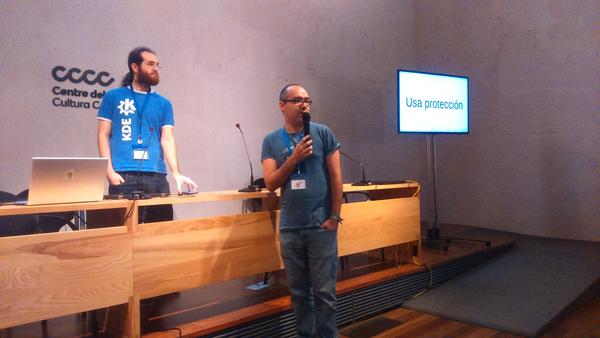
Para más detalles, mira las líneas generales del Call for Papers. Tienes de plazo para enviar tu propuesta hasta el domingo 2 16 de abril 23:59:59 CEST al correo akademy-es-org@kde-espana.org.
Es importante tener en cuenta las siguientes consideraciones:
- Se puede elegir entre dos formatos de charlas:
- Charlas de 45 minutos.
- Charlas relámpago (Lightning talk) de 10 minutos.
- Si la duración de las charlas propuestas no se ajusta a ninguno de estos dos esquemas (por ejemplo, si se necesita más tiempo), esto debe indicarse claramente en la comunicación.
- Se permitirá a KDE España la distribución bajo una licencia libre de todo el material utilizado para la realización de la actividad, así como de la grabación de la misma.
- La charla puede ser tanto a nivel de usuario como de nivel técnico.
¿Qué es Akademy-es?
Akademy-es (#akademyes, que es la etiqueta para las redes sociales) es evento más importante para los desarrolladores y simpatizantes de KDE, que se ha ido celebrando desde el 2006 con éxito creciente.
En general, las Akademy-es son el lugar adecuado para conocer a los desarrolladores, diseñadores, traductores, usuarios y empresas que mueven este gran proyecto.
En ellas se realizan ponencias, se presentan programas, se hace un poco de caja para los proyectos libres (camisetas, chapas, etc) pero sobre todo se conoce a gente muy interesante y se cargan baterías para el futuro.
Podéis repasar las anteriores ediciones en estas entradas del blog:
- Camino Akademy-es 2013: Las anteriores ediciones (I): 2006 – 2008
- Camino Akademy-es 2013: Las anteriores ediciones (II): 2009-2010
- Camino Akademy-es 2013: Las anteriores ediciones (III): 2011-2012
- Anteriores ediciones de Akademy-es (IV): 2013 y 2014
La entrada Ampliado el plazo para presentar charlas para Akademy-es 2023 de Málaga Opensouthcode edition #akademyes se publicó primero en KDE Blog.
#openSUSE Tumbleweed revisión de la semana 13 de 2023
Tumbleweed es una distribución de GNU/Linux «Rolling Release» o de actualización contínua. Aquí puedes estar al tanto de las últimas novedades.

openSUSE Tumbleweed es la versión «rolling release» o de actualización continua de la distribución de GNU/Linux openSUSE.
Hagamos un repaso a las novedades que han llegado hasta los repositorios esta semana.
El anuncio original lo puedes leer en el blog de Dominique Leuenberger, publicado bajo licencia CC-by-sa, en este este enlace:
De nuevo esta semana se llega a la cifra de 7 snapshots publicadas.
Además de muchos otros cambios, estas 7 snapshots (0322, 0324…0329) han traido estas actualizaciones a los repositorios de openSUSE Tumbleweed:
- GNOME 44.0 (Snapshot 0324)
- cURL 8.0.1
- Linux kernel 6.2.8
- LibreOffice 7.5.2.1
- Samba 4.18.0
- LLVM 16
- Mesa 23.0.1
- cmake 3.26.0 & 3.26.1
Y para próximas actualizaciones se están preparando las siguientes:
- python-setuptools 67.6.0
- Linux kernel 6.2.9
- openSSL 3.1
- GNU coreutils 9.2
- TeXLive 2023
Si quieres estar a la última con software actualizado y probado utiliza openSUSE Tumbleweed la opción rolling release de la distribución de GNU/Linux openSUSE.
Mantente actualizado y ya sabes: Have a lot of fun!!
Enlaces de interés
- ¿Por qué deberías utilizar openSUSE Tumbleweed?
- zypper dup en Tumbleweed hace todo el trabajo al actualizar
- ¿Cual es el mejor comando para actualizar Tumbleweed?
- ¿Qué es el test openQA?
- http://download.opensuse.org/tumbleweed/iso/
- https://es.opensuse.org/Portal:Tumbleweed

——————————–

Ransomware no produto da IBM com gravidade 9,8

Imagem gerada por IA.
Os atacantes estão explorando uma vulnerabilidade crítica (CVE-2022-47986) na solução de transferência de arquivos centralizados IBM Aspera Faspex para invadir organizações.
Sobre CVE-2022-47986:
O IBM Aspera Faspex oferece uma solução para a troca de arquivos entre os colaboradores de uma organização, possibilitando a transferência deles de forma ágil e segura. Esta ferramenta da Aspera utiliza um servidor central para realizar o envio e o recebimento dos arquivos.
Um ataque remoto pode explorar a vulnerabilidade CVE-2022-47986, que é uma falha de desserialização YAML, enviando uma chamada de API especialmente criada. Esta vulnerabilidade afeta o IBM Aspera Faspex 4.4.2 Nível de Patch 1 e versões anteriores, permitindo a execução de código arbitrário.
No final de janeiro, a IBM avisou de uma vulnerabilidade crítica no Aspera versões 4.4.2 Patch Nível 1 e anteriores. De acordo com a Caitlin Condon, pesquisadora de segurança da Rapid7, o Aspera Faspex é normalmente instalado em servidores locais, e algumas organizações não tomaram as medidas adequadas para fechar a brecha de segurança quando o IBM lançou os patches.
Infelizmente para eles, a pontuação da vulnerabilidade foi elevada para 9,8 (max 10), para refletir melhor a sua gravidade. Mais importante ainda, Max Garrett, o pesquisador que a descoberta, compartilhou os detalhes técnicos e o código de exploração de prova de conceito.
Exploiting CVE-2022-47986
Os atacantes começaram a explorá-lo quase imediatamente e não pararam desde então. Em Março, a SentinelOne detectou ataques com o ransomware IceFire em sistemas Linux em empresas na Turquia, Irã, Paquistão e Emirados Árabes Unidos. Desde então, a Greynoise vem monitorando vários esforços de exploração.
Os administradores da empresa são aconselhados a atualizar imediatamente o seu servidor IBM Aspera Faspex.
openSUSE Tumbleweed – Review of the week 2023/13
Dear Tumbleweed users and hackers,
This week we are fully back on track with 7 published snapshots. One significant change to mention again is:
RPMs for i586 (intel 32bit systems) are no longer part of the regular Tumbleweed snapshots. This has been moved into a legacyx86 port in OBS and is published separately on download.opensuse.org. See also this announcement on the factory mailing list.
Other than that, the 7 snapshots published (0322, 0324…0329) contained these changes:
- GNOME 44.0 (Snapshot 0324)
- cURL 8.0.1
- Linux kernel 6.2.8
- LibreOffice 7.5.2.1
- Samba 4.18.0
- LLVM 16
- Mesa 23.0.1
- cmake 3.26.0 & 3.26.1
Staging projects keep on being filled, at the moment these changes are being tested:
- systemd-rpm-macros: Drop support for -n/-f options in %service_del_postun
- python-setuptools 67.6.0
- Linux kernel 6.2.9
- openSSL 3.1
- GNU coreutils 9.2
- TeXLive 2023
Mi escritorio Plasma de marzo 2023 #viernesdeescritorio
Si el mes pasado hice doblete, este casi no llego. Menos mal que tiene 31 días y el último cae en viernes.Sigo la iniciativa #viernesdeescritorio con una nueva captura, con la que llegaré a más de un año y medio compartiendo «Mi escritorio» de forma mensual, una mirada a la intimidad de mi entorno de trabajo. De esta forma, bienvenidos a mi escritorio Plasma de marzo 2023, el cuarto del año (por la ración doble del mes pasado) que destaca por el fondo de pantalla y los iconos que estoy utilizando.
Mi escritorio Plasma de marzo 2023 #viernesdeescritorio
Esta va a ser la trigésimacuarta vez que muestro mi escritorio Plasma 5 en público, lo cual es número nada desdeñable de entradas que sigue creciendo de forma constante. Hice un recopilatorio con los 12 escritorios del 2022 y tengo pendiente seguir con otros, para finalizar con una entrada que los recopile todos… pero eso será en un futuro.
El tema de escritorio global es Future Dark, con los iconos Unmicons, de los que hablé hace poco. Respecto a plasmoides, he despejado el escritorio de todos ellos ya que me ha gustado tanto el fondo de pantalla que me apetecía verlo sin distracciones. No se puede negar que destaca el fondo de pantalla «Lake mountains rocks evening» que creo que es de alguna versión de Mac, pero que es colorido y me alegra la vista.
También podréis observar que he puesto la barra de tareas en la parte izquierda con lo que aprovecho mejor el monitor ancho que utilizo en mi despacho.
El resultado de mi escritorio de marzo de 2023 es un entorno de trabajo oscuro y, como siempre, funcional que podéis ver en la imagen inferior (pinchad sobre ella para verlo un poco más grande). Por cierto, he añadido un poco de transparencia a Konsole.

La entrada Mi escritorio Plasma de marzo 2023 #viernesdeescritorio se publicó primero en KDE Blog.

GNOME, curl, LLVM Update in Tumbleweed
This week in openSUSE Tumbleweed had both enormous and single-package snapshots.
A new GNOME, compiler tools and music player updates arrived this week along with a ton of other packages.
Snapshot 20230329 provided an update of Mesa 23.0.1, which fixed some bugs from its major release. Sandboxing tool for Flatpak and similar projects had an update; bubblewrap 0.8.0 added a --disable-userns option to prevent the sandbox from creating its own nested user namespace. Fixes for recent GLibs warnings were made in the libostree 2023.2 update. A 1.3 release of fwupd-efi had a few fixes for arm devices and fixed a regression.
A few packages arrived in snapshot 20230328. The XFS utilities package xfsprogs was among the updates. The 6.2.0 version now has a command that can now retrieve the UUID of mounted filesystems and has a fix for broken realtime free block unit conversions. A major version of the compiler and toolchain LLVM brought Clang compiler tools. One of those tools is used to detect locally available GPUs by the Clang OpenMP driver. Another standalone tool determines which headers are used by using existing functionality in clangd. File-synchronization tool unison 2.53.2 improves stopping of update propagation, and fuse3 3.14.1, which is the Interface for userspace programs to export a filesystem to the Linux kernel, no longer has flags available that were introduced in 3.14, but will likely be reintroduced in the next release. updated to version. A few other packages were updated in the snapshot.
The snapshot with the single-package update was 20230327. That single package was transactional-update 4.1.5. This package, which provides updates for Linux operating systems in a transactional way, adds support for configuration of file snippets.
The snapshot from the day prior wasn’t much bigger. Snapshot 20230326 updated two packages. One GNOME package received its second update this week; gnome-music updated from its release candidate, which arrived in snapshot 20230324, to version 44. The music application for GNOME users made a small change with the appdata for the 44.0 release. Another of the project’s packages that was updated was gobject-introspection 1.76.1. This package updated documentation and the handle null default values.
A major update of xwayland 23.1.0 took care of some regressions in snapshot 20230325; it also improved rootful mode for using Xwayland as a nested Xserver. An update of php 8.1.17 fixed some incorrect check conditions and a memory leak. The libstorage-ng package had some cleanup and propagated the failure of the snapper installation-helper with the 4.5.87 update. There were a couple time zone packages updated in the snapshot related to changes surrounding daylight savings. Egypt now uses daylight savings again and Morocco will move the clocks forward April 23 rather than April 30. KDE music player amarok fixed a crash and added support for ffmpeg 5.0 with a minor version bump. A 4.18.0 samba update provided Server Message Block performance improvements and a new wbinfo --change-secret-at option. A few other packages updated in the snapshot.
Snapshot 20230324 was enormous in size. GNOME 44 was released in this snapshot and the Kuala Lumpur code-name release didn’t disappoint. A new grid view is available with the use of GTK4. However, some appy may still use the previous version. The Device Security that was introduced in the previous version gains a new status view as either “Checks Failed”, “Checks Passed”, or “Protected”. The accessibility setting had a redesign and the sound setting gained a number of polish improvements. Another new major version in the snapshot was curl 8.0.1. It fixed a crash, added Fortran bindings and took care of more than a few Common Vulnerabilities and Exposures. One of those was CVE-2023-27538 that reuses a previously created connection even when an ssh related option had been changed, which should have prohibited reuse. Several regressions in the handling of GFileInfo attributes were made with the glib2 2.76.1 update. An update of ImageMagick 7.1.1.3 reverted some changes due to file conflicts and the version build aids with AVX2 and enables the hwcaps library for x86-64-v3 so try a zypper inr if you have v3 hardware. LibreOffice reverted some patches and had a harfbuzz text shaping fix. Several other packages updated in the snapshot including GTK3 3.24.37, gvfs 1.50.4, sqlite 3.41.2, webkit2gtk3 2.40.0 and many more.
Lanzado GCompris 3.2, corrigiendo errores
Ayer fue lanzado GCompris 3.2 , una nueva versión que viene con varias correciones de errores y alguna que otra mejoras gráficas. Otro paso de una aplicación que sigue ofreciendo verdaderas maravillas para niñas y niños y que no deja de evolucionar y mejorar.
Lanzado GCompris 3.2, corrigiendo errores

Como nos tiene acostumbrado el equipo de desarrolladores de GCompris, cada nuevo lanzamiento de esta suite de juegos educativos nos ofrece una buena colección de novedades
Este GCompris 3.2 no es una excepción y a las típicas correcciones de errores y actualizaciones en el paquete de idiomas que forman parte de la suite. En palabra de sus desarrolladores:
Hoy hemos publicado GCompris versión 3.2.
Esta nueva versión contiene algunas correcciones de errores en varias actividades, como «Descubre el código morse internacional», «Controla la manguera» y las actividades musicales.
También contiene nuevos gráficos para todas las actividades de memoria y para «Puzle para niños».
Se ha añadido un nuevo argumento a la línea de órdenes (–difficulty {valor|mín-máx}) que permite forzar el filtro de dificultad al valor o intervalo indicado.
El tipo de letra Andika se ha actualizado a su última versión (6.200).

Puedes encontrar paquetes de esta nueva versión para GNU/Linux, Windows, Raspberry Pi y MacOS en la página de descargas. Esta actualización estará disponible en breve en la Play Store de Android, el repositorio F-Droid y en la Windows Store.
Quisiera destacar que en mi opinión esta aplicación debería estar presente en todas las comunidades educativas, como lo está en muchos centros logopédicos.
Más información: GCompris
¿Qué es GCompris?
GCompris es un colección de aplicaciones educativas que contiene diferentes actividades para niños entre 2 y 10 años de edad. Originalmente GCompris estaba escrito lenguaje C y Python utilizando las herramientas de GTK+ pero a principios de 2014, desde que sus desarrolladores anunciaron que pasaban a ser un proyecto de la Comunidad KDE, se ha reescrito en a C++ y QML utilizando las herramientas Qt.

Más información: GCompris
La entrada Lanzado GCompris 3.2, corrigiendo errores se publicó primero en KDE Blog.

Linux Saloon | 25 Mar 2023 | Archcraft Linux
Releasing version 0.8
Six weeks ago we announced D-Installer 0.7 and a lot has happened since then. The most important news is that we just released a new prototype with version 0.8, integrating several exciting new features we will go through in this post. But this prototype is not only important because of those features, but also because it will be the last D-Installer release! Fear not, we are not abandoning the project... quite the opposite.
We want to consolidate D-Installer in the following months from the experimental project it currently is into a solid alternative for installing several Linux distributions. And the name was perceived by some people as an obstacle for that. So we will change it to an already decided alternative starting with the next prototype.
Adjusting the scope
As said, we want D-Installer to become a real alternative to install some of the future and even present (open)SUSE distributions. So the first step was to better define the list of supported distribution, called "products" in D-Installer jargon. If you grab the default flavor of the testing ISO we provide, you will see the following selection.
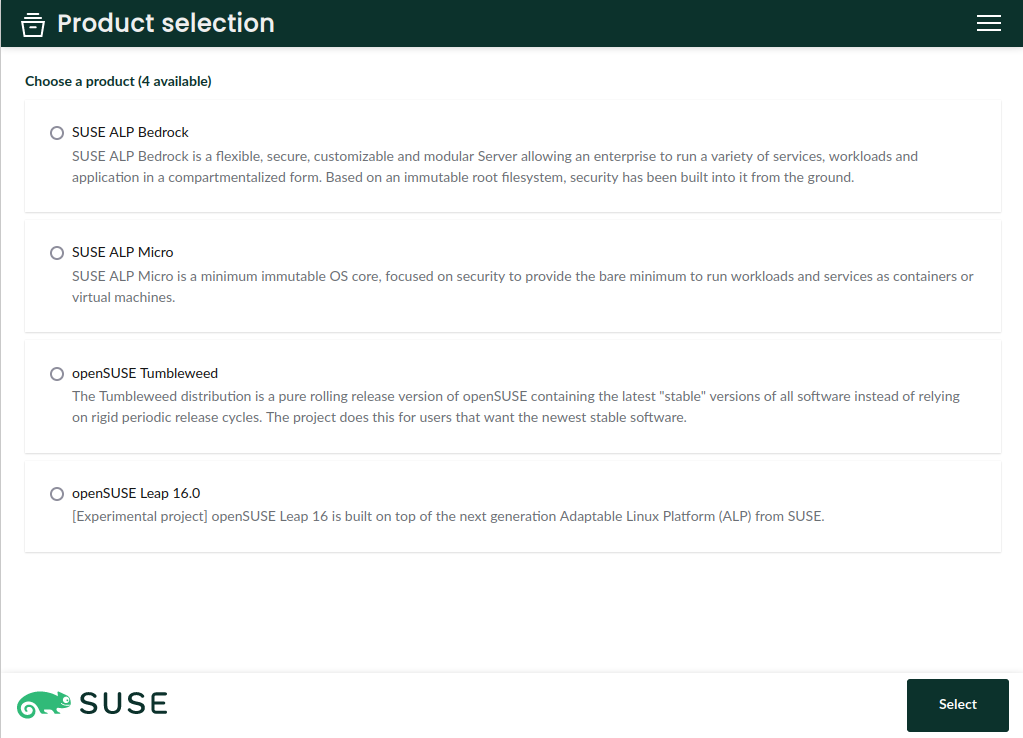
Take into account the YaST Team is not in charge of those distributions. D-Installer simply grabs the packages and default patterns from the corresponding repositories and installs them into your system. If you detect any inconsistency in the patterns of a distribution or any missing package, please contact the corresponding maintainers so they can fix the issue.
Support for s390x
One of the main highlights of the latest D-Installer prototype is the ability to install the mentioned distributions in s390x mainframes. That includes installing in LPAR mode, on z/VM and as a KVM guest.
That's a bigger achievement that it may look like. Sure having YaST under the hood eased the task of handling of the nuances of installing into such a special platform. But the real challenge here was making it possible to run D-Installer itself on all kind of s390 systems. We usually execute D-Installer using an slightly modified version of a live image in which we pack D-Installer and Firefox. The point is that regular (open)SUSE live images didn't come with full support for s390x out of the box.
Fortunately, SUSE is full of smart people that know a lot about Linux and all kind of hardware architectures. So after knocking on the appropriate doors we got a nice image that can be used to install any of the distributions supported by the D-Installer on any kind of s390x system by just following these instructions.
Advanced storage devices: iSCSI and DASD
Apart from its multi-architecture nature, another key aspect of the (open)SUSE installation process is its broad support for all kind of storage devices. D-Installer aims to simplify the installation experience without sacrificing those historical possibilities, like installing into network disks through iSCSI and FCoE or into disks relying on s390x technologies like DASD, XPRAM or zFCP.
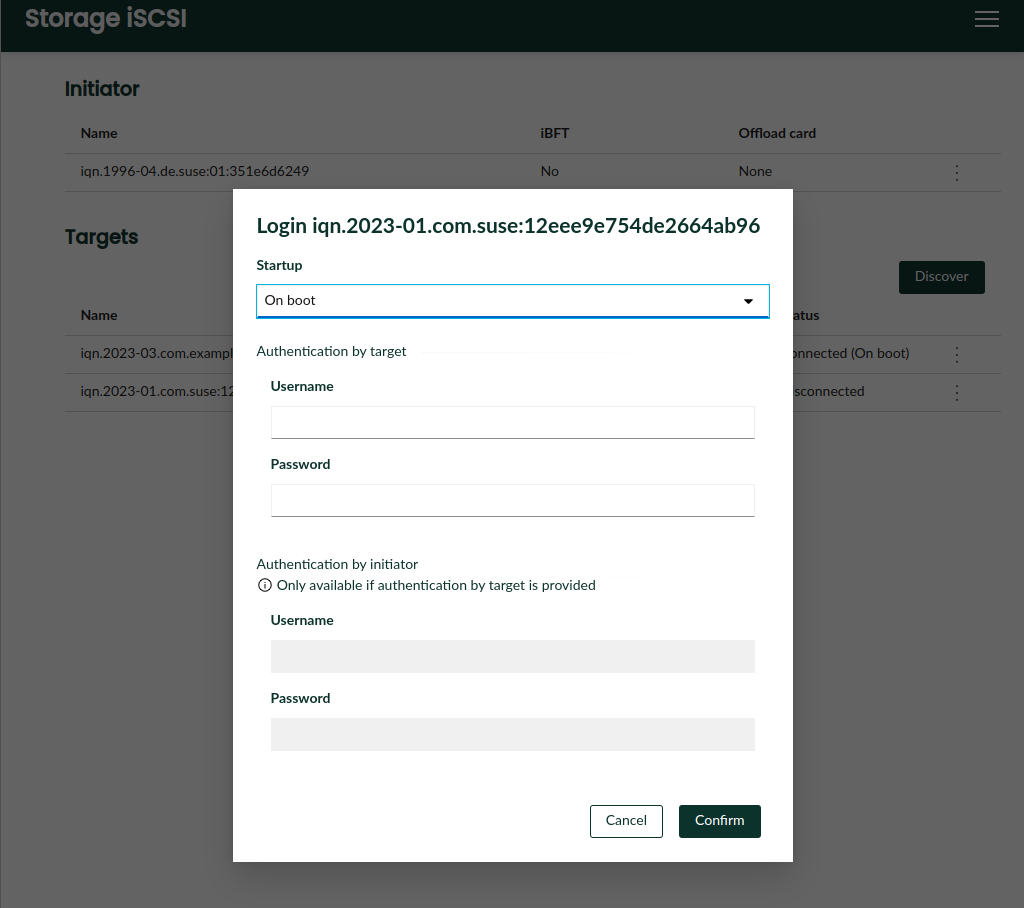
The latest version of D-Installer supports configuring an iSCSI initiator and connecting to iSCSI targets during the installation process, including the configuration of both discovery and login authentication. Of course, the iSCSI configuration is transferred to the target system. If iBFT is used to configure iSCSI via firmware, D-Installer recognizes and displays the corresponding configuration and makes it possible to install the system into the remote iSCSI disk.
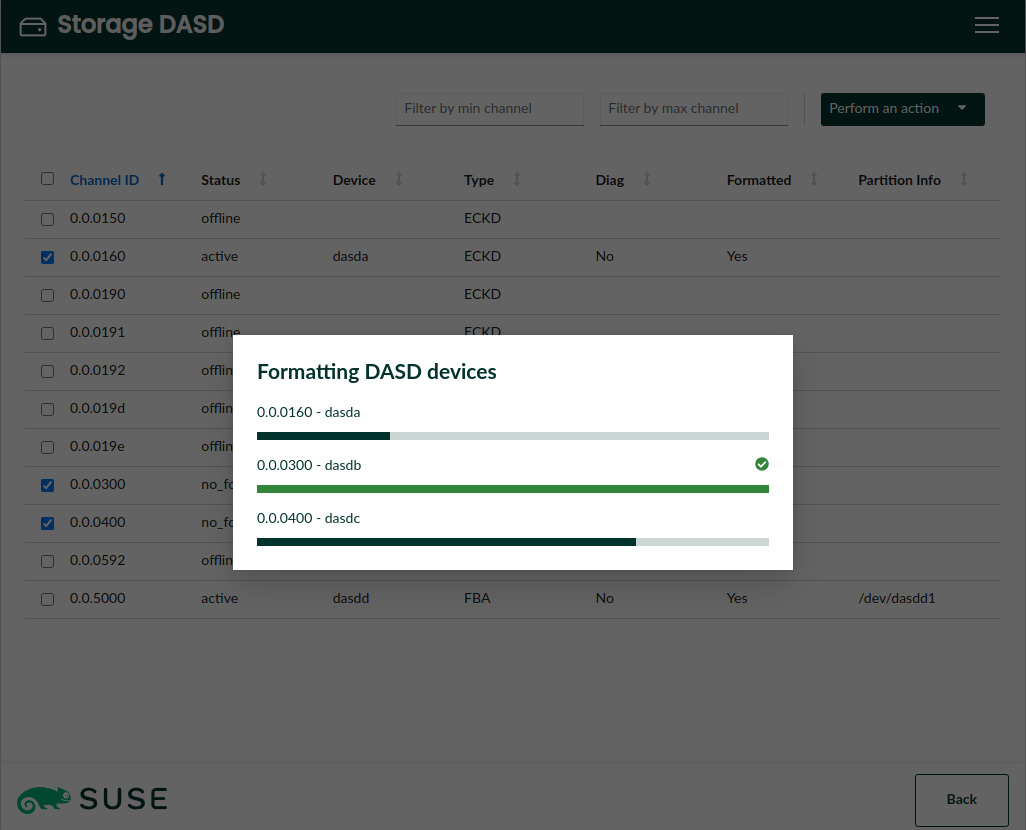
The iSCSI protocol is widely used in data-centers with all kind of hardware architectures. But in the mainframe world, DASD is probably the most common technology to provide storage space. DASDs need some previous configuration before they can accommodate a Linux system and now D-Installer offers the possibility to activate and format DASDs, together with other operations that have been traditionally available in YaST, like deactivation or configuration of the DIAG mode.
Interface polishing and reorganization
In addition to all the advanced features mentioned above, D-Installer 0.8 brings good news also for those geckos not running a full-featured data-center. 😉 First of all, we polished a bit the summary page to offer a more clear overview of the installation settings, moving configuration of authentication and network to new separate pages. See the screenshots at the corresponding pull request.
Moreover, we reorganized the sidebar that contains the advanced menu (which we fondly call "the hamburger menu). The actions are now grouped by topics and the menu offers contextual actions related to the current page, like configuration of iSCSI or DASD when the user is visiting the storage section.
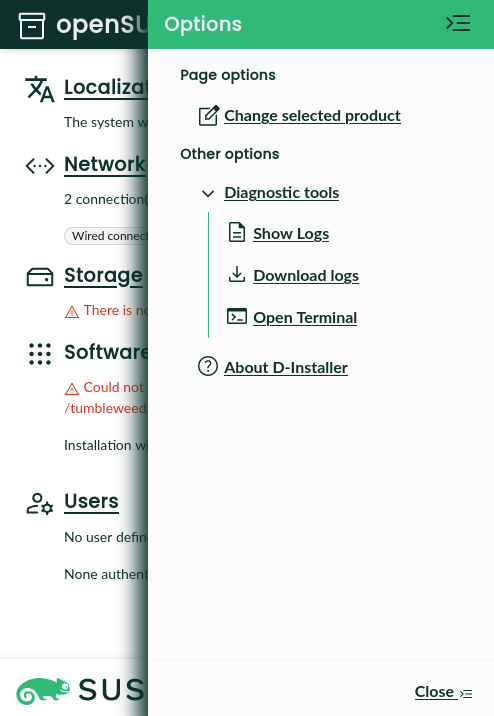
Integrated terminal
In the screenshot above, you may have noticed the entry "Open terminal" in the "Diagnosis tools" sub-menu. No surprises there, it does exactly what you would expect. That is, offering a terminal embedded in the web interface that runs a shell on the very same Linux system that is executing D-Installer. Because we know our users can not resist to tweak and inspect all kind of things in the systems they run!
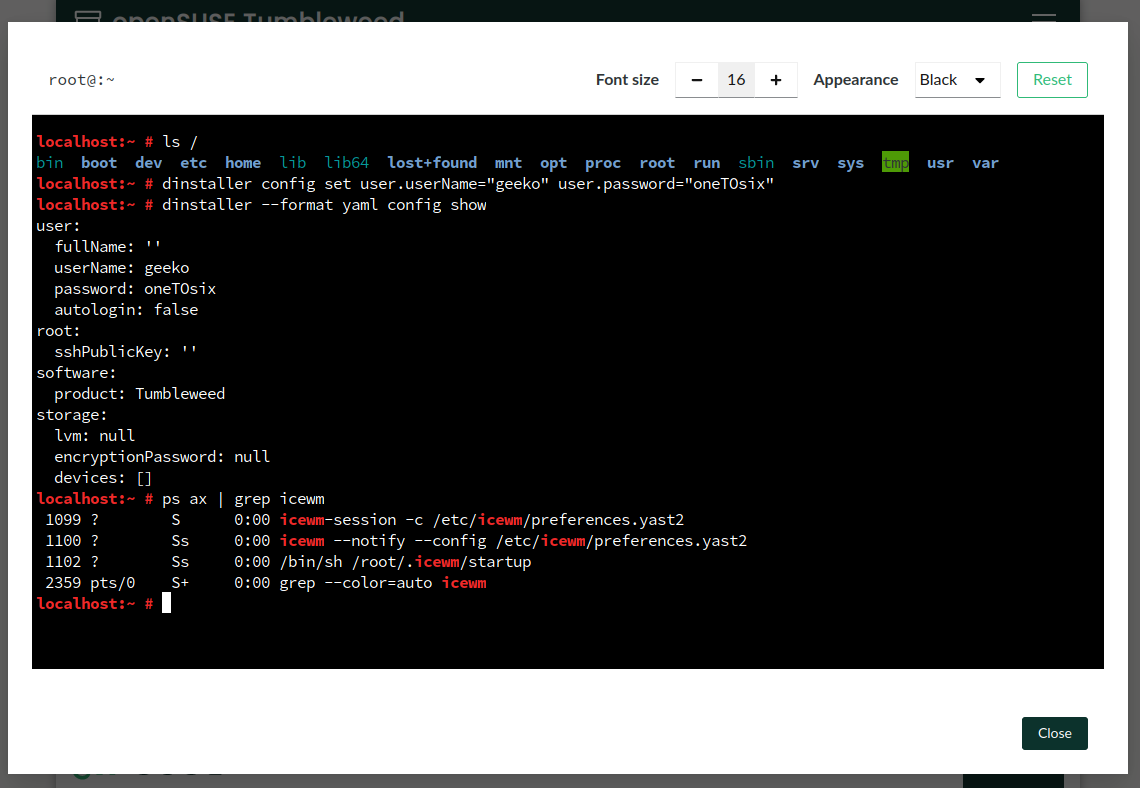
Kudos to the Cockpit project, relying on its infrastructure made this feature quite straightforward to implement.
Re-implemented command-line interface
You surely know D-Installer is way more than just a web front-end for YaST. Its architecture is designed to provide different kinds of interfaces and ways to operate. To make that more more visible than ever, D-Installer 0.8 comes with a new command-line interface rewritten from scratch (using the Rust programming language, if you are interested in those geeky details).
With the command-line interface you can drive the installation with sequences of command like:
dinstaller config set software.product=Tumbleweed
dinstaller config set user.fullName="Jane Doe" user.userName="jane.doe" user.password="12345"
dinstaller install
What is even better, that command-line is a crucial building block for another very relevant feature...
Preliminary support for unattended installation
Many (open)SUSE users rely on AutoYaST to install their systems. D-Installer aims to also be useful in the kind of unattended and mass-deployment scenarios in which AutoYaST shines. But D-Installer will follow a slightly different path. First of all, D-Installer offers two alternative approaches.
On the one hand, the user can provide a file, known as a "profile", with the settings to use during installation. This might sound familiar to AutoYaST users. The format and philosophy of D-Installer profiles is different from the AutoYaST ones, although there are plans to partially support AutoYaST profiles at D-Installer.
On the other hand, D-Installer can accept just a plain shell script, enabling custom installation workflows that rely on the D-Installer infrastructure and, potentially, also on other tools available in the installation media.
A more detailed explanation of both modes can be found at this document that covers several topics like the different ways to trigger an unattended installation, the format of the profile files, the mechanisms to make those profiles dynamic, etc.
Stay in touch
The D-Installer project is heading into interesting times, starting with the rename already pointed at the beginning of this document. We also want to take some time to reflect on internal aspects like memory usage and usability topics like exposing more possibilities to configure the network or the storage layout.
All opinions and feedback are welcome. So do not hesitate to give D-Installer a try and tell us
about your experience and thoughts. You can contact us through the GitHub
project's page or, as usual, in our #yast channel at
Libera.chat or the YaST Development mailing
list.

Announcing D-Installer 0.8
Six weeks ago we announced D-Installer 0.7 and a lot has happened since then. The most important news is that we just released a new prototype with version 0.8, integrating several exciting new features we will go through in this post. But this prototype is not only important because of those features, but also because it will be the last D-Installer release! Fear not, we are not abandoning the project… quite the opposite.
We want to consolidate D-Installer in the following months from the experimental project it currently is into a solid alternative for installing several Linux distributions. And the name was perceived by some people as an obstacle for that. So we will change it to an already decided alternative starting with the next prototype.
Adjusting the Scope
As said, we want D-Installer to become a real alternative to install some of the future and even present (open)SUSE distributions. So the first step was to better define the list of supported distribution, called “products” in D-Installer jargon. If you grab the default flavor of the testing ISO we provide, you will see the following selection.

Take into account the YaST Team is not in charge of those distributions. D-Installer simply grabs the packages and default patterns from the corresponding repositories and installs them into your system. If you detect any inconsistency in the patterns of a distribution or any missing package, please contact the corresponding maintainers so they can fix the issue.
Support for s390x
One of the main highlights of the latest D-Installer prototype is the ability to install the mentioned distributions in s390x mainframes. That includes installing in LPAR mode, on z/VM and as a KVM guest.
That’s a bigger achievement that it may look like. Sure having YaST under the hood eased the task of handling of the nuances of installing into such a special platform. But the real challenge here was making it possible to run D-Installer itself on all kind of s390 systems. We usually execute D-Installer using an slightly modified version of a live image in which we pack D-Installer and Firefox. The point is that regular (open)SUSE live images didn’t come with full support for s390x out of the box.
Fortunately, SUSE is full of smart people that know a lot about Linux and all kind of hardware architectures. So after knocking on the appropriate doors we got a nice image that can be used to install any of the distributions supported by the D-Installer on any kind of s390x system by just following these instructions.
Advanced Storage Devices: iSCSI and DASD
Apart from its multi-architecture nature, another key aspect of the (open)SUSE installation process is its broad support for all kind of storage devices. D-Installer aims to simplify the installation experience without sacrificing those historical possibilities, like installing into network disks through iSCSI and FCoE or into disks relying on s390x technologies like DASD, XPRAM or zFCP.
The latest version of D-Installer supports configuring an iSCSI initiator and connecting to iSCSI targets during the installation process, including the configuration of both discovery and login authentication. Of course, the iSCSI configuration is transferred to the target system. If iBFT is used to configure iSCSI via firmware, D-Installer recognizes and displays the corresponding configuration and makes it possible to install the system into the remote iSCSI disk.

The iSCSI protocol is widely used in data-centers with all kind of hardware architectures. But in the mainframe world, DASD is probably the most common technology to provide storage space. DASDs need some previous configuration before they can accommodate a Linux system and now D-Installer offers the possibility to activate and format DASDs, together with other operations that have been traditionally available in YaST, like deactivation or configuration of the DIAG mode.

Interface Polishing and Reorganization
In addition to all the advanced features mentioned above, D-Installer 0.8 brings good news also for those geckos not running a full-featured data-center. :wink: First of all, we polished a bit the summary page to offer a more clear overview of the installation settings, moving configuration of authentication and network to new separate pages. See the screenshots at the corresponding pull request.
Moreover, we reorganized the sidebar that contains the advanced menu (which we fondly call “the hamburger menu). The actions are now grouped by topics and the menu offers contextual actions related to the current page, like configuration of iSCSI or DASD when the user is visiting the storage section.

Integrated Terminal
In the screenshot above, you may have noticed the entry “Open terminal” in the “Diagnosis tools” sub-menu. No surprises there, it does exactly what you would expect. That is, offering a terminal embedded in the web interface that runs a shell on the very same Linux system that is executing D-Installer. Because we know our users can not resist to tweak and inspect all kind of things in the systems they run!

Kudos to the Cockpit project, relying on its infrastructure made this feature quite straightforward to implement.
Re-implemented Command-line Interface
You surely know D-Installer is way more than just a web front-end for YaST. Its architecture is designed to provide different kinds of interfaces and ways to operate. To make that more more visible than ever, D-Installer 0.8 comes with a new command-line interface rewritten from scratch (using the Rust programming language, if you are interested in those geeky details).
With the command-line interface you can drive the installation with sequences of command like:
dinstaller config set software.product=Tumbleweed
dinstaller config set user.fullName="Jane Doe" user.userName="jane.doe" user.password="12345"
dinstaller install
What is even better, that command-line is a crucial building block for another very relevant feature…
Preliminary Support for Unattended Installation
Many (open)SUSE users rely on AutoYaST to install their systems. D-Installer aims to also be useful in the kind of unattended and mass-deployment scenarios in which AutoYaST shines. But D-Installer will follow a slightly different path. First of all, D-Installer offers two alternative approaches.
On the one hand, the user can provide a file, known as a “profile”, with the settings to use during installation. This might sound familiar to AutoYaST users. The format and philosophy of D-Installer profiles is different from the AutoYaST ones, although there are plans to partially support AutoYaST profiles at D-Installer.
On the other hand, D-Installer can accept just a plain shell script, enabling custom installation workflows that rely on the D-Installer infrastructure and, potentially, also on other tools available in the installation media.
A more detailed explanation of both modes can be found at this document that covers several topics like the different ways to trigger an unattended installation, the format of the profile files, the mechanisms to make those profiles dynamic, etc.
Stay in Touch
The D-Installer project is heading into interesting times, starting with the rename already pointed at the beginning of this document. We also want to take some time to reflect on internal aspects like memory usage and usability topics like exposing more possibilities to configure the network or the storage layout.
All opinions and feedback are welcome. So do not hesitate to give D-Installer a try and tell us
about your experience and thoughts. You can contact us through the GitHub
project’s page or, as usual, in our #yast channel at
Libera.chat or the YaST Development mailing
list.