
 Member
 baltolkien
Más novedades de Plasma Mobile Gear 22.09
Finalizadas las charlas de Akademy 2022 de Barcelona e iniciándose los talleres donde se perfilará el trabajo del siguiente año de los diferentes grupos de desarrollo, es un buen momento de seguir hablando de más novedades de Plasma Mobile Gear 22.09, el cual estuvo disponible el 27 de septiembre. Es hora de conocer las novedades más destacas de este lanzamiento.
Más novedades de Plasma Mobile Gear 22.09
Como comenté hace unos días ha sido lanzado Plasma Mobile Gear 22.09, la cual llega con muchas novedades de las cuales día unas pinceladas en medio de Akademy-es 2022 de Barcelona.
Sigamos con los detalles algunas de ellas:
-
Pantalla principal:
- Añadido Halcyon, la nueva pantalla de inicio por defecto. Halcyon busca la simplicidad y permite utilizarla con una sola mano. También ha actualizado el diseño de la configuración de la pantalla de inicio, facilitando el cambio entre la antigua pantalla de inicio (Folio) y la nueva.


-
Dialer (marcador):
- Mejorada la aceptación de llamadas, la visualización de las notificaciones y la retroalimentación háptica, el cambio de los modos de audio de las llamadas de forma automática y también CI/CD para comprobar los cambios de los desarrolladores.
- Implementado el soporte de superposición de la pantalla de bloqueo para la pantalla de llamadas entrantes.
- Nuevo control de deslizamiento para responder a las llamadas.
- Soporte para el bloqueo de llamadas de números desconocidos. Esto permite cambiar la lógica de las notificaciones según la libreta de direcciones o los números de llamada que coincidan con un patrón.
- Introducida una corrección de regresión para soportar la inhibición del la suspensión cuando la llamada está activa.
-
Configuración:
- Se han varios módulos de configuración al nuevo estilo de formulario móvil y se ha modificado el módulo de configuración de energía para incluir más información sobre la batería.
-
Otras mejoras:
- Ahora se permite que Plasma Mobile se instale junto con el Plasma Desktop normal, simplificando la configuración necesaria. Ahora sólo tienes que cambiar el «Tema Global» en la Configuración a «Plasma Mobile», y entrar en la sesión de Plasma Mobile
¿Qué es Plasma Mobile?

Para los que no lo conozcan Plasma Mobile es la alternativa libre a interfaz gráfica para smartphones de la Comunidad KDE, hablé de él hace un tiempo y, poco a poco, se está convirtiendo en un clásico del blog.
Su idea es muy simple, tras conquistar tu escritorio KDE la Comunidad también quiere conquistar tu teléfono móvil… aunque todavía lo tenga complicado por todas las limitaciones de hardware que todavía tiene este campo de la tecnología.
No obstante, confiemos que de igual forma se han ido conquistando los ordenadores de sobremesa, portátiles y servidores, lleguemos un día que podamos tener libertad total en nuestros smartphones.
Y para cuando eso ocurra la Comunidad KDE estará preparada para ello y por eso está confeccionando un catálogo más que decente de aplicaciones con tecnología adaptativa.
La entrada Más novedades de Plasma Mobile Gear 22.09 se publicó primero en KDE Blog.
Las novedades de Plasma Mobile Gear 22.09
Hoy, en medio de Akademy 2022 de Barcelona es un buen momento para hablar de las novedades de Plasma Mobile Gear 22.09, el cual está disponible desde el 27 de septiembre. Es hora de conocer las novedades más destacas de este lanzamiento.
Las novedades de Plasma Mobile Gear 22.09
Como comenté hace unos días ha sido lanzado Plasma Mobile Gear 22.09, la cual llega con muchas novedades de las cuales día unas pinceladas en medio de Akademy-es 2022 de Barcelona.
Veamos hoy con detalles algunas de ellas:
-
Nucleo o motor (shell):
- Se está preparando para que Plasma Mobile utilice Plasma 5.26 (bendita convergencia) que será lanzado el próximo 11 de octubre.
-
Cajón de acciones (action drawer):
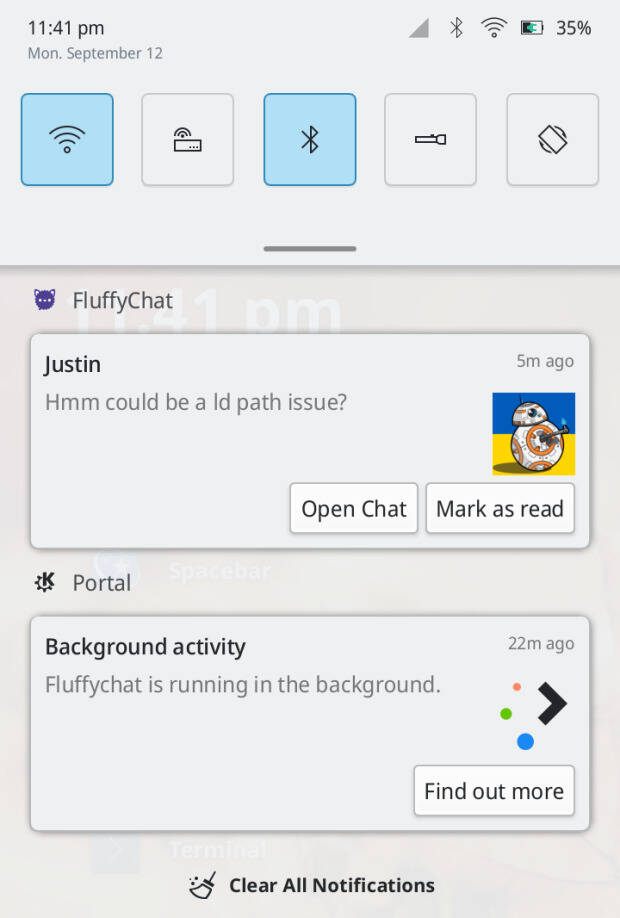
- Se ha añadido un botón «Borrar todas las notificaciones» a la lista de notificaciones para borrar rápidamente las notificaciones. También se ha añadido un ajuste rápido de «no molestar» para activar/desactivar las notificaciones que aparecen como ventanas emergentes.
- Añadido avisos más descriptivos en la configuración rápida de los datos móviles. Ahora pueden notificar a los usuarios si no tienen una tarjeta SIM insertada o no tienen un APN configurado.
-
Barra de navegación:
- Añadido soporte en KWin para informar de si las aplicaciones admiten la aparición del teclado virtual por sí mismas, y Devin ha integrado esta API en la barra de navegación: ahora se muestra un botón de alternancia de teclado si la aplicación actual no admite teclados (útil para las aplicaciones que utilizan XWayland)
-
Conmutador de tareas:
- Añadido un botón para cerrar todas las aplicaciones.
¿Qué es Plasma Mobile?
Para los que no lo conozcan Plasma Mobile es la alternativa libre a interfaz gráfica para smartphones de la Comunidad KDE, hablé de él hace un tiempo y, poco a poco, se está convirtiendo en un clásico del blog.
Su idea es muy simple, tras conquistar tu escritorio KDE la Comunidad también quiere conquistar tu teléfono móvil… aunque todavía lo tenga complicado por todas las limitaciones de hardware que todavía tiene este campo de la tecnología.
No obstante, confiemos que de igual forma se han ido conquistando los ordenadores de sobremesa, portátiles y servidores, lleguemos un día que podamos tener libertad total en nuestros smartphones.
Y para cuando eso ocurra la Comunidad KDE estará preparada para ello y por eso está confeccionando un catálogo más que decente de aplicaciones con tecnología adaptativa.
La entrada Las novedades de Plasma Mobile Gear 22.09 se publicó primero en KDE Blog.
Wallpaper Engine Kde Plugin, otro gestor de fondos para Plasma
Que el escritorio Plasma de la Comunidad KDE es increiblemente configurable es un hecho incontestable. Y desde hace unas cuantas versiones de Plasma todavía más ya que es posible descargar nuevos tipos de fondos de pantalla en nuestro escritorio. De esta forma se puede ampliar las opciones básicas como el color plano, la imagen fija o el carrusel de imágenes. Hoy me congratula compartir con vosotros uno más: Wallpaper Engine Kde Plugin, otro gestor de fondos para Plasma, una opción más de la Comunidad KDE.
Wallpaper Engine Kde Plugin, otro gestor de fondos para Plasma
Ya llevo presentados en el blog unos cuantos plugins que sirven para personalizar de forma extrema nuestro fondo de pantalla del escritorio Plasma de la Comunidad KDE. A modo de resumen he presentado:
- Video Wallpaper, un plugin con el que podíamos poder un vídeo como fondo de pantalla en Plasma. Un tiempoEra una opción muy interesante y, que según el vídeo a reproducir, consumía pocos recursos.
- Animated Image Wallpaper otro plugin de fondo de pantalla creado por Dark-Eye con el que podemos poner imágenes animadas como fondo de pantalla y que soporta los formatos animado GIF, MNG y WEBP.
- Flip Clock, un wallpaper animado para nuestro entorno de trabajo y que queda de fábula. No tiene ninguna opción y se instala directamente desde la configuración del fondo de pantalla.
- Game of Life un fondo de pantalla animado para nuestro escritorio que simula el clásico juego de cero jugadores, lo que quiere decir que su evolución está determinada por el estado inicial y no necesita ninguna entrada de datos posterior. (Vía: Wikipedia).
- Reddit Wallpaper, un plugin que selecciona una imagen de reddit, concretamente del subreddits que elijas, los cuales son muchos y variados.
- Shader Wallpaper, una creación de y4my4my4m que nos proporciona un número desmesurado de fondos animados con los que decorar nuestro escritorio.
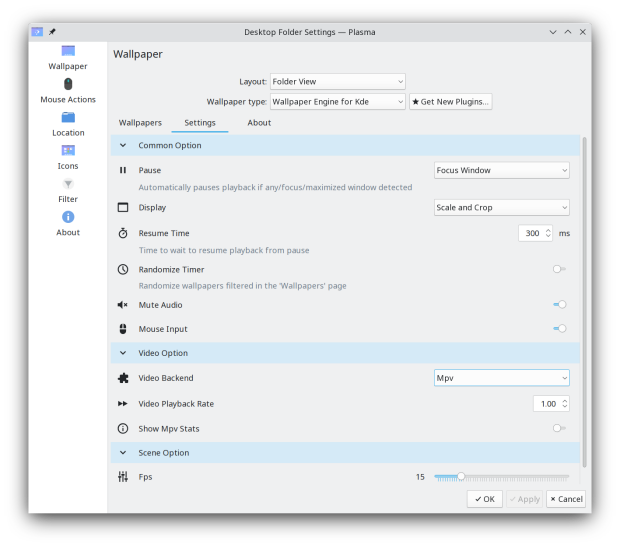
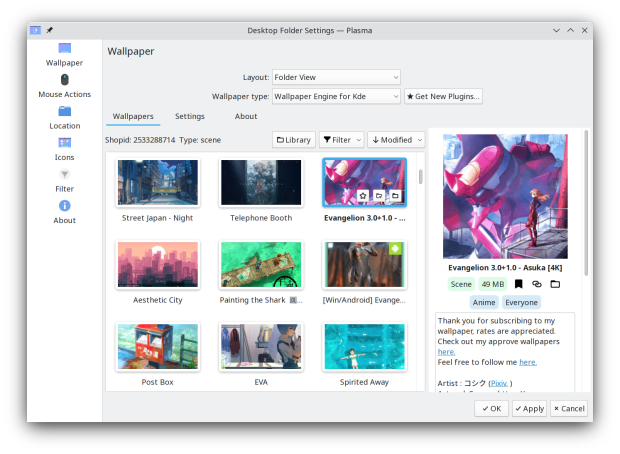
En esta ocasión os presento Wallpaper Engine Kde Plugin, otro gestor de fondos para Plasma que nos viene de la mano catsout y que nos permite controlar de forma muy precisa tanto imágenes o vídeos.
Y como siempre digo, si os gusta este plugin para el fondo de pantalla podéis “pagarlo” de muchas formas en la página de KDE Store, que estoy seguro que el desarrollador lo agradecerá: puntúale positivamente, hazle un comentario en la página o realiza una donación. Ayudar al desarrollo del Software Libre también se hace simplemente dando las gracias, ayuda mucho más de lo que os podéis imaginar, recordad la campaña I love Free Software Day 2017 de la Free Software Foundation donde se nos recordaba esta forma tan sencilla de colaborar con el gran proyecto del Software Libre y que en el blog dedicamos un artículo.
Más información: KDE.Store
La entrada Wallpaper Engine Kde Plugin, otro gestor de fondos para Plasma se publicó primero en KDE Blog.
#openSUSE Tumbleweed revisión de la semana 39 de 2022
Tumbleweed es una distribución «Rolling Release» de actualización contínua. Aquí puedes estar al tanto de las últimas novedades.

openSUSE Tumbleweed es la versión «rolling release» o de actualización continua de la distribución de GNU/Linux openSUSE.
Hagamos un repaso a las novedades que han llegado hasta los repositorios esta semana.
El anuncio original lo puedes leer en el blog de Dominique Leuenberger, publicado bajo licencia CC-by-sa, en este este enlace:
Durante esta semana se han publicado 5 nuevas snapshots que como siempre han traido cambios importantes a los repositorios de openSUSE tumbleweed.
De las 5 snapshots (0922..0929 excluyendo 0924 y 0927) podemos destacar:
- bind 9.18.7
- libreoffice 7.4.1.2
- nodejs 18 como predeterminado
- Mesa 22.2.0
- Kernel 5.19.10
- btrfsprogs 5.19.1
- mariadb 10.9.3
- gnome-shell-extensions 43.0
- libqt5 5.15.16
- perl-Mojolicious 9.27
En la próxima snapshot (0930) veremos cambios como:
- Linux kernel 5.19.12
- Nodejs 18.10
- distrobox 1.4.1
Y en próximas actualizaciones podremos esperar:
- KDE Plasma 5.26
- LLVM 15
- bash 5.2/readline 8.2
- fmt 9.0
- gpgme 1.18
- libxslt 1.1.36
- util-linux 2.38.1
Si quieres estar a la última con software actualizado y probado utiliza openSUSE Tumbleweed la opción rolling release de la distribución de GNU/Linux openSUSE.
Mantente actualizado y ya sabes: Have a lot of fun!!
Enlaces de interés
- ¿Por qué deberías utilizar openSUSE Tumbleweed?
- zypper dup en Tumbleweed hace todo el trabajo al actualizar
- ¿Cual es el mejor comando para actualizar Tumbleweed?
- ¿Qué es el test openQA?
- http://download.opensuse.org/tumbleweed/iso/
- https://es.opensuse.org/Portal:Tumbleweed

——————————–
openSUSE Tumbleweed – Review of the week 2022/39
Dear Tumbleweed users and hackers,
This week’s been a little different from Tumbleweed as our regular release wrangler, Dominique, has been sick. Therefore I’ve stepped in and picked things up without our usual handovers which made things a little challenging, but I’m proud to be able to say we still released 5 snapshots in the last 7 days, including some pretty big changes.
The 5 snapshots (0922..0929 excluding 0924 and 0927) released during this week brought you these larger changes among many many smaller ones:
- bind 9.18.7 (Security and minor feature/bug fixes)
- libreoffice 7.4.1.2
- nodejs 18 as the default
- Mesa 22.2.0
- Kernel 5.19.10
- btrfsprogs 5.19.1
- mariadb 10.9.3
- gnome-shell-extensions 43.0
- libqt5 5.15.16
- perl-Mojolicious 9.27
In the next snapshot (0930) we expect the following fun stuff:
- Linux kernel 5.19.12
- Nodejs 18.10
- distrobox 1.4.1
In the staging projects, we currently test submissions like:
- distrobox as the default instead of toolbox for the MicroOS Desktop (Staging:C)
- KDE Plasma 5.26 (5.25.90 staged, Staging:K)
- LLVM 15: breaks all versions of PostgreSQL (Staging:M, almost ready)
- bash 5.2/readline 8.2 (breaks tre and also broke tcsh but fix already with these in Staging:A)
- fmt 9.0: Breaks ceph and zxing-cpp
- gpgme 1.18: breaks LibreOffice
- libxslt 1.1.36: breaks daps
- util-linux 2.38.1: this also brings a massive package layout change, which will probably take some time to settle. It’s part of the distro bootstrap and we have to be careful not to blow it out of proportion

Kmail Message List Tabs
Disponible Plasma Mobile Gear 22.09
Hoy, en medio de Akademy-es 2022 de Barcelona y empezando Akademy con las mismas fechas y ciudad de celebración, toca hablar de que también está disponible, desde el 27 de septiembre, Plasma Mobile Gear 22.09, la colección de aplicaciones especialmente diseñadas para dispositivos móviles. Hagamos una breve reseña del lanzamiento.
¿Qué es Plasma Mobile?
Para los que no lo conozcan Plasma Mobile es la alternativa libre a interfaz gráfica para smartphones de la Comunidad KDE, hablé de él hace un tiempo y, poco a poco, se está convirtiendo en un clásico del blog.
Su idea es muy simple, tras conquistar tu escritorio KDE la Comunidad también quiere conquistar tu teléfono móvil… aunque todavía lo tenga complicado por todas las limitaciones de hardware que todavía tiene este campo de la tecnología.
No obstante, confiemos que de igual forma se han ido conquistando los ordenadores de sobremesa, portátiles y servidores, lleguemos un día que podamos tener libertad total en nuestros smartphones.
Y para cuando eso ocurra la Comunidad KDE estará preparada para ello y por eso está confeccionando un catálogo más que decente de aplicaciones con tecnología adaptativa.
Disponible Plasma Mobile Gear 22.09
En este mes de septiembre, y siguiendo la estela de los KDE Gear, Plasma Mobile Gear ha lanzado su versión 22.09, la cual llega con muchas novedades. Veamos algunas de ellas a la espera de poder realizar un articulo más completo.
- Se ha añadido un botón «Borrar todas las notificaciones» a la lista de notificaciones para borrar rápidamente las notificaciones. También se ha añadido un ajuste rápido de «no molestar» para activar/desactivar las notificaciones que aparecen como ventanas emergentes.
- Añadido soporte en KWin para informar de si las aplicaciones admiten la aparición del teclado virtual por sí mismas, y Devin ha integrado esta API en la barra de navegación: ahora se muestra un botón de alternancia de teclado si la aplicación actual no admite teclados (útil para las aplicaciones que utilizan XWayland).
- Añadido Halcyon, la nueva pantalla de inicio por defecto. Halcyon busca la simplicidad y permite utilizarla con una sola mano. También ha actualizado el diseño de la configuración de la pantalla de inicio, facilitando el cambio entre la antigua pantalla de inicio (Folio) y la nueva.
- Simplificada la interfaz de Kstats combinando la página de podcasts con la de la lista de episodios. También trabajó en la mejora de las páginas de información del podcast y de los episodios, añadiendo una barra de botones (desplazando las acciones fuera de la cabecera de la aplicación), y reelaborando el diseño de la información.
La entrada Disponible Plasma Mobile Gear 22.09 se publicó primero en KDE Blog.
Cómo seguir Akademy-es 2022 de Barcelona en línea #akademyes
Hoy empieza Akademy-es 2022 de Barcelona 2022, el esperado encuentro organizado por KDE España para todos los simpatizantes del proyecto que este año será presencial y en línea. Los seguidores del blg sabrán que se celebra el 29 y 30 de sepetiembre pero no sabrán cómo seguir Akademy-es 2022 ya que todavía no se había hecho pública la dirección de la sala. Por eso, escribo esta entrada y comparto el enlace con todos vosotros, al tiempo que os animo a hacer los mismo con vuestro allegados y redes sociales.
Mañana empieza Akademy-es 2022 de Barcelona
Como sabrán los lector del blog (y me consta porque hay alguno que incluso se me ha quejado) el 29 y 30 de octubre se va a celebrar Akademy-es 2022 de Barcelona de forma híbrida, el evento más importante para los desarrolladores y simpatizantes de KDE, organizado por KDE España.
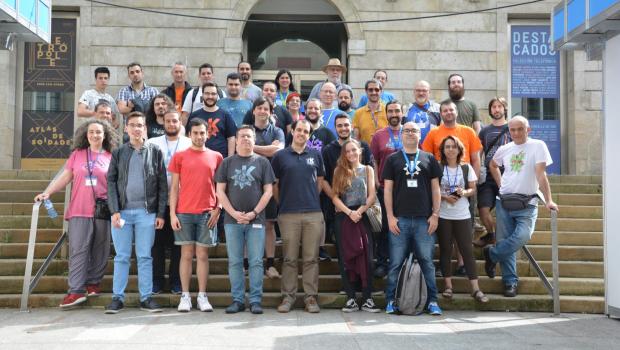
A lo largo de muchas entradas he hablado de patrocinadores, colaboradores, sede, programa, las razones para ir al evento… es decir, he promocionado al máximo Akademy-es 2022 por su importancia dentro de la Comunidad Kdeera, por ser un momento dinamizador de la asociación y por ser la antesala de Akademy 2022, la versón internacional que se celebrará del 1 al 7 de octubre, aunque no en la misma sede… alerta con eso.
No obstante, la entrada de hoy, y dado que yo no puedo estar de forma presencial, quiero compartir el enlace por el que podreís entrar a la modalidad en línea: https://meet.kde.org/b/jos-fh3-rdp-wjn
Aunque mejor pinchar en la imagen de abajo que es todavía más sencillos acceder:

Programa del jueves 29 de septiembre por la tarde
La entrada Cómo seguir Akademy-es 2022 de Barcelona en línea #akademyes se publicó primero en KDE Blog.

SMB3 UNIX Extensions
One of the primary issues preventing the last few holdouts from migrating away from SMB1 is a lack of Posix/UNIX extensions in SMB2+. SMB1 is definitely going away though in the near future.
To compensate, the community has been hard at work creating a new UNIX extension standard for SMB3. These have been in the works since as early as 2010, but have recently seen some renewed interest in completion. The Linux ksmbd server and cifs client both support SMB3 UNIX extensions. Several third party servers also offer support. Support from Samba server is nearing completion.
A critical part of implementing a new standard is documenting that standard. I, along with several other members of the Samba team, have collaborated on an open standard (not GPL), which fits neatly in with the other SMB protocol documents. The project is currently hosted on codeberg. The license is intentionally friendly to both opensource and closed source.
The details of the documentation are only now being written down, but have been hashed out over the past 12 years in various iterations. A preliminary version of the specification is available below.
If you have comments or suggested edits, please join the discussion on the samba-technical mailing list.
syslog-ng 101: how to get started with learning syslog-ng?
How to get started with syslog-ng? There are two main resources: the syslog-ng documentation and the syslog-ng blogs. You should learn the concepts and basics from the documentation. The blogs document use cases and you can use the docs as a reference.
syslog-ng logo
Read the rest of my blog at: https://www.syslog-ng.com/community/b/blog/posts/syslog-ng-101-how-to-get-started-with-learning-syslog-ng