
 Member
 baltolkien
Mix de novedades de KDE Gear 21.08
Como estoy comentando estos días, estamos ante un nuevo lanzamiento masivo de actualizaciones de las aplicaciones KDE, en esta ocasión en pleno mes de agosto, con el que los desarrolladores de la Comunidad KDE siguen mostrando al mundo que tienen claro que su objetivo es ofrecer los mejor del Software Libre para todos de forma continua, constante y sin cambios revolucionarios. Finalizo la serie con el mix de novedades de KDE Gear 21.08, siguiendo la estela de las novedades de Dolphin, de Okular , de Konsole o de Gwenview de días anteriores.
Mix de novedades de KDE Gear 21.08
Son decenas, sino más de una centenar, las aplicaciones del ecosistema KDE, siempre en continua evolución, buscando adaptarse a los usuarios.

Muchas de estas aplicaciones tienen actualizaciones menores en cada cambio de numeración, otras tienen grandes novedades, de las cuales ya hemos hablado, y otras, como las que nos ocupan en la entrada de hoy, simplemente incorporan una mejora que merezca la pena destacar, como vamos a hacer en esta entrada:
- Elisa, un reproductor de audio de KDE, recuerda ahora la pista y el momento exacto de reproducción al reanudar una lista de ídem.
- Spectacle ahora permite ahora hacer capturas de la ventana que esté debajo del cursor pulsando la combinación de teclas Meta (Windows) + Ctrl + Imprimir. Spectacle también es más rápido y más fiable en Wayland y las opciones sobre qué copiar tras hacer una captura se han simplificado.
- Kate adquiere una nueva funcionalidad: Fragmentos. Los fragmentos son útiles plantillas de porciones de código que puede soltar en sus proyectos cuando mientras esté programando.
- Kdenlive, el software multipropósito de edición de vídeo de KDE, ha migrado a MLT 7. Esto significa que puede esperar nuevas funcionalidades en las funciones existentes, como cambiar la velocidad de un clip, que ahora es un efecto de los fotogramas clave.
- KDE Connect permite que dos o más dispositivos (como el teléfono y el portátil) se comuniquen fácilmente entre sí y puedan compartir archivos y recursos.
- Yakuake , un emulador de terminal (como Konsole) que reside en la parte superior de la pantalla, ahora permite cambiar de un panel al siguiente usando [Ctrl] + [Tabulador].
- Ark ahora muestra una pantalla de bienvenida cuando se abre sin un archivo comprimido y puede descomprimir archivos ZIP con barras inversas al estilo de Windows que se usan como separadores de rutas.
Y con esto finalizamos el resumen de KDE Gear  21.08 espero que os haya gustado.. y ahora a actualizar, probar y esperar a las novedades de septiembre.
Más información: KDE Gear 21.08


Customize IBus User Guide
GNOME Desktop
First, make sure you have installed the GNOME Shell Extension: Customize IBus https://extensions.gnome.org/extension/4112/customize-ibus/
Installation
You can refer to here: https://itsfoss.com/gnome-shell-extensions/ to install the GNOME Shell Extension from a web browser.
or
- Linux:
git clone https://github.com/openSUSE/Customize-IBus.git
cd Customize-IBus && make install
- FreeBSD:
git clone https://github.com/openSUSE/Customize-IBus.git
cd Customize-IBus && gmake install
If you want to install Customize IBus as a system extension for all users:
- For Arch based:
yay -S gnome-shell-extension-customize-ibus

- For Fedora:
wget https://github.com/openSUSE/Customize-IBus/raw/package-repo/customize-ibus-rpm.repo
sudo mv customize-ibus-rpm.repo /etc/yum.repos.d/
sudo dnf update
sudo dnf install gnome-shell-extension-customize-ibus
- For OpenSUSE:
wget https://github.com/openSUSE/Customize-IBus/raw/package-repo/customize-ibus-rpm.repo
sudo mv customize-ibus-rpm.repo /etc/zypp/repos.d/
sudo zypper refresh
sudo zypper install gnome-shell-extension-customize-ibus
Or install directly through the ymp file.
- For Debian based (Ubuntu):
echo "deb http://opensuse.github.io/Customize-IBus/deb/ /" | sudo tee -a /etc/apt/sources.list.d/customize-ibus-deb.list > /dev/null
wget -q -O - http://opensuse.github.io/Customize-IBus/hollowman.pgp | sudo apt-key add -
sudo apt update
sudo apt install gnome-shell-extension-customize-ibus
PPA:
sudo add-apt-repository ppa:hollowman86/customize-ibus
sudo apt-get update
You can download the majority of your Linux distributions related packages through OpenSUSE OBS and then install.
- Gentoo:
git clone https://github.com/openSUSE/Customize-IBus.git
cd Customize-IBus && make emerge
- NixOS:
sudo nix-env -i gnomeExtensions.customize-ibus
- Guix:
guix install gnome-shell-extension-customize-ibus
- FreeBSD:
wget https://github.com/openSUSE/Customize-IBus/raw/package-repo/customize_ibus.conf
sudo mkdir -p /usr/local/etc/pkg/repos/
sudo mv customize_ibus.conf /usr/local/etc/pkg/repos/
sudo pkg update
sudo pkg install gnome-shell-extension-customize-ibus
After installation, you will find that there is an additional entry Customize IBus in the IBus input source indicator menu. Click it, and you will open the Customize IBus preferences. If there is no such menu entry, you can press Alt+F2 to restart the GNOME shell, or log out and log in again. If that still doesn’t work, please make sure you have installed the latest version of the extension and have enabled the extension.

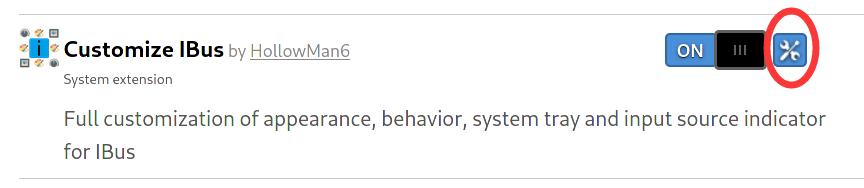
You can also click the configuration icon of the Customize IBus extension in https://extensions.gnome.org/local/ to open the preferences.
General

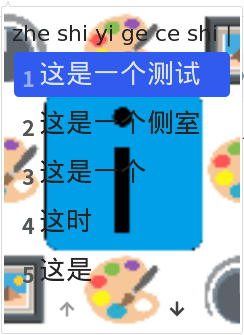
At item Candidates orientation, select the check box on the left to enable the configuration of the IBus candidate box direction. Click on the right side to select, it can be set to vertical or horizontal.
At item Candidates popup animation, select the check box on the left to enable the configuration of the IBus animation. Click on the right side to select, support setting to no animation, slide, fade, and both.
Example to turn on the sliding animation: 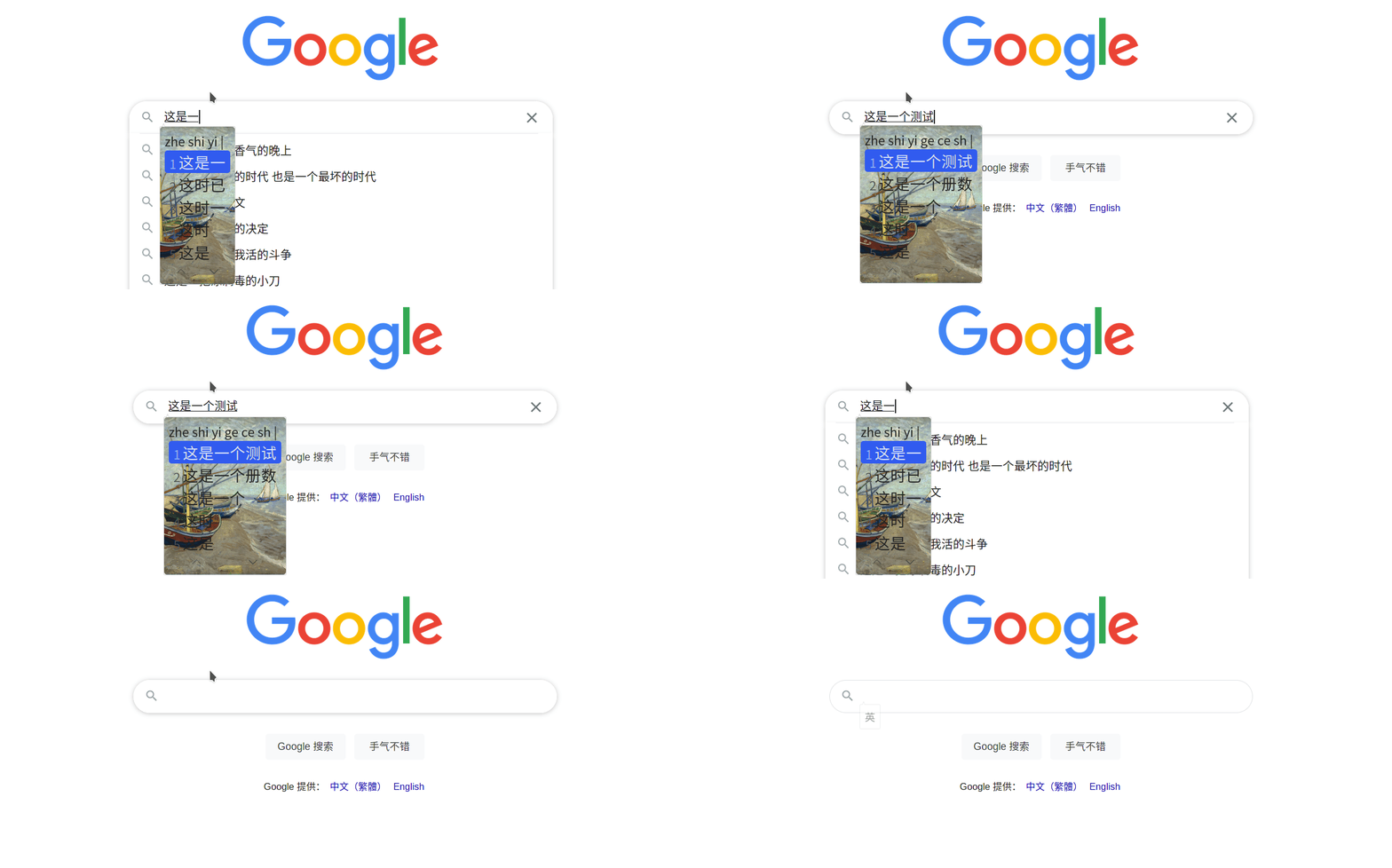
At item Candidate box right click, select the check box on the left to enable the configuration of right-click the candidate box to perform related operations when using the IBus. Click on the right to make a selection, and you can set to open the tray menu or switch the input source.
At item Candidates scroll, select the check box on the left to enable the configuration of actions performed when scrolling using the IBus. Click on the right to select, and you can set to switch the current candidate word or page.
At item Fix candidate box, select the check box on the left to enable a fixed candidate box. Click on the right to select. You can set the candidate box position with 9 options. Recommend to enable Drag to reposition candidate box at the same time so that you can rearrange the position at any time. Will remember candidate position forever after reposition if you set to Remember last position, and restore at next login.
At item Use custom font, select the check box on the left to enable configuration of the font and size of the text in the IBus candidate box. Click on the right to open the font selector. In the pop-up dialog box, you can select the font you want in the upper part and the font size in the lower part. Click Select to confirm the modification. 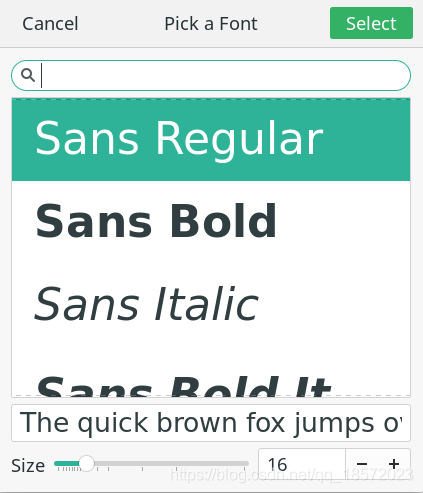
At item Auto switch ASCII mode, select the check box on the left to enable configuration of switching ASCII mode when switching windows, Click on the far right to select. It supports setting to make ASCII mode on and off, or just keep to remain current mode. You can also set to remember input state or not on the near right. If you have set to Remember Input State, every opened APP’s input mode will be remembered if you have switched the input source manually in the APP’s window, and the newly-opened APP will follow the configuration. APP’s Input State will be remembered forever.
At item Candidate box opacity, select the check box on the left to enable configuration of the opacity in the IBus candidate box. Slide the right button to configure opacity ranging from 0 to 255 step 1.
At item Fix IME list order, click the switch on the right to turn this feature on or off.
If you use multiple input methods in your system, when you use the keyboard shortcut to switch input methods (usually Win + Space), the input method displayed by default on the screen will be sorted by the most recently used input method. Turn on this feature to modify the order of input methods as fixed.
When off:

When on:

At item Enable drag to reposition candidate box, click the switch on the right to turn this feature on or off.
Example of turning on drag to reposition candidate box: 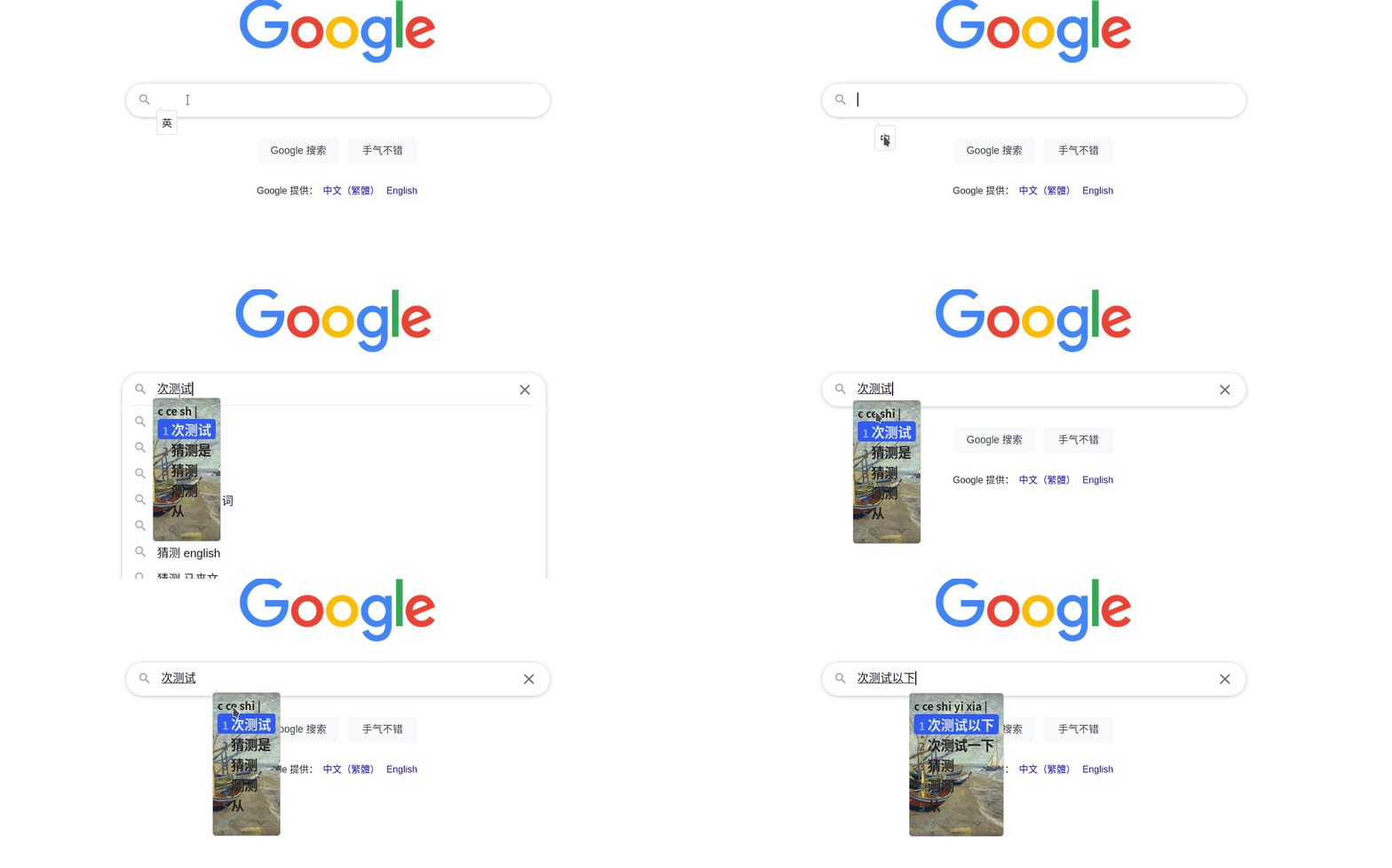
At item Candidate box page buttons, click the switch on the right to show or hide the candidate page buttons.
Tray
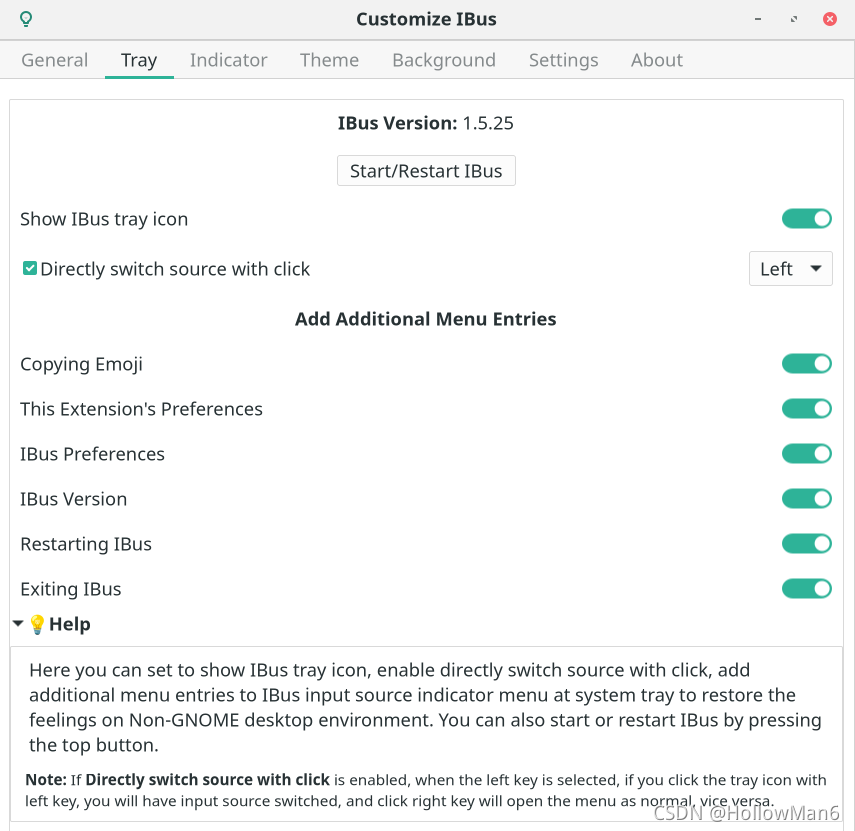
Here you can set to show IBus tray icon, enable directly switch source with click, add additional menu entries to IBus input source indicator menu at system tray to restore the feelings on Non-GNOME desktop environment.
All menus are enabled:

You can also start or restart IBus by pressing the top button: 
Indicator
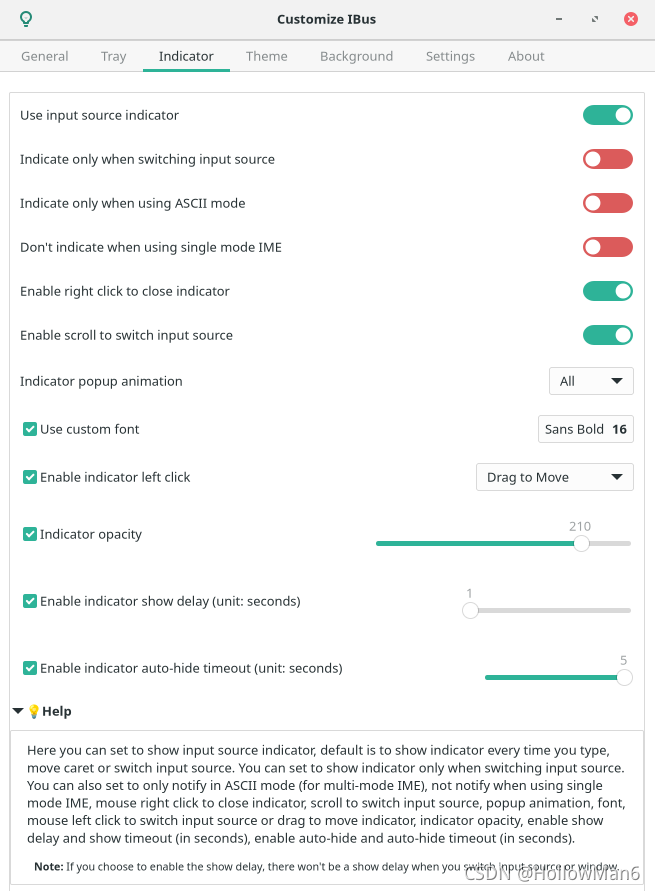
Here you can set to Use input source indicator, default is to show indicator every time you type, move caret or switch input source. You can set to Indicate only when switching input source by clicking the switch on the right. You can also set to Indicate only when using ASCII mode (for multi-mode IME), Don't indicate when using single mode IME, Right click to close indicator, Scroll to switch input source, Indicator popup animation supporting None, Slide, Fade, All. Also support to Use custom font, Enable indicator left click to switch input source or drag to move indicator, set Indicator opacity supporting range of 0 to 255, and the setting step is 1, Enable indicator show delay (unit: seconds), Enable indicator auto-hide timeout (unit: seconds) and auto-hide timeout (in ” “seconds) supporting to set the hidden delay in the range of 1 second to 5 seconds, and the setting step is 1.
Note: If you choose to enable the show delay, there won’t be a show delay when you switch input source or window.
Example animation: 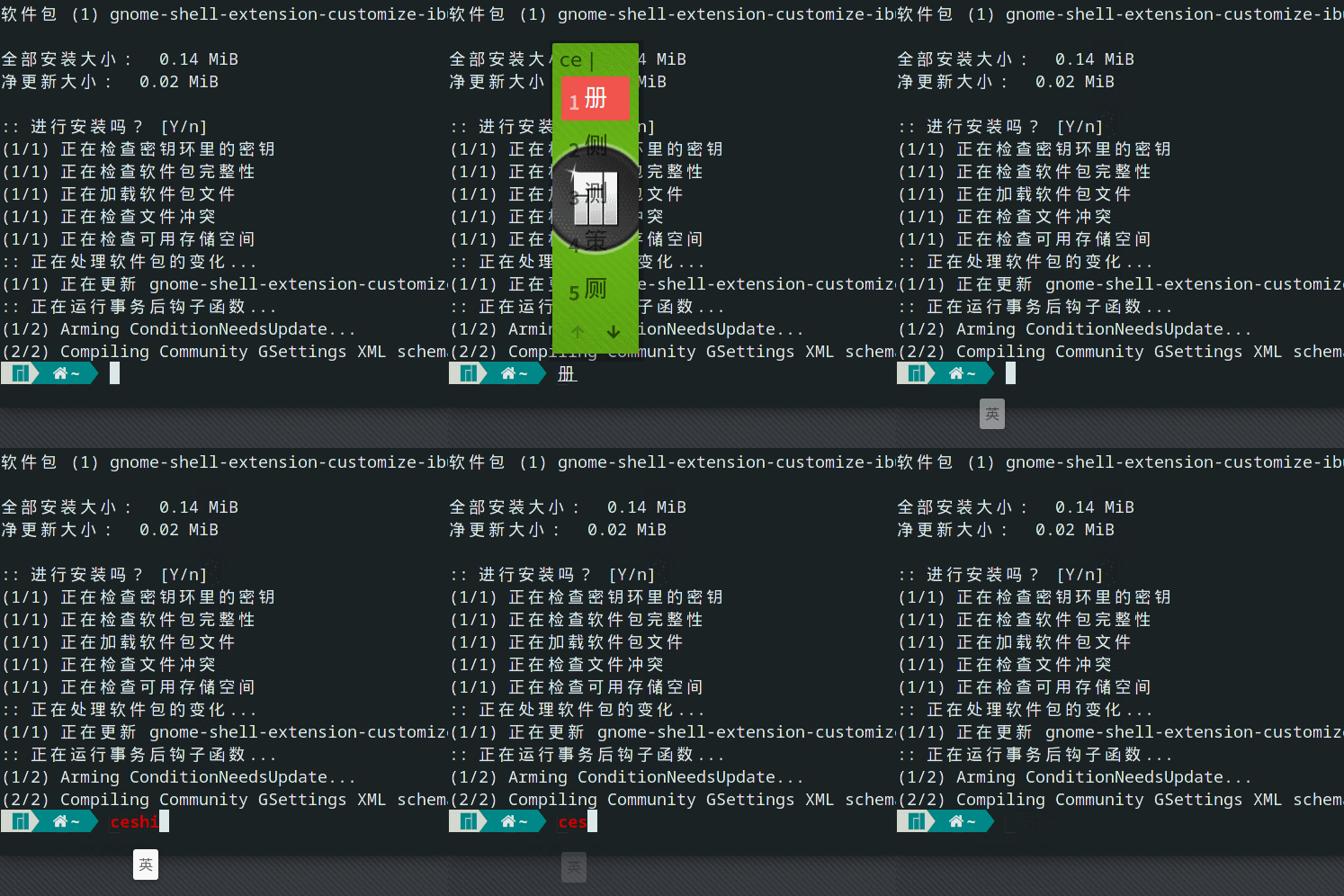
Theme
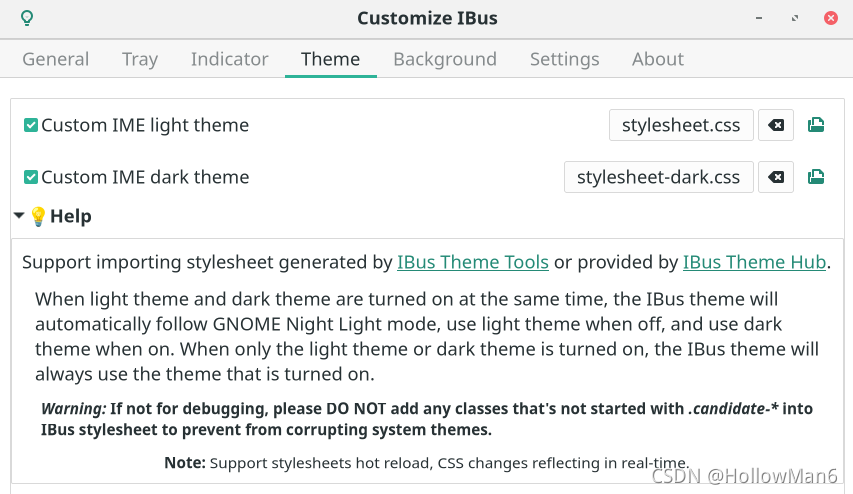
Same as the general part, select the check box on the left to enable the configuration, and click on the right to select the IBus theme style sheet.
If you have selected a style sheet, click the icon on the far right to directly open it to view the style sheet. You can also click the clear icon to make it follow system theme.
Supports importing style sheets generated by the IBus Theme Tools or provided by the IBus Theme Hub.
When light theme and dark theme are turned on at the same time, the IBus theme will automatically follow GNOME Night Light mode, use light theme when off, and use dark theme when on. When only the light theme or dark theme is turned on, the IBus theme will always use the theme that is turned on.
If not for debugging, please DO NOT add any classes that’s not started with .candidate-* into IBus stylesheet to prevent from corrupting system themes.
If your IBus style sheet has changed after application, please close and reopen the corresponding Starting from v69, now this extension support stylesheets hot reload, CSS changes will reflect in real-time.custom IME theme to make it effective.
You can download more GNOME Shell themes from this website: https://www.pling.com/s/Gnome/browse/cat/134/order/latest/, then put it under the $HOME/.themes/ directory to complete the installation.
The IBus theme tool style sheet generation uses the GNOME Shell theme that has been installed on the computer to extract the IBus style. The extraction steps are as follows:
- Refer to the following part:
Non-GNOME Desktop->Customize IBus Themesteps 1-2 to run the program. - Enter the number of the IBus-related GNOME Shell theme style you want to export, and press
Enter.
- Enter the location of the GNOME Shell theme style sheet exported related to IBus that you want to store, and press
Enter. Empty selection will be the default, that is in the current directoryexportedIBusTheme.cssfile. If there is no error message, it will be successfully exported to the specified location.


Example export file:
/*
 Generated by IBus Theme Tools
 Tool Author: Hollow Man <hollowman@hollowman.ml>
 Tool Source Code: https://github.com/openSUSE/IBus-Theme-Tools
 Tool Licence: GPLv3
 CSS Source File: /usr/share/gnome-shell/theme/gnome-classic-high-contrast.css

 Recommend to use Customize IBus GNOME Shell Extension:
 https://extensions.gnome.org/extension/4112/customize-ibus/
 to change IBus theme by selecting this file.

 If you make any changes to this content after applying this file in above extension,
 for Customize IBus Extension before v68, please disable and then enable 'custom IME theme'
 again to make the changes take effect.

 Starting from v69, support stylesheets hot reload, CSS changes reflecting in real-time.
*/

/*
 Imported from CSS Source File: /usr/share/gnome-shell/theme/gnome-classic.css
*/

.candidate-page-button:focus {
  color: #2e3436;
  text-shadow: 0 1px rgba(255, 255, 255, 0.3);
  icon-shadow: 0 1px rgba(255, 255, 255, 0.3);
  box-shadow: inset 0 0 0 2px rgba(53, 132, 228, 0.6);
}

.candidate-page-button:hover {
  color: #2e3436;
  background-color: white;
  border-color: #d6d1cd;
  box-shadow: 0 1px 1px 0 rgba(0, 0, 0, 0.1);
  text-shadow: 0 1px rgba(255, 255, 255, 0.3);
  icon-shadow: 0 1px rgba(255, 255, 255, 0.3);
}

.candidate-page-button:insensitive {
  color: #929595;
  border-color: #e1ddda;
  background-color: #faf9f8;
  box-shadow: none;
  text-shadow: none;
  icon-shadow: none;
}

.candidate-page-button:active {
  color: #2e3436;
  background-color: #efedec;
  border-color: #cdc7c2;
  text-shadow: none;
  icon-shadow: none;
  box-shadow: none;
}

.candidate-index {
  padding: 0 0.5em 0 0;
  color: #17191a;
}

.candidate-box:selected,
.candidate-box:hover {
  background-color: #3584e4;
  color: #fff;
}

.candidate-page-button-box {
  height: 2em;
}

.vertical .candidate-page-button-box {
  padding-top: 0.5em;
}

.horizontal .candidate-page-button-box {
  padding-left: 0.5em;
}

.candidate-page-button-previous {
  border-radius: 5px 0px 0px 5px;
  border-right-width: 0;
}

.candidate-page-button-next {
  border-radius: 0px 5px 5px 0px;
}

.candidate-page-button-icon {
  icon-size: 1em;
}

.candidate-box {
  padding: 0.3em 0.5em 0.3em 0.5em;
  border-radius: 5px; /* Fix candidate color */
  color: #2e3436;
}

.candidate-popup-content {
  padding: 0.5em;
  spacing: 0.3em; /* Fix system IBus theme background inherited in replaced theme */
  background: transparent;
  /* Fix system IBus theme candidate window border inherited in replaced theme */
  border: transparent;
  /* Fix system IBus theme candidate box shadow inherited in replaced theme */
  box-shadow: none;
  /* Fix candidate color */
  color: #2e3436;
}

.candidate-popup-boxpointer {
  -arrow-border-radius: 9px;
  -arrow-background-color: #f6f5f4;
  -arrow-border-width: 1px;
  -arrow-border-color: #cdc7c2;
  -arrow-base: 24px;
  -arrow-rise: 12px;
  -arrow-box-shadow: 0 1px 3px rgba(0, 0, 0, 0.5); /* Fix black border at pointer when system theme is black */
  border-image: none;
}

/* Unify system page button and IBus style page button */
.candidate-page-button {
  border-style: solid;
  border-width: 1px;
  min-height: 22px;
  padding: 3px 24px;
  color: #2e3436;
  background-color: #fdfdfc;
  border-color: #cdc7c2;
  box-shadow: 0 1px 1px 0 rgba(0, 0, 0, 0.1);
  text-shadow: 0 1px rgba(255, 255, 255, 0.3);
  icon-shadow: 0 1px rgba(255, 255, 255, 0.3); /* IBus style page button */
  padding: 4px;
}

/* EOF */
You can also go directly to the IBus Theme Hub and download specialized made IBus theme style sheet file. Here are the IBus theme style sheet files with Microsoft IME style: https://github.com/openSUSE/IBus-Theme-Hub/tree/main/%E4%BB%BF%E5%BE%AE%E8%BD%AFMicrosoft
Background
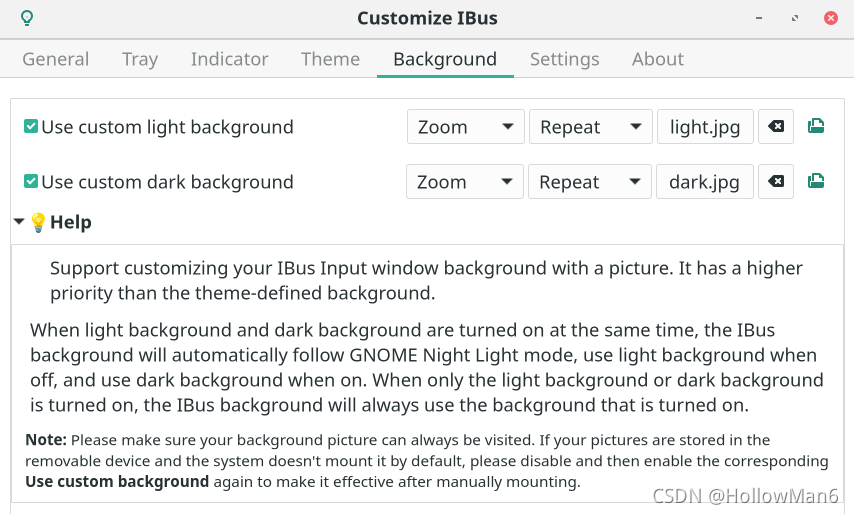
Support customizing your IBus Input window background with a picture. It has a higher priority than the theme-defined background.
If you have selected a picture, click the icon on the far right to directly open and view the picture. You can also click the clear icon to make it follow theme background.
When light background and dark background are turned on at the same time, the IBus background will automatically follow GNOME Night Light mode, use light background when off, and use dark background when on. When only the light background or dark background is turned on, the IBus background will always use the background that is turned on.
Please make sure your background picture can always be visited. If your pictures are stored in the removable device and the system doesn’t mount it by default, please disable and then enable the corresponding Use custom background again to make it effective after manually mounting.
Same as the general part, select the check box on the left to enable the configuration, and click on the right to select the background image of the IBus input candidate box.
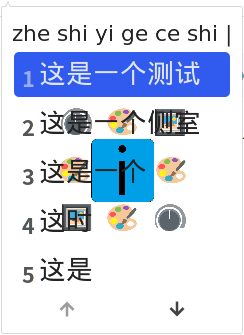
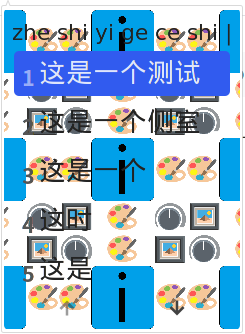
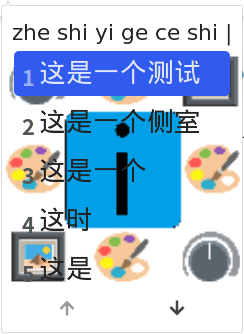
You can also set the background picture display mode, you can set whether the background picture is displayed repeatedly, or the display mode Centered, Full or Zoom.
Examples of various picture display modes (using 128×128 compressed pictures: https://github.com/openSUSE/Customize-IBus/blob/main/customize-ibus%40hollowman.ml/img/logo.png ):

- Centered + No repeat:
- Centered + Repeat:
- Full + No repeat:
- Full + Repeat:

- Zoom + No Repeat/Repeat (equivalent):

Settings
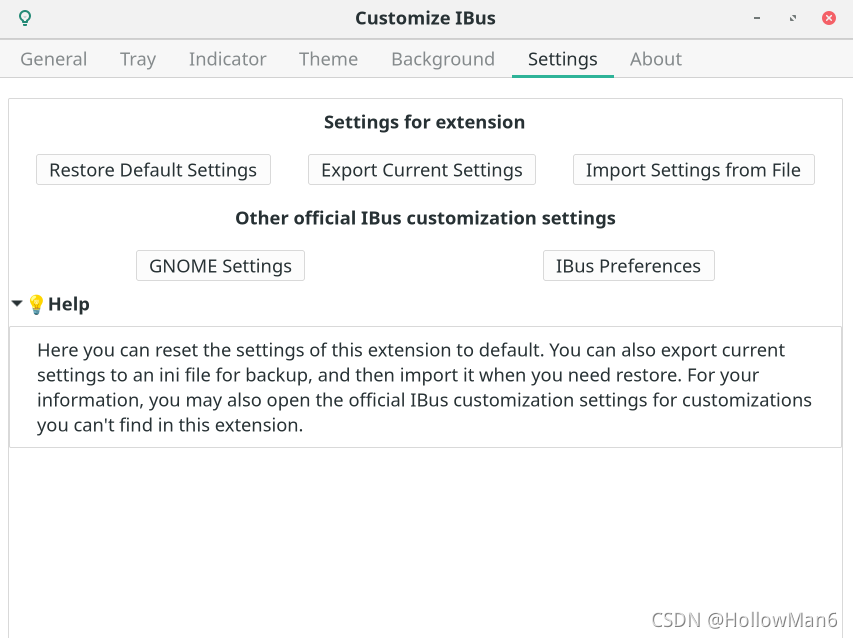
Here you can reset the settings of this extension to default. You can also export current settings to an ini file for backup, and then import it when you need restore. For your information, you may also open the official IBus customization settings for customizations you can’t find in this extension.
Click Restore Default Settings, after confirming, you can re-initialize the extension.

Click Export Current Settings, you can choose to export the current settings as a *.inifile. The default file name is Customize_IBus_Settings_[Current Time].ini: 
Example settings export file content:
[/]
candidate-box-position={'x': uint32 0, 'y': 0}
candidate-opacity=uint32 210
candidate-orientation=uint32 0
candidate-scroll-mode=uint32 0
custom-bg='/home/hollowman/图片/light.jpg'
custom-bg-dark='/home/hollowman/图片/dark.jpg'
custom-bg-mode=uint32 2
custom-bg-repeat-mode=uint32 1
custom-font='Sans 16'
custom-theme='/home/hollowman/stylesheet.css'
custom-theme-dark='/home/hollowman/stylesheet-dark.css'
enable-custom-theme=true
enable-custom-theme-dark=true
enable-orientation=true
fix-ime-list=true
ibus-restart-time='1625063857427'
indicator-custom-font='Sans Bold 16'
indicator-left-click-func=uint32 0
indicator-opacity=uint32 210
input-indicator-hide-time=uint32 2
input-indicator-not-on-single-ime=true
input-indicator-right-close=true
input-indicator-show-time=uint32 1
input-indicator-use-scroll=true
input-mode-list={'undefined': true, '': false, 'gjs': false, 'org.gnome.nautilus': false, 'google-chrome-beta': false, 'gedit': false, 'gnome-terminal': true, 'code': false, 'org.gnome.shell.extensions': true}
input-mode-remember=uint32 0
menu-ibus-emoji=true
menu-ibus-exit=true
menu-ibus-preference=true
menu-ibus-restart=true
menu-ibus-version=true
use-candidate-box-right-click=true
use-candidate-buttons=false
use-candidate-opacity=true
use-candidate-reposition=true
use-candidate-scroll=true
use-candidate-still=false
use-custom-bg=true
use-custom-bg-dark=true
use-custom-font=true
use-indicator-auto-hide=true
use-indicator-custom-font=true
use-indicator-left-click=true
use-indicator-opacity=true
use-indicator-reposition=true
use-indicator-show-delay=true
use-input-indicator=true
use-popup-animation=true
use-tray=true
use-tray-click-source-switch=true
Click Import Settings from File, you can choose to import the settings file you just saved: 
About
At any time, you can click on the icon in the upper left corner to open this guide:

Non-GNOME desktop
Customize IBus theme
In non-GNOME Shell desktop environment, the display effect of IBus is determined by the current GTK theme.
You can download more GTK3/4 themes from this website: https://www.gnome-look.org/browse/cat/135/, then put them in the $HOME/.themes/ directory to complete the installation.
The following steps can change the GTK theme of IBus:
- First, Install ibus-theme-tools:
Recommend to use pip to install:
pip install ibus-theme-tools
You can also install manually:
git clone https://github.com/openSUSE/IBus-Theme-Tools.git
cd IBus-Theme-Tools && python3 setup.py install
For install using package manager:
- Arch Linux:
You can use AUR to install:
yay -S ibus-theme-tools
- Ubuntu:
You can use PPA to install:
sudo add-apt-repository ppa:hollowman86/ibus-theme-tools
sudo apt-get update
- openSUSE:
You can install directly through the ymp file.
You can download the majority of your Linux distributions related packages through OpenSUSE OBS and then install.
- Gentoo:
git clone https://github.com/openSUSE/IBus-Theme-Tools.git
cd IBus-Theme-Tools && make emerge
- NixOS:
sudo nix-env -i ibus-theme-tools
- Guix:
guix install ibus-theme-tools
- Then run
ibus-theme-toolsin the terminal. - Enter
1, choose to extract an IBus-related GTK theme, and pressEnter.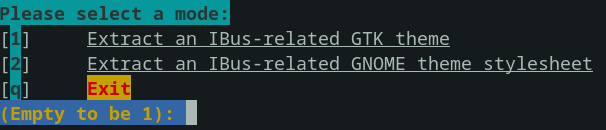
- Enter the IBus GTK theme you want to extract, and then press
Enter. (Note that the theme name ends with:darkis the dark mode of the theme)
- Enter the system GTK you want to mix, and then press
Enter.
- Select whether to add a customized background image for IBus panel, if you need press
2and then pressEnter.
- Enter the picture address:

- Then choose repeat and sizing modes, and set background border radius (unit:
px).
- If there is no error message, the setting action should be successful. Then you can choose the GTK theme that just generated in the system theme settings to apply the previous choices.



Customize IBus font size
Recommend to directly change the font and font size settings in the IBus preferences (ibus-setup).
Or:
$HOME/.config/gtk-3.0/settings.ini defines the current GTK3 theme and font size.
Example of the content of the file is as follows:
[Settings]
gtk-theme-name=Materia-light
gtk-font-name=更纱黑体 SC 12
In the above content, gtk-theme-name specifies that the current GTK theme is material-light, gtk-font-name specifies that the current font is 更纱黑体 SC and the font size is 12.
The IBus font and font size can be changed by modifying the above documents.
Customize IBus colors (Create a GTK theme)
Create a GTK3 theme called ibus-custom-theme by running:
mkdir -p $HOME/.themes/ibus-custom-theme/gtk-3.0
$EDITOR $HOME/.themes/ibus-custom-theme/gtk-3.0/gtk.css
then edit the file content. An example can be:
* {
  color: #0b141a; /* Font Color */
  background-color: #ffffff; /* Background Color */
  -gtk-secondary-caret-color: #d4d4d4; /* Highlight Background Color */
}
After that, referring to the actions of the Customize IBus theme part, please select the theme ibus-custom-theme which you just created.
My Google Summer of Code 2021

Blog Posted on openSUSE News about the Project
Project Introduction
IBus Customize @openSUSE by Songlin Jiang (@HollowMan6)
Before GSoC 2021, the IBus theme follows the global GNOME-Shell theme in GNOME and the global GTK theme in other desktop environments, and IBus lacks customization for users in GNOME.
Main Focus
This project aims to make IBus themes separate from the current GNOME-Shell theme and GTK theme so that users can customize it with other GNOME-Shell themes and GTK themes.
Other Goals
Improve the UI usability for IBus in GNOME. That is, to add more features, including customization of orientation, animation, font, opacity. Support right-click to switch the input source or open the tray menu, scroll to switch among pages or candidates, fix candidate box and IME switch list order, ASCII mode auto-switch, reposition, show or hide candidate box page buttons, set system tray settings, input source indicator with settings. Theme and background picture follow GNOME Night Light Mode, and so on. These customizations will make users find IBus in GNOME familiar if they have just switched from another platform. Eventually, an extension providing full customization of appearance, behavior, system tray, input source indicator for IBus will be available.
Archived Codebase

Contribution in Details
Blog Posts both in Chinese and English of the Documentations Related to the Project User Guide
Customize IBus Extension (All the commits and releases submitted by @HollowMan6 are my contributions)

Functionalities
- Candidate Box Orientation (imported from ibus-tweaker, refer to ibus-font-setting for settings sync with
ibus-setup) - Candidate Box Animation (thanks for the help from Florian Müllner)
- Right-click Candidate Box to Switch the Input Mode or Open the Tray Menu
- Scroll on Candidate Box to Switch among Pages or Candidates
- Fix Candidate Box to Not Follow the Caret and Set Fixed Position
- Candidate Box Font (imported from ibus-tweaker and ibus-font-setting)
- Input Mode Remember and Auto-switch by APP (imported from ibus-tweaker, refactor to enable configuring input mode remember)
- Change Candidate Box Opacity
- Fix IME List Order (imported from fixed-ime-list)
- Drag Candidate Box to Reposition
- Show or Hide Candidate Box Page Buttons
- Restart or Start IBus from Preferences
- System Tray Menus and Interaction Settings
- Show or Hide Tray Icon
- Directly Click Tray Icon to Switch Input Mode
- Add Additional Menu
- Input Source Indicator Appearance and Interaction Settings
- Enable Indicator
- Only Indicate when Switching Input Mode
- Only Indicate when Using ASCII Input Mode
- Right-click Indicator to Hide
- Scroll on Indicator to Switch Input Mode
- Indicator Animation
- Customize Font
- Left-click Indicator to Drag to Move Indicator or Switch Input Mode
- Change Opacity
- Enable Auto-hide Indicator and Configure Auto-hide Timeout
- Configure Theme (Stylesheet Provided by IBus Theme Hub or Extracted from IBus Theme Tools GNOME Shell Themes)
- Add a Candidate Box Background Picture and Configure its Displaying Style
- Theme and Background Picture Follow GNOME Night Light Mode (partly referred to ibus-tweaker for this feature)
- Multi GNOME Version Support ranging from GNOME 3.34 to GNOME 40 Simultaneously
- Hot Reload Support for Theme
- Reset to Default Settings
- Export Current Settings to File
- Import Current Settings from File
- Open Official Settings from Preferences
- Multi-Linguistic Support (Chinese and English)
- Packages Definition Files that can Pack it in Arch, RPM Based, Debian Based
- Logo Design
- Eslint and Prettier Check Support
- Workflow for Auto-Generating Extension Upload Zip file
- Distribution Repos
- Makefile for Build, Release, Package, Translate
(Credits for the GJS Documentation and GNOME Shell Codebase!)
Issues and PRs Opened and Resolved
Submitted to Open Build Service


Source Repository (Before revision 87)
Upstream Repository (Before revision 4)


IBus Theme Tools (All the commits and releases submitted by @HollowMan6 are my contributions)

Functionalities
- Non-GNOME Desktop Change IBus GTK Theme, Add Theme Settings to Startup (Before v3). Generate an IBus Mixed GTK theme, Supporting to Select a Background Picture and Configure Border Radius (After v4)
- GNOME Desktop Extract IBus Style from GNOME Shell Theme
- Pack into Module Using Python Package Setup
- Multi-Linguistic Support (Chinese and English)
- Workflow for Python Package Check
- Packages Definition Files that can Pack it in Arch
- Makefile for Build, Release, Package, Translate
Issues and PRs Opened and Resolved
Submitted to Open Build Service
Source Repository (Before revision 17)
Upstream Repository (Before revision 3)
IBus Theme Hub (All the commits and releases submitted by @HollowMan6 are my contributions)

Functionalities
- Microsoft IME Theme (imported from ibus-tweaker Stylesheet, Page buttons added by Me)
- Nord Theme (contributed by @stonegate, I did some fixes)
- PR template
Issues, Discussions, and PRs Opened and Resolved
IBus (All the commits and releases submitted by @HollowMan6 are my contributions)

Novedades de Gwenview para KDE Gear 21.08
Como estoy comentando estos días, estamos ante un nuevo lanzamiento masivo de actualizaciones de las aplicaciones KDE, en esta ocasión en pleno mes de agosto, con el que los desarrolladores de la Comunidad KDE siguen mostrando al mundo que tienen claro que su objetivo es ofrecer los mejor del Software Libre para todos de forma continua, constante y sin cambios revolucionarios. Y como siempre voy a dedicar algunos artículos a repasar las buenas nuevas, así que hoy toca hablar de las novedades de Gwenview para KDE Gear 21.08, siguiendo la estela de las novedades de Dolphin, de Okular y de Konsole de días anteriores.
Novedades de Gwenview para KDE Gear 21.08

El ecosistema de aplicaciones de la Comunidad KDE está bien surtido. Tenemos de todo tipo: ligeras, potentes, rápidas, profesionales, etc.
No obstante, una de las más utilizadas es Gwnview ya que combina rapidez con funcionalidades de forma muy efectiva.
Y, como no puede ser de otra manera, Gwenview no para de mejorar gracias al trabajo constante de los desarrolladores de la Comunidad KDE. De esta forma en este KDE Gear 21,08, esta aplicación nos ofrece las siguientes novedades:
- Cambio de diseño y apariencia que le confiere más rapidez y velocidad.
-
Nuevos controles compactos en la esquina inferior derecha de la aplicación. Concretamente:
- Selector de ampliación/tamaño que usa un menú emergente
- Selector de colores para el área de visualización de Gwenview
- Adoptado completamente el KHamburger del mismo modo que Dolphin: ahora se puede acceder a todas las opciones de Gwenview desde el menú desplegable situado en la esquina superior derecha de la aplicación.
- Mejoras en el manejo de imágenes mediante teclado tanto para las vistas previas como en el control de vídeos.
- Posibilidad de mostrar imágenes con color de 16 bits y puede leer información de perfiles de color de JPEG y PNG.
Más información: KDE Gear 21.08 | Gwenview
#openSUSE Tumbleweed revisión de las semanas 32 y 33 de 2021
Tumbleweed es una distribución “Rolling Release” de actualización contínua. Aquí puedes estar al tanto de las últimas novedades.

openSUSE Tumbleweed es la versión “rolling release” o de actualización continua de la distribución de GNU/Linux openSUSE.
Hagamos un repaso a las novedades que han llegado hasta los repositorios esta semana.
El anuncio original lo puedes leer en el blog de Dominique Leuenberger, publicado bajo licencia CC-by-sa, en este enlace:
En estas dos semanas solo se han publicado 3 snapshots released, las 0807, 0810 y 0817. Las snapshots 0811, 0812, 0816 y 0818 produjeron diferentes fallos durante el proceso de testeo:
- DVD ISO creció de tamaño descontroladamente
- Un fallo aleatorio en la compilación de Vim hací que todo fallase
Entre las actualizaciones que han traído estas snapshots podemos destacar:
- kernel 5.13.8
- KDE Gear 21.08
- apparmor 3.0.3
- vim 8.2.3318
Y en próximas llegarán entre otras estas:
- kernel 5.13.12
- systemd v249.2
- nodejs 16.6.2
- glibc 2.34
- podman & crio con crun habilitado por defecto
Si quieres estar a la última con software actualizado y probado utiliza openSUSE Tumbleweed la opción rolling release de la distribución de GNU/Linux openSUSE.
Mantente actualizado y ya sabes: Have a lot of fun!!
Enlaces de interés
-
-
- ¿Por qué deberías utilizar openSUSE Tumbleweed?
- zypper dup en Tumbleweed hace todo el trabajo al actualizar
- ¿Cual es el mejor comando para actualizar Tumbleweed?
- Comprueba la valoración de las “snapshots” de Tumbleweed
- ¿Qué es el test openQA?
- http://download.opensuse.org/tumbleweed/iso/
- https://es.opensuse.org/Portal:Tumbleweed
-

——————————–
openSUSE Tumbleweed – Review of Weeks 2021/32 & 33
Dear Tumbleweed users and hackers,
Dominique has been enjoying a vacation these last two weeks and left Tumbleweed in my hands. It’s been quite an interesting fortnight.
These two weeks have only seen 3 snapshots released, numbered 0807, 0810 and 0817. Snapshots 0811, 0812, 0816 and 0818 were all produced but discarded for a number of reasons including:
- DVD ISO grew too big (twice!)
- Random vim build failure produced an amusingly broken snapshot
- And probably a few other bits and pieces I’m forgetting now
Plus on a personal note this was the fortnight I moved house so I wasn’t able to fix all the issues as fast as normal when they came up. Thanks for everyone’s patience and understanding
The changes delivered these weeks included:
- kernel 5.13.8
- KDE Gear 21.08
- apparmor 3.0.3
- vim 8.2.3318
- And lots of other miscellaneous fixes
The future, near or far, will bring those updates:
- kernel 5.13.12 (Currently being tested in 0819)
- systemd v249.2
- nodejs 16.6.2
- glibc 2.34
- podman & crio with crun enabled by default
- and many more…
Have a lot of fun!
– Richard

openqa-cli Cheatsheet
Checkout the new openqa-cli cheat sheet page where I start to collect some useful “how do I do …” snippets for the openQA CLI utility openqa-cli.
Charla y taller «Install Party» en Bolbait (València) organizado por Asociació Emanciació Comunitaria y Asociación GNU/Linux València
Me congratula promocionar una nueva actividad conjunta de la Asociació Emanciació Comunitaria y de la Asociación GNU/Linux València. Se trata de la charla y taller «Install Party» en Bolbait (Vaència) que se va a realizar el próximo 21 de agosto. Más información, sigue leyendo.
Charla y taller «Install Party» en Bolbait (València)

Parece ser que poco a poco vuelve la normalidad en cuanto a actividades presenciales de la comunidad GNU/Linux. Eso si, con todas las medidas de seguridad que sean necesarias.

Es por ello que me complace compartir con vosotros un nuevo evento del grupo de personas que en València está impulsado el Software Libre gracias a sus reuniones tanto presenciales, cuando se podía, y ahora mismo de forma virtual, conjuntamente con la Asociació Emanciació Comunitaria, que podéis encontrar en su Grupo y Canal de Telegram.
Es por ello que os invito a la charla y taller «Install Party» en Bolbait (Vaència) que se va a realizar el próximo 21 de agosto que tiene como lema «Para una sociedad libre necesitamos una tecnología que no esté controlada por el poder».

De esta forma se han organizado varias actividades:
- 10:00 h: Charla sobre el Software Libre, donde se explicará la importancia del software libre en una comunidad con democracia real
- Comida comunitaria, preferiblemente vegana.
- 17:00 h: Taller Install Party, al que podréis LLEVAR VUESTRO EQUIPO y os ayudaremos a instalar un Sistema Operativo COMPLETAMENTE LIBRE!! · ◡ · además de otras herramientas. que nos permiten independencia de aquellas controladas por instituciones, empresas y estados.
Resumiendo, la información básica es:
- Fecha: sábado, 21 de agosto de 2021
- Horario: A partir de las 10:00
- Lugar: Bolbait (cerca de Xàtiva, València)
- ¿Registro necesario? Si, plazas limitadas. Reserva en los siguientes teléfonos: 625084409 Juan Carlos o 609618868 Gorgina
Si podéis asistir no os lo perdáis, seguro que no quedáis decepcionados.
Más información: GNU/Linux València
¡Únete a GNU/Linux València!
Aprovecho para recordar que desde hace unos meses, los chicos de GNU/Linux Valencia ya tienen su menú propio en el blog, con lo que seguir sus eventos en esta humilde bitácora será más fácil que nunca, y así podréis comprobar su alto nivel de actividades que realizan que destacan por su variedad.
Y que además, GNU/Linux València ha crecido y se ha ¡¡¡convertido en asociación!!! Así que si buscas una forma de colaborar con el Software Libre, esta asociación puede ser tu sitio. ¡Te esperamos!

Tumbleweed Fast Forwards with KDE Gear, Frameworks Updates
A lot of work this week has been taking place in the background to release openSUSE Tumbleweed snapshots.
Documented on the mailing list in the latest openSUSE release engineering meeting was information about some challenges Tumbleweed development had this week building images with the Open Build Service. There were some build failures, which caused some broken builds. These builds aren’t released as a snapshot since these must pass openSUSE’s openQA testing. The size of the ISO media also became too large to fit on a DVD; adjustments are made frequently when the capacity exceeds the size, so let’s get into the snapshot that was released.
The efforts to build, test and release a successful snapshot did come with the release of snapshot 20210817. Users received some much anticipated software with some really cool new features. KDE Gear 21.08.0 was among the many packages for rolling release users. The Dolphin file manager now shows an animated sequence of previews for folders containing a lot of previewable files. Its preview code has also been optimized so thumbnails pop up faster and files inside encrypted locations, such as Plasma Vaults, can show a preview. The PDF viewer Okular made some enhancements in the toolbar that allows for a color design to make reading more comfortable and to help avoid eye-strain. The Konsole terminal offers a preview feature from the command line when hovering the cursor over image filenames. Enhancements were also made for the Gwenview image viewer and the Elsa music player. KDE Frameworks 5.85.0 also came in the snapshot. The developer user interface Kirigami corrected some spacing between the close button and action buttons. It also added a method to push a page as a new window on the desktop. Optimizations for the network mounting performance were made to the KTextEditor and KWayland fixed a check for an mmap system call failure. AppStream, which is a package that provides a standard for creating app stores across distributions, updated to version 0.14.4 and improved text line wrapping. Mozilla Thunderbird 78.13.0 fixed a half dozen Common Vulnerabilities and Exposures; three of those involved fixes for possible memory corruption. Better native Wayland support for handling client-side decorations and other functionality were made to the update of media SDL2 2.0.16. The first major 1.0.0 version for firewalld was released in the snapshot; the dynamically managed firewall reduced dependencies, cleaned the spec file and deprecated the iptables backend. Vector graphics editor inkscape advanced a few minor versions to 1.1 and added a Welcome dialog where the look of Inkscape can be selected and some choices for the new document size or file to open are available. And when pasting a copied object, Inkscape now pastes it directly on top of the currently selected object by default. There is a list of several more packages that updated in the snapshot. Among some of those packages update were apparmor 3.0.3, ipset 7.15, nodejs16 16.6.2, openvpn 2.5.3, vim 8.2.3318, pipewire 0.3.33 and yast2-users 4.4.6, which made an update to allow for the editing of the name of an existing user and another update to remove the password of an existing user.
openqa-cli cheat sheet
openqa-cli is a command-line utility for interacting with openQA. The tool is versatile and allows you to control and interact with an arbitrary openQA instance from the comfort of your command line. While the internal help is quiet comprehensive, I list some of the most basic tasks in the form of a tutorial or knowledge base here.