
The Document Foundation elections: an intimacy between you, your choices and (maybe) the NSA guy
As many who follow the LibreOffice mailing lists know, soon we will have the elections for the Bord of Directors again. Without doubt, there will be a lot of good candidates and the choice will be difficult. Different competencies, personalities, sensibilities. As many parameters as there could ever be. Nonetheless, there is one parameter that was eliminated from before the first election: the corporate pressure.
From the very beginning of The Document Foundation, the Steering Committee and the initial Membership Committee knew that while corporations can contribute a lot to open source, they can also in some moments try to use the community bodies for their own interest. That is the reason that all elected bodies of The Document Foundation have the 30 per cent rule, where no more then 30 per cent of any body can have the same affiliation. In the same spirit, the election system was designed the way that it is technically impossible for anybody to know how a given member voted. From the experience with the "old good times" of OpenOffice.org, it was obvious that corporate influence can do a lot of harm and skew the elections in a considerable way. And even if the rule of 30 per cent is in place, it might be hard for a election officer or for a MC member to stand strong before a corporate pressure. And this was the reason why we chose a design that makes it impossible even for the election officer to know whom you voted for. This information is known only to you.
 Member
 swyear
安裝 xmind
僅提供 deb 格式下載
若想要在 openSUSE 作業系統中運作
可以使用 alien 這個應用程式將 deb 轉成 rpm
到 http://software.opensuse.org/search 搜尋 alien
使用單鍵安裝
(提醒:並不是所有的 deb 轉成 rpm 都能正常運作)
下載 xmind 的 deb 檔(例如:xmind-linux-3.4.0.201311050558_i386.deb)
執行
$ alien -rv --scripts xmind-linux-3.4.0.201311050558_i386.de
就會產生一個 xmind-3.4.0-2.i386.rpm
用指令安裝
# rpm -ivh xmind-3.4.0-2.i386.rpm
完成後即可使用
參考:
http://thefreecountry.wordpress.com/2010/11/12/alien/
http://forums.opensuse.org/deutsch-german/hilfe-und-helfen/anwendungen/454719-howto-xmind-auf-opensuse-installieren.html


若出現類似
# A fatal error has been detected by the Java Runtime Environment:

#

#  SIGSEGV (0xb) at pc=0x933a737d, pid=5596, tid=3076298496

#

# JRE version: Java(TM) SE Runtime Environment (7.0_45-b18) (build 1.7.0_45-b18)

# Java VM: Java HotSpot(TM) Client VM (24.45-b08 mixed mode linux-x86 )

# Problematic frame:

# C  [libsoup-2.4.so.1+0x5837d]  soup_session_feature_detach+0x1d
的崩潰訊息
可能是因為 https://bugs.eclipse.org/bugs/show_bug.cgi?id=404776
您可以編輯 /usr/local/xmind/XMind.ini
在該檔案的 -vmargs 加上
-Dorg.eclipse.swt.browser.DefaultType=mozilla
目前在 openjdk 1.7 或 java 1.7 均可以執行

openSUSE 13.1; VMware Workstation 9+ "Cannot find a valid peer process to connect to"
This does not happen with everyone, but the problem seems to come from the Nvidia drivers. At least as far as I can tell thus far. I have not been able to debug further because this problem is not happening to me. If you have this problem and your running the Nvidia 331.20 drivers then you will want to do the following.
1) Download the Nvidia 325.15 driver from here http://www.nvidia.com/object/linux-display-amd64-325.15-driver.html
Create a custom patched Nvidia driver.
2) Download the patch below for the latest kernel in openSUSE 13.1 which is 3.11+
http://cvs.rpmfusion.org/viewvc/*checkout*/rpms/nvidia-kmod/devel/kernel_v3.11.patch?revision=1.1&root=nonfree
save as kernel_v3.11.patch
3) Execute the following to create the custom patched Nvidia installer.
# sh NVIDIA-Linux-x86_64-325.15.run --apply-patch kernel_v3.11.patch4) You will get a file output NVIDIA-Linux-x86_64-325.15-custom.run
5) You can now install this custom Nvidia driver which should fix your VMware Workstation problem.
Enjoy!
VLANs: tagged, untagged -- what's the difference?
When there is an untagged VLAN on a switch or port, it means the VLAN information is private to the switch. No VLAN information is added to packets leaving the switch. This has a lot of important implications. A machine connecting to an untagged VLAN port does not need to know (and will not know) what VLAN it is in. If I'm connecting two switches together using a cable connected to untagged VLAN ports, each end of the cable could be in a different VLAN and the switches will not care. So, for example, I could send untagged VLAN 1 from one switch and bring it into another switch as untagged VLAN 20.
Tagged VLAN means that the switch does insert the VLAN information into the header of each packet. In fact, this information is called a "tag", hence the term "tagged VLAN", which means "VLAN where packets contain VLAN tags". Assuming I'm sending tagged VLAN packets (and no untagged ones) on a port, if I connect the eth0 interface of a vanilla-installed PC to that port, and give the interface an address in the tagged VLAN's range, the network will not work over that interface. Of course, I will be able to 'see' the packets using wireshark or tcpdump, but I won't be able to make TCP, UDP, ICMP, etc. connections.
openSUSE 13.1 Release Note (中文版)以及一些網路資源
當然如果您還沒裝 openSUSE 13.1 就沒得看了
許多重要訊息會在此揭示,全文轉貼如下,感謝 Ramax Lo 的翻譯
已經看過的請自行跳過
- 節 1, “雜項”:這些項目是由 openFATE,即特色與需求管理系統 (http://features.opensuse.org)自動引入。
- 節 2, “安裝”:若您想從頭開始安裝系統,請閱讀本節。
- 節 3, “一般說明”:每位使用者都應閱讀的資訊。
- 節 4, “系統昇級”:若您是透過系統更新來從舊版本昇級到新版的 openSUSE,本節包含了昇級過程的相關議題。
- 節 5, “技術議題”:本節包含一些技術上的變化與改進,提供給進階使用者參考。
- yast2-autofs
- yast2-dbus-client
- yast2-dirinstall
- yast2-fingerprint-reader
- yast2-irda
- yast2-mouse
- yast2-phone-services
- yast2-power-management
- yast2-profile-manager
- yast2-sshd
- yast2-tv
tmpfs /dev/shm
devpts /dev/pts
sysfs /sys sysfs
proc /proc proc
sudo /usr/sbin/grub2-mkconfig --output=/boot/grub2/grub.cfg
/etc/cron.daily/mlocate.cron
PULSE_LATENCY_MSEC=60 skype
Running Webex on openSUSE 13.1 64-bit
zypper in libpango-1_0-0-32bit \
libpangomm-1_4-1-32bit \
libpangox-1_0-0-32bit \
libgtk-2_0-0-32bit \
libgtk-3-0-32bit \
libglib-2_0-0-32bit \
libXau6-32bit \
libXmu6-32bit \
libxcb1-32bit_64 \
libXext6-32bit
Enjoy!
LibreOffice Import filters - what is stewing in the sauce-pan
Long time not see, dear friends. But that does not mean that there is nothing to speak about. So, hence a new blog post for those that were wondering what was happenning in the reverse-straight engineering partnership.
After the moments in August and September, where I transitioned from working on LibreOffice to working on SuSE Linux Enterprise and after some breathing pause to give to the Cesar (or also known as family) what is belonging to Cesar, the activity on LibreOffice related stuff restarted in October. Just this time, during nights, weekends and other free time.
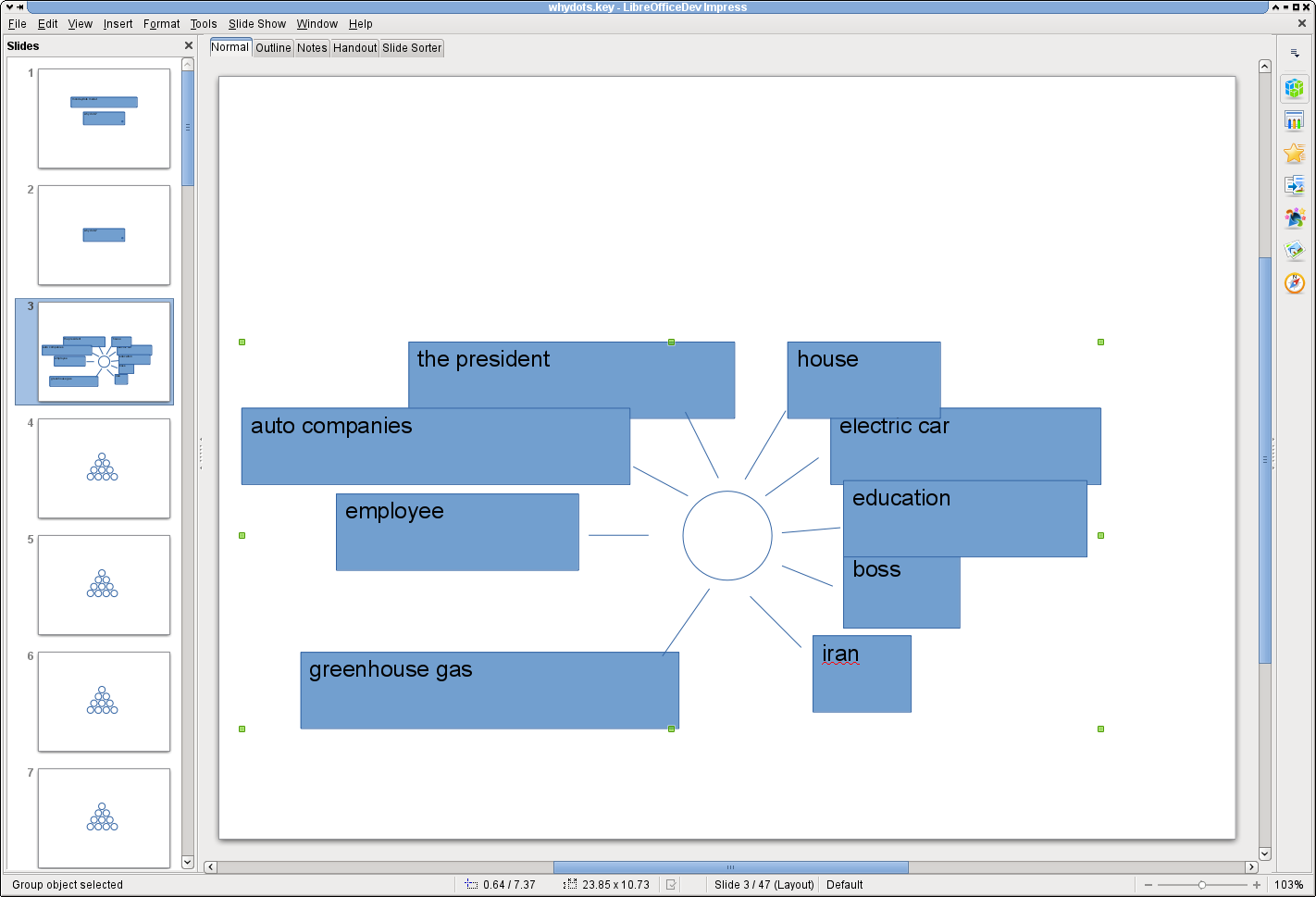
Sample Keynote presentation in LibreOffice 4.2
It is with a huge pleasure that I realized that we start to have a vibrant developer community around the libwpd/libwpg family, as well as around Valek's reverse-engineering framework. SUSE Hackweek 10 helped me to produce an initial importer for Freehand file-format. Close to that, David Tardon of RedHat fame added a library to parse Keynote files and a library to convert different e-book file-formats. Laurent Alonso works like a bee on importing Microsoft Works spreadsheets (*.wks). Many exciting things in the pipeline, as you can see.
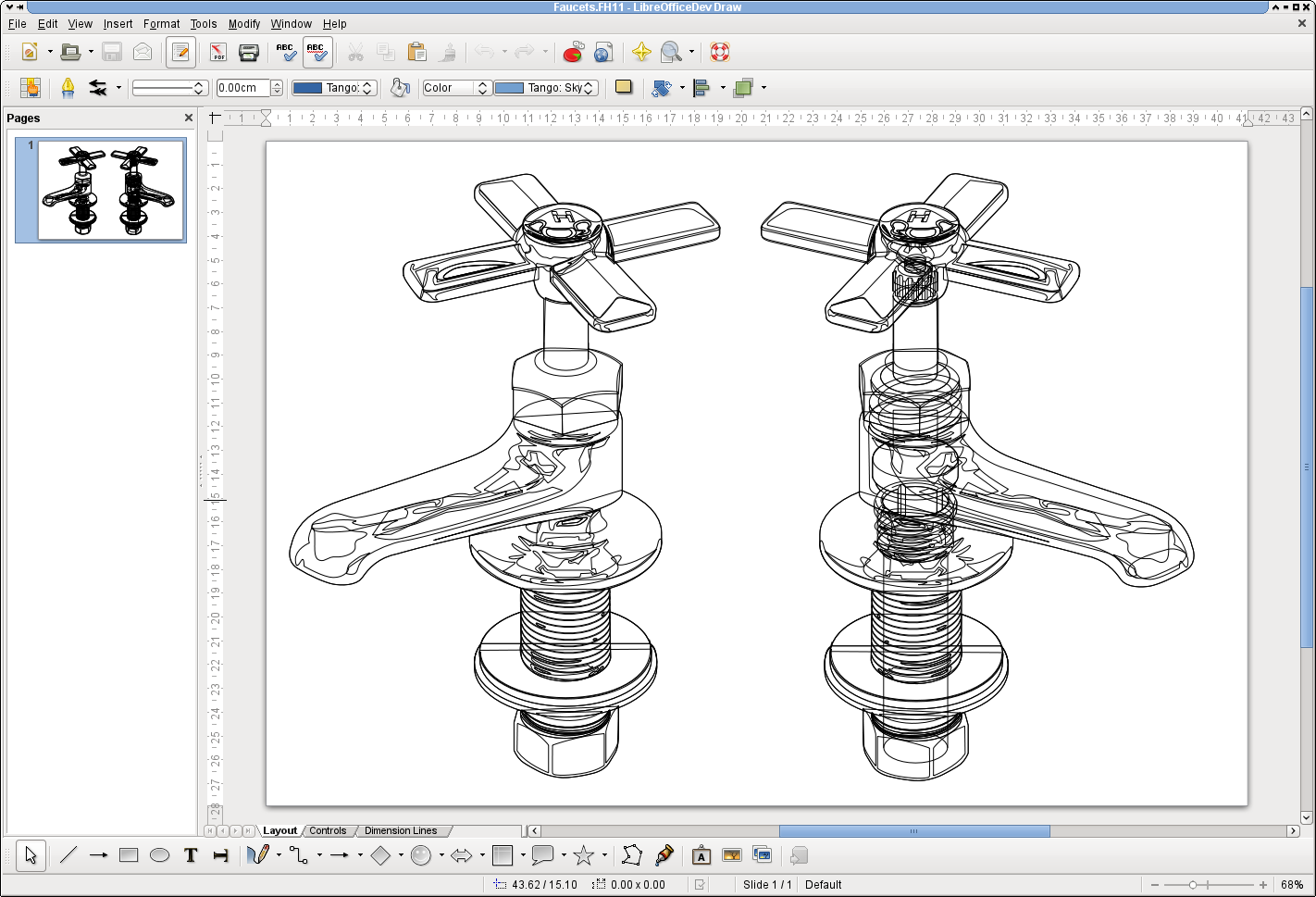
Wireframe of shapes from a sample Freehand drawing in LibreOffice 4.2
With the extension to presentations and spreadsheets, we decided that the time has come to simply break the super-stable libwpd/libwpg API and profit to make it even more future-proof and in the same token solve some of the API issues that were preventing us from importing correctly several features; most notable of which the Visio connectors.
librevenge
We decided to diminish drastically dupplication of code and we extracted from libwpd, libwpg and from libetonyek the API classes along with the used types. We created a new library, librevenge where we also added as sub-libraries the (structured) stream implementations that used to be in libwpd-stream, as well as several classes that the libraries used to copy and paste between them. The structured stream implementations support now both OLE2 and Zip containers and the relevant libraries assume this. That means that we will have to eventually extend the WPXSvStream implementation in LibreOffice's "writerperfect" module to cater for Zip too.
A new sub-library, librevenge-generators has the simple implementations of the interface classes that we use to convert documents into html, text, or that we use to see the raw API calls for the purpose of regression testing. The exception is the RVNGSVGDrawingGenerator class. In the current stable branches, all of the libraries that convert graphics file-formats contain an SVG generator and they rely on its presence in several cases for things like fills with vector graphics. This class is thus not part of the librevenge-generators library, but of the base librevenge, which is a hard dependency of all of the converter libraries.
RVNGPropertyList
The base type for passing information using the API callbacks is RVNGPropertyList, which was born from libwpd's WPXPropertyList. We modified the design of this class the way that each atrribute can have as a value either a simple property or an array of RVNGPropertyList element. This allows us to do more or less all that JSON is able to do. The API classes are even more flexible and future-proof, since extending the information passed in the different callbacks will not modify function signatures.
Quality improvement
Although the relevant libraries were quite extensively regression-tested in the past, the new librevenge extends the coverage of unit tests. We hope that this helps us to keep under control the basic functionalities without having to use the heavy regression tests on each commit.
Other effort is to avoid to copy in the API calls huge data structures. This effort will result in some performance improvements especially if a document contains a lot of shapes that are filled by different bitmap fills.
When will it be ready?
When it is ready! But seriously, we are trying to take our time and get the APIs right. Like this we intend to prevent gratuitous breakages of binary compatibility in the future. So, it will not be in LibreOffice 4.2 for sure.
If this is interesting for you, please drop by at #libreoffice-dev channel at irc.freenode.net in order to meet us. We cannot promise you that you will become rich, but we can guarantee you fame and eternal gratitude

openSUSE on RaspberryPi with ownCloud
This morning during a cup of coffee I wanted to do something adventurous. I put the raspberry which I bought recently (without having very much played with it because of my light apt-* allergy) on the table and thought I will try to install the openSUSE distribution.
I remembered awesome Bernhard was blogging about that topic recently. On that page one can find this link where raspberrypi images can be found. Oh, surprise, there is even a file from november 10th, so I downloaded that. People always recommend the latest stuff.
Following this Howto I quickly had the RaspberryPi running in my home network, surprisingly enough identifying itself as powered by openSUSE 13.1 :-)
Well, that was easy and far away from adventure which I was looking for. So I remembered that the cool kids on the block have an ownCloud server running on the RaspberryPi. Would that be as easy? There are no official packages for the Pi yet, so what could I do?
Well, ownCloud is noarch, because it is plain PHP. So I downloaded the two ownCloud server packages owncloud and owncloud-3rdparty from our ownCloud nightly build repository on OBS and installed them with
zypper in owncloud owncloud-3rdparty
I was (adventure!) ignoring all the warnings and stuff, what you should never do! Just for a test, before the coffee is cold.
After having started apache, what should I say? It simply worked. No need for antihistamine, all nice green around, and ownCloud running after having finished it’s setup page.
That really pushed me for the day! It was such a smart experience having that running within a couple of minutes, with absolutely no fiddling around. This is cool stuff! Thanks to Bernhard and all the other openSUSE guys for doing that!
My congrats for the 13.1 release! I really hope that people will understand (again) how awesome the openSUSE distribution and the project is, especially for the more nerdy folks! Really, you wanna run the Geeko these days.
Enough praise, now, maybe there is somebody who will help me in OBS to provide proper ownCloud packages for ARM? I am sure there is not much missing.
And if you want to run ownCloud on your “normal” PC, this is the repository of the latest stable version which we actively maintain…
openSUSE 13.1 你可能想知道的事
使用繁體中文安裝預設的輸入法是 gcin
如果您使用 gnome 3 桌面
雖然看不見系統匣上的小圖示
但仍然可以輸入中文
您可以使用 TopIcons 這個 gnome-shell 擴充套件來顯示傳統系統匣的圖示
 |
| 寄件者 openSUSE 13.1 |
https://extensions.gnome.org/extension/495/topicons/
可直接線上安裝
但顯示有點不正常,算堪用啦
2. GNOME 3 桌面設定分在兩處
設定值 Settings 和 調校工具 Tweak tool
 |
| 寄件者 openSUSE 13.1 |
 |
| 寄件者 openSUSE 13.1 |
「正在啟動 Caja...」
請編輯 /usr/share/applications/caja.desktop 將
Exec=caja -n
改成
Exec=caja -n --sync
4. gcin 的 post script 可能有問題,單獨安裝 gcin 時,無法更新 gtk-immodule
原因是新版的 gtk2 使用 %libdir/gtk-2.0/2.10.0/immodules.cache 當成快取檔案
導致 gcin 原本的更新快取機制失效
這個問題影響不大,在 13.1 oss repo 中的 gcin 仍可以用
一般人使用DVD繁體中文安裝時,ibus 也會一起被安裝,ibus 在執行 gtk-immodule 更新時
會一併將 gcin immodule 更新
唯一有影響的是使用英文(或其他語文)安裝,再另行安裝 gcin 時,firefox 等 gtk-base 程式會無法使用中文輸入
此時您可以用 root 執行
# gtk-query-immodules-2.0 --update-cache
新啟動的程式即可使用中文輸入(不必登出)
您也可以使用 M17N 中的 gcin (已修正此問題)
5. openSUSE 13.1 是下一個 Evergreen 版本
可以讓您在 SUSE 官方支援結束後用得更久
(一般的 openSUSE 版本官方支援 18 個月,Evergreen 社群支援再 18 個月,共 3 年)
6. zypper 有些新功能,如果您需要中文翻譯檔,在此。
(zypper .mo 此非原始文字檔,將此檔案放在 /usr/share/locale/zh_TW/LC_MESSAGES/ 目錄中即可)
7.GNOME 3 桌面使用 ibus 輸入法
以下為使用 GNOME 3 Live USB 測試的結果
(不確定使用DVD安裝中文語系的是否需要如此設定)
該影像沒有中文語系支援(可自行安裝),但是可以正常顯示中文
如果你習慣用拼音、倉頡或bopomofo 輸入法,設定完後也可以直接輸入中文
但我習慣使用酷音,所以還是要先安裝
# zypper in ibus-chewing
接著(可能要重新登入)看圖說故事
進行設定
 |
| 寄件者 openSUSE 13.1 |
進入"區域與語言"
 |
| 寄件者 openSUSE 13.1 |
按輸入來源的 "+" 新增輸入來源
 |
| 寄件者 openSUSE 13.1 |
先新增一個英文
 |
| 寄件者 openSUSE 13.1 |
再從 Chinese(Taiwan) 新增 Chinese(Chewing)
 |
| 寄件者 openSUSE 13.1 |
你的 Input Source 會變成這樣
 |
| 寄件者 openSUSE 13.1 |
這一步最重要:新版的 ibus 鍵盤快速鍵已經改成了 Super+space
(白話文: win 鍵+空白)
(似乎沒辦法用 ibus 偏好設定來改...)
Update: 在 gnome 3 中要改變 ibus 的快速鍵,請用 Settings 中的鍵盤設定(謝謝 Amigo)
然後你就可以在這兩種輸入法間切換輸入中文或英文
 |
| 寄件者 openSUSE 13.1 |
8. 13.1 使用和 12.3 一樣的 grub2 畫面、啟動畫面、預設桌面佈景(有點小失望)
KDM 佈景主題有變漂亮了
9. 如果你的機器不夠高級,建議你不要用 GNOME 3 桌面
我的測試機器:
MSi U100 laptop
Intel Atom CPU @1.60GHzx2
Menory 1GB
Intel 945GME x86/MMX/SSE2 Graphics
10 inches 1024x600 monitor
使用 GNOME 3 的感覺是『無法忍受』
使用 KDE 4 感覺可以接受
但是在家中的桌機(沒開機我就不列出配備了),即使使用 Live GNOME 仍十分順暢

openSUSE Summit Conclusion
