
 Member
 DimStar
openSUSE Tumbleweed – Review of the week 2023/45
Dear Tumbleweed users and hackers,
This week was all in the name of Hackweek, which means some people diverged their efforts a bit away from Factory/Tumbleweed and others have finally found the time they craved and could submit what they had on their wish-list. The Release Team was trying to keep up with the submissions while also having their own time dedicated to hackweek. Seeing that we published 6 snapshots (1102, 1103, 1105, 1106, 1107, and 1108) I dare say this worked out pretty well.
The six delivered snapshots contained these changes:
- GNOME-Shell/Mutter 45.1
- libxml 2.11.5
- Pipewire 0.3.84
- systemd: disabled utmp support
- Libvirt 9.9.0
- xfconf 4.18.3
- fwupd 1.9.7
- VLC 3.0.20
- BlueZ 5.70
- LLVM 17.0.4
- SQLite 3.44.0
Snapshot 1109 is already in QA, 1110 is building, and stagings are getting ready. All in all, you can expect these changes to happen soon-ish:
- Linux kernel 6.6 (Snapshot 1109+)
- gAWK 5.3.0
- Binutils 2.41 (Snapshot 1110+)
- KDE Gear 23.08.3
- Mozilla Firefox 119.0.1
- RPM 4.19: Some preparation work has happened to ensure packages still build (e.g. %patch with unnumbered patches is no longer supported)
- dbus-broker as the default dbus session manager

My containerized websites
Coincidentally I have had multiple needs for serving websites from behind containers instead of directly from the host. After some practicing, which can be also described as ”hacking without carefully documenting what I did”, I decided not to explicitly describe my setup but how I achieved (towards) my goal of serving my web sites (3 on the same server) from behind containers. This will enable me to consider using things like PHP or other notorious pieces of software thanks to a level of sandboxing.
Here in this rant paragraph I note that I'm not overtly fan of pulling random images from the web even if not quite as bad as using curl-sudo ”install method”. Containers are at least sandboxed, but coming from Linux distribution background perspective I somewhat dislike all software vendors acting as OS image providers. I will need to learn more about the aspects of where the images come from, what is the trust model, and what happens if eg Official Nginx (tm) image or Official Certbot (tm) image or Docker Hub gets compromised. I do mostly trust Debian, SUSE, Ubuntu etc infrastructure, so it will take some time until I construct my trust towards alternatives. One possible option could be of course to use my pre-trusted vendors via some alternative image registry, and do a bit more work with Ansible for example to utilize them instead of trusting Nginx or Certbot via Docker Hub.
My setup is looking like ending up like this, involving docker-compose, nginx as a proxy, several web host containers, and a Certbot container that is used to renew certificates via a cronjob:

But before I ended up with that I said hello to Search Engine. One result showed the general idea of sharing directories. Another reminded how to serve acme-challenge in nginx since I’ve been mainly Apache user. There were several guides about Apache and Let’s encrypt too, without proxy. I probably read this when figuring out the actual nginx proxy setup. At some point I needed to check that nginx is ”nginx” while certbot is ”certbot/certbot”. I was happy to find certbot command line option ideas although I learned the hard way to use --dry-run as well especially in the case of forgetting restart option in docker-compose.yml. I did not need any kind of bootstrap phase since I already had existing Let’s Encrypt certificates.
Finally, in practice what I have done so far is a proof that it works and can be used as drop in replacement for my on-host Apache. I have served all of the web sites from inside a container (pointed to the same content as the on-host), and Certbot container works to renew the certificate, replacing acme-tiny I have used before. Currently however the setup is not complete for simultaneous serving of all the 3 sites, cronjobs are not set up (or tested to be functional). I can’t have my on-host Apache and containerized Nginx proxy competing for ports 80 and 443 at the same time, so I can really enable the setup only when everything is fully complete. It’s nice however how easy switching between the two already is!
Finally², I can’t say it would be 100% complete even then! At some point in the past I have largely but not completely ”ansibled” my host when I sadly moved from a really old quad-core ARM server to x86_64 server. I like different architectures, but the ARM servers were decommissioned by Scaleway. Anyway, regarding Ansible this kind of containerization obviously increases ”Ansible debt” further by a fair amount, and that would be a different story to get that fully done…
But it has been some nice hacking!

LLVM, VLC updates in Tumbleweed
During Hack Week this weeek, openSUSE’s rolling release Tumbleweed still manages to send out four snapshots.
Software packages like LLVM, the Linux Kernel’s firmware, VLC and fwupd were just a few that landed on peoples’ systems after a zypper dup.
The arrival of kernel-firmware 20231107 in snapshot 20231108 enhances various hardware, including Intel Bluetooth firmware updates for several devices like AX201, AX203, AX210, AX211, and more. A update of sqlite3 3.44.0 brings the addition of aggregate functions like string_agg(), concat(), and concat_ws(), which aligns compatibility with other SQL projects. Some error handling table statements were refined that contribute to a more immediate error-identification process. Data compression package brotli updates to 1.1.0 and the build process now incorporates optimal flags and introduces a new command-line option --dictionary. Another package to update was libgusb 0.4.8 that introduces a new device error code for busy that enhances its capability to handle device errors more effectively.
Snapshot 20231107 updates the Linux Bluetooth protocol stack bluez to version 5.70. The update fixes problems related to Generic Attribute Profile (GATT) confirmations and it introduces support for Media Independent Command Protocol profile and the Mesh Independent Control Service while adding a patch to address a regression when pairing with game controllers. An update of gupnp 1.6.6 makes improvements to the resilience in handling unusual formatting during introspection, along with the addition of a new Application Programming Interface for creating actions in ServiceProxy. It also addresses memory leaks. An update of llvm17 17.0.4 was updated to ensure compatibility with 17.0.0 version along with maintaining API and Application Binary Interface consistency. The package did include libomptarget.devicertl.a in libomp*-devel for pivotal GPU offloading functionality. A few other packages were updated in the snapshot.
An update of yast2-trans in snapshot 20231106 involving translations via Weblate includes updates for Slovak, Czech, Dutch, Catalan, Japanese, and Indonesian languages among others. A new POT files for text domains like storage, installation, and update have been introduced. An update of jasper 4.1.0 introduces support for building various JasPer application programs for the WebAssembly target with WASI support. The update also resolves an integer overflow bug. A few other packages updated including openSUSE’s tool to manage systemd-boot sdbootutil. This git+ update focuses on enhancing the sdboot in snapper hooks, installing commands with specific snapshots and refining the behavior of sdbootutil within RPM scriptlets.
The 20231105 snapshot updates the super-thin layer on the DBus interface - fwupd. The 1.9.7 version includes additions such as child device requirements in metadata, new hardware support for Logitech Rally System devices. The update adds new security attributes for BIOS capsule updates, and expanded support for parsing Extended Display Identification Data and Concise Software Identifier payload sections. An update of VLC 3.0.20 was mainly focusing on bug fixes and improvements. There were some notable changes like addressing crashes associated with some older versions of AMD drivers and fixing event propagation problems on double-clicking with the mouse wheel. The 2.42.1 version update of git addresses issues related to the exit code handling in git diff and refines the behavior of rebase -i in scenarios where the command is interrupted by conflicting changes. A few other packages like openldap2 2.6.6 and redis 7.2.3 were updated along with several RubyGems packages, which saw rubygem-pairing_heap update from version 1.0.0 to version 3.0.1.


Hackweek 23
Hack Week is the time SUSE employees experiment, innovate & learn interruption-free for a whole week! Across teams or alone, but always without limits.
The Hack Week 23 was from November 6th to November 10th, and my project was to gvie some love to the GNOME Project.
Before the start of the Hack week I asked in the GNOME devs Matrix channel, what project needs some help and they gave me some ideas. At the end I decided to work on the GNOME Calendar, more specifically, improving the test suite and fixing issues related to timezones, DST, etc.
GNOME Calendar
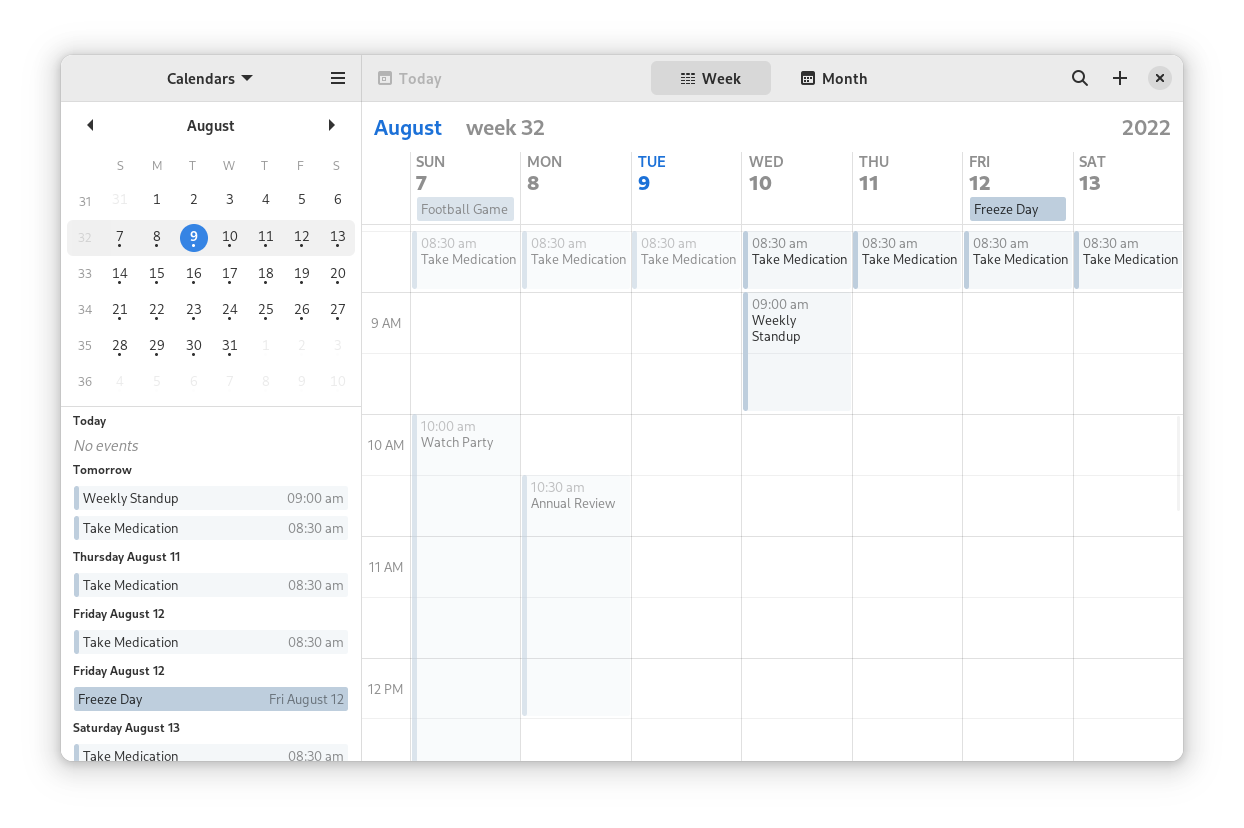
GNOME Calendar is a Gtk4 application, written in C, that heavily uses the evolution-data-server library. It's a desktop calendar application with a modern user interface that can connect handle local and remote calendars. It's integrated in the GNOME desktop.
The current gnome-calendar project has some unit tests, using the GLib testing framework. But right now there are just a few tests, so the main goal right now is to increase the number of tests as much as possible, to detect new problems and regressions.
Testing a desktop application is not something easy to do. The unit tests can check basic operations, structures and methods, but the user interaction and how it's represented is something hard to test. So the best approach is to try replicate user interactions and check the outputs.
A more sophisticated approach could be to start to use the accessibility stack in tests, so it's possible to verify the UI widgets output without the need of rendering the app.
With gnome-calendar there's another point of complexity for tests because it relies on the evolution-data-server to be running, the app communicates with it using dbus, so to be able to do more complex tests we should mock the evolution-data-server and we should create fake data for testing.
My contribution
By the end of the week I've created four Merge requests, three of them have been merged now, and I'll continue working on this project in the following weeks/months.
I'm happy with the work that I was able to do during this Hack Week. I've learned a bit about testing with GLib in C, and a lot about the evolution-data-server, timezones and calendar problems.
It's just a desktop calendar application, how hard it could be? Have you ever deal with dates, times and different regions and time zones? It's a nightmare. There are a lot of edge cases working with dates that can cause problems, operations with dates in different time zones, changes in dates for daylight saving, if I've an event created for October 29th 2023 at 2:30 it will happens two times?
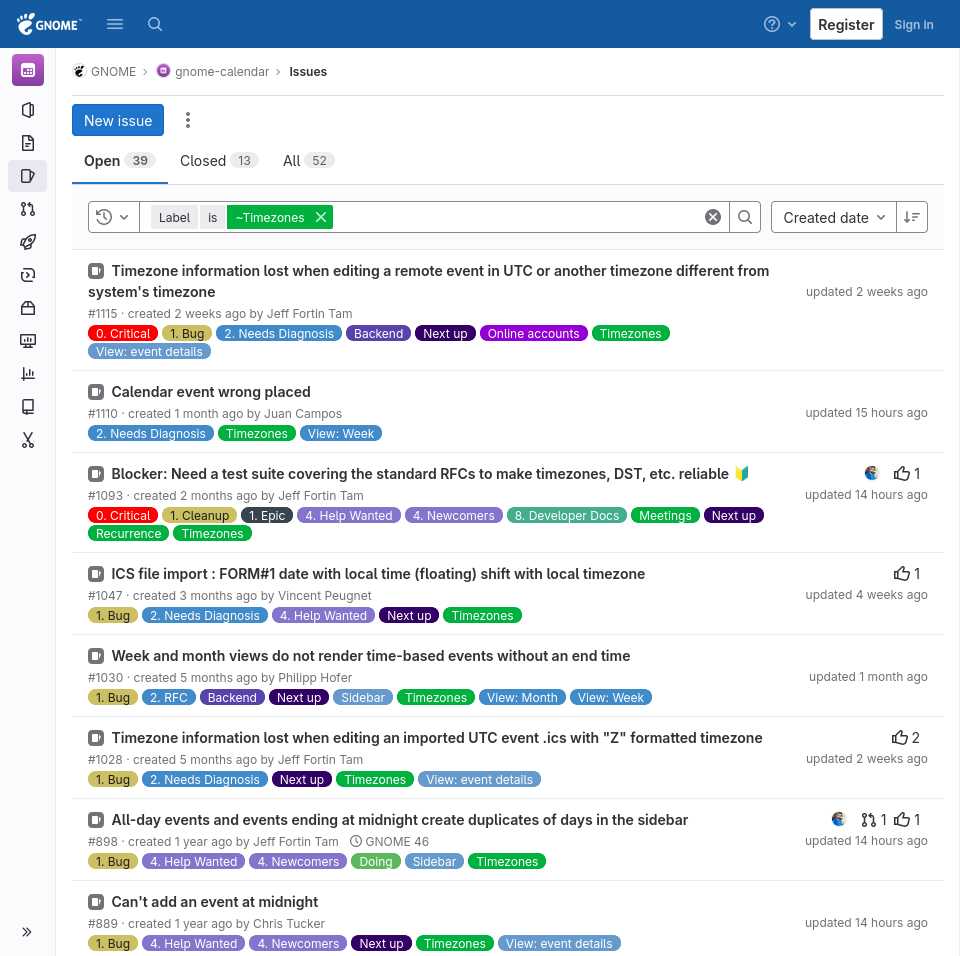
A lot of problems could happen and there are a lot of bugs reported for gnome-calendar related to this kind of issues, so working on this is not something simple, it requires a lot of edge case testing and that's the plan, to cover most of them with automated tests, because any small change could lead to a bug related to time zones that won't be noticed until someone has an appointment at a very specific time.
And this week was very productive thanks to the people working on gnome-calendar. Georges Stavracas reviews my MR very quickly and it was possible to merge during the week, and Jeff Fortin does a great work with the issues in gitlab and leading me to most relevant bugs.
So after a week of going deep into the gnome-calendar source code it could be a pity to just forget about it, so I'll try to keep the momentum and continue working on this project, of course, I'll have just a few hours per week, but any contribution is better than nothing. And maybe for the next summer I can propose a Google Summer of Code project to get an intern working on this full time.
Community to Explore Engineering Depths with AMA Session
The open-source community is in for a treat next week as an Ask Me Anything (AMA) session on the openSUSE Project’s Jitsi instance will provide unique and insightful information about how Quality Engineering teams work.
The AMA is scheduled for November 16 at 19:00 UTC and will take place online at meet.opensuse.org/meeting.
Santiago Zarate, who is a Product Owner of SUSE’s Quality Engineering Core team, will run the session organized during Hack Week.
The AMA session aims to provide a closer look at how developers in the Research and Development (R&D) sector of SUSE work. The primary goal is to foster collaboration and understanding between Global Services and Infrastructure (GSI) and Engineering, which will help to unravel the intricacies of development workflows and shed some light on Quality Engineering practices.
The objective of the session is clear; give the audience a window into the inner workings of SUSE Engineering, offering people an opportunity to ask questions and gain insights into the processes behind the scenes.
Attendees are encouraged to submit their questions beforehand at https://etherpad.opensuse.org/p/ama to ensure a vibrant and engaging discussion during the live AMA.
While the AMA offers a limited window into SUSE Engineering for open-source attendees, it serves as a valuable platform to enhance the collective understanding of the organization’s processes.
The AMA session is not just an opportunity to ask questions, but also a chance to foster collaboration, bridge gaps, and gain a deeper understanding of the intricate processes that drive engineering efforts. Don’t miss out on this unique chance to connect with like minded software engineers.
Mark your calendars for November 16 at 19:00 UTC, and join the conversation on meet.opensuse.org/meeting. The community’s regular weekly meeting is scheduled to follow the AMA at 20:00 UTC, but the time for the community meeting can be used to extend the AMA.
Results of Use Case Survey Published
The openSUSE Project ran a use-case survey during the month of October and results are now available via a 254-page report and a summary of the survey’s findings is on the community’s wiki.
The survey provides a breakdown of the use cases of Linux among respondents based on their primary use of IT.
The survey had general questions along with sections for Work/Business and Home/Hobby. Those who responded as using both, which if selected provides the surveyee the opportunity to take the entire 30-question survey.
Questions on various IT technologies like cloud computing, containerization, configuration management, desktop computing, server infrastructure, serverless computing, virtualization, edge computing, IoT applications, machine learning, blockchain, gaming and a category of others were part of the survey.
People were able to rate their use of these technologies as well as to provide comments for selective questions. The raw text from the full report was compiled to provide a summary for the ratings and use cases.
People reviewing the report are more than welcome to enhance the summary on the wiki.
Music of the week: Pictures at an Exhibition
As you might have guessed from my previous blog posts: I love music. Colleagues, family, and friends often turn to me for suggestions if they want to listen to something new and less mainstream. This blog is about music I listen to, the first part of what will hopefully become a series. I hope you also find something interesting here!

Why did I pick “Pictures at an Exhibition” when I talk about “less mainstream” music in the opening paragraph? Well, everyone knows this piece of music. Or do they? The original music composed by Mussorgsky was a piano suite in 1874, but most people are only aware about one of the orchestrated versions. I can still recall from primary school, when our music teacher played the orchestration by Ravel, and asked us to give a title for each movement.
Ravel was not the only one orchestrating “Pictures at an Exhibition”. For this blog I collected those which I listened to, but if you do a quick search on your favorite music service, I am pretty sure that you will find a lot more. In each case I chose the closing movement: The Great Gate of Kiev.
First let’s listen to the version which comes to the mind of most people when Pictures at an Exhibition is mentioned. It is also the one I listened to first: the orchestration by Ravel from 1922. It was recorded by many orchestras. Here I chose the version which I have at home: played by the Berliner Philharmoniker, conducted by Herbert von Karajan:
TIDAL: https://listen.tidal.com/album/77611281
Next, listen to the original, piano version. It does not seem to be recorded as often as the orchestrated versions. Here I chose randomly, just making sure that it is a good quality recording:
TIDAL: https://tidal.com/browse/video/101487217
The version I learned about next was created by Tomita, a Japanese pioneer of electronic music. I do not remember who gave a copy to me on tape, just that I also got Switched-On Bach by Wendy Carlos at the same time. I was born to a family where Bartók was considered to be too modern. These reworks opened me to contemporary music.
TIDAL: https://listen.tidal.com/album/63190788
During my university years I became an Emerson, Lake & Palmer fan, in part due to their interpretation of Pictures at an Exhibition. It is one of my favorite concert recordings, so I have it both on CD and as high resolution FLAC files from Hdtracks.
TIDAL: https://listen.tidal.com/album/63101464
The last version I want to show you is a concert recording by the Hungarian band, Panta Rhei. As they write below the video: “As our concert on 22/04/2022 approached, we were wondering which piece of music would be a fitting encore to our performance of the Peer Gynt Suite. A few weeks before our concert a war broke out in one of our neighbouring countries. We chose to express our solidarity with the people of Ukraine with our interpretation of Mussorgsky’s “The Great Gate of Kiev”.” I was there at the concert: it was fantastic.
Unfortunately, they are not on TIDAL, but you can find their music on YouTube at https://www.youtube.com/@pantarheiofficial3562 and have a website at http://panta-rhei.hu/
You can learn more about the history of Pictures at an Exhibition at https://en.wikipedia.org/wiki/Pictures_at_an_Exhibition

Microsoft Teams Rooms The Easy Way with Logitech Tap Controller and Shure STEM Ceiling Microphone
openSUSE Tumbleweed – Review of the week 2023/44
Dear Tumbleweed users and hackers,
Week 44 is over – and with it, about 83% of the year 2023. What does that mean for Tumbleweed? Not really much, as it just keeps rolling from snapshot to snapshot. And during this week, you have received 6 of those (1026, 1028, 1029, 1030, 1031, and 1101). 1027 had been discarded due to crashes identified in XFCE (xfconf 4.18.2 – which was reverted to 4.18.1 for 1028)
The six delivered snapshots brought you the following updates:
- LLVM 17.0.3
- Qemu 8.1.2
- VLC 3.0.19
- Boost 1.83.0
- systemd: Ship the main configuration files in /usr/lib/; this change will hopefully encourage users to customize the defaults via drop-ins instead of changing the main config files
- Linux kernel 6.5.9
- openSSL 3.1.4
- PHP 8.2.12
- Mozilla Firefox 119.0
- shadow 4.14.2
- strace & linux-glibc-devel 6.6: getting ready for Kernel 6.6
- Poppler 23.10.0
As usual, a new snapshot is already in QA, and more changes are piling up. These things have been staged by now:
- gnome-shell/mutter 45.1
- libxml2 2.11.5 (you remember, we already had that a while back in the list. This time it is happening)
- xfconf 4.18.3
- libvirt 9.9.0
- fwupd 1.9.7
- binutils 2.41: libqt5-qtwebengine runs OOM when linking on i586
- Linux kernel 6.6
Firefox, hiredis, Strace updates in Tumbleweed
Snapshots of openSUSE Tumbleweed this week have been frequent with a fair amount of software packages arriving in each snapshot..
Among some of the packages to update this week were Vim, libsoup, libzypp, strace and more.
A cool 13 packages arrived in snapshot 20231101. An update of dracut was among those that arrived. The initial ramdisk tool addresses issues related to PKCS11, dracut’s version handling, Bash compatibility, network device naming and more. An update of gnome-text-editor 45.1 improves proper entity tags for comparing documents after a “Save As” operation. The package also fixes row styling in preferences and addresses a memory leak issue with GtkNativeDialog. An update of hxtools 20231101 makes changes such as adding compression .zst suffix support for the qtar tool to eliminate unnecessary lines in spec files. An update of poppler 23.10.0 makes several core improvements like updating type 3 fonts for Cairo 1.18’s Application Programming Interface and fixes a crash issue with malformed files. The build system enhancements make certain dependencies soft-mandatory and adds support for more gpg releases. Updates of yast2-trans, selinux-policy 20231030, gpgme 1.23.1 and more arrived in the snapshot.
The Halloween snapshot wasn’t too scary with a large amount of Common Vulnerabilities and Exposures being crushed in snapshot 20231031. With the 10 updated software packages, Mozilla Firefox 119.0 addresses a significant amount of CVEs. Solving CVE-2023-5721 was significant as the fix prevents a click-jacking attack, which could trick users into unintentionally interacting with browser prompts and dialogs by improving the activation delay. The release includes fixes for cross-origin size and header leakage, cookie character issues and takes care of 10 other CVEs. The browser also requires Mozilla Network Security Services (Mozilla NSS) 3.94 for its functionality, which arrived in snapshot 20231029. Plasma users should know that KDE integration has been reactivated with updated patches for improved compatibility. The gnu-unifont-fonts 15.1.04 update includes larger supersets of Plane 2 and Plane 3 glyphs in both the default and Japanese versions of the font. Notable changes in the ncurses 6.4.20231021 in the update include the use of oldxterm+sm+1006 in virtual terminal emulator-2014, default configuration changes for “opaque” and “widec” options, and the package has some minor cleanup of the compiler and manpage warnings. The command-line tool qpdf updates to version 11.6.3 and includes tweaks to improve handling of files between 2 GB and 4 GB in size. The tool also has a fix for a data loss bug that could discard characters after escaped octal strings with fewer than three digits. The bug was introduced in qpdf between versions 10.6.3 and 11.0.0. The 6.6 version of the diagnostic, debugging and instructional userspace package strace introduces a new --kill-on-exit option, which sets PTRACE_O_EXITKILL to all tracee processes and prevents them from running after the tracer exits. This option is automatically activated when using -seccomp-bpf without the -p/--attach option. There were also several new syscall decodings and constant updates have been implemented in this release. Thunar 4.18.8 improves the file manager to allow it to guess the correct display to use and fixies critical issues related to unset GNOME Input/Output (GIO) attributes. Shadow 4.14.2 and a few other packages updated in the snapshot.
The 20231030 snapshot introduces support for GL_EXT_texture_shadow_lod and GL_NV_displacement_micromap extensions with the glslang 13.1.1 update. The package also adds a new --no-link option and removes a previously merged patch related toCMake and resource limits. The hiredis 1.2.0 package, which is a C library that provides a minimalistic and easy-to-use client for the Redis database, includes the addition of various features for the sdevent adapter, the ability to specify the keepalive interval and a RedisModule adapter. The package also provides a helper for setting the TCP_USER_TIMEOUT socket option and includes bug fixes for improved stability and functionality. The vulkan-loader 1.3.268.0 update introduces the addition of the VK_LOADER_LAYERS_ALLOW environment variable and includes support for the Debug extension in the test layer; the changes enhance the Vulkan loader’s functionality for managing layers and extensions in Vulkan applications. The vulkan-tools 1.3.268.0 was the last package to update in the snapshot and enhances the capabilities of the Vulkan tools for graphics and compute applications.
The 20231029 snapshot had a fair amount of packages updates. The glib2 2.78.1 package addresses various bug fixes and improvements. It fixes the file truncation issues with ` g_file_set_contents_full()` , resolves build errors and ensures proper file handling. The package also includes enhancements like preserving microseconds for access/modify times. The open-source HTTP client/server library libsoup 3.4.4 brings improvements in HTTP/2 performance, particularly when there is significant buffering. The package adds support for building the libnghttp2 implementation as a subproject, which enhances the capabilities of the library for handling HTTP requests and responses. The second update of the week for libstorage-ng updates the package to version 4.5.155. This update includes changes like merging a specific GitHub issue and extends the testsuite. The update mozilla-nss 3.94 updates prepares the Tumbleweed release for a later update and improves handling string literals, and other adjustments to improve the library’s functionality and security. The update of php8 8.2.12 addresses issues like memory leaks, type errors, and segfaults in the core components. The update also enhances performance, exception handling and content detection in various PHP modules and functions. The vim 9.0.2078 update includes numerous bug fixes and improvements. The text editor addresses issues related to type aliases, Vim9 support, text change triggers and more. The package enhances security measures, improves file recognition and resolves various document-related issues in the snapshot. Other package updates were also in the snapshot and the xfconf version was downgraded to version 4.18.1, which was upgraded to version 4.18.2 a day earlier in snapshot 20231028.
Snapshot 20231028 updates the Linux Kernel. The 6.5.0 kernel-source version bringing improvements such as Bluetooth enhancements and fixes related to ice, KVM, and x86. Advanced Linux Sound Architecture codecs wcd938x also received updates to address runtime Package Manager imbalances and resource leaks. The libstorage-ng 4.5.154 update enhances error reporting in SystemCmd, adds test cases and makes more use of the new SystemCmd interface, along with other minor enhancements and fixes. An issue with the timer library was resolved with thelibzypp 17.31.23 update. An update of openssl 3.1.4 fixes key and IV resizing issues and improves cryptography performance. The xfconf package for the Xfce desktop environment updates to version 4.18.2 and brings various enhancements that were downgraded in the following snapshot.