
Highlights of YaST Development Sprints 88 and 89
The Contents
- The System Role selection dialog got usability improvements
- and we added a CustomStatusItemSelector to the widget library in the process.
- Snapper gained machine-readable output
- Storage:
- remote encrypted devices are activated properly at boot time
- random and pervasive encryption also supported in AutoYaST
- improved support for AutoYaST Guided Partitioning
A More User Friendly Role Selector Dialog
Step by step, we continue improving the user experience making use of the newly added widgets to libyui. This sprint was the turn to update the role selection dialog to use the new item selector introduced during the sprint 87. Apart from looking better as it can be seen in the screenshots below, there are two immediate improvements:
- the vertical scroll, when present, is respected after selecting a role (instead of “jumping to the beginning”), and
- the selected role (if any) will be visible when arriving at the dialog even when the list is quite long or the available space too short.
| Before | After |

What is more, updating the dialog was also useful for us to realize about some needed improvements for the widget itself, mentioned in the next section. Quite a productive change :smiley:
When one Bit is not Enough: The CustomStatusItemSelector
A few weeks ago, we wrote about the new ItemSelector widget that is finding its way into YaST user interfaces. It turned out that just a simple on/off status is not enough in some cases, so we had to extend that concept. For example, software modules may have dependencies, and we want to show the difference between one that was explicitly selected by the user and one that was auto-selected because some other software module requires it.


This kind of shook the foundations of the underlying classes; all of a sudden a bit is no longer just a bit, but it needs to be broken down into even smaller pieces. Well, we cheated; we now use integer values instead. Most of the class hierarchy still only uses 0 and 1, but the new YCustomStatusItemSelector also supports using higher numbers for application-defined purposes.
For each possible status value, the application defines the name of the icon to be displayed (for graphical UIs like the Qt UI), the text equivalent (for text mode / the NCurses UI), and an optional nextStatus which tells the widget what status to cycle to when the user changes the status of an item with a mouse click or with the keyboard. A value of -1 lets the application handle this.
So this is not a one-trick-pony that is useful only for that one use case (the software modules), but a generic tool that might find good uses in other places all over YaST as well.
Snapper and Machine-readable Output
Most likely you already know snapper, a great tool to work with your filesystem snapshots. Some third-party scripts and tools (e.g., YaST) use the snapper CLI to get some information, but generally, snapper generates an output intended to be human-readable. Sometimes that could cause some troubles in scripts checking the snapper output. Now on, snapper also offers CLI options to generate its output in a machine-readable format, i.e., CSV and JSON. Please, check this post for more information about those new options.
Fix Boot Problems with Remote Encrypted Devices
Since we adopted systemd, the management during system boot of encrypted devices on top of network-based devices like iSCSI or FCoE disks has been less than optimal. But now we are happy to announce that we have put all the pieces together to make the experience as smooth as possible.
One of the main responsibilities of systemd is sorting the actions performed during boot and setting the dependencies between them. For example, if there are encrypted devices, systemd will first ask you for the password and activate the devices to afterwards mount the file system contained in those encrypted devices. Systemd should be able to distinguish when an encrypted device is based on a network-based storage device and, thus, can only be initialized after the network is up. In some cases that detection failed (for example network block device based mounts, such as iSCSI and FCoE disks) and systemd got stuck before initializing the network waiting for the device to be available.
Recently, SLE and openSUSE Leap has incorporated support for specifying
the _netdev option in the /etc/crypttab file. With such option,
systemd will recognize the encrypted device as network-based and will
only try to activate it after setting up the network. That’s analogous
to the corresponding _netdev option in /etc/fstab that has been
already there for quite some time and that can be used to defer when a
device is mounted. For it to work properly, the _netdev option must be
present in all the relevant entries of both crypttab and fstab.
And that’s exactly what YaST will do now in openSUSE Tumbleweed and
upcoming releases of both SLE and openSUSE Leap. From now on, the
_netdev option will be added fstab for all mount points depending
(directly or indirectly) on the network. In addition, that option (and
also the noauto and nofail ones) will be propagated from fstab to
all the corresponding crypttab entries.
This should mark the end of a dark age of encrypted iSCSI and FCoE devices timing out during boot.
AutoYaST Support for Random and Pervasive Encryption
Back in October, we announced that YaST got support for new encryption methods like random or pervasive encryption. At that time, AutoYaST was out of scope because we wanted to have a stable (and tested) API first. Fortunately, the time has come and now AutoYaST supports these encryption mechanisms.
Starting in autoyast2 4.2.17, you can specify the encryption method
using a crypt_method element, as shown in the example below. Possible
values are luks1 (regular LUKS1 encryption), pervasive_luks2
(pervasive volume encryption), protected_swap (encryption with
volatile protected key), secure_swap (encryption with volatile secure
key) and random_swap (encryption with volatile random key).
<drive>
 <type config:type="symbol">CT_DISK</type>
 <use>all</use>
 <partitions config:type="list">
  <partition>
   <size>20G</size>
   <mount>/</mount>
   <filesystem config:type="symbol">ext4</filesystem>
   <crypt_method config:type="symbol">luks1</crypt_method> <!-- default method if crypt_key is defined -->
   <crypt_key>S3CR3T</crypt_key>
  </partition>
  <partition>
   <size>1G</size>
   <mount>swap</mount>
   <crypt_method config:type="symbol">random_swap</crypt_method> <!-- set encryption method -->
  </partition>
 </partitions>
</drive>
As we want AutoYaST to be as user-friendly as possible, it will try to help you if you do some mistake setting the encryption configuration as when in the screenshot below.

Finally, the old crypt_fs element is deprecated, although it stills
works for backward-compatibility reasons. Basically, it is equivalent to
setting crypt_method to luks1.
Improve Support for AutoYaST Guided Partitioning
When it comes to partitioning, we can categorize AutoYaST use cases into three different levels:
- Automatic partitioning: the user does not care about the partitioning and trusts in AutoYaST to do the right thing.
- Guided partitioning: the user would like to set some basic settings (use LVM, set an encryption password, etc.)
- Expert partitioning: the user specifies how the layout should look, although a complete definition is not required.
To some extent, it is like using the regular installer where you can skip the partitioning screen and trust in YaST, use the Guided Proposal, or define the partitioning layout through the Expert Partitioner.
The second level (Guided partitioning) was introduced in AutoYaST with the release of SUSE Linux Enteprise 15 (and Leap 15.0) but it was not documented at all. Additionally, although it was working as designed at first sight, it was far from being that useful.
This sprint with invested quite some time improving the documentation (kudos to our awesome documentation team) and the behaviour. Now, if you want to set up an LVM system without having the specify all the details, you can use the following snippet in your profile:
<general>
  <storage>
    <lvm config:type="boolean">true</lvm>
  </storage>
</general>
If you are interested in the available options, you can check the documentation draft.

 Member
Get rid of Invalid MIT-MAGIC-COOKIE-1 key error

 lnussel
using YaST firstboot wizard in WSL
When starting a WSL distribution for the first time, a text prompt for user name and password appears:

The code for that is partially in the Windows launcher. The Windows side actually prompts for the user name:
https://github.com/microsoft/WSL-DistroLauncher/blob/master/DistroLauncher/DistroLauncher.cpp#L44
and passes it to ‘adduser’:
https://github.com/microsoft/WSL-DistroLauncher/blob/1f8551f7e2ea22bba2e6fb02f01e7a5f7fb757f3/DistroLauncher/DistributionInfo.cpp#L14
That seems to be a Debian specific tool that also prompts for a password. We don’t have it in openSUSE. When done, the Windows part actually calls into the Linux environment again with ‘id -u’ to get the uid of the added user:
https://github.com/microsoft/WSL-DistroLauncher/blob/1f8551f7e2ea22bba2e6fb02f01e7a5f7fb757f3/DistroLauncher/DistributionInfo.cpp#L44
So in order to also prompt for the password we’d have to write a wrapper like the Debian one or implement another prompt in the launcher. Implementing such a prompt in Windows code seems boring to me. When writing a wrapper, I’d do something dialog based to make it look more fancy. There’s already jeos-firstboot that does something similar already and more. But then the WSL image doesn’t have to be really minimal, which means we have YaST!
So even though WSL doesn’t really boot as it has no systemd it would be still possible to run the YaST firstboot wizard on first start. What modules it launches is configurable via xml file. So leaving out hardware/VM specific things like network configuration it works pretty well:
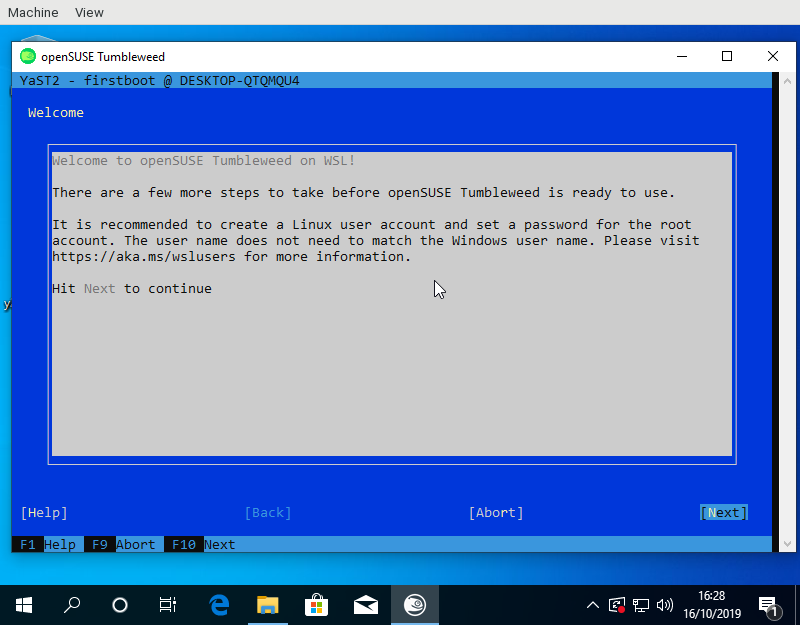
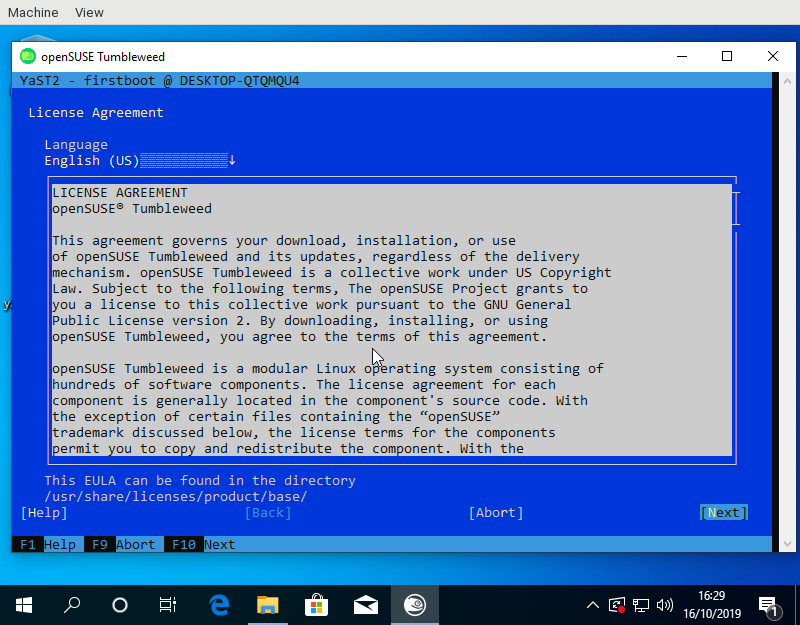
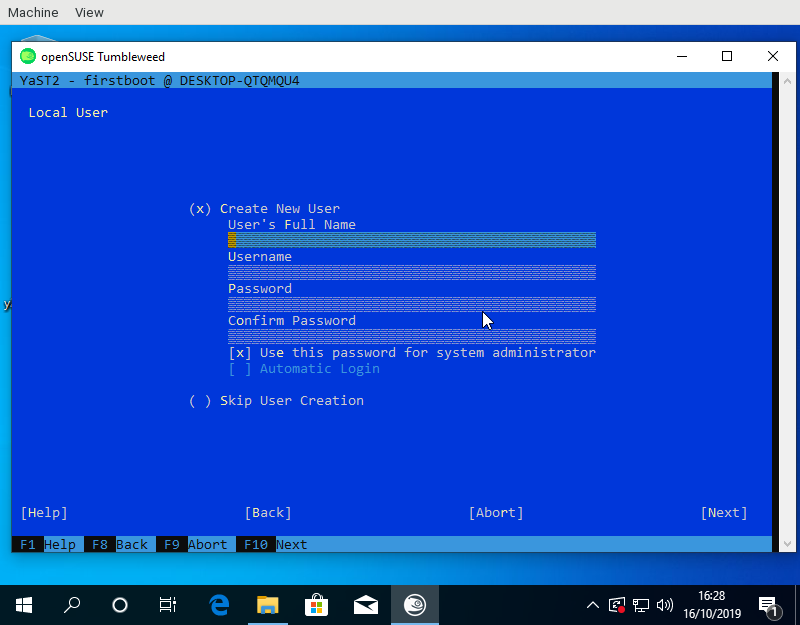
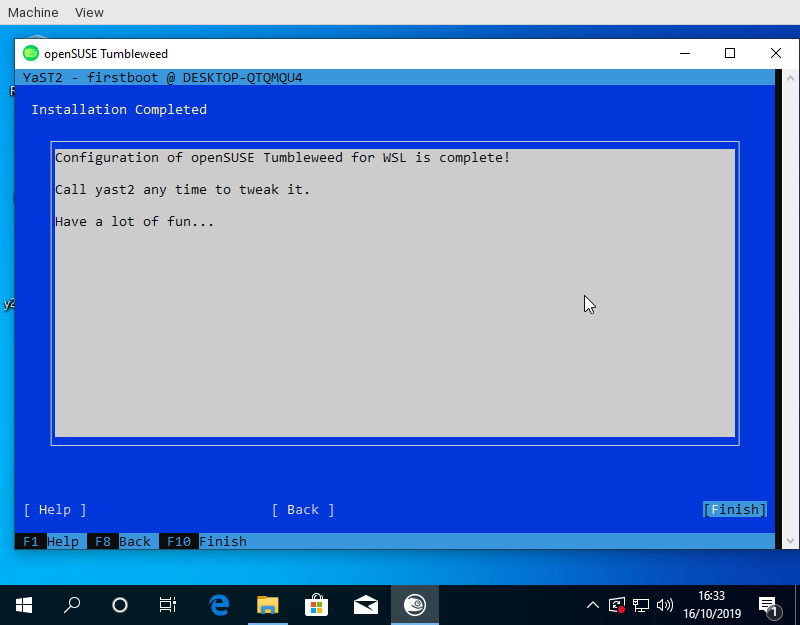
For the launcher to know the name of the created user a small YaST module was needed to write the name into /run/wsl_firstboot_uid. The launcher fetches it from there.
Using the YaST firstboot wizard also allows to use e.g. the existing registration dialogs on SLE or add other useful configuration steps. One feature I have in mind would be for example is the role selection screen to offer some pre defined package selections for WSL use cases.
Tumbleweed and Leap appx files to test this are available from download.opensuse.org. Keep in mind that one needs to import the certificates used by OBS for signing first.
Show a dialog with Kdialog (part 1)

Refactoring the Length type
CSS length values have a number and a unit, e.g. 5cm
or 6px. Sometimes the unit is a percentage, like 50%, and SVG
says that lengths with percentage units should be resolved with
respect to a certain rectangle. For example, consider this circle
element:
<circle cx="50%" cy="75%" r="4px" fill="black"/>
This means, draw a solid black circle whose center is at 50% of the width and 75% of the height of the current viewport. The circle should have a 4-pixel radius.
The process of converting that kind of units into absolute pixels for the final drawing is called normalization. In SVG, percentage units sometimes need to be normalized with respect to the current viewport (a local coordinate system), or with respect to the size of another object (e.g. when a clipping path is used to cut the current shape in half).
One detail about normalization is that it can be with respect to the horizontal dimension of the current viewport, the vertical dimension, or both. Keep this in mind: at normalization time, we need to be able to distinguish between those three modes.
The original C version
I have talked about the original C code for lengths before; the following is a small summary.
The original C code had this struct to represent lengths:
typedef struct {
    double length;
    char factor;
} RsvgLength;
The parsing code would set the factor field to a
character depending on the length's unit: 'p' for percentages, 'i'
for inches, etc., and '\0' for the default unit, which is pixels.
Along with that, the normalization code needed to know the direction (horizontal, vertical, both) to which the length in question refers. It did this by taking another character as an argument to the normalization function:
double
_rsvg_css_normalize_length (const RsvgLength * in, RsvgDrawingCtx * ctx, char dir)
{
    if (in->factor == '\0')            /* pixels, no need to normalize */
        return in->length;
    else if (in->factor == 'p') {      /* percentages; need to consider direction */
        if (dir == 'h')                                     /* horizontal */
            return in->length * ctx->vb.rect.width;
        if (dir == 'v')                                     /* vertical */
            return in->length * ctx->vb.rect.height;
        if (dir == 'o')                                     /* both */
            return in->length * rsvg_viewport_percentage (ctx->vb.rect.width,
                                                          ctx->vb.rect.height);
    } else { ... }
}
The original post talks about how I found a couple of bugs with
how the directions are identified at normalization time. The function
above expects one of 'h'/'v'/'o' for horizontal/vertical/both, and one or
two places in the code passed the wrong character.
Making the C version cleaner
Before converting that code to Rust, I removed the pesky characters and made the code use proper enums to identify a length's units.
+typedef enum {
+    LENGTH_UNIT_DEFAULT,
+    LENGTH_UNIT_PERCENT,
+    LENGTH_UNIT_FONT_EM,
+    LENGTH_UNIT_FONT_EX,
+    LENGTH_UNIT_INCH,
+    LENGTH_UNIT_RELATIVE_LARGER,
+    LENGTH_UNIT_RELATIVE_SMALLER
+} LengthUnit;
+
 typedef struct {
     double length;
-    char factor;
+    LengthUnit unit;
 } RsvgLength;
Then, do the same for the normalization function, so it will get the direction in which to normalize as an enum instead of a char.
+typedef enum {
+    LENGTH_DIR_HORIZONTAL,
+    LENGTH_DIR_VERTICAL,
+    LENGTH_DIR_BOTH
+} LengthDir;

 double
-_rsvg_css_normalize_length (const RsvgLength * in, RsvgDrawingCtx * ctx, char dir)
+_rsvg_css_normalize_length (const RsvgLength * in, RsvgDrawingCtx * ctx, LengthDir dir)
Making the C version easier to get right
While doing the last change above, I found a place in the code that used the wrong direction by mistake, probably due to a cut&paste error. Part of the problem here is that the code was specifying the direction at normalization time.
I decided to change it so that each direction value carried its own
direction since initialization, so that subsequent
code wouldn't have to worry about that. Hopefully, initializing a
width field should make it obvious that it needed
LENGTH_DIR_HORIZONTAL.
 typedef struct {
     double length;
     LengthUnit unit;
+    LengthDir dir;
 } RsvgLength;
That is, so that instead of
  /* at initialization time */
  foo.width = _rsvg_css_parse_length (str);

  ...

  /* at rendering time */
  double final_width = _rsvg_css_normalize_length (&foo.width, ctx, LENGTH_DIR_HORIZONTAL);
we would instead do this:
  /* at initialization time */
  foo.width = _rsvg_css_parse_length (str, LENGTH_DIR_HORIZONTAL);

  ...

  /* at rendering time */
  double final_width = _rsvg_css_normalize_length (&foo.width, ctx);
This made the drawing code, which deals with a lot of coordinates at the same time, a lot less noisy.
Initial port to Rust
To recap, this was the state of the structs after the initial refactoring in C:
typedef enum {
    LENGTH_UNIT_DEFAULT,
    LENGTH_UNIT_PERCENT,
    LENGTH_UNIT_FONT_EM,
    LENGTH_UNIT_FONT_EX,
    LENGTH_UNIT_INCH,
    LENGTH_UNIT_RELATIVE_LARGER,
    LENGTH_UNIT_RELATIVE_SMALLER
} LengthUnit;

typedef enum {
    LENGTH_DIR_HORIZONTAL,
    LENGTH_DIR_VERTICAL,
    LENGTH_DIR_BOTH
} LengthDir;

typedef struct {
    double length;
    LengthUnit unit;
    LengthDir dir;
} RsvgLength;
This ported to Rust in a straightforward fashion:
pub enum LengthUnit {
    Default,
    Percent,
    FontEm,
    FontEx,
    Inch,
    RelativeLarger,
    RelativeSmaller
}

pub enum LengthDir {
    Horizontal,
    Vertical,
    Both
}

pub struct RsvgLength {
    length: f64,
    unit: LengthUnit,
    dir: LengthDir
}
It got a similar constructor that took the
direction and produced an RsvgLength:
impl RsvgLength {
    pub fn parse (string: &str, dir: LengthDir) -> RsvgLength { ... }
}
(This was before using Result; remember that the original
C code did very little error checking!)
The initial Parse trait
It was at that point that it seemed convenient to introduce a Parse
trait, which all CSS value types would implement to
parse themselves from string.
However, parsing an RsvgLength also needed an extra piece of data,
the LengthDir. My initial version of the Parse trait had an
associated called Data, through which one could pass an extra piece
of data during parsing/initialization:
pub trait Parse: Sized {
    type Data;
    type Err;

    fn parse (s: &str, data: Self::Data) -> Result<Self, Self::Err>;
}
This was explicitly to be able to pass a LengthDir to the parser for
RsvgLength:
impl Parse for RsvgLength {
    type Data = LengthDir;
    type Err = AttributeError;

    fn parse (string: &str, dir: LengthDir) -> Result <RsvgLength, AttributeError> { ... }
}
This was okay for lengths, but very noisy for everything else that
didn't require an extra bit of data. In the rest of the code, the
helper type was Data = () and there was a pair of extra parentheses ()
in every place that parse() was called.
Removing the helper Data type
Introducing one type per direction
Over a year later, that () bit of data everywhere was driving me
nuts. I started refactoring the Length module to remove it.
First, I introduced three newtypes to wrap Length, and indicate
their direction at the same time:
pub struct LengthHorizontal(Length);
pub struct LengthVertical(Length);
pub struct LengthBoth(Length);
This was done with a macro because now each wrapper type
needed to know the relevant LengthDir.
Now, for example, the declaration for the <circle> element looked
like this:
pub struct NodeCircle {
    cx: Cell<LengthHorizontal>,
    cy: Cell<LengthVertical>,
    r: Cell<LengthBoth>,
}
(Ignore the Cell everywhere; we got rid of that later.)
Removing the dir field
Since now the information about the length's direction is embodied in
the LengthHorizontal/LengthVertical/LengthBoth types, this made it
possible to remove the dir field from the inner
Length struct.
 pub struct RsvgLength {
     length: f64,
     unit: LengthUnit,
-    dir: LengthDir
 }

+pub struct LengthHorizontal(Length);
+pub struct LengthVertical(Length);
+pub struct LengthBoth(Length);
+
+define_length_type!(LengthHorizontal, LengthDir::Horizontal);
+define_length_type!(LengthVertical, LengthDir::Vertical);
+define_length_type!(LengthBoth, LengthDir::Both);
Note the use of a define_length_type! macro to generate code for
those three newtypes.
Removing the Data associated type
And finally, this made it possible to remove the Data associated
type from the Parse trait.
 pub trait Parse: Sized {
-    type Data;
     type Err;

-    fn parse(parser: &mut Parser<'_, '_>, data: Self::Data) -> Result<Self, Self::Err>;
+    fn parse(parser: &mut Parser<'_, '_>) -> Result<Self, Self::Err>;
 }
The resulting mega-commit removed a bunch of stray parentheses ()
from all calls to parse(), and the code ended up a lot easier to
read.
Removing the newtypes
This was fine for a while. Recently, however, I figured out that it would be possible to embody the information for a length's direction in a different way.
But to get there, I first needed a temporary refactor.
Replacing the macro with a trait with a default implementation
Deep in the guts of length.rs, the key function that does something
different based on LengthDir is its scaling_factor method:
enum LengthDir {
    Horizontal,
    Vertical,
    Both,
}

impl LengthDir {
    fn scaling_factor(self, x: f64, y: f64) -> f64 {
        match self {
            LengthDir::Horizontal => x,
            LengthDir::Vertical => y,
            LengthDir::Both => viewport_percentage(x, y),
        }
    }
}
That method gets passed, for example, the width/height of the
current viewport for the x/y arguments. The method decides whether
to use the width, height, or a combination of both.
And of course, the interesting part of the define_length_type! macro
was to generate code for calling LengthDir::Horizontal::scaling_factor()/etc. as
appropriate depending on the LengthDir in question.
First I made a trait called Orientation with a scaling_factor
method, and three zero-sized types that implement that trait. Note
how each of these three implementations corresponds to one of the
match arms above:
pub trait Orientation {
    fn scaling_factor(x: f64, y: f64) -> f64;
}

pub struct Horizontal;
pub struct Vertical;
pub struct Both;

impl Orientation for Horizontal {
    fn scaling_factor(x: f64, _y: f64) -> f64 {
        x
    }
}

impl Orientation for Vertical {
    fn scaling_factor(_x: f64, y: f64) -> f64 {
        y
    }
}

impl Orientation for Both {
    fn scaling_factor(x: f64, y: f64) -> f64 {
        viewport_percentage(x, y)
    }
}
Now most of the contents of the define_length_type! macro can go in
the default implementation of a new trait
LengthTrait. Crucially, this trait has an
Orientation associated type, which it uses to call into the
Orientation trait:
pub trait LengthTrait: Sized {
    type Orientation: Orientation;

    ...

    fn normalize(&self, values: &ComputedValues, params: &ViewParams) -> f64 {
        match self.unit() {
            LengthUnit::Px => self.length(),

            LengthUnit::Percent => {
                self.length() *
                <Self::Orientation>::scaling_factor(params.view_box_width, params.view_box_height)
            }

            ...
    }
}
Note that the incantation is
<Self::Orientation>::scaling_factor(...) to call that method on the
associated type.
Now the define_length_type! macro is shrunk a lot, with the
interesting part being just this:
macro_rules! define_length_type {
    {$name:ident, $orient:ty} => {
        pub struct $name(Length);

        impl LengthTrait for $name {
            type Orientation = $orient;
        }
    }
}

define_length_type! { LengthHorizontal, Horizontal }
define_length_type! { LengthVertical, Vertical }
define_length_type! { LengthBoth, Both }
We moved from having three newtypes of length-with-LengthDir to three newtypes with dir-as-associated-type.
Removing the newtypes and the macro
After that temporary refactoring, we had the Orientation trait and
the three zero-sized types Horizontal, Vertical, Both.
I figured out that one can use PhantomData as a way to carry
around the type that Length needs to normalize itself, instead of
using an associated type in an extra LengthTrait. Behold!
pub struct Length<O: Orientation> {
    pub length: f64,
    pub unit: LengthUnit,
    orientation: PhantomData<O>,
}

impl<O: Orientation> Length<O> {
    pub fn normalize(&self, values: &ComputedValues, params: &ViewParams) -> f64 {
        match self.unit {
            LengthUnit::Px => self.length,

            LengthUnit::Percent => {
                self.length
                    * <O as Orientation>::scaling_factor(params.view_box_width, params.view_box_height)
            }

            ...
        }
    }
}
Now the incantation is <O as Orientation>::scaling_factor() to call
the method on the generic type; it is no longer an associated type in
a trait.
With that, users of lengths look like this; here, our <circle>
element from before:
pub struct Circle {
    cx: Length<Horizontal>,
    cy: Length<Vertical>,
    r: Length<Both>,
}
I'm very happy with the readability of all the code now. I used to
think of PhantomData as a way to deal with wrapping pointers from
C, but it turns out that it is also useful to keep a generic
type around should one need it.
The final Length struct is this:
pub struct Length<O: Orientation> {
    pub length: f64,
    pub unit: LengthUnit,
    orientation: PhantomData<O>,
}
And it only takes up as much space as its length and unit fields;
PhantomData is zero-sized after all.
(Later, we renamed Orientation to Normalize, but the code's
structure remained the same.)
Summary
Over a couple of years, librsvg's type that represents CSS lengths went from a C representation along the lines of "all data in the world is an int", to a Rust representation that uses some interesting type trickery:
-
C struct with
charfor units. -
C struct with a
LengthUnitsenum. -
C struct without an embodied direction; each place that needs to normalize needs to get the orientation right.
-
C struct with a built-in direction as an extra field, done at initialization time.
-
Same struct but in Rust.
-
An ugly but workable
Parsetrait so that the direction can be set at parse/initialization time. -
Three newtypes
LengthHorizontal,LengthVertical,LengthBothwith a common core. A cleaned-upParsetrait. A macro to generate those newtypes. -
Replace the
LengthDirenum with anOrientationtrait, and three zero-sized typesHorizontal/Vertical/Boththat implement the trait. -
Replace most of the macro with a helper trait
LengthTraitthat has anOrientationassociated type. -
Replace the helper trait with a single
Length<T: Orientation>type, which puts the orientation as a generic parameter. The macro disappears and there is a single implementation for everything.
Refactoring never ends!

Things are Looking Pod-tastic | Fall Time Blathering

Private and Air-Gap registry for openSUSE Kubic
Intro
Sometimes there are occasions where direct internet access is not possible (proxy/offline/airgapped). Even in this setups it is possible to deploy and use Kubernetes with openSUSE Kubic and a local private registry.
In this blog I will explain how to setup a local server which acts as private registry providing all the container images needed to deploy Kubernetes with openSUSE Kubic.
Installation
OS
As OS for our host serving the required services
openSUSE MicroOS is used, which needs
to be installed with the MicroOS Container Host system role.
The following additional packages are required and need to be installed:
- container-registry-systemd
- mirror-registry
- skopeo with the latest sync patches as provided in openSUSE Tumbleweed
- reg (optional, for testing and debugging)
# transactional-update pkg install mirror-registry skopeo container-registry-systemd reg
# systemctl reboot
After the reboot the tools are available and we can start with the setup of the registry.
Registry Setup
There is a script to setup a local private registry running in containers. By default, everybody can list and pull images from it, but only the admin is allowed to push new images.
# setup-container-registry
There is no default password for the admin account, which means it is necessary to set one to be able to sync the containers to this registries. The password must be a bcrypt (blowfish) hash:
# htpasswd -nB admin
Modify the password entry for the admin account and set the new hash:
# nano /etc/registry/auth_config.yml
Additional, the ACL rules can be adjusted.
Start the containers for the registry:
# systemctl start container-registry
# systemctl start registry-auth_server
Now your registry is running and should work. This can be verified with:
# reg ls localhost
Repositories for localhost
REPO                TAGS
Certificates
By default setup-container-registry will create self signed
certificates, which are valid for 1,5 year and stored in
/etc/registry/certs. They can be replaced with official certificates.
If the self signed certificates are used, the public CA certificate needs
to be installed on all machines, which should access the registry. Copy
/etc/registry/certs/ContainerRegistryCA.crt to /etc/pki/trust/anchors/
and run update-ca-certificates on every machine.
List of container images
The tool mirror-registry will be used to create a list of containers
which needs to be mirrored. It will analyse a remote registry and
create a yaml file with all containers and tags matching a regex to
sync with skopeo to a private registry.
This tool can run on any architecture, the target platform can be specified as argument. In contrast to this, skopeo needs to run on the target architecture. Else it will fail or sync the wrong container image if there are multi-architecture container images in the source repository.
All container images below registry.opensuse.org/kubic/ are required.
Additional, it could be from help to mirror all official openSUSE
container images from registry.opensuse.org/opensuse/, too.
Else utilities like toolbox will not work.
The commnd to create a list of container images is:
# mirror-registry --out kubic-full.yaml registry.opensuse.org "(^kubic|^opensuse/([^/]+)$)"
This command will mirror all builds of all versions of the required container images. But most of the time it is enough to mirror the latest build of every version:
# mirror-registry --out kubic-small.yaml --minimize registry.opensuse.org "(^kubic|^opensuse/([^/]+)$)"
kubic-small.yaml can now be further tuned. If e.g. weave is used for the POD
network, flannel and the cilium containers don’t need to be mirrored
and can be deleted from the list.
Private registry
From a host, which has access to the source registry and the internal private registry, the container images can now be synced with skopeo:
# skopeo sync --scoped --src yaml --dest docker --dest-creds admin:password kubic-small.yaml registry.local
The --scoped option will prefix the internal registry name to the
current external repository name, so the repository will be
registry.opensuse.org/... and the pull command
podman pull registry.local/registry.opensuse.org/...
to avoid clashes with the namespace of the internal registry or by
mirroring additional registries.
The result can be verified with:
# reg ls registry.local
skopeo needs recent enough patches adding the sync option. This patches
are already part of openSUSE Tumbleweed, openSUSE MicroOS and openSUSE Kubic,
but not of SUSE Linux Enterprise Server 15.
Airgapped/offline registry
If there is no host which can access both registries, the external and the internal one, the container images needs to be copied to a disk, which then needs to be transfered into the internal network.
Copy the container images to an external disk:
# skopeo sync --scoped --src yaml --dest dir kubic-small.yaml /media/external-disk
Take the external disk to the internal registry machine and import the container images:
# skopeo sync --scoped --src dir --dest docker --dest-creds admin:password /media/external-disk localhost
Verify the result:
# reg ls registry.local
Node configuration
After the private registry is running and contains all container images, cri-o and podman need to be aware of this registry and pull the images from it.
Both tools share the same configuration file for this: /etc/containers/registries.conf.
The default configuration file is using the v1 syntax, but v2 is needed. The documentation can be found here. A working configuration template, which needs to be deployed on every kubernetes node, could look like:
[[registry]]
prefix = "registry.opensuse.org/kubic"
location = "registry.local/registry.opensuse.org/kubic"
insecure = false
blocked = false

[[registry]]
prefix = "registry.opensuse.org/opensuse"
location = "registry.local/registry.opensuse.org/opensuse"
insecure = false
blocked = false
- insecure:
trueorfalse. By default TLS is required when retrieving images from a registry. If insecure is set to true, unencrypted HTTP as well as TLS connections with untrusted certificates are allowed. - blocked :
trueorfalse. If true, pulling images with matching names is forbidden.
After updating the configuration file, cri-o needs to be restarted on that node if it is running:
# systemctl status crio
* crio.service - Open Container Initiative Daemon
   Loaded: loaded (/usr/lib/systemd/system/crio.service; disabled; vendor preset: disabled)
   Active: active (running) since Sat 2019-11-02 18:09:23 UTC; 8min ago
[...]
# systemctl stop crio
# systemctl start crio
Now you can deploy kubernetes!
Configuration files
Following configuration files define the behavior of the registry and the authentication server:
- /etc/registry/config.yml - configuration file for registry
- /etc/registry/auth_config.yml - configuration file for auth server
- /etc/sysconfig/container-registry - configuration file for the two containers


Laravel homestead box get corrupted!
I keep getting this same error message when I tried to run vagrant up on my machine
$ vagrant up
Bringing machine 'homestead' up with 'virtualbox' provider...
==> homestead: Importing base box 'laravel/homestead'...
Progress: 90%
There was an error while executing `VBoxManage`, a CLI used by Vagrant
for controlling VirtualBox. The command and stderr is shown below.

Command: ["import", "/home/rnm/.vagrant.d/boxes/laravel-VAGRANTSLASH-homestead/8.2.1/virtualbox/box.ovf", "--vsys", "0", "--vmname", "ubuntu-18.04-amd64_1573673848596_76505", "--vsys", "0", "--unit", "11", "--disk", "/home/rnm/VirtualBox VMs/ubuntu-18.04-amd64_1573673848596_76505/ubuntu-18.04-amd64-disk001.vmdk"]

Stderr: 0%...10%...20%...30%...40%...50%...60%...70%...80%...90%...100%
Interpreting /home/rnm/.vagrant.d/boxes/laravel-VAGRANTSLASH-homestead/8.2.1/virtualbox/box.ovf...
OK.
0%...
Progress state: NS_ERROR_INVALID_ARG
VBoxManage: error: Appliance import failed
VBoxManage: error: Code NS_ERROR_INVALID_ARG (0x80070057) - Invalid argument value (extended info not available)
VBoxManage: error: Context: "RTEXITCODE handleImportAppliance(HandlerArg*)" at line 957 of file VBoxManageAppliance.cpp
Arghh..this is quite anoyying.. I tried executing same command again and again but no luck. I check my disk space and there is plenty.
I have no choice, I will delete ~/.vagrant.d and execute vagrant command again
$ rm -rf ~/.vagrant.d
removed '/home/rnm/.vagrant.d/insecure_private_key'
removed '/home/rnm/.vagrant.d/rgloader/loader.rb'
removed directory '/home/rnm/.vagrant.d/rgloader'
removed directory '/home/rnm/.vagrant.d/tmp'
removed directory '/home/rnm/.vagrant.d/gems/2.4.9'
removed directory '/home/rnm/.vagrant.d/gems'
removed '/home/rnm/.vagrant.d/setup_version'
removed '/home/rnm/.vagrant.d/boxes/laravel-VAGRANTSLASH-homestead/8.2.1/virtualbox/ubuntu-18.04-amd64-disk001.vmdk'
removed '/home/rnm/.vagrant.d/boxes/laravel-VAGRANTSLASH-homestead/8.2.1/virtualbox/Vagrantfile'
removed '/home/rnm/.vagrant.d/boxes/laravel-VAGRANTSLASH-homestead/8.2.1/virtualbox/box.ovf'
removed '/home/rnm/.vagrant.d/boxes/laravel-VAGRANTSLASH-homestead/8.2.1/virtualbox/metadata.json'
removed directory '/home/rnm/.vagrant.d/boxes/laravel-VAGRANTSLASH-homestead/8.2.1/virtualbox'
removed directory '/home/rnm/.vagrant.d/boxes/laravel-VAGRANTSLASH-homestead/8.2.1'
removed '/home/rnm/.vagrant.d/boxes/laravel-VAGRANTSLASH-homestead/metadata_url'
removed directory '/home/rnm/.vagrant.d/boxes/laravel-VAGRANTSLASH-homestead'
removed directory '/home/rnm/.vagrant.d/boxes'
removed '/home/rnm/.vagrant.d/data/machine-index/index.lock'
removed directory '/home/rnm/.vagrant.d/data/machine-index'
removed '/home/rnm/.vagrant.d/data/lock.dotlock.lock'
removed '/home/rnm/.vagrant.d/data/checkpoint_signature'
removed '/home/rnm/.vagrant.d/data/checkpoint_cache'
removed '/home/rnm/.vagrant.d/data/lock.machine-action-13105a2995d25174a20c9b1d206a4f8a.lock'
removed directory '/home/rnm/.vagrant.d/data'
removed directory '/home/rnm/.vagrant.d'
and when I execute vagrant, re-downloading the box then suddenly it worked!
$ vagrant up
Bringing machine 'homestead' up with 'virtualbox' provider...
==> homestead: Box 'laravel/homestead' could not be found. Attempting to find and install...
    homestead: Box Provider: virtualbox
    homestead: Box Version: >= 8.2.0
==> homestead: Loading metadata for box 'laravel/homestead'
    homestead: URL: https://vagrantcloud.com/laravel/homestead
==> homestead: Adding box 'laravel/homestead' (v8.2.1) for provider: virtualbox
    homestead: Downloading: https://vagrantcloud.com/laravel/boxes/homestead/versions/8.2.1/providers/virtualbox.box
    homestead: Download redirected to host: vagrantcloud-files-production.s3.amazonaws.com
==> homestead: Successfully added box 'laravel/homestead' (v8.2.1) for 'virtualbox'!
==> homestead: Importing base box 'laravel/homestead'...
==> homestead: Matching MAC address for NAT networking...
==> homestead: Checking if box 'laravel/homestead' version '8.2.1' is up to date...
==> homestead: Setting the name of the VM: homestead
Vagrant is currently configured to create VirtualBox synced folders with
the `SharedFoldersEnableSymlinksCreate` option enabled. If the Vagrant
guest is not trusted, you may want to disable this option. For more
information on this option, please refer to the VirtualBox manual:

  https://www.virtualbox.org/manual/ch04.html#sharedfolders

This option can be disabled globally with an environment variable:

  VAGRANT_DISABLE_VBOXSYMLINKCREATE=1

or on a per folder basis within the Vagrantfile:

  config.vm.synced_folder '/host/path', '/guest/path', SharedFoldersEnableSymlinksCreate: false
==> homestead: Clearing any previously set network interfaces...
==> homestead: Preparing network interfaces based on configuration...
    homestead: Adapter 1: nat
    homestead: Adapter 2: hostonly
==> homestead: Forwarding ports...
    homestead: 80 (guest) => 8000 (host) (adapter 1)
    homestead: 443 (guest) => 44300 (host) (adapter 1)
    homestead: 3306 (guest) => 33060 (host) (adapter 1)
    homestead: 4040 (guest) => 4040 (host) (adapter 1)
    homestead: 5432 (guest) => 54320 (host) (adapter 1)
    homestead: 8025 (guest) => 8025 (host) (adapter 1)
    homestead: 9600 (guest) => 9600 (host) (adapter 1)
    homestead: 27017 (guest) => 27017 (host) (adapter 1)
    homestead: 22 (guest) => 2222 (host) (adapter 1)
==> homestead: Running 'pre-boot' VM customizations...
==> homestead: Booting VM...
==> homestead: Waiting for machine to boot. This may take a few minutes...
    homestead: SSH address: 127.0.0.1:2222
    homestead: SSH username: vagrant
    homestead: SSH auth method: private key
    homestead: Warning: Connection reset. Retrying...
    homestead: Warning: Remote connection disconnect. Retrying...
    homestead: Warning: Remote connection disconnect. Retrying...
    homestead: Warning: Remote connection disconnect. Retrying...
    homestead: Warning: Connection reset. Retrying...
    homestead: Warning: Remote connection disconnect. Retrying...
    homestead:
    homestead: Vagrant insecure key detected. Vagrant will automatically replace
    homestead: this with a newly generated keypair for better security.
    homestead:
    homestead: Inserting generated public key within guest...
    homestead: Removing insecure key from the guest if it's present...
    homestead: Key inserted! Disconnecting and reconnecting using new SSH key...
==> homestead: Machine booted and ready!
==> homestead: Checking for guest additions in VM...
==> homestead: Setting hostname...
==> homestead: Configuring and enabling network interfaces...
==> homestead: Mounting shared folders...
    homestead: /vagrant => /home/rnm/Homestead
    homestead: /home/vagrant/project1 => /home/rnm/workplace/laravel/project1
==> homestead: Running provisioner: file...
    homestead: /home/rnm/Homestead/aliases => /tmp/bash_aliases
==> homestead: Running provisioner: shell...
    homestead: Running: inline script
==> homestead: Running provisioner: shell...
    homestead: Running: inline script
    homestead:
    homestead: ssh-rsa
==> homestead: Running provisioner: shell...
    homestead: Running: inline script
==> homestead: Running provisioner: shell...
    homestead: Running: inline script
==> homestead: Running provisioner: shell...
    homestead: Running: inline script
==> homestead: Running provisioner: shell...
    homestead: Running: inline script
    homestead: Ignoring feature: mariadb because it is set to false
==> homestead: Running provisioner: shell...
    homestead: Running: inline script
    homestead: Ignoring feature: ohmyzsh because it is set to false
==> homestead: Running provisioner: shell...
    homestead: Running: inline script
    homestead: Ignoring feature: webdriver because it is set to false
==> homestead: Running provisioner: shell...
    homestead: Running: /tmp/vagrant-shell20191114-1822-10idfmj.sh
==> homestead: Running provisioner: shell...
    homestead: Running: /tmp/vagrant-shell20191114-1822-1pewpva.sh
==> homestead: Running provisioner: shell...
    homestead: Running: script: Creating Certificate: project1.test
==> homestead: Running provisioner: shell...
    homestead: Running: script: Creating Site: project1.test
==> homestead: Running provisioner: shell...
    homestead: Running: inline script
==> homestead: Running provisioner: shell...
    homestead: Running: /tmp/vagrant-shell20191114-1822-yobfu3.sh
==> homestead: Running provisioner: shell...
    homestead: Running: script: Checking for old Schedule
==> homestead: Running provisioner: shell...
    homestead: Running: script: Clear Variables
==> homestead: Running provisioner: shell...
    homestead: Running: script: Restarting Cron
==> homestead: Running provisioner: shell...
    homestead: Running: script: Restarting Nginx
==> homestead: Running provisioner: shell...
    homestead: Running: script: Creating MySQL Database: project1
==> homestead: Running provisioner: shell...
    homestead: Running: script: Creating Postgres Database: project1
==> homestead: Running provisioner: shell...
    homestead: Running: script: Update Composer
    homestead: Updating to version 1.9.1 (stable channel).
    homestead:
    homestead: Use composer self-update --rollback to return to version 1.9.0
==> homestead: Running provisioner: shell...
    homestead: Running: /tmp/vagrant-shell20191114-1822-o4c7za.sh
==> homestead: Running provisioner: shell...
    homestead: Running: script: Update motd
==> homestead: Running provisioner: shell...
    homestead: Running: /tmp/vagrant-shell20191114-1822-13ajt5r.sh
nice!
$ vagrant global-status
id       name      provider   state   directory
--------------------------------------------------------------------------
dd946c7  homestead virtualbox running /home/rnm/Homestead

The above shows information about all known Vagrant environments
on this machine. This data is cached and may not be completely
up-to-date (use "vagrant global-status --prune" to prune invalid
entries). To interact with any of the machines, you can go to that
directory and run Vagrant, or you can use the ID directly with
Vagrant commands from any directory. For example:
"vagrant destroy 1a2b3c4d"

$ vagrant ssh
Welcome to Ubuntu 18.04.3 LTS (GNU/Linux 4.15.0-64-generic x86_64)

Thanks for using
 _                               _                 _
| |                             | |               | |
| |__   ___  _ __ ___   ___  ___| |_ ___  __ _  __| |
| '_ \ / _ \| '_ ` _ \ / _ \/ __| __/ _ \/ _` |/ _` |
| | | | (_) | | | | | |  __/\__ \ ||  __/ (_| | (_| |
|_| |_|\___/|_| |_| |_|\___||___/\__\___|\__,_|\__,_|

* Homestead v9.2.2 released
* Settler v8.2.0 released

0 packages can be updated.
0 updates are security updates.


vagrant@homestead:~$
Seems, my vagrant box was corrupted and re-download the box is the solution.

Debugging on MicroOS made easier with toolbox
Until now, it was not easy to run debugging tools on openSUSE MicroOS or Kubic for the simple reason that installing any package using the transactional-update in package_name command would require a reboot for the program to be available on the system. Why so? MicroOS & Kubic use transactional updates and thus, the root filesystem is mounted as read-only. Packages that are installed are available in a "snapshot" which is selected at the next boot. openSUSE MicroOS & Kubic fall in the category of immutable operating systems.
One couldn't just reboot the system every time a simple program was needed - e.g using Vi to edit a YAML config or using database client utils for a rapid inspection.
But now we have a toolbox script available in MicroOS & Kubic that allows us to launch a container and use debugging utilities that can interact with the host. The script is written in Bash and it is based on CoreOS/toolbox.
Thorsten Kukuk, SUSE Engineer & Architect (SLES / MicroOS), announced the availability of the toolbox container on the openSUSE Kubic mailing list in October.
The toolbox script resides in the system $PATH and thus can be called directly. On its first execution, the script will pull the toolbox container from the openSUSE Container Registry.
microos:~ # toolbox
Trying to pull registry.opensuse.org/opensuse/toolbox...
Getting image source signatures
Copying blob 92a022f7c0d8 [>-------------------------------------] 2.8MiB / 122.9MiB
Copying blob f0c8107beec9 [==>-----------------------------------] 3.0MiB / 36.4MiB
The host root filesystem can be accessed at /media/root/ and since the toolbox container is spawned as the root user, the files will be modifiable.
toolbox:/ # ls /media/root/
bin   dev  home  lib64	opt   root  sbin     srv  tmp  var
boot  etc  lib	 mnt	proc  run   selinux  sys  usr
Non-root toolbox containers will have read-only access to the host files, unless the --root flag is provided.
ish@microos:~> toolbox --root
Next, use zypper to install the required utilities and interact with the host and other containers.
Exiting toolbox will stop and the container and next time the script is called, the container is started again. Therefore, previously installed utilities remain available.
Each toolbox container is named by appending the username calling it, e.g toolbox-ish.
microos:~ # podman ps --format "{{.ID}} {{.Status}} {{.Names}}"
7f61fba95487 Up 10 minutes ago toolbox-ish
00ada606ec4f Up 33 minutes ago toolbox-root
CSS in librsvg is now in Rust, courtesy of Mozilla Servo
Summary: after an epic amount of refactoring, librsvg now does all CSS parsing and matching in Rust, without using libcroco. In addition, the CSS engine comes from Mozilla Servo, so it should be able to handle much more complex CSS than librsvg ever could before.
This is the story of CSS support in librsvg.
Introduction
The first commit to introduce CSS parsing in librsvg dates from 2002. It was as minimal as possible, written to support a small subset of what was then CSS2.
Librsvg handled CSS stylesheets more "piecing them apart" than
"parsing them". You know, when g_strsplit() is your best friend.
The basic parsing algorithm was to turn a stylesheet like this:
rect { fill: blue; }

.classname {
    fill: green;
    stroke-width: 4;
}
Into a hash table whose keys are strings like rect and .classname,
and whose values are everything inside curly braces.
The selector matching phase was equally simple. The code only handled a few possible match types as follows. If it wanted to match a certain kind of CSS selector, it would say, "what would this selector look like in CSS syntax", it would make up a string with that syntax, and compare it to the key strings it had stored in the hash table from above.
So, to match an element name selector, it would sprintf("%s",
element->name), obtain something like rect and see if the hash
table had such a key.
To match a class selector, it would sprintf(".%s",
element->class), obtain something like .classname, and look it up
in the hash table.
This scheme supported only a few combinations. It handled tag,
.class, tag.class, and a few combinations with #id in them.
This was enough to support very simple stylesheets.
The value corresponding to each key in the hash table was the stuff
between curly braces in the stylesheet, so the second rule from the
example above would contain fill: green; stroke-width: 4;. Once
librsvg decided that an SVG element matched that CSS rule, it would
re-parse the string with the CSS properties and apply them to the
element's style.
I'm amazed that so little code was enough to deal with a good number of SVG files with stylesheets. I suspect that this was due to a few things:
-
While people were using complex CSS in HTML all the time, it was less common for SVG...
-
... because CSS2 was somewhat new, and the SVG spec was still being written...
-
... and SVGs created with illustration programs don't really use stylesheets; they include the full style information inside each element instead of symbolically referencing it from a stylesheet.
From the kinds of bugs that librsvg has gotten around "CSS support is too limited", it feels like SVGs which use CSS features are either hand-written, or machine-generated from custom programs like data plotting software. Illustration programs tend to list all style properties explicitly in each SVG element, and don't use CSS.
Libcroco appears
The first commit to introduce libcroco was to do CSS parsing, from March 2003.
At the same time, libcroco was introducing code to do CSS matching. However, this code never got used in librsvg; it still kept its simple string-based matcher. Maybe libcroco's API was not ready?
Libcroco fell out of maintainership around the first half of 2005, and volunteers have kept fixing it since then.
Problems with librsvg's string matcher for CSS
The C implementation of CSS matching in librsvg remained basically untouched until 2018, when Paolo Borelli and I started porting the surrounding code to Rust.
I had a lot of trouble figuring out the concepts from the code. I didn't know all the terminology of CSS implementations, and librsvg didn't use it, either.
I think that librsvg's code suffered from what the refactoring
literature calls primitive
obsession.
Instead of having a parsed representation of CSS selectors, librsvg
just stored a stringified version of them. So, a selector like
rect#classname really was stored with a string like that, instead of
an actual decomposition into structs.
Moreover, things were misnamed. This is the field that stored stylesheet data inside an RsvgHandle:
GHashTable *css_props;
From just looking at the field declaration, this doesn't tell me anything about what kind of data is stored there. One has to grep the source code for where that field is used:
static void
rsvg_css_define_style (RsvgHandle * ctx,
                       const gchar * selector,
                       const gchar * style_name,
                       const gchar * style_value,
                       gboolean important)
{
    GHashTable *styles;

    styles = g_hash_table_lookup (ctx->priv->css_props, selector);
Okay, it looks up a selector by name in the css_props, and it
gives back... another hash table styles? What's in there?
        g_hash_table_insert (styles,
                             g_strdup (style_name),
                             style_value_data_new (style_value, important));
Another string key called style_name, whose key is a
StyleValueData; what's in it?
typedef struct _StyleValueData {
    gchar *value;
    gboolean important;
} StyleValueData;
The value is another string. Strings all the way!
At the time, I didn't really figure out what each level of nested hash
tables was supposed to mean. I didn't understand why we handled style
properties in a completely different part of the code, and yet this
part had a css_props field that didn't seem to store properties at all.
It took a while to realize that css_props was misnamed. It wasn't
storing a mapping of selector names to properties; it was storing a
mapping of selector names to declaration lists, which are lists of
property/value pairs.
So, when I started porting the CSS parsing code to Rust, I started to create real types with for each concept.
// Maps property_name -> Declaration
type DeclarationList = HashMap<String, Declaration>;

pub struct CssStyles {
    selectors_to_declarations: HashMap<String, DeclarationList>,
}
Even though the keys of those HashMaps are still strings, because librsvg didn't have a better way to represent their corresponding concepts, at least those declarations let one see what the hell is being stored without grepping the rest of the code. This is a part of the code that I didn't really touch very much, so it was nice to have that reminder.
The first port of the CSS matching code to
Rust
kept the same algorithm as the C code, the one that created strings
with element.class and compared them to the stored selector names.
Ugly, but it still worked in the same limited fashion.
Rustifying the CSS parsers
It turns out that CSS parsing is divided in two parts. One can have a
style attribute inside an element, for example
<rect x="0" y="0" width="100" height="100"
      style="fill: green; stroke: magenta; stroke-width: 4;"/>
This is a plain declaration list which is not associated to any selectors, and which is applied directly to just the element in which it appears.
Then, there is the <style> element itself, with a normal-looking CSS stylesheet
<style type="text/css">
  rect {
    fill: green;
    stroke: magenta;
    stroke-width: 4;
  }
</style>
This means that all <rect> elements will get that style applied.
I started to look for existing Rust crates to parse and handle CSS data. The cssparser and selectors crates come from Mozilla, so I thought they should do a pretty good job of things.
And they do! Except that they are not a drop-in replacement for anything. They are what gets used in Mozilla's Servo browser engine, so they are optimized to hell, and the code can be pretty intimidating.
Out of the box, cssparser provides a CSS tokenizer, but it does not know how to handle any properties/values in particular. One must use the tokenizer to implement a parser for each kind of CSS property one wants to support — Servo has mountains of code for all of HTML's style properties, and librsvg had to provide a smaller mountain of code for SVG style properties.
Thus started the big task of porting librsvg's string-based parsers
for CSS properties into ones based on cssparser tokens. Cssparser
provides a Parser struct, which extracts tokens out of a CSS
stream. Out of this, librsvg defines a Parse trait for parsable
things:
use cssparser::Parser;

pub trait Parse: Sized {
    type Err;

    fn parse(parser: &mut Parser<'_, '_>) -> Result<Self, Self::Err>;
}
What's with those two default lifetimes in Parser<'_, '_>?
Cssparser tries very hard to be a zero-copy tokenizer. One of the
lifetimes refers to the input string which is wrapped in a
Tokenizer, which is wrapped in a ParserInput. The other lifetime
is for the ParserInput itself.
In the actual implementation of that trait, the Err type also uses
the lifetime that refers to the input string. For example, there is a
BasicParseErrorKind::UnexpectedToken(Token<'i>), which one returns
when there is an unexpected token. And to avoid copying the substring
into the error, one returns a slice reference into the original
string, thus the lifetime.
I was more of a Rust newbie back then, and it was very hard to make sense of how cssparser was meant to be used.
The process was more or less this:
-
Port the C parsers to Rust; implement types for each CSS property.
-
Port the
&str-based parsers into ones that usecssparser. -
Fix the error handling scheme to match what cssparser's high-level traits expect.
This last point was... hard. Again, I wasn't comfortable enough with Rust lifetimes and nested generics; in the end it was all right.
Moving declaration lists to Rust
With the individual parsers for CSS properties done, and with them already using a different type for each property, the next thing was to implement cssparser's traits to parse declaration lists.
Again, a declaration list looks like this:
fill: blue;
stroke-width: 4;
It's essentially a key/value list.
The trait that cssparser wants us to implement is this:
pub trait DeclarationParser<'i> {
    type Declaration;
    type Error: 'i;

    fn parse_value<'t>(
        &mut self,
        name: CowRcStr<'i>,
        input: &mut Parser<'i, 't>,
    ) -> Result<Self::Declaration, ParseError<'i, Self::Error>>;
}
That is, define a type for a Declaration, and implement a
parse_value() method that takes a name and a Parser, and outputs
a Declaration or an error.
What this really means is that the type you implement for
Declaration needs to be able to represent all the CSS property types
that you care about. Thus, a struct plus a big enum like this:
pub struct Declaration {
    pub prop_name: String,
    pub property: ParsedProperty,
    pub important: bool,
}

pub enum ParsedProperty {
    BaselineShift(SpecifiedValue<BaselineShift>),
    ClipPath(SpecifiedValue<ClipPath>),
    ClipRule(SpecifiedValue<ClipRule>),
    Color(SpecifiedValue<Color>),
    ColorInterpolationFilters(SpecifiedValue<ColorInterpolationFilters>),
    Direction(SpecifiedValue<Direction>),
    ...
}
This gives us declaration lists (the stuff inside curly braces in a CSS stylesheet), but it doesn't give us qualified rules, which are composed of selector names plus a declaration list.
Refactoring towards real CSS concepts
Paolo Borelli has been steadily refactoring librsvg and fixing things like the primitive obsession I mentioned above. We now have real concepts like a Document, Stylesheet, QualifiedRule, Rule, AtRule.
This refactoring took a long time, because it involved redoing the XML loading code and its interaction with the CSS parser a few times.
Implementing traits from the selectors crate
The selectors crate contains Servo's code for parsing CSS selectors and doing matching. However, it is extremely generic. Using it involves implementing a good number of concepts.
For example, this SelectorImpl trait has no methods, and is just a
collection of types that refer to your implementation of an element
tree. How do you represent an attribute/value? How do you represent
an identifier? How do you represent a namespace and a local name?
pub trait SelectorImpl {
    type ExtraMatchingData: ...;
    type AttrValue: ...;
    type Identifier: ...;
    type ClassName: ...;
    type PartName: ...;
    type LocalName: ...;
    type NamespaceUrl: ...;
    type NamespacePrefix: ...;
    type BorrowedNamespaceUrl: ...;
    type BorrowedLocalName: ...;
    type NonTSPseudoClass: ...;
    type PseudoElement: ...;
}
A lot of those can be String, but Servo has smarter things in store.
I ended up using the markup5ever crate, which provides a string
interning framework for markup and XML concepts like a LocalName, a
Namespace, etc. This reduces memory consumption, because instead of
storing string copies of element names everywhere, one just stores
tokens for interned strings.
(In the meantime I had to implement support for XML namespaces, which the selectors code really wants, but which librsvg never supported.)
Then, the selectors crate wants you to say how your code implements an
element tree. It has a monster trait Element:
pub trait Element {
    type Impl: SelectorImpl;

    fn opaque(&self) -> OpaqueElement;

    fn parent_element(&self) -> Option<Self>;

    fn parent_node_is_shadow_root(&self) -> bool;

    ...

    fn prev_sibling_element(&self) -> Option<Self>;
    fn next_sibling_element(&self) -> Option<Self>;

    fn has_local_name(
        &self,
        local_name: &<Self::Impl as SelectorImpl>::BorrowedLocalName
    ) -> bool;

    fn has_id(
        &self,
        id: &<Self::Impl as SelectorImpl>::Identifier,
        case_sensitivity: CaseSensitivity,
    ) -> bool;

    ...
}
That is, when you provide an implementation of Element and
SelectorImpl, the selectors crate will know how to navigate your
element tree and ask it questions like, "does this element have the id
#foo?"; "does this element have the name rect?". It makes perfect
sense in the end, but it is quite intimidating when you are not 100%
comfortable with webs of traits and associated types and generics with
a bunch of trait bounds!
I tried implementing that trait twice in the last year, and failed. It turns out that its API needed a key fix that landed last June, but I didn't notice until a couple of weeks ago.
So?
Two days ago, Paolo and I committed the last code to be able to completely replace libcroco.
And, after implementing CSS specificity (which was easy now that we have real CSS concepts and a good pipeline for the CSS cascade), a bunch of very old bugs started falling down (1 2 3 4 5 6).
Now it is going to be easy to implement things like letting the application specify a user stylesheet. In particular, this should let GTK remove the rather egregious hack it has to recolor SVG icons while using librsvg indirectly.
Conclusion
This will appear in librsvg 2.47.1 — that version will no longer require libcroco.
As far as I know, the only module that still depends on libcroco (in GNOME or otherwise) is gnome-shell. It uses libcroco to parse CSS and get the basic structure of selectors so it can implement matching by hand.
Gnome-shell has some code which looks awfully similar to what librsvg had when it was written in C:
-
StTheme has the high-level CSS stylesheet parser and the selector matching code.
-
StThemeNode has the low-level CSS property parsers.
... and it turns out that those files come all the way from HippoCanvas, the CSS-aware canvas that Mugshot used! Mugshot was a circa-2006 pre-Facebook aggregator for social media data like blogs, Flickr pictures, etc. HippoCanvas also got used in Sugar, the GUI for One Laptop Per Child. Yes, our code is that old.
Libcroco is unmaintained, and has outstanding CVEs. I would be very happy to assist someone in porting gnome-shell's CSS code to Rust :)