
 Member
 Futureboy
openSUSE Linux on a Dell Inspiron 3646 | Low Budget Multimedia Configuration for a Small Church
MX Linux | Review from an openSUSE User
Just a Christmas Day Blathering | Linux Makes it Better
BunsenLabs Linux | Review from an openSUSE User

Eighty Percent ownCloud
Recently the German computer magazin C’t posted an article about file sync solutions (“Unter eigener Regie”, C’t 23, 2018) with native sync clients. The article was pretty positive about the FOSS solution of… Nextcloud! I was wondering why they had not choosen ownCloud’s client as my feeling is that ownCloud is way more busy and innovative developing the desktop client for file synchronization together with community.
[caption id=“attachment_943” align=“alignright” width=“338”] Code lines changed as of Nov. 10, 2018[/caption]
That motivated me to do some investigation what the Nextcloud client actually consists of (at due date Nov. 10, 2018). I was looking into the NC desktop client git repoository grouped the numbers of commits of people that can be associated clearly to either the ownCloud- or Nextcloud project, or to “other communities” or machine commits. Since the number of commits could be misleading (maybe some commits are huge?) I did the same exercise with numbers of changed lines of code.
When looking on the changed lines, the first top six contributors to the Nextcloud desktop client are only active in the ownCloud project. Number seven is an “other community” contributor whos project the client was based on in the beginning. Number eight to eleven go to Nextcloud, with a low percentage figure.
[caption id=“attachment_944” align=“alignnone” width=“666”] # of commits to the Nextcloud Desktop repository as of Nov. 10, 2018[/caption]
As a result, far more than 80% of the changed lines of the Nextcloud client is actually work that ownClouders did (not considering the machine commits). In the past, and also today. The number would be even higher if it considered all the commits that go into the NC repo with an NC author, but are actually ownCloud patches where the original author got lost on the way by merging them through a NC branch. It looks like the Nextcloud developers were actually adding less commits to their client than all “other community” developers so far.
No wonder, it is a fork, you might think, and that is of course true. However, to my taste these numbers are not reflecting a “constructive” fork driving things forward when we talk about sync technology.
That is all fine, and I am proud that the work we do in ownCloud is actually stimulating two projects, with different focus areas nowadays. On the other hand, I would appreciate if the users of the technology would take a closer look to understand who really innovates, drives things forward and also fixes the nasty bugs in the stack. As a matter of fairness, that should be acknowledged. That is the motivation that keeps free software contributors busy and communities proud.
Minitube a YouTube Application on openSUSE

Ruby 2.6
Christmas is around the corner, but I couldn’t wait and I have already been trying the new Ruby release! :christmas_tree: :tada: Ruby 2.6, apart from efficiency improvements, which include the initial implementation of a just-in-time compiler, brings us many new cool features. Taking advance of the cold outside, let’s discover some of them! :snowflake:
Array#union & Array#difference
This Ruby version is particularly special to me because it includes my two new methods for the Array class, which I presented in my talks at EuRuKo and Brighton Ruby. Array#union and Array#difference are just readable alias for Array#| and Array#- respectively when only having two arrays:
[1, 3, 5, 7, 9].union([2, 3, 4, 5, 6]) #=> [1, 3, 5, 7, 9, 2, 4, 6]
[1, 1, 3, 3, 5, 7, 9].difference([3, 4, 7]) #=> [1, 1, 5, 9]
Array#union is also equivalent to combine Array#concat and Array#uniq (with the difference that concat modifies the array), but more readable.
But what is really important about those new methods, are the gains in efficiency when having more than two arrays.
We need some Benchmark now. :wink:
Using Array.new(num_elements) { Random.rand(20_100_000) } to create four arrays with 20,000,000, 30,000,000, 8,000,000 and 25,000,000 elements, those are the times for the different options:
-
(array1 | array2 | array3 | array4)~ 20.043 seconds -
array1.union(array2, array3, array4)~ 13.390 seconds -
array1.concat(array2, array3, array4).uniq~ 20.633 seconds
So please, stop using concat + uniq :pray: and let’s finally refactor some Ruby code! :tada:
Hash#merge with multiple parameters
Hash#merge and Hash#merge! were only able to merge two hashes at the same time.
With Ruby 2.6, we can merge as many hashes as we want at once, which provides an performance improvement similar to Array#union and Array#difference when merging several big hashes.
{ a: 1, b: 2 }.merge({ b: 3, c: 4 }, { d: 5 }) #=> {:a=>1, :b=>3, :c=>4, :d=>5}
Enumerable#to_h
Enumerable#to_h accepts a block which allows to do things that used to require iterating manually or prepending map, being consequently more efficient.
The following examples illustrate how it works:
(1..5).to_h { |x| [x, x % 3] } #=> {1=>1, 2=>2, 3=>0, 4=>1, 5=>2}
[1, 1, 2, 4].to_h { |x| [x, true] } #=> {1=>true, 2=>true, 4=>true}
Endless range
Ruby 2.6 introduces endless ranges like (1..), (74..) and (1..nil), whose size is infinite:
(1..).size => Infinity
It provides a nice alternative to [1..-1] to retrieve a slice up to the end of an Array or String:
[1, 2, 3, 4, 5][3..] => [4, 5]
'hello world'[6..] => "world"
It can also be combined with other methods to produce such elegant code:
# Selects from an array a range and from an element to the end
[0, 1, 2, 3, 4, 5, 6].values_at(1..3, 5..) #=> [1, 2, 3, 5, 6]

# Iterates over more than one array at the same time with index
[:a, :b, :c].zip([10, 37, 30], 1..) { |x1, x2, index| puts "#{index}: #{x1} #{x2}" }

# Multiples of π less than 100
(1..).lazy.map { |x| x * Math::PI }.take_while{ |x| x < 100 }.force
Last, it can be used to write infinit loops with index: (1..).each { |n| ... }, however we had already several alternatives to do this.
I personally find the following ones more readable:
1.step { |n| ... }
n = 1; loop { ...; n += 1 }
Note: Be careful when trying infinite ranges, as if you iterate over a range (for example with map) and forget lazy (or to stop it for instance with break), it may consume all the memory of your computer, as it happened to me. :sweat:
You can use ulimit to limit the memory available for the console where you execute irb when playing with it to avoid this (on Linux and macOS). :nerd_face:
Range#=== uses cover? instead of include?
Although Matz always aims to prioritize backwards compatibility, in this case performance has won.
Range#=== uses now cover? instead of include? to check if an object is an element of the range.
This is a reasonable but also breaking change, which modifies the behaviour of statements like:
(Date.today..(Date.today + 1)) === DateTime.now #=> true (false in Ruby 2.5)
Take into account that Range#=== is used in case, so the following example also change its behaviour:
case DateTime.now
when (Date.today..(Date.today + 1))
  'you are in Ruby 2.6!'
else
  'update to Ruby 2.6'
end
Proc#« & Proc#»
We can now compose procs both from left to right (>>) and from right to left (<<):
double = proc { |x| x * 2 }
increment = proc { |x| x + 1 }
(double >> increment).call(2) #=> 5
(double << increment).call(2) #=> 6
Procs with multiple arguments are also supported:
f = proc { |x, y| x + y }
g = proc { |x, y| [x * 2, -(y * 3)] }
(f << g).call(2, 1) #=> 1
Enumerator#+ and Enumerable#chain
Ruby 2.6 introduces Enumerator::Chain, a new class to represent a chain of enumerables that works as a single enumerator as well as methods to create chain of enumerables: Enumerable#chain and Enumerator#+:
chain = (1..3).chain([7, 8]) #=> #<Enumerator::Chain: [1..3, [7, 8]]>
chain.to_a #=> [1, 2, 3, 7, 8]

chain = (1..3).each + [7, 8] #=> #<Enumerator::Chain: [#<Enumerator: 1..3:each>, [7, 8]]>
chain.map { |x| x * 2 } #=> [2, 4, 6, 14, 16]
Dir#each_child & Dir#children
The Dir class had already the class methods children and each_child.
Ruby 2.6 add the equivalent instance methods:
d = Dir.new("/home/ana") #=> #<Dir:/home/ana/>
d.children #=> [".config", "bin", ".gitignore", ".vimrc", "github", "cat_pictures", ".bashrc", "VirtualBox VMs"]
non-ASCII constant names
Constant names can now start with non-ASCII capital letters. I am not sure how useful this is, but you can do funny things like:
class Σ♥²; end
In few days, you can update to Ruby 2.6 and have fun too! :wink:
Solus | Review from an openSUSE User
Google Summer of Code 2018
One more year, Google Summer of Code (GSoC), a mentoring program in which openSUSE helps university students contribute to open source project, has come to an end. So, before 2018 ends as well and we start preparing for the new edition of GSoC, it is time to speak about all the great things that happened this year. :sparkles:
GSoC 2018
Let’s start by the most important part, our students’ work. Our successful students, Ankush Malik and Liana Xu, have spent 3 months hacking on openSUSE projects, during which they have written a lot of impressive code. But GSoC is much more than code, it is about learning, having fun and becoming part of the openSUSE community. Both Ankush and Liana claim that it has been an inspiring experience and are really thankful for the support they received from their mentors.
Ankush’s improvements in the Hackweek tool are noticeable. In his last weeks of work, he focused on giving all projects the chance to be viewed and on implementing a mailer. Check the last chapter of his GSoC journey: https://medium.com/@ankushmalik631/gsoc-wrap-up-86bba25bbb6d
Liana has been working on integrating Cloud Input in ibus-libpinyin and she has learnt ton about GNOME developer libraries and functions. Read about her project from her own words in her last blog post: https://liana.hillwoodhome.net/2018/08/13/about-programming-life-during-gsoc
It is also worthwhile mentioning the great collaboration which makes me particularly proud of the openSUSE community. Thanks to the help of contributors all around the world, the blog posts about GSoC were shared, republished and translated to languages like Japanese, Spanish and Indonesian. We also had the help of the openSUSE Indonesian community to design “Thank you” mugs to send to our mentors. Look how cute they are: :cupid:
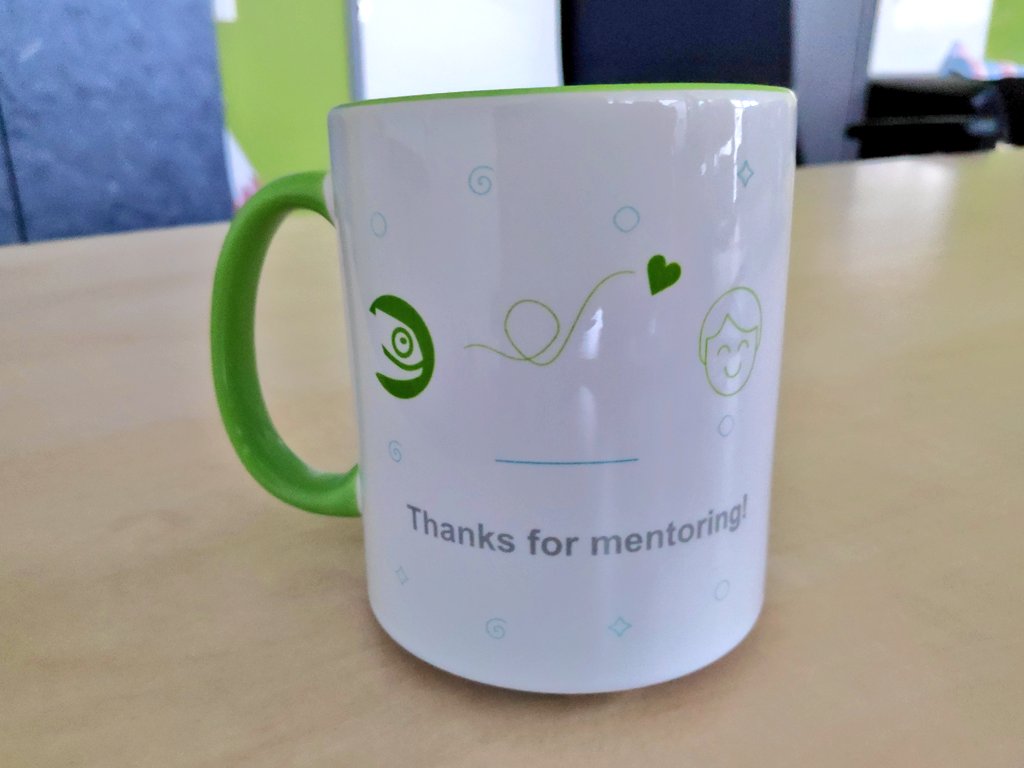
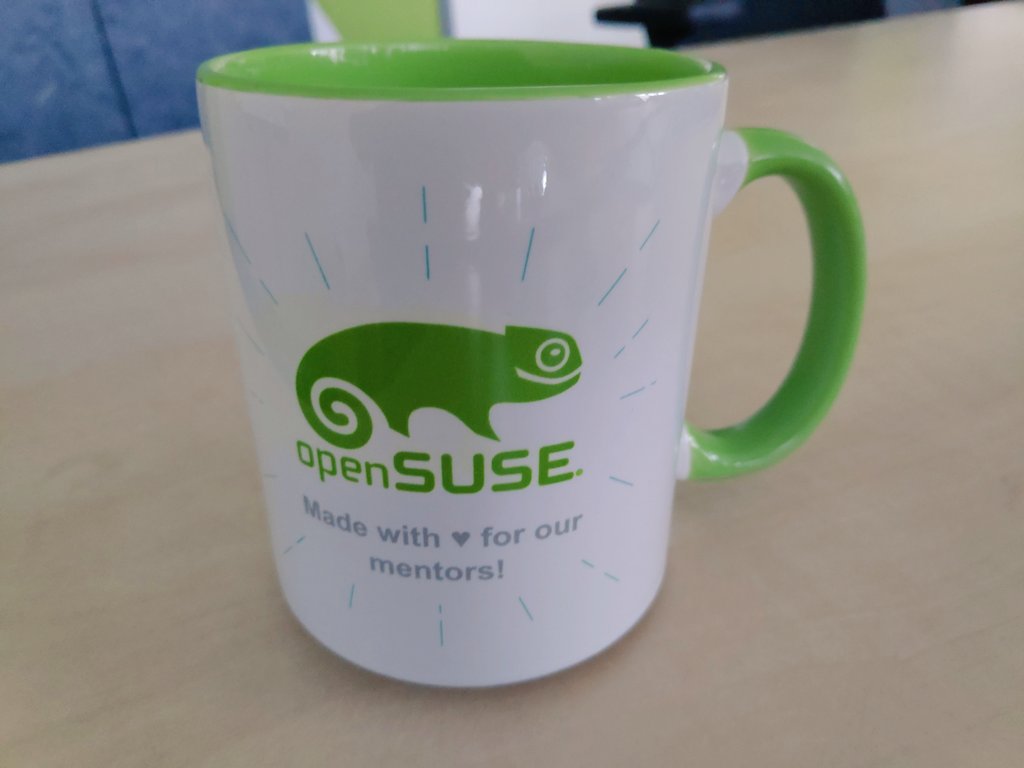
Last but not least, I would like to thank our passionate mentors and admins who took out time from their busy schedules to guide the students, our motivated students for their willingness to learn and good work, Douglas DeMaio who helped with shipping packages and organization, Google and specifically its open source team not only for the program itself but also for the well organized conference, SUSE for their support (especially economically), TSP which allows our students to attend the openSUSE conference every year, the blog post translators, Pramasta Ramadha and the rest of the designers who helped with the mugs design and everybody else who made this year GSoC amazing. Because of people like you, openSUSE is much more than just software. :green_heart:
GSoC 2019
Now let’s get ready for next year to keep helping new passionate students becoming part of openSUSE! Google has already announced Google Summer of Code 2019 and openSUSE is looking for mentors and organization admins who would like to help bringing new programmers to our community. We need at least one more organization admin and several openSUSE related projects to be able to participate. The application period for organizations is open from January 15 to February 6, so if you would like to participate as an organization admin please get in touch with Hernán, Christian or me by January 20. For mentors, the deadline to create an issue with your project(s) in the mentoring page is January 31. If you want more information about the program and what openSUSE has been doing, check out last blog posts, our mentoring page, Google’s Mentor Guide and the following video:
See you next year! :wave:
About me
My name is Ana and I am a mentor and an organization admin for openSUSE in GSoC, openSUSE Board member, Open Build Service Frontend Engineer at SUSE and open source contributor in projects inside and outside openSUSE.