
 Member
 mvidner
LinuxTag 2011 Pictures
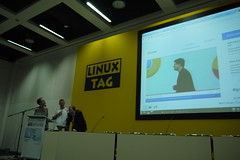
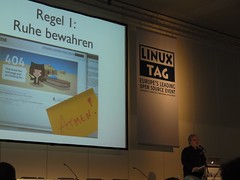
"Rule 1: Stay calm." Ralph Angenendt talks about problem solving.
Party!


Wine on Linuxtag 2011
As Christian Boltz and myself held a quite successful talk on Wine on the 2010 openSUSE conference, we decided to again hold a talk at Germanys largest Linux fair, Linux Tag 2011 in Berlin.
We again ran the pun talk “Wine” (not) the Emulator vs “Wine” the beverage, with Christian talking about life and work at a vineyard and his wine grower community at Deutsches Weintor.
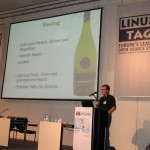
Included in this talk was a Wine tasting of 4 different kinds of Wine, as grown in the area were Christian lives.
His stories on Vineyard activities and the processing from grape to wine interluded with myself talking about Wine the Emulator, its historical and statistical parts, game support and futures.
Around 70 people enjoyed our light hearted wrap up talk of this Linux Tag conference.
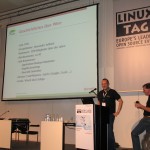
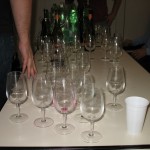
Images: by hueck2342 at flickr.com, licensed as Creative Commons – Share Alike, Attribute, Non Commercial http://creativecommons.org/licenses/by-nc-sa/2.0/

ISO image for GNOME3 promo DVD available for download
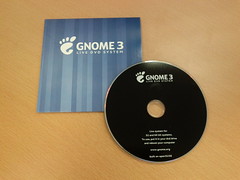
a quick post for people who want the GNOME 3 promo DVD iso image (it is based on 1.1.0 image, combining both x86 and x86-64 images and some demo video and music).
You can download it at : http://ftp.gnome.org/pub/GNOME/misc/promo-dvd/
Beware this image will not be updated, it is just there for archiving purpose.

Pixel Limits With The Intel 945GME

What's an orig-addon ?
Funny question eh? :)
Let me take a step back first. There are quite a few packages that the openSUSE project cannot publish on their main infrastructure, not because of legal reasons, but for reasons of potential software patent infringements. That, combined with the fact that the main sponsor of the openSUSE project (Attachmate, formerly Novell) also sponsors almost all the IT infrastructure, the fact that Attachmate (and Novell before them) is a business in the USA, and that the USA has the most ludicrous legal precedents regarding software patents (hey, the market regulates itself, right ?), puts us into such a situation. It isn't different for most other distributions by the way, except for a very few which probably only get away with it because they remain rather small and under the radar.
What am I talking about? Well, packages such as gstreamer-0_10-plugins-bad, MPlayer, vlc, xine, libmad, etc... Typically because they contain implementations of multimedia codecs such as for MP3 or H.264 which are heavily covered with software patents.
The Packman project and repository provides many of those packages (amongst other things) for openSUSE, hosted in a country where software patents do not apply. Now, don't confuse software patents and copyright: copyright is well established, precise and there are no groups of people on the planet who respect copyright more than open source and Free software developers, specifically because copyrights such as the GPL, BSD or ASL (to name just a few) protect our work and our ideals. Hence, what we are doing is not illegal in any way. As an example, the mad library might be subject to software patent infringement where applicable, but is under the GPL.
Okay, now back to the actual topic. The libraries of the gstreamer framework are maintained by several contributors of the openSUSE project in the multimedia:libs project in our famous openSUSE Build Service. However, as explained above, the download repositories of multimedia:libs may not host the packages that might infringe on software patents (where applicable). So what we are doing, is to link those packages on our Build Service instance at Packman (yes, the Build Service can do that, awesome feature :)). The difference is that on Packman, due to some macros, we do build those parts that potentially infringe on software patents, and also host them in our repository and its mirrors. The trick is that they're subpackages that end in "-orig-addon". For example, for the package "gstreamer-0_10-plugins-bad", its companion is "gstreamer-0_10-plugins-bad-addon-orig" (yes, I agree, the suffix "orig-addon" is stupid, too "geeky" and not intuitive in any way.)
So, to see whether you have those installed, first open a shell as root, then do the following:
It will probably result in something like this:
Reading installed packages...
S | Name | Summary | Type
--+--------------------------------------------------------+----------------------------------------------------------------------+--------
| gstreamer-0_10-plugins-bad-orig-addon | GStreamer Streaming-Media Framework Plug-Ins | package
| gstreamer-0_10-plugins-bad-orig-addon-32bit | GStreamer Streaming-Media Framework Plug-Ins | package
| gstreamer-0_10-plugins-bad-orig-addon-debuginfo | Debug information for package gstreamer-0_10-plugins-bad-orig-addon | package
| gstreamer-0_10-plugins-bad-orig-addon-debuginfo-32bit | Debug information for package gstreamer-0_10-plugins-bad-orig-addon | package
| gstreamer-0_10-plugins-ugly-orig-addon | GStreamer Streaming-Media Framework Plug-Ins | package
| gstreamer-0_10-plugins-ugly-orig-addon-32bit | GStreamer Streaming-Media Framework Plug-Ins | package
| gstreamer-0_10-plugins-ugly-orig-addon-debuginfo | Debug information for package gstreamer-0_10-plugins-ugly-orig-addon | package
| gstreamer-0_10-plugins-ugly-orig-addon-debuginfo-32bit | Debug information for package gstreamer-0_10-plugins-ugly-orig-addon | package
In order to install those bits, do the following:
:)
On a side note: if those results don't show up when doing the search, then add the Packman repository with the following command and try again:

Greek openSUSE community, Translation of openSUSE Weekly news in Greek(issue 174)
Due to the FOSSCOMM conference (the majority of the greek openSUSE community was there staying asleep) we delayed (a lot) starting the translating procedure. However I am very pleased to announce the new issue (174) of openSUSE Weekly News in Greek in (almost) time.
A lot of thanks to the translators for their speed and efforts.
In this one you will read about:
* Alex Eftimie: GSoC 2011: PackageKit and AppStream integration for Software Center
* Sebastian Kügler: Plasma Active at Tokamak 5
* openSUSE Ambassadors are rocking all over the world
* h-online/Thorsten Leemhuis: Kernel Log: Coming in 2.6.39 (Part 3) – Architecture and infrastructure
* Greek openSUSE Ambassadors: openSUSE in Fosscomm 2011
And of course many many interesting news about openSUSE, plus usefull
advice for making our lives easier.
Enough… read more at: own.opensuse.gr or at
http://el.opensuse.org/Weekly_news.
Looking forward to hearing your comments, advice and anything you would
like to read about at the next issue.
Enjoy it!
Efstathios Agrapidis (efagra)
On The Road To Getting Focus Back

#gtk#
I had never seen this channel with people in it at all in the past. I guess the recent interest comes from the fact that gtk-sharp master is already targeting Gtk+ 3.x API and some people are starting to use it to port things.
One example is Hyena, the awesome library that Gnome projects F-Spot, Banshee and PdfMod use (am I missing some other?). I started the port some weeks ago and all I have received is positive feedback, encouragement, and also a lot of help! For example Olivier Dufour (which I guess he will be recently known as one of the superstars that brought DVD support to Banshee -- work finished but still unmerged) who helped with accessibility and warnings, and Mike Kestner (father/maintainer of all these GAPI-based *-sharp bindings) which helped reviewing my patches to the binding and fixing other issues I reported (and of course for making huge efforts, in the first place, to have the bindings ready for the 3.x cycle, with even some GObject-Introspection experimentation, which I guess is still in the early stages and not enabled yet).
Stay tuned for the progress! (as new contributors have expressed interest in helping out soon). Branches are being created so you can join the effort if you feel like (bugs in bugzilla too, to track what's pending).

What's Happening @Banshee
@Banshee is finally on twitter, where we'll always keep you up to date and sometimes entertained if you follow us.
We also just released Banshee 2.0.1, a stable, bug-fix-only follow on to 2.0.0!
We've got 2.1.x releases scheduled leading up to 2.2 in September. We'll be porting to Gtk# 3 and dropping a bunch of legacy deps in the process, while still supporting users on older distros. I e-mailed banshee-list more about what that means and how we'll do it.
Greek openSUSE community, Translation of openSUSE Weekly news in Greek (issue 172)
Hello out there,
I am very pleased to announce the new issue (172) of openSUSE Weekly
News in Greek.
At this point I want to thank all the people for the quality of their work on the translations they send. Also, I would like to congratulate the «usual suspects» of the translating work not only for the quality of their translations but also for the improvement of their work that I have personally observed. Geeckossss, keep up the good work! Finally, I want to welcome the new volunteers to our team for their interest and offcourse for their priceless help.
In this issue you will read about:
* Greg Kroah-Hartman: openSUSE Tumbleweed status for the week of April 22, 2011
* MakeUseOf/Justin Pot: Super Mario Brothers X: The Best Fan-Made Mario Game Ever
* DarkDuck: How To: Page Numbering in Open Source Text Processors
* HowtoForge/Falko Timme: Virtualization With KVM On An OpenSUSE 11.4 Server
* How to upgrade to openSUSE 11.4 Tumbleweed
And of course many many interesting news about openSUSE, plus usefull
advice for making our lives easier.
Enough… read more at: own.opensuse.gr or at
http://el.opensuse.org/Weekly_news.
Looking forward to hearing your comments, advice and anything you would
like to read about at the next issue.
Enjoy it!
Efstathios Agrapidis (efagra)