
 metalgod
Javascript experiments
I fell in love by this language and how easy is to code around it. The worst part of this journey and what it become difficult to write a full application with it was that the gjs and seed are very different and it's very easy to spot bugs on them. But thanks to their maintainers (they've been very helpful) we hopefully get things more stable and bug free.
The lack of documentation is other problem that these implementations have. Hopefully i found someone with the same problem around the web that is trying to get this problem fixed and making javascript one of the finest language bindings for GTK+.
Now my contribution for documentation is this statusicon example that should be work on seed.
I found a bug on gjs that should be fixed on the next GTK+ release and i should get the working version on gjs done too.
So here's statusicon.js available on my people.gnome.org page.
With this i try to get some ideas and try to write one of the first full GNOME applications using javascript!
PS: Thanks to Alan Knowles for helping me with some seed specific stuff since i wrote this initially for gjs.
Activating Virgin Media Broadband on Linux
When I plugged in the router and went to view a website on my computer, I was redirected to an activation page, where I had to enter my name and postcode and stuff like that. Except that the first page you go to checks to make sure you're running Windows or using a Mac. Thankfully, Konqueror and Opera both let me change my browser identification string so that Virgin's servers think I am using Windows. So far, so good. The next problem comes a few steps later when the 'Next' button doesn't respond. A quick view of the page's source shows that Virgin is trying to set the browser's homepage using some bad JavaScript. It also shows that after trying to do that, it was just going to redirect to another page anyway, so I was able to copy that URL into the address bar and carry on. I don't remember what the URL was, but if you look for the function called 'next()' in the source, you'll see it there. A few pages later it prompts you to download and install their special tools. There's no option to skip this, but if you click on 'Next', it starts the download and then goes onto the next page anyway. You can just ignore the download.
After all that, your connection should be activated. Mine was, anyway. Now I get about a 4 Mbit connection instead of the slow 2 Mbit ADSL connection. Which is still slow, considering Virgin Media advertise it as a 20 Mbit connection, but I wasn't expecting anything that good from Virgin Media. After all, they are just NTL with a new name.

Banshee Community Extensions
Writing a Banshee extension and getting it into users' hands has never been easier. We have started a new sub-project called Banshee Community Extensions (BCE), collecting various existing extensions under one source repo, bug tracker, and autobuild setup.
Its source is hosted on gitorious, dramatically lowering the barrier to committing and sharing your code publicly.
This centralization makes things easier on translators and packagers, too. And users get access (without manually downloading/installing) to the fruits of the extension community's labor.
Creating a Working Extension in MinutesIt's ridiculously easy to make a new extension. Install Banshee 1.5.3 (including the devel package), or build/install the latest from git master instead. Then,
git clone git://gitorious.org/banshee-community-extensions/banshee-community-extensions.git
cd banshee-community-extensions
./create-extension Foo
make run
This creates, builds, and runs Banshee with your extension. Go to Edit » Preferences » Extensions to enable it, and see it appear:
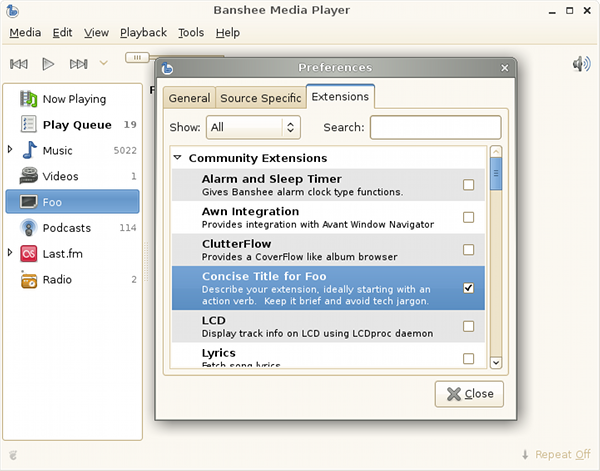
We already have seven extensions migrated, and one brand new one!
- AlarmClock
- Awn
- ClutterFlow
- LCD
- Lyrics
- Mirage
- RadioStationFetcher
- StreamRecorder
We have bleeding-edge openSUSE/SLED packages available, and Ubuntu packages should be ready in time for Banshee 1.5.4 next week.
If you've been putting off some extension idea you've had, delay no longer! Read the full Extension Writers Guide, and get started today!
ThanksThanks to Chow Loong Jin (aka hyperair, our fearless Ubuntu packager) for broaching the idea behind BCE, and to Bertrand Lorentz for teaming with me to get things to this state - in just two weeks!

 Member
Planning For The Future
FOSDEM 2010: One week later
It is almost one week after the 10th edition FOSDEM (Free Software Developers European Meeting) (http://fosdem.org/2010/) took place in the city of Brussels. As is usual, lots of Free Software developers, promotors and fans attended to the event. Different from other years, this time I had the chance to live on my own the FOSDEM spirit and had the chance to meet some FLOSS supporters from different projects, seeing the almighty improved KDE 4.4 being successfully presented under 640×480 adverse projecting conditions. In addition to this, lots of openSUSE people at the openSUSE booth
For those of you who couldn’t attend to FOSDEM or for those who attended and want to see it again, here some of the videos of the talks are available for download. Additionally, you can visit the official FOSDEM youtube channel, enjoy… and don’t forget: Have a lot of fun


supertuxkart does not start due to pulse audio
I tried to start supertuxkart, the marvelous race game, in openSUSE_11.2 (x86_64 if that matters) but it failed with the following error:
$ supertuxkart

Data files will be fetched from: '/usr/share/games/supertuxkart/'

AL lib: pulseaudio.c:382: Context did not get ready: Connection refused
The problem is a configuration setting in /etc/openal/alsoft.conf. Just uncomment the drivers line and remove pulse from the drivers line in that file and supertuxkart starts to work again.
It can be easily tested with the command openal-info. Before the change one get the error message shown above, and after one gets useful information.
I got this problem solved, due to a discussion on the ubuntu forums. Thank you guys.
Hopefully this short note is useful for someone.
Update (16 Feb 2010): just today openal was updated from version 1.10 to 1.11 and with the new version supertuxkart started without problems 
Exmap fixed, and a little resulting peek at memory usage
KDE Project:
I have fixed Exmap, my still favourite tool to measure system memory usage, to compile with latest kernels, and also to work on x86_64 (the latter was a bit of guess-work, but I think I got it right). KSysGuard seems to be getting close, and with Exmap unmaintained by its author :( I don't feel like doing this forever, but for now, it's still possible to get exmap from my home:llunak:kernel repository. And as I don't feel like trying to do cross-distro kernel packages in the buildservice, those not using openSUSE are left with either trying to package it for their other distro, or pick out the patches from the .src.rpm .
While I was at it, I had just a little look at memory usage. Since I had done quite some comparisons of KDE3's memory usage with other desktops in the past, the first thing that came to my mind was doing that quickly again. As these days LXDE appears to be the new lightweight kid on the block, I tried that one, and also Xfce. Finally there's TWM, basically just to show the memory usage without any desktop. All of them are default desktops on openSUSE 11.2 for a new user with a file browser and terminal open, the only exceptions being adding a mixer to the default Xfce setup for a reason that will be obvious later and not using the nvidia driver. LXDE is from the X11:lxde repo, KDE version is 4.3.5 that'll soon end up in an online update. So, here it is (for those who don't want to find out what all those values mean, the most important number here is the 'Effective Resident TOTALS').


Of course, this is not really comparable to my old memory usage test, for a number of reasons, such as this being x86_64 machine, the setup being different, and so on.
It's interesting to note that LXDE actually loses to Xfce. That 'python' there is in fact GMixer. That really shows that you don't get lightweight things unless you check the setup yourself. And it probably also shows that you can get lightweight things only if also your expectations are lightweight.
It also shows that KDE4's memory usage is not as bad some some might think, although it would be nice if somebody would be bored enough to analyse it in more detail. There seem to be enough people bored enough to just complain about KDE4 performance but not do anything else, and this is actually pretty simple. Or do you need an Akademy talk for that or what?
FOSDEM’10
 Just laptop and headphones, book and a bit eat/drink for trip time and of course rube’s cube are in my rucksack On last weekend I was on FOSDEM.
FOSDEM is probably the most developer-oriented European Free and Open Source conference/event. As usual it was in Bruxelles, Belgium on first weekend of February. I was there with another Novell/SUSE employees. Majority of they are responsible for work with community. For example, boosters team.
On 5th February we went from Nuremberg at 12 am (by bus) and was in Brussel at 9 pm. At half past ten we (Holgi, Dinar and me) were on the beer event. What can I say about this evening? It was really nice to meet and speak with another developers for a cup of beer
The main thing that happens on conferences is learning. This was main reason why I was there and why Novell/SUSE help me to visit FOSDEM. A lot of presentation/talks about KDE, or packaging (RPM), or BuildService or… a lot about another open source projects…
I like such events It’s not only interesting presentations through which you open/learn a lot of new, but also possibility to get acquainted with other developers or is simple with enthusiasts whom it is unconditional as bring the contribution to development free and open source software.
The next evening I have devoted to walk across Bruxelles. It was very interesting to speak with people there. I have made a lot of photos.
For sure, I’m going to visit FOSDEM in next year, but for next time it will be depends on money. Anyway I will recomend to visit this event for every Linux-/*BSD- user/developer.

Sad and blue
 I'm blue. And not only that, I seem to suffer from writer's block. If there's something like "code-writer's block", I probably suffer from that, too (I believe there is, there was just no Stephen King to write a few horror books about it so far .... something I can consider doing when I retire).
I no longer feel the sense of accomplishment from the things I'm working on and I'm unhappy with the way where something I was always doing with passion (ie. YaST hacking) is heading. The fact that I can do absolutely nothing to change that further deepens my blues.
Most of the time, I tend to be the one trying to cheer up my colleagues and friends when they write blogposts like this by writing encouraging comments or pasting links to some feel-good stuff (my favourite one). Unfortunately, I can't do the same now for myself. Oh well ...
AstroGarrobo Beta
Space, the Final Frontier! This is the tale of one Amateur Astronomer that have found in openSUSE a terrific tool for public outreach, self-learning and teaching platform.
Ok, that was a bit exagerated.
But the truth is that I am enjoying the new SUSE Studio suite. And that’s because it is facilitating my job as an educator. I work with the Nicaraguan Amateur Astronomers Society (ANASA) in teaching basic astronomy to the public. Obviously, my workhorse is an openSUSE laptop, loaded with Stellarium, Celestia, KStars and Xephem (and many other tools for my personal job as an astronomer).
For a long time, I’ve been advocating the use of openSUSE as the reliable, user-friendly and safe Linux distribution that it is, but I face a big barrier: the big majority of people attending our astronomy lessons does not have the needed technical skill and knowledge to install a new operative system, specially one like Linux.
So, I’ve decided to build a Live CD using SUSE Studio, focused entirely in provide the same basic tools for learning the sky and their basic steps in Amateur Astronomy.
The name of the Project: AstroGarrobo

Garrobo is the Nicaraguan name for a male Iguana. The Nicaraguan Linux community have nicknamed our openSUSE mascot as Garrobo instead of the familiar Chameleon, because a Chameleon is a rare species here in my Nation.
So far, there is a Beta version available for download at SourceForge. I have received many valuable reports from Beta Testers from different parts o the world.
My goal here is to obtain a stable LiveCD, for free distribution, that may help others to obtain the tools needed to inspire, feed and motivate their love for Space.
I’ve written a more detailed explanation of this project in my Blog (in Spanish). I would appreciate any comments, insights and recommendations about AstroGarrobo.
Clear skies!