
 Member
 baltolkien
Nuevo Excalibur de Slimbook
Hace tiempo que no hablo de mis marca de ordenadores favorita. Aunque eso no significa que no tenga novedades. Aprovechando que han lanzado la campaña Black Days 2024 os presento el nuevo Excalibur de Slimbook, un ultrabook que ofrece potencia, versatibilidad y ligereza gracias a su excelente cpu, gran pantalla de 16b pulgadas y chasis de alumino.
Nuevo Excalibur de Slimbook
No puedo seguir ya el ritmo de la compañía de ensambladores de ordenadores Slimbook. Sabía que existía un Excalibur que fue lanzado sobre el 2017 o 2018, pero no sabía que había sido renovado recientemente.
Es por ello que enmiendo el error y os presento el, para mí, nuevo Excalibur de Slimbook, un ultrabook de 1,8 Kg y pantalla de 16 pulgadas ideal para usuarios exigentes gracias a su potente procesador, gráfica sorprendente, memoria Ram ultrarápida y a un precio, que en verdad, me parece más que ajustado.

Las características de este nuevo Excalibur son las siguientes:
Procesador: AMD Ryzen 7 8845HS
8 núcleos 16 hilos, hasta 5.1GHz
Gráficos: AMD Radeon 780M
Pantalla: 16″ WQXGA (2560×1600) 16:10 sRGB 100%,120HZ, 400 nits
Puertos: 2x USB-C USB3.2 Gen1 con carga PD3.0 y salida video 4K@60Hz
Puertos: 3x USB-A 3.2 Gen1
Teclado: retro-iluminado
Material: aluminio
Redes: Wi-Fi 6, Bluetooth 5.2
Memoria RAM: hasta 96GB DDR5
Discos: 2x SSD NVMe PCIe 4.0 M.2 hasta 8TB
Teclado: múltiples idiomas
Sistema operativo: Linux/Windows
Pendrive: disponible con tu distro Linux

Y si te gusta el portátil este es el momento, ya que la compañía valenciana está celebrando sus Black Days y lanzado descuentos importantes en sus productos, siendo el nuevo Excalibur uno de los portátiles que reciben el descuento.
🚨😵💫 SLIMBOOK BLACK DAYS 😵💫🚨 Disfruta durante los próximos 10 días de DESCUENTOS EXCLUSIVOS sólo en nuestra web 💻🌐👇
— SLIMBOOK (@slimbook) November 19, 2024
Nuestro modelo ÉXITO EN VENTAS 🆕 Renovado 🆕
➕ Chasis más firme y resistente
➕ Más RAM
➕ Más Disco
➕ Más Batería
➕ Altavoces mejorados… pic.twitter.com/vgjPRJRfQf
Y por cierto, no penséis que hago toda esta publicidad porque reciba una compensación económica, simplemente porque confio en esta empresa que no olvida que el Software Libre es algo más que Software.
Más información: Slimbook
La entrada Nuevo Excalibur de Slimbook se publicó primero en KDE Blog.
20 años del navegador Firefox
El navegador Firefox ha cumplido 20 años. Un proyecto comunitario que ha ayudado a cambiar la web

El navegador web Firefox cumple 20 años de historia y hace un repaso a algunos hitos de su historia y de la historia de la web. De cómo ha cambiado en estos 20 años.
Lo que empezó siendo un proyecto comunitario como alternativa a un único y omnipresente navegador, se ha convertido en un gran proyecto con colaboradores en todo el mundo que tratan de seguir haciendo una web más abierta y respetuosa con quienes la utilizamos.
Veamos un repaso de esos 20 años. Desde la llegada de Firefox 1.0 un 9 de noviembre de 2004 hasta nuestros días.
El artículo original en inglés lo tienes disponible en este enlace:
¿Cómo era navegar por la web en 2004? La gente decía cosas como «surfear por Internet», para empezar. Los anuncios emergentes excesivos eran molestos (N.d.T:vaya, en eso parece que no ha cambiado mucho), pero se sentían como la norma. No existía la barra de búsqueda y las pestañas múltiples y parecía haber solo un navegador a la vista. Bueno, hasta que llegó Firefox 1.0 y como un verdadero competidor.
Creado por un grupo de desarrolladores apasionados que creían que la web debería ser abierta, segura y no controlada por una sola gran empresa tecnológica, Firefox se convirtió en la alternativa para quienes querían experimentar internet de una manera diferente. Millones de personas hicieron el cambio, y la web se sintión más grande.
Y mientras que internet comenzaba a evolucionar, también lo hizo Firefox, convirtiéndose en un símbolo de innovación abierta, privacidad digital y sobre todo la posibilidad de experimentar la web con tus propios términos.
Vamos a repasar algunos momentos clave en estos 20 años de historia de Firefox.
2004: Publicación de Firefox 1.0
Firefox 1.0 se lanzó el 9 de noviembre de 2004. Como proyecto de código abierto, Firefox fue desarrollado por una comunidad global de voluntarios que colaboraron para hacer un navegador que sea más seguro, fácil de usar y personalizable.
Con el bloqueo de ventanas emergentes incorporado, los usuarios finalmente podrían decidir cuándo y si querían ver las ventanas emergentes. Firefox introdujo la navegación con pestañas, que permite a las personas abrir múltiples sitios en una ventana.
También hizo de la seguridad en línea una prioridad, con protección de fraude para protegerse contra las técnicas de suplantación de identidad.
2005: Mozilla Developer Center
Mozilla lanzó Mozilla Developer Center ahora llamado MDN Web Docs, como un repositorio donde encontrar la documentación para estándares web y recursos para desarrolladores.
Mozilla junto con una comunidad global de colaboradores, sigue manteniendo este importante recurso.
2007: Ayuda de la comunidad del software libre
La plataforma SUMO (support.mozilla.org) se construyó originalmente en 2007 para proporcionar un canal de soporte comunitario de código abierto para los usuarios, y para ayudar a colaborar de manera más efectiva con los colaboradores que participaban de manera voluntaria.
Con los años, SUMO se ha convertido en una plataforma poderosa que ayuda a los usuarios a aprovechar al máximo Firefox, brinda oportunidades para que los usuarios se conecten y aprendan más unos de otros, y permite reunir ideas importantes, todo impulsado por la comunidad de colaboradores.
¡Seis colaboradores activos han estado con nosotros desde el primer día (Cor-El, JSCHER2000, James, Mozbrowser, Alicewyman y Marsf) y 16 colaboradores han estado aquí durante 15 años!
2008: Record Guiness mundial
Firefox 3.0 hizo historia estableciendo un récord mundial Guinness por ser el software más descargado en un solo día. Más de 8 millones de descargas en un solo día. El evento conocido como el día de descarga se celebró en las comunidades de Mozilla en todo el mundo.
2010: Firefox llega al dispositivo móvil
Firefox hizo su debut en dispositivos móviles en Nokia N900. Trajo características muy utilizadas como navegación con pestañas, la impresionante barra y la sincronizació, lo que permite a los usuarios sincronizar entre Firefox de su escritorio y el móvil. También se convirtió en el primer navegador móvil en admitir complementos, dando a los usuarios la libertad de personalizar su navegación.
2013: Hola Chrome, Firefox llamando
Firefox dio un gran salto con WebRTC (Web Real-Time Communication), que permite a los usuarios realizar videollamadas y llamadas de voz directamente entre Firefox y Chrome sin necesidad de complementos.
Esta comunicación entre navegadores fue un gran avance para los estándares web abiertos, lo que facilitó que los usuarios se conectaran sin problemas. Firefox también introdujo RTCPeerConnection, que permite a los usuarios compartir archivos durante las videollamadas, mejorando aún más la colaboración en línea.
2014: Privacidad en la web
Firefox ha lanzado un ritmo constante de funciones anti-seguimiento a lo largo de los años, aumentando en gran medida la privacidad de la web. El impacto ha ido más allá de los usuarios de Firefox, ya que la privacidad en línea es ahora un producto esencial para todos los navegadores.
- 2014: Bloquear la carga de rastreadores
- 2016: Los contenedores pueden aislar sitios dentro de Firefox
- 2018: La protección de rastreo mejorada bloquea las cookies de rastreo
- 2020: Mejoras significativas para evitar que los sitios tomen hagan un rastreo a los usuarios
- 2022: Total Cookie Protection aísla todas las cookies de seguimiento de terceros
2017: Dos veces más rápido y 30% menos de memoria
Firefox dio un gran paso adelante con Firefox Quantum, una actualización que hizo que la navegación fuera el doble de rápida. Gracias a un nuevo motor construido con el lenguaje de programación Rust de Mozilla, Firefox Quantum hizo que las páginas se cargaran más rápido y usó un 30% menos de memoria que Chrome.
Se trataba de velocidad y eficiencia, permitiendo que los usuarios podamos navegar más rápido sin ralentizar nuestros equipos.
2018: Firefox bloquea rastreadores
La protección de seguimiento mejorada (Enhanced Tracking Protection o ETP ) se introdujo como una nueva función que bloquea las cookies de terceros, la herramienta principal utilizada por las empresas para rastrear a los usuarios en los sitios web.
ETP simplificó a los usuarios la protección de su privacidad al bloquear automáticamente los rastreadores y garantizar que los sitios web siguieran funcionando sin problemas.
Inicialmente una característica opcional, ETP se convirtió en la configuración predeterminada a principios de 2019, marcando un paso significativo para brindar a los usuarios una mejor privacidad sin sacrificar la experiencia de navegación.
2019: Defensa de los formatos de los medios de comunicación no gravados por patentes
Mozilla desempeñó un papel importante en la estandarización y adopción de AV1 y AVIF como parte de su compromiso con los estándares de medios abiertos, libres de derechos de autor y de alta calidad para la web.
La publicación temprana en Firefox para AV1 y AVIF, junto con la defensa de Mozilla, aceleró la adopción por parte de plataformas como YouTube, Netflix y Twitch.
El resultado es un códec de vídeo de última generación, libre de derechos de autor, que proporciona compresión de vídeo de alta calidad sin derechos de licencia, lo que lo convierte en una opción abierta y accesible para toda la web.
2020: Adobre Flash es discontinuado
Adobe retiró Flash el 31 de diciembre de 2020. Mozilla y Firefox jugaron un papel fundamental en el final de Adobe Flash al liderar la transición hacia estándares web más seguros, de alto rendimiento y abiertos como HTML5, WebGL y WebAssembly.
A medida que Firefox y otros navegadores adoptaron HTML5, ayudó a establecerlos como alternativas viables a Flash.
Este cambio apoyó formas más seguras y eficientes de entregar contenido multimedia, minimizando la dependencia de la web de complementos privativos como Flash.
2022: Total Cookie Protection
Firefox llevó la privacidad más allá con Total Cookie Protection (TCP), basándose en la base de ETP que hemos visto anteriormente.
Las cookies, si bien son útiles para tareas específicas del sitio, como mantenerlo conectado, también pueden ser utilizadas por los anunciantes para rastrearnos a los usuarios en varios sitios.
TCP aísla las cookies manteniéndolas bloqueadas en el sitio del que provienen, evitando el seguimiento entre sitios. Inspirado en las características de privacidad del navegador Tor, el enfoque de Firefox integra esta herramienta directamente en ETP, dando a los usuarios más control sobre sus datos y deteniendo a los rastreadores en seco.
2024: 20 años de Firefox
Estos hitos son solo unas cuantas pinceladas de la historia de Firefox, llena de muchos capítulos que han dado forma a la web tal y como la conocemos.
En la actualidad, Firefox se mantiene a la vanguardia de la defensa de la privacidad, la innovación abierta y la elección. Y aunque los últimos 20 años han sido transformadores, lo mejor está por venir.

Notes on installing openSUSE remotely
Or said in another way: How to run openSUSE on Hetzner dedicated servers.
TL;DR:
- Install any other linux distribution from their installer.
- Follow the SDB article about remote installation
- Install openSUSE via SSH.
Why not build an image for their installimage tool? I have that too. But last time I used that, the install tool logged more things to their logging server than I liked. And it did so via plain HTTP.
KDE Edu estará presente en el III Seminario Anual GNU/Linux
El próximo sábado finaliza un evento online donde el Software Libre ha sido el protagonista. Esto ya fue anunciado en el blog hace un tiempo y he ido publicitando las charlas a lo largo del mes. Pero como todo el evento llega a su fin, y por designios del destino he vuelto a aser invitado para ser el que lo cierre. Me complace anunciar que KDE Edu estará presente en el III Seminario Anual GNU/Linux organizado por la Comunidad OpenShield. Este evento, que será retransmitido a todo el mundo utilizando los servicios de Telegram y Youtube, pretende mostrar, enseñar y demostrar las bondades de Linux, GNU/Linux.
KDE Edu estará presente en el III Seminario Anual GNU/Linux
Hace un tiempo que me invitaron y, por supuesto, acepté, a participar en el III Seminario Anual GNU/Linux representando a la Comunidad KDE. Debido a problemas de agenda, se han caído las dos últimas ponencias que estaban planificadas, así que los organizadores pidieron si alguien quería cerrar el evento… y dado que tengo un poco de tiempo he decidido aceptar el ofrecimiento para seguir promocionando el Software Libre.
De esta forma, no os perdáis el sábado 23 de noviembre a las 20:00 hora peninsular española «KDE Edu: el conjunto de aplicaciones educativas de KDE» donde realizaré la charla, recomendada para todo el mundo, presentando la suite educativa de la Comunidad KDE.
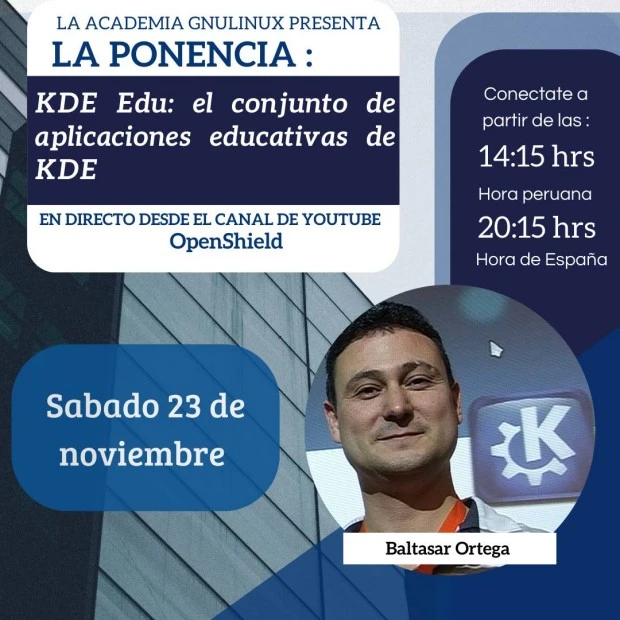
III Seminario Anual GNU/Linux
Todos los fines de semana de noviembre tienes una cita con el mundo GNU/Linux en forma de ponencia en directo con divulgadores de todo el mundo hispano hablante con la nueva edición del seminario Anual GNU/Linux.
De esta forma, la Comunidad OpenShield está organizando 8 presentaciones con las que iniciarse, aprender, profundizar y, en general, conocer un poco más el abanico de posibilidades que te ofrece el mundo del Conocimiento Libre al módico precio de un poco de tu tiempo (que no es poco).
El objetivo de este evento es mostrar, enseñar y demostrando las bondades de Linux, GNU/Linux. Pero lo mejor es que veáis el vídeo presentación:
Esta es la lista de participantes:
🗣 Klaibson Ribeiro 🇧🇷 🏢 Comunidad Brasileña del Software Libre de Brasil 📝 La IA en Suites de ofimatica
🗣 Roberto Ronconi 🇦🇷 🏢 Independiente 📝 Migración de Windows a GNULinux
🗣 Baltasar Ortega (un servidor) 🇪🇸 🏢 Comunidad KDE España 📝 10 cosas que no sabías que podías hacer con Plasma 6
🗣 Angelo Ramírez 🇨🇱 🏢 Bit Technology 📝 Seguridad, Apache, MySQL
🗣 Andres Gomez 🇨🇱 🏢 Bit Technology 📝 MySQL, Docker
🗣 Lina Castro 🇨🇴 🏢 Cencosud 📝 Romper las barreras de Android, sumérgete en Ubuntu Touch
🗣 Marga Manterola 🇦🇷 🏢 Aprendiendo con Marga 📝 Una carrera exitosa con sofware libre
🗣️ Jorge Varela🇲🇽 🏢 Red Hat Latinoamérica 📝 Primeros pasos en Fedora CoreOS

¿Qué os parece?
Más información: III Seminario GNU/Linux
La entrada KDE Edu estará presente en el III Seminario Anual GNU/Linux se publicó primero en KDE Blog.

Ignite Creativity in Hack Week
Open-source software developers, tech enthusiasts and innovators worldwide are set for Hack Week 24 that starts today and runs through Nov. 22.
The event is a cornerstone of fostering creativity and collaboration and invites participants to explore personal and community-driven projects.
Hack Week provides a unique opportunity for developers to step away from their usual tasks and dive into passion projects, learning new skills and forge new connections.
This year’s theme is “Train of Thought” and draws inspiration from the idea that seemingly unrelated ideas can connect to spark innovative breakthroughs.
Here are some Hack Week 24 projects that are garnering attention.
- New openSUSE-welcome: This project aims to revamp the openSUSE Welcome app to enhance the first-time user experience. Key goals include integrating end-of-life (EOL) notifications for openSUSE Leap, addressing potential upgrade notifications and ensuring the application is rebranded and maintained. The updated application will be submitted to openSUSE Factory and Leap 16.0, with corresponding updates to openQA testing.
- Port Classic Games to Linux: Revive 1990s-era games by reverse-engineering their data and creating open-source engines.
- Cluster API Provider for Harvester: This project builds on progress made in Hack Week 23 to create an infrastructure provider for Harvester using Cluster API (CAPI). Enhancements for 2024 include adding support for ClusterClass, improved CI and end-to-end testing. Developers are also exploring packaging templates as Helm Charts and testing with newer Harvester versions. The project encourages collaboration from those familiar with CAPI, Harvester, and related technologies.
- openSUSE on LoongArch: Targeting a new architecture from China, this project focuses on building openSUSE support for LoongArch, which has already seen adoption in Debian Ports and Gentoo. The initial goal is to integrate LoongArch into OBS (Open Build Service) and build a minimal set of packages.
Other projects range from deep learning integration to creating openSUSE images for emerging architectures like Arm and RISC-V. Participants can also join efforts to modernize system tools or explore creative avenues like applying AI to board games or designing user-friendly command-line tools.
Hack Week thrives on collaboration and participants are encouraged to join discussions through platforms like the Uyuni Gitter channel or work on group projects.
Whether you’re an experienced coder or a curious learner, Hack Week 24 offers a welcoming environment to push the boundaries of open-source innovation.
For more details, visit the Hack Week website.

OmniGen: Revolucionando a Geração de Imagens.
OmniGen é um modelo integrado de geração de imagens capaz de criar uma ampla variedade de imagens a partir de instruções multimodais. Seu design prioriza a simplicidade, flexibilidade e facilidade de uso. Oferecemos o código de inferência para que todos possam explorar as diversas funcionalidades do OmniGen.

Exemplo: do projeto OmniGen em funcionamento.
Modelos tradicionais de geração de imagens geralmente exigem a carga de múltiplos módulos adicionais de rede (como ControlNet, IP-Adapter, Reference-Net, entre outros) e a realização de etapas extras de pré-processamento (por exemplo, detecção de rosto, estimativa de pose, recorte, etc.) para gerar imagens satisfatórias. No entanto, acredita-se que o paradigma futuro da geração de imagens deve ser mais simples e flexível, ou seja, capaz de gerar diversas imagens diretamente por meio de instruções multimodais arbitrárias, sem a necessidade de plugins adicionais e operações, de maneira semelhante ao funcionamento do GPT na geração de linguagem.
Devido a recursos limitados, ainda há espaço para aprimorar o OmniGen. O projeto continua sendo otimizado e espera-se que ele inspire modelos de geração de imagens mais universais. Além disso, você pode afinar facilmente o OmniGen sem se preocupar com o design de redes para tarefas específicas; basta preparar os dados correspondentes e executar o script. A imaginação deixa de ter limites; todos podem construir qualquer tarefa de geração de imagens, e talvez seja possível alcançar resultados muito interessantes, maravilhosos e criativos.
OmniGen é um modelo de geração de imagens que permite realizar diversas tarefas, incluindo, mas não se limitando a, geração de imagem a partir de texto, geração direcionada por assunto, geração que preserva identidade, edição de imagem e geração condicionada por imagem. O OmniGen não necessita de plugins adicionais ou operações específicas, pois pode identificar automaticamente as características (como objeto requerido, pose humana, mapeamento de profundidade) nas imagens de entrada de acordo com o prompt de texto. Mostramos alguns exemplos no arquivo inference.ipynb e, no arquivo inference_demo.ipynb, apresentamos um pipeline interessante para gerar e modificar uma imagem.
Abaixo as instruções de instalação:
git clone https://github.com/VectorSpaceLab/OmniGen.git
cd OmniGen
pip install torch==2.3.1+cu118 torchvision --extra-index-url https://download.pytorch.org/whl/cu118
pip install -e .
Apoya a buenas personas: campaña de recaudación para KDE 2024
Ya estamos en la recta final del año y es el momento de dar un toque a las personas que creen que el Software Libre necesita también impulso económico. Y es que nunca está de más que nada en esta vida es gratis, todo se paga de diversos modos: colaborando, con tiempo, con dinero o con código son solo algunas de las formas que tenemos de pagar todo lo bueno quje nos aporta el Software Libre. Es por eso que quiero promocionar la campaña de recaudación para KDE 2024, que tiene como lema «Apoya a buenas personas» que contrasta con el hilo de su presentación que sigue las historias terroríficas de Halloween.
Apoya a buenas personas: campaña de recaudación para KDE 2024
Donar a proyectos abiertos es una de las formas de colaborar más sencillas en el desarrollo de estas iniciativas. Y es que debemos tener claro que gran parte del Software Libre es gratuito pero implica unos gastos básicos, por ejemplo, en cuanto a servidores. Además, si queremos calidad y que se tenga garantías de desarrollo los usuarios, o gran parte de estos, deben colaborar de alguna forma en su desarrollo. Creo que es un buen momento para invitaros a leer este artículo ya algo viejo que publiqué en su día en este humilde blog.
De esta forma se inició una campaña de recaudación de fondos para KDE para que la Comunidad KDE siga creciendo y tenga los recursos necesarios para afrontar los posibles retos que seguro aparecen. Además, de esta forma se comprometen a serguir ofreciendo más y más software de calidad de forma gratuita, tanto de forma monetaria como en forma de datos personales.

El espiritu con el que sigue esta campaña es el siguiente:
Mientras KDE exista, seguiremos ofreciendo cada vez más software libre interesante para que el mundo lo disfrute.
Cada día, los colaboradores de KDE aportan nuevas ideas para funciones de Plasma, nuevas aplicaciones, infraestructuras para los desarrolladores, formas de mantener nuestro software y correcciones de fallos. Todo ello requiere un flujo constante de recursos y tú puedes ayudarnos.
Puedes ser parte de nuestra comunidad colaborando con tu habilidad única y conocimientos, o apoyarnos económicamente y convertirte en miembro de apoyo oficial.
Y es que la Comunidad KDE necesita dinera para optimizar actividades como:
- Sprints para desarrolladores: Ayudarás a financiar las reuniones presenciales que mantienen a nuestros desarrolladores con energía y centrados en hacer KDE aún mejor.
- Gastos de viaje a eventos: Apoyarás la presencia de nuestro equipo en reuniones y conferencias importantes, como FOSDEM, FOSSAsia y LinuxCons.
- Evento Akademy: Garantizará el éxito del evento anual de la comunidad KDE para todos los miembros, y fomentará la colaboración y el crecimiento.
- Funcionamiento de KDE: Mantendrás las luces encendidas en la sede de KDE y nuestro hogar digital funcionando sin problemas.
- Pagar al personal de apoyo: Te asegurarás de que KDE tenga a mano los expertos que necesitamos para ayudar a nuestros colaboradores y usuarios.
Más información: KDE
La entrada Apoya a buenas personas: campaña de recaudación para KDE 2024 se publicó primero en KDE Blog.

Clock from the KDE Community
Quinta actualización de digiKam 8, ahora con etiquetas de colores
El mejor gestor de imágenes de la Comunidad KDE (y una de las mejores del mercado tanto libre como privado) sigue su desarrollo y me complace anunciar que ha sido lanzada la cuarta actualización de digiKam 8, una nueva versión que incluye un buen número de soluciones de errores y la incorporación de algunas mejoras, como el traductor automático de etiquetas.
Quinta actualización de digiKam 8, ahora con etiquetas de colores
Tras cinco meses de mantenimiento activo y muchas semanas corrigiendo errores, el equipo de digiKam se enorgullece de presentar la versión 8.5.0 de su gestor de fotos digitales de código abierto.
Se han corregido más de 160 errores y se ha dedicado mucho tiempo a ponernos en contacto con los usuarios para validar los cambios en las versiones preliminares y confirmar las correcciones antes de desplegar el programa en producción.
También se ha actualizado la internacionalización de la aplicación. digiKam y Showfoto se lanzan con 61 idiomas diferentes para la interfaz gráfica configuirables desde al cuadro de diálogo Configuración/Configurar idioma.

Como siempre , esta versión viene con una gran lista novedades, aunque en esta ocasión vienen heredadas de las actualizaciones de sus componentes. De esta forma tenemos:
- Actualización de componentes internos:
- Esta versión llega con el decodificador interno RAW Libraw actualizado a la rolling-release snapshot 2024-09-10, incluyendo correcciones de errores.
- Para la gestión de metadatos, el componente de código abierto estándar del sector ExifTool se ha actualizado en todos los paquetes a la última versión 12.99. Además, la conocida biblioteca compartida Exiv2 se ha actualizado a la versión 0.28.3.
- Paquete nativo Apple Silicon: Ya está disponible por primera vez un paquete nativo de macOS para la arquitectura Apple Silicon arm64. Este paquete aprovecha el framework Qt6 versión 6.7.2, el framework KDE 6.7.0 y FFmpeg 6.1 para facilitar la reproducción de vídeo. Además, ya no es necesario utilizar el emulador Rosetta 2 de Apple.
- Novedades:
- Actualizaciones y mejoras en la gestión de rostros
- Utilidad de las etiquetas de color
Más información: Digikam
Las novedades de digiKam 8

El pasado 16 de abril, es decir, ayer fue lanzado digiKam 8.0, la nueva versión de uno de los gestores de imágenes más completo que puedes encontrar en el mundo GNU/Linux, e incluso en el mundo privativo.
Este nuevo digiKam ha recibido un intenso trabajo en muchas de sus facetas, no en vano han pasado más de dos años de desarrollo donde se han ido puliendo aspectos que estaban descuidados, que simplemente se habían quedado obsoletos o que deben adaptarse a los tiempos en los que vivimos.

Y es que, en el mundo del Software, y en cualquier otro mundo también, si no se evoluciona te extingues. De esta forma, una pincelada de las novedades que nos ofrece su octava versión estable son las siguientes:
- Mejoras en la traducciones.
- Revisión completa de la versión Windows.
Más información: digiKam
¿Qué es digiKam?
La mejor forma de definir digiKam es buscar como se describe esta aplicación de userbase.kde.org y realizar una pequeña síntesis:
«DigiKam es una aplicación que te permite la importación de fotografías desde cámaras, creación de álbumes, etiquetado con fechas, temas y otras propiedades, utilidades de búsqueda excelentes y modificación de imágenes en masa.»
La entrada Quinta actualización de digiKam 8, ahora con etiquetas de colores se publicó primero en KDE Blog.
#openSUSE Tumbleweed revisión de la semana 46 de 2024
Tumbleweed es una distribución de GNU/Linux «Rolling Release» o de actualización contínua. Aquí puedes estar al tanto de las últimas novedades.

openSUSE Tumbleweed es la versión «rolling release» o de actualización continua de la distribución de GNU/Linux openSUSE.
Hagamos un repaso a las novedades que han llegado hasta los repositorios esta semana.
Y recuerda que puedes estar al tanto de las nuevas publicaciones de snapshots en esta web:
El anuncio original lo puedes leer en el blog de Dominique Leuenberger, publicado bajo licencia CC-by-sa, en este este enlace:
Siguiendo la media, esta semana se han publicado un total de cinco nuevas snapshots (1108, 1109, 1111, 1112, y 1113)..
Las actualizaciones más destacadas de esta semana:
- KDE Gear 24.08.3
- KDE Frameworks 6.8.0
- Mesa 24.2.6
- LLVM 19.1.3
- cURL 8.11.0
- Mozilla Firefox 132.0.1
- Linux kernel 6.11.7
- Swig 4.3.0
Pero hay mucho más que se está preparando
- Linux kernel 6.11.8
- Habilitación de mósulos de Python 3.13
- Icu 76.1
- cmake 3.31.0
- Debugedit 5.1
- dbus-1-x11 será eliminado
Si quieres estar a la última con software actualizado y probado utiliza openSUSE Tumbleweed la opción rolling release de la distribución de GNU/Linux openSUSE.
Mantente actualizado y ya sabes: Have a lot of fun!!
Enlaces de interés
- ¿Por qué deberías utilizar openSUSE Tumbleweed?
- zypper dup en Tumbleweed hace todo el trabajo al actualizar
- ¿Cual es el mejor comando para actualizar Tumbleweed?
- ¿Qué es el test openQA?
- http://download.opensuse.org/tumbleweed/iso/
- https://es.opensuse.org/Portal:Tumbleweed

——————————–