
 Member
 DimStar
openSUSE Tumbleweed – Review of the week 2022/23
Dear Tumbleweed users and hackers,
Another week is over and many people had the pleasure to meet in person at the openSUSE conference ’22 this year. I hear it was a great event, with lots of fun. Exactly, what the openSUSE community stands for. And as usual, the same openSUSE community also works without interruption on the rolling release: openSUSE Tumbleweed. In this week, we have seen daily snapshots (0602…0608).
The main changes included in these snapshots include:
- Bind 9.18.3
- Poppler 22.06.0
- libdrm 2.4.111: libkms has been removed
- Linux kernel 5.18.1 & 5.18.2
- Mozilla Firefox 101.0
- Mesa 22.1.1
- Wine 7.10
Looking at the current staging projects and the release schedule of some upstream, next week promises to be interesting. We are currently working on:
- openssl 1.1.1o
- KDE Plasma 5.25.0
- KDE Gear 22.04.2
- Systemd 251.2
- SELinux 3.4
- Python 3.10 as the default interpreter: all build fails should be addressed and first, preliminary openQA results looked good. Almost there!
- krb5 1.20.0: breaks samba
- Sphinx 5: breaks qemu

Kubic Project Wound Down
Announcement
As previously discussed on the Kubic Project mailing lists, the Kubic Project is now officially wound down.
Kubic is no longer available for download, and will no longer be maintained.
openSUSE MicroOS, once an offshoot of the Kubic Project, will now take more of a prominent role for those of us contributing who previously needed to split our attention between them.
Users wishing to run kubernetes workloads atop of an openSUSE base are recommended to install openSUSE MicroOS and then install k3s.
Users who prefer the kubernetes RPM packages and containers formerly offered by the Kubic Project may continue to use them, as they will be maintained by a new community maintainer going forward. Please understand this effort is entirely voluntary and on a ‘best effort’. It is not expected to be as polished an experience as previously offered under Kubic. Exact details regarding any installation/migration/upgrade steps using those packages will be communicated via the Kubic mailing list and openSUSE wiki.
All of the ‘non-kubernetes’ official openSUSE containers that were jointly maintained by the MicroOS and Kubic Project teams will continue to be maintained and supported for MicroOS. You can get them, as always, direct from registry.opensuse.org
Thanks for everyones contributions over the years, and we look forward to seeing where we can take MicroOS with this more focused approach.
The Kubic/MicroOS Team
Extensión para Firefox para compartir una pestaña en Mastodon
Con esta extensión para el navegador Firefox podrás compartir rápidamente la url y título de una pestaña en un toot en tu cuenta de Mastodon

Esta extensión para Firefox te permite compartir rápidamente una pestaña en tu cuenta de Mastodon, sin necesidad de copiar el enlace, texto y demás, y pegarlo en Mastodon para compartirlo.
Hace tiempo que estaba buscando una extensión que hiciera exactamente lo que hace esta de manera sencilla y sin necesidad de dar permisos, y por supuesto con el código a la vista.
Pongamos el ejemplo. Estás navegando por la red con tu navegador Firefox, pero no tienes abierta en ninguna pestaña tu sesión de Mastodon, y encuentras una página interesante que te gustaría compartir con tus seguidores en esa red social.
Sin esta extensión, tendrías que abrir una pestaña nueva, abrir Mastodon, copiar la url de la página que has encontrado y quieres compartir y pegarla en Mastodon, y a lo mejor volver a copiar algo del texto, encabezado o título para darle algo de contexto y después ya enviar.
Con esta extensión instalada en Firefox todo es más rápido y sencillo. Simplemente encuentras la página que quieres compartir, pinchas sobre el icono en la barra de herramientas, te abre una ventana con el título y la url ya en la ventana de edición, añades o quitas texto su quiere y das a publicar.
Con esta extensión puedo compartir contenido que encuentro interesante sin necesidad de tener Mastodon abierto en otra pestaña.
La extensión se llama Share on Mastodon escrita por Ushitora Anqou y está disponible para Firefox en este enlace:
Tienes el código fuente en este repositorio de GitHub y la página oficial del desarrollador:
La única mejora que le pondría sería que la ventana emergente que aparece para compartir el contenido en Mastodon, se cerrara automáticamente al publicar el toot.
He estado mirando a ver si aprendía un poco cómo poder hacerlo, pero esto de no ser desarrollador, me lleva mucho tiempo mirando documentación para hacer algo que seguro es sencillo.
Si pruebas la extensión y te resulta útil, no dudes en puntuarla para agradecer al desarrollador su trabajo o incluso enviarle un correo agradeciéndolo.


openSUSE Leap 15.4 available on AWS
I build the openSUSE Leap 15.4 version available on AWS. In addition to multipurpose, complete stable and easy to use. It is intended for users, developers, administrators, and any professional who wants openSUSE features on the server.

This release provides full compatibility (same source) with SUSE Linux Enterprise 15 Service Pack 4 (SP4) binary packages, openSUSE Leap 15.4 makes it easy to migrate if necessary to SUSE Linux Enterprise Server (SLES) or vice versa almost immediate.
It is worth paying attention to some packages such as the Linux kernel 5.14 which is fully maintained by SUSE and with support for Raspberry Pi 4 embedded hardware. In addition to the packages It is worth noting the Artificial Intelligence (AI) packages such as Grafana, ONNX, Prometheus, PyTorch and TensorFlow Lite, and the Linux kernel 5.3.18 which is fully maintained by SUSE and supports Raspberry Pi 4 embedded hardware.
This distribution caters for beginners, experienced users and ultra geeks, in short, it’s perfect for everyone! Suggestions at cabelo@opensuse.org, AMI image link here: https://aws.amazon.com/marketplace/pp/prodview-lyboctxh3gu76octxh3gu76

Source: https://assuntonerd.com.br/2022/06/09/opensuse-leap-15-4-disponivel-na-aws/

openSUSE Leap 15.4 disponível na AWS
Disponibilizo a versão do openSUSE Leap 15.4 na AWS. Além de multiúso, completa estável e fácil de usar. Destina-se a usuários, desenvolvedores, administradores, e qualquer profissional que deseja os recursos openSUSE no servidor.

Esta versão proporciona total compatibilidade (mesma fonte) com os pacotes binários do SUSE Linux Enterprise 15 Service Pack 4 (SP4), o openSUSE Leap 15.4 facilita a migração se necessário para o SUSE Linux Enterprise Server (SLES) ou vice-versa de maneira quase imediata.
Vale a pena prestar atenção para alguns pacotes como kernel Linux 5.14 que é totalmente mantido pela SUSE e com suporte ao hardware embarcados Raspberry Pi 4. Além dos pacotes Vale o destaque para os pacotes de Inteligência Artificial (AI) como Grafana, ONNX, Prometheus, PyTorch e TensorFlow Lite, e o kernel Linux 5.3.18 que é totalmente mantido pela SUSE e com suporte ao hardware embarcados Raspberry Pi 4.
Esta distribuição atende usuários iniciantes, experientes e ultra geeks, em resumo, é perfeito para todos! Sugestões em cabelo@opensuse.org, Link da imagem AMI aqui: https://aws.amazon.com/marketplace/pp/prodview-lyboctxh3gu76octxh3gu76
Trumpet Test Audio – Plasmoides de KDE (201)
Una vez superados los 200 plasmoides seguimos aumentad este número con Trumpet Test Audio un plasmoides que nos ayuda a saber si la tarjeta de sonido de nuestro equipo funciona de forma correcta probando el funcionamiento de los dos altavoces del sistema.
Trumpet Test Audio – Plasmoides de KDE (201)
Por norma general los plasmoides sirven para decorar,ampliar funcionalidades o proporcionar información. Este es el caso del que os presento hoy y que puede tener su utilidad en diversas ocasiones como, por ejemplo, cuando no sabemos si es nuestro sistema el que no recibe el sonido de una webconferencia o es el conferenciante al que no le funciona su salida de audio.
Inspirado en la función de sonido de prueba de Ordissimo. os presento Trumpet Audio Test, un widget creado por nicolabaesso en el que puedes probar si tu audio funciona mediante un sonido de trompeta.

Y como siempre digo, si os gusta el plasmoide podéis “pagarlo” de muchas formas en la cambiante página de KDE Store, que estoy seguro que el desarrollador lo agradecerá: puntúale positivamente, hazle un comentario en la página o realiza una donación. Ayudar al desarrollo del Software Libre también se hace simplemente dando las gracias, ayuda mucho más de lo que os podéis imaginar, recordad la campaña I love Free Software Day 2017 de la Free Software Foundation donde se nos recordaba esta forma tan sencilla de colaborar con el gran proyecto del Software Libre y que en el blog dedicamos un artículo.
Más información: KDE Store
¿Qué son los plasmoides?
Para los no iniciados en el blog, quizás la palabra plasmoide le suene un poco rara pero no es mas que el nombre que reciben los widgets para el escritorio Plasma de KDE.
En otras palabras, los plasmoides no son más que pequeñas aplicaciones que puestas sobre el escritorio o sobre una de las barras de tareas del mismo aumentan las funcionalidades del mismo o simplemente lo decoran.
La entrada Trumpet Test Audio – Plasmoides de KDE (201) se publicó primero en KDE Blog.
Crear un nuevo módulo para Tide el prompt para Fish
Vamos a ver cómo crear un módulo para Tide, el prompt para Fish, que muestre el valor del «uptime» de nuestro equipo

Desde hace tiempo fish es la shell que utilizo en mi distribución de GNU/Linux. Una shell con un montón de características que hacen que realizar tareas en la terminal sea sencillo, me ahorra tiempo y pulsaciones de teclas.
Y casi al mismo tiempo que fish descubrí el prompt Tide, que es el que utilizo por la información que muestra y hacerlo de una forma bonita. Sobre ambas cosas puedes leer en sendos artículos:
- https://victorhckinthefreeworld.com/2020/02/12/fish-la-shell-para-linux-amigable-e-interactiva/
- https://victorhckinthefreeworld.com/2021/11/25/tide-como-prompt-para-la-shell-fish/
El prompt Tide incluye un buen número de módulos que añaden y muestran información en nuestro prompt. Tide es extensible, por lo que se pueden crear nuevos módulos personalizados.
En este caso os mostraré cómo he creado un módulo para el prompt Tide que me muestre el valor del «uptime» de mi equipo.
En primer lugar aclarar que esta es la manera en que lo he hecho yo, no quiero decir que sea la mejor, ya que no soy desarrollador, por tanto te explico solo lo que a mí me ha funcionado.
En primer lugar, vamos a necesitar un script en Bash que nos muestre el uptime en un formato que podamos mostrar de manera bonita.
Para eso, podéis descargar el script que hice yo y sobre el que escribí en este artículo:
Ya tenemos la base que utilizaremos más adelante. Ahora vamos a ver cómo crear el propio módulo para Tide.
Creando el nuevo módulo para Tide
Tide admite prompt en la parte izquierda de la pantalla, lo que es lo habitual y también en la parte derecha. En mi caso quiero que el nuevo prompt se muestre en la parte derecha después de la hora, como se muestra en la captura que abre el artículo.
Vamos a echar un vistazo a la wiki del proyecto Tide que ofrece (algo de) información sobre cómo hacer módulos personalizados.
En primer lugar vamos a crear una función que se llamará (en mi caso): _tide_item_uptime.fish y dentro escribiremos:
function _tide_item_uptime
    _tide_print_item uptime $tide_uptime_icon' ' (/home/victorhck/Scripts/aptaim)
end
Dentro de los paréntesis es donde debería ir el código para que la función haga lo que queremos, en mi caso lo que hago es una llamada al script «aptime» que he mencionado antes, proporcionándole la ruta donde se encuentra.
Guardamos el archivo en la ruta: /home/tu_usuario/.config/fish/functions/
Ahora con la función ya creada, vamos a incluirla en el prompt Tide para que se muestre. Para eso, en la documentación dice que se haría ejecutando estas dos líneas:
echo $tide_right_prompt_items
set --append tide_right_prompt_items uptime
Pero yo lo he hecho de otra manera. Editando el archivo: /home/tu_usuario/.config/fish/fish_variables
Y añadimos el nombre de la función, en mi caso se llama uptime, en el prompt derecho, añadiéndolo en esta línea, tal como está al final.
En tu caso quizás tienes otros módulos configurados, pero tendrías que añadirlo anteponiendo un x1e antes del nombre del módulo.
SETUVAR tide_right_prompt_items:status\x1ecmd_duration\x1econtext\x1ejobs\x1enode\x1evirtual_env\x1ephp\x1evi_mode\x1etime\x1euptime
También en ese archivo podremos configurar el color del texto, y del fondo y si queremos un icono, usando NerdFont. En mi caso puse estas configuraciones de colores:
SETUVAR tide_uptime_bg_color:1C1C1C
SETUVAR tide_uptime_color:5F8787
Y con esto ya estaría todo completo y ya se debería ver el nuevo módulo en el prompt de Tide. Aquí lo dejo documentado, para mi yo del futuro y para ti lector o lectora que recalas en el blog buscando cómo hacerlo.
Espero que te sea útil, si es así escríbelo en los comentarios y haz feliz a un gatito.


A quick textmode-themed update
Summer is coming and I've got a couple of posts cooking that may turn out mildly interesting, but — time constraints being what they are — in the meantime there's this.
Chafa
I (judiciously, as one might opine) pulled back from posting about every single feature release, but things have kept plodding along in quiet. ImageMagick is finally going away as per a buried remark from 2020, which means no more filling up /tmp, no more spawning Inkscape to read in SVGs, and so on. There's also lots of convenience and robustness and whatnot. Go read the release notes.

As for eye candy, I guess the new 16/8-color mode qualifies. It's the good old "eight colors, but bold attribute makes foreground bright" trick, which requires a bit of special handling since the quantization step must apply two different palettes.
With this working, the road to ANSI art scene Naraka nirvana is short: Select code points present in your favorite IBM code page, strip newlines (only if your output is 80 columns wide), and convert Chafa's Unicode output to the target code page. You'll get a file worthy of the .ANS extension and perhaps a utility like Ansilove (to those who care: There's some mildly NSFW art in their Examples section. Definitely don't look at it. You've been warned).
Taken together, it goes something like this:
$ chafa -f symbol -c 16/8 -s 80 -w 9 --font-ratio 1 --color-space din99d \
    --symbols space+solid+half+stipple+ascii they_wont.jpg | tr -d \\n | \
    iconv -c -f utf8 -t cp437 > they_wont.ans
$ ansilove -f 80x50 -r they_wont.ans -o top_notch_blog_fodder.png
It's a bit of a screenful, but should get better once I get around to implementing presets.
Finally, I added a new internal symbol range for Latin scripts. It's got about 350 new symbols to work with on top of the ASCII that was already there. Example anim below; might be a good idea to open this one in a separate tab, as browser scaling kind of ruins it.

--fg-only --symbols latin. Input from 30000fps.Thanks
Apart from the packagers, who are excellent but too numerous to list for fear of leaving anyone out, this time I'd like to thank Lionel Dricot aka Ploum for lots of good feedback. He develops a text mode offline-first browser for Gemini, Gopher, Spartan and the web called Offpunk, and you should check it out.
One more. When huntr.dev came onto my radar for the first time this spring, I admit to being a little bit skeptical. However, they've been a great help, and every interaction I've had with both staff and researchers has been professional, pleasant and highly effective. Big thumbs up. I've more thoughts on this, probably enough for a post of its own. Eventually.
A propos
I came across Aaron A. Reed's project 50 Years of Text Games a while back (via Emily Short's blog, I suspect), and have been following it with interest. He launched his kickstarter this week and is knocking it out of the park. The selection is a tad heavy on story/IF games (quoth the neckbeard, "grumble grumble, Empire, ZZT, grumble"), but it's really no complaint considering the effort that obviously went into this.

Seems low-risk too (the draft articles are already written and available to read), but I have a 75% miss rate on projects I've backed, so what do I know. Maybe next year it'll be 60%.
openSUSE Leap 15.4 lançado oficialmente!

Esta disponível para download o sistema operacional openSUSE Leap 15.4, que por sua vez proporciona novos recursos, componentes atualizados e muitas melhorias.
Idêntico ao SUSE Linux Enterprise 15 SP4 (Service Pack 4) lançado recentemente, o openSUSE Leap 15.4 conta com a série de kernel Linux 5.14 mantida pela SUSE.
Para o mercado um recurso de migração de SUSE Linux Enterprise Server comercial para o sistema operacional openSUSE Leap gratuito ficou bem mais fácil.
Os ambientes gráficos disponíveis são KDE Plasma 5.24 LTS , GNOME 41 e Xfce 4.16. Também é possível instalar MATE 1.26, Enlightenment 0.25.3, e Deepin Desktop Environment (DDE) 20.3.
Muitos pacotes de IA (Inteligência Artificial) estão disponíveis também no Leap 15.4, agora disponível no SITE OFICIAL em imagens ISO com Plasma KDE, Ambientes de desktop GNOME e Xfce pré instalado. Disponível nas plataformas desktops de 64 bits, servidores PowerPC (ppc64le), servidores UEFI ARM de 64 bits (AArch64) e servidores IBM System Z e LinuxONE (s390x).
Parabolic Calendar – Plasmoides de KDE (200)
La fiesta de plasmoides no para y hoy ¡llegamos al número 200! En esta ocasión con un widget que cumple dos funciones decorar nuestro escritorio y proporcionar información: Parabolic Calendar.
Parabolic Calendar – Plasmoides de KDE (200)
Tenemos muchos plasmoides estilo reloj para Plasma, pero pocos para calendarios. Aunque haciendo un rápida búsqueda por el blog me aparecen unos cuantos (Calendar WL, Event Calendar, Weekday Grid, etc) debo reconocer todavía hay variantes por explorar.
Y es por ello que me alegra presentaros Parabolic Calendar, una creación de Adhe, un simple plasmoide que nos muestra el día de la semana dentro de un calendario con un efecto visual my interesante. Además, en Parabolic Calendar podemos definir algunos interesantes parámetros como el número de días a mostrar, posición de la parábola izquierda o derecha, estilo del fondo del calendario, etc.
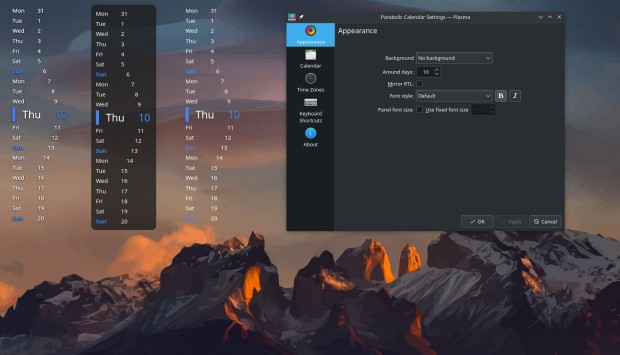
Y como siempre digo, si os gusta el plasmoide podéis “pagarlo” de muchas formas en la cambiante página de KDE Store, que estoy seguro que el desarrollador lo agradecerá: puntúale positivamente, hazle un comentario en la página o realiza una donación. Ayudar al desarrollo del Software Libre también se hace simplemente dando las gracias, ayuda mucho más de lo que os podéis imaginar, recordad la campaña I love Free Software Day 2017 de la Free Software Foundation donde se nos recordaba esta forma tan sencilla de colaborar con el gran proyecto del Software Libre y que en el blog dedicamos un artículo.
Más información: KDE Store
¿Qué son los plasmoides?
Para los no iniciados en el blog, quizás la palabra plasmoide le suene un poco rara pero no es mas que el nombre que reciben los widgets para el escritorio Plasma de KDE.
En otras palabras, los plasmoides no son más que pequeñas aplicaciones que puestas sobre el escritorio o sobre una de las barras de tareas del mismo aumentan las funcionalidades del mismo o simplemente lo decoran.
La entrada Parabolic Calendar – Plasmoides de KDE (200) se publicó primero en KDE Blog.