
 Member
 DimStar
openSUSE Tumbleweed – Review of the week 2022/06
Dear Tumbleweed users and hackers,
As we are used to by now, Tumbleweed keeps on rolling at a steady pace. Once again, we managed to publish 5 snapshots during the week (0203x 0204, 0205, 0206, and 0207); 0208 was not created (delays in build time, too much load) and 0209 was discarded due to failures around vagrant dependencies.
The most relevant changes shipped as part of those 5 snapshots were:
- KDE Gear 21.12.2
- KDE Plasma 5.24.0
- rpm no longer pulls glibc-locale, but only glibc-locale-base, See this discussion
- Mesa 21.3.5
- llvm 13.0.1
- systemd: drop SUSE specific sysv support. Generic, upstream based sysv support remains in place. See original announcement at Factory mailinglist
- Linux kernel 5.15.5
- zstd 1.5.2: introduces zstd-gzip, an alternative, faster implementation of gzip. It is not (yet) a drop-in replacement, as the command line parameters are not matching
That matches pretty well the announcements of last week – of course, the longer-lasting things are still pending and work in progress. Staging projects currently contain:
- Mesa 21.3.6
- Linux kernel 5.15.8 – with full drm support in earlyboot, see Mailinglist
- glibc 2.35
- Python 3.6 interpreter will be removed (We have roughly 75 python36-FOO packages left)
- Python 3.10 as the distro default interpreter (a bit down the line)
- GCC 12 introduction has started to be as ready as possible for when the upstream release happens.
Memperbaiki Function Key Keyboard Keychron K2 di openSUSE Tumbleweed
Keychron K2 adalah keyboard external keluaran dari Keychron yang dikhususkan untuk Mac dan Windows.
Ketika pertama kali menghubungkan ke openSUSE Tumbleweed ada beberapa masalah yang ditemui, salah satunya adalah tidak berfungsinya function key, issue tersebut bisa dipecahkan dengan menambahkan beberapa konfigurasi seperti berikut :
- Tambahkan file hid_apple.conf di direktori modprobe.d
sudo vim /etc/modprobe.d/hid_apple.conf
- Isi file tersebut dengan baris berikut
options hid_apple fnmode=2
- Simpan file kemudian jalankan perintah berikut diterminal
sudo mkinitrd
- Reboot laptop/komputer Anda
Selamat menikmati function key yang telah berfungsi kembali.
Sumber:
- https://github.com/Kurgol/keychron/blob/master/k2.md#f-keys-on-ubuntu
The syslog-ng Insider 2022-02: Reboot; Sequence; Monterey; CentOS 9;
The February syslog-ng newsletter is now on-line:
- syslog-ng relaunch
- Sequence – making PatternDB creation for syslog-ng easier
- Syslog-ng on MacOS Monterey
- Installing syslog-ng on CentOS Stream 9
It is available at https://www.syslog-ng.com/community/b/blog/posts/the-syslog-ng-insider-2022-01-reboot-sequence-monterey-centos-9

syslog-ng logo

Remove file from the last commit in git
- So, you want to remove that pesky file from your last commit?
- By accident (naturally, as you and me are perfect beings) a file was commited and it should have not?
- The cat went over the keyboard and now there’s an extra file in your commit?
If the answer to any of the above is yes, here’s how to do it without pain (Tanking into account, that you want to do that on the last commit; If you need to do it in the middle of a rebase, see the previous post or combine this trick with a rebase (edit a commit with a rebase…).
git restore --source=HEAD^ pesky.file
You can always checkout the file again, or use some witchcraft extracted from man git-restore to do it all at once
This is blatantly stolen from: https://devconnected.com/how-to-remove-files-from-git-commit/ but also man git
could get you there too, given enough reading.

Latest Plasma Lands in Tumbleweed, Set for Leap Beta
This week’s openSUSE Tumbleweed snapshots delivered exciting news not only to rolling release users, but also brought significant news for users of the long-established Leap release.
KDE’s next Long-Term Support (LTS) release, Plasma 5.24, arrived in a recent snapshot, and it brings the “Perfect Harmony” for both Tumbleweed and Leap users. Plasma 5.24 will be one of the Desktop Environments (DE) in Leap 15.4; the beta version of Leap 15.4 is expected to be released for testing with the new Plasma version within the next couple of weeks, according to the roadmap.
Plasma 5.24 arrived in snapshot 20220207. The release has improvements in looks and ease of use. It is the final Plasma 5 version until the transition to Plasma 6. Breeze, Plasma’s default theme, was changed giving the DE an improved visual consistency. Breeze lets users pick accent colors and the light/dark color preference gives non-KDE apps that respect the FreeDesktop preferences an automatic light or dark switch based on the chosen color scheme. Discover gives users the option to automatically restart after an update is completed. By simply clicking the checkbox at the bottom of the Updates page, users can take a break and come back to a rebooted, updated system. There are several other feature improvements in the update and people can watch the creation of the Honeywave wallpaper that was developed for the release since it was streamed live on YouTube. The 5.16.5 Linux Kernel update brought several changes for semiconductor company and openSUSE sponsor Marvell; most of this centered on fixes and enablements for their OCTEON® TX2 processor family. Facebook’s fast compression package zstd updated to version 1.5.2, did some spec file cleanup and enabled a zlib/gzip compatible backend since compression library zlib is shown to be significantly faster than gzip. There were about 50 RubyGem packages updated in the snapshot and rubygem-spring 4.0.0 was the only major version update in the snapshot.
Some of the daily snapshots this week were large and the 20220206 snapshot had a variety of packages updated. An update of Mesa 21.3.5 and Mesa-drivers 21.3.5 fixed Zink driver bugs. Finnish translations were made with the update of libstorage-ng 4.4.79 and openSUSE’s 0.1.8 opensuse-welcome package also updated translations. A quarterly update of Google’s regular expression library re2 20220201 addressed a -Wunused-but-set-variable warning from Clang 13.x and yast2-storage-ng 4.4.35 improved integration with the yast2-nfs-client to offer a consistent user experience. Other packages to update in the snapshot were xwayland 22.0.99.902, llvm13 13.0.1 and python-Pillow 9.0.1.
A total of six packages arrived in snapshot 20220205. Text editor vim 8.2.4286 states in the changelog that entering a character with CTRL V may include modifiers. The texted editor update also fixed two Common Vulnerabilities and Exposures, CVE-2022-0417 and CVE-2022-0393. File system utility update e2fsprogs 1.46.5 fixed a crash and fixed the handling of resizing the file system, which would exceed inode limitations. Light-weight programming language lua54 5.4.4 fixed some bugs and removed two patches and ncurses 6.3.20220129 added a warning in the configuration script if the file specified for --with-caps does not exist. Both yast2-core 4.4.1 and yast2-country 4.4.11 were also updated; the latter fixed arguments for the localectl set-locale.
The 20220204 snapshot brought KDE Gear 21.12.2. File manager Dolphin improved zooming of the files. Video editor Kdenlive fixed an issue that sometimes could not move grouped clips to the right when only one empty frame was present. It also fixed a freeze when trying to drag a clip that was just added to Bin. Kmail fixed a build issue with GNU Compiler Collection 12 and learning tool kgeography fixed the color of Howland, Baker and Jarvis islands of United States minor. The Universal Command Line Interface for Amazon Web Services, aws-cli 1.22.46 updated requirements in the spec file from setup.py. The release added a new NNA accelerator compilation support for Sagemaker Neo, which is used for optimizing machine learning. A Qt 6 development pattern was added with the patterns-kde 20220203 update. Both findutils 4.9.0 and a git + version of mobile shell mosh 1.3.2 were updated in the snapshot.
The two snapshots starting off the week were loaded with several packages. While snapshot 20220202 was mostly filled with RubyGem packages, snapshot 20220203 had more updates of Python Package Index and YaST packages. Snapshot 20220203 had multiple package updates for a broad range of users. Audio package PipeWire should again be able to play sound in Zoom, telegram and other apps with the 0.3.45 update. The default sink and source names and properties in PipeWire are also improved. Support for seamless and saliency blending of a foreground and background image was made in the ImageMagick 7.1.0.22 update. The screen reader package for individuals with visual impairments, orca, updated to version 41.2, fixed a couple bugs, improved handling performance and added more event-flood detection. The kernel dump helpers package kdump 1.0.2 fixed the network interface naming and added a dependency on kdumptool. Other packages to update in 20220203 were sudo 1.9.9 and a git + update for samba 4.15.5. Snapshot 20220202 updated to the 5.16.4 Linux Kernel, which had a decent amount of improvements for Flash Memory through Memory Technology Device changes. XML parser library expat 2.4.4 fixed CVE-2022-23852 and CVE-2022-23990, which affected the integer overflow. Out of the 26 RubyGem packages to update in the snapshot, rubygem-hashie 5.0.0 was the only package to have a major version update, which added exporting a normal Hash from an indifferent one through the to_hash method.

Website-Watcher (freeware) et la détection de rançongiciels
Quoique nous soyons des aficionados de Linux et du concept de Logiciel Libre, nous devons de temps en temps nous tourner vers des freeware afin de sécuriser nos amis utilisant Windows contre les rançongiciels (par exemple). Dans la lumière de ce qui précède, nous vous invitons à venir voir le freeware Website-Watcher en action le …
Website-Watcher (freeware) et la détection de rançongicielsRead More »
The post Website-Watcher (freeware) et la détection de rançongiciels appeared first on Cybersécurité, Linux et Open Source à leur plus haut niveau | Network Users Institute | Rouen - Normandie.
FOSDEM 2022: my experiences, sudo talk answers
I spent my last weekend in Brussels at FOSDEM. Well, not really: while I had a couple of Belgian beers, the conference itself was a virtual event and I was at home in Budapest. It’s the second year that FOSDEM is virtual, and yet again I can state that it’s the best virtual event of the year. I had two talks this year. After my second talk, I got some questions during the Q & A session which I could not answer, so I will try to answer them. But before that, let me share my experience!
Experience
Why do I say that FOSDEM is the best virtual event? Of course, even they cannot re-create everything from a real-life event, but it is probably the closest and there are even some improvements compared to IRL events.
All talks are pre-recorded and recordings are played back automatically, so there are no schedule problems. As they are pre-recorded, even if the presenter has technical problems, like I had an unstable Internet connection due to storm damage, everyone can still watch the talks.
Talks are available as a simple video stream, but if you register, then there is a live chat where you can ask and upvote questions. There were lively discussions during both of my syslog-ng and sudo talks, and the questions are also answered live during the video stream after the playback is finished.
If the time is up, attendees can stay in the virtual room and watch the next talk starting automagically, or they can also have a hallway track with the presenter. Instructions are printed in the chat and I had some good discussions after my talks in this way.
Sudo talk answers
“do you happen to know why sudo -e has been broken on Fedora CoreOS has been broken for a while?”
This problem has already been fixed upstream, see: https://github.com/sudo-project/sudo/issues/122 It will be most likely fixed as soon as sudo is updated to the latest version (or the patch is picked).
“Does sudo support logfmt, which is somewhat more readable? Halfway between fully structured and human-readable.”
No. Regular sudo logs are pretty similar and slightly more complex, but syslog-ng can parse them: (sudo parser):
Feb 7 17:51:51 czplaptop sudo[21742]: czanik : TTY=pts/1 ; PWD=/home/czanik ; USER=root ; COMMAND=/bin/bash
Starting with version 1.9.4 there is also JSON formatting, which is less human-readable, but can be parsed by just about anything and contains a lot more information:
Defaults log_format=json
“Do you have any feedback regarding using sudo with SELinux?”
It is possible to specify an SELinux role and optional type in sudoers rules. The role/type can also be specified on the command line (see -r and -t options). This makes it possible to do SELinux-style role-based access control using sudo. Basically, you can use sudo to run commands with a specific SELinux role/type just like you would with a traditional Linux user.
“What kind of sudo extensions are possible using the C/python API?”
I listed a few in my live answer, but here is the documentation listing all possibilities:
- C: https://www.sudo.ws/docs/man/1.9.9/sudo_plugin.man/
- Python: https://www.sudo.ws/docs/man/1.9.9/sudo_plugin_python.man/
“Are session recordings encrypted?”
Session recordings are encrypted while in transit, see Securing the sudo to sudo_logsrvd connection. Session recordings are not stored in an encrypted format by sudo and sudo_logsrvd.
If you want to make sure that your sudo session recordings are tamper-proof, check out Safeguard for Privileged Sessions(a commercial product), which supports collecting sudo session recordings, saves them in an encrypted and time-stamped storage, and can play back recordings in a web-based interface.

Sudo logo
Curso online de Linux desde cero de OSLUZ
Dicen que más vale tarde que nunca…y eso me ha pasado con este curso online de Linux desde cero organizado por la Oficina del Software Libre de la Universidad de Zaragoza. ¿Quieres saber más? Sigue leyendo.
Curso online de Linux desde cero de OSLUZ
El pasado 28 de enero de 2022 se inició a las 13:00 horas una iniciativa que tiene como público objetivo cualquier persona que tenga interés en comenzar a utilizar Linux, por curiosidad o por necesidad, sin ningún tipo de conocimiento previo.
El formato de las clases es ONLINE y se puede acceder desde el enlace https://videoconferencia.unizar.es/b/osl-cux-cmh y os podéis registrar en el curso enviando un correo a osluz@unizar.es, de esta forma recibirás recordatorios y material del curso.
El calendario de sesiones es el siguiente:
1ª sesión 28-1-2022: Instalación de linux: Comenzaremos el curso trabajando la instalación de 2 distribuciones Linux. Veremos lo fácil que es instalarlas y distintas opciones a seleccionar en Virtualbox. También crearemon un pen USB para poder instalar Linux en cualquier dispositivo.
2ª sesión 11-2-2022: El entorno gráfico de Linux, personalización del sistema. Instalación de aplicaciones. Más concretamente se va a dedicar a la personalización de Kubuntu y Plasma y a la revisión de aplicaciones desde el Centro de Software Discover y desde la terminal con APT y DPKG.

3ª sesión 25-2-2022: El administrador de archivos e introducción a la terminal. Comandos básicos.
4ª sesión 11-3-2022: Imprimir en Linux: instalación de impresoras y CUPS. Editores de texto.
5ª sesión 24-3-2022 (Jueves): Paquete de ofimática Libreoffice
6ª sesión 8-4-2022: Gestión de usuarios y grupos.
7ª sesión 22-4-2022: Instalar Windows junto a Linux o viceversa
8ª sesión 6-5-2022: Instalación de programas Windows en Linux: Wine
9ª sesión 20-5-2022: – Anexo I Copias. Uso de cp, mv, dd, rsync, scp, (empaquetados) tar y cpio, compresión gzip y bzip2. Uso para copias de seguridad.
10ª sesión 3-6-2022: Anexo II Programar tareas: Crond
De esta forma Si eres un usuario de Windows que quiere migrar a Linux o si has oído hablar de Linux y lo quieres probar o si tienes algún ordenador o tablet antiguo al que le quieres dar una nueva vida, este es tu curso.
Todas las sesiones se grabarán y se publicarán en el canal de Youtube de OSLUZ.
Esta actividad se enmarca en el Concilio de lo Libre, iniciativa de Software Libre en la que participa la Universidad de Zaragoza a través de la Oficina de Software Libre y de la que ya hablamos en el blog.
Más información: OSLUZ

Mastodon Setup with Docker and Caddy
In my previous post, we setup a Mastodon server using Docker and nginx-proxy. In this post, we use instead the web server Caddy. I’ve only discovered Caddy a week ago. The configuration of Mastodon is now even simpler and shorter. Caddy redirects traffic automatically from HTTP to HTTPS and configures HTTPS for all domains via Let’s Encryption. :rocket:
Our starting point is the docker-compose.yml shipped with the Mastodon code. Why is it not enough? It assumes you setup up proxy with HTTPS endpoints yourself. So let’s integrate this as well in Docker.
Setup
Few remarks to start with:
- my testing system: Ubuntu 20.04.3 LTS (GNU/Linux 5.4.0-97-generic x86_64)
- install first some software with
apt install docker docker.io caddy jq git -
create an unprivileged user account, e.g.
mastodonadduser --disabled-login mastodon adduser mastodon docker adduser mastodon sudo # optional, remove later su mastodon # switch to that user -
my docker compose: Docker Compose version v2.2.3 (based on go)
install docker compose in 3 lines:
mkdir -p ~/.docker/cli-plugins curl -sSL https://github.com/docker/compose/releases/download/v2.2.3/docker-compose-linux-x86_64 -o ~/.docker/cli-plugins/docker-compose chmod +x ~/.docker/cli-plugins/docker-compose -
my testing domain (for this example): social.host
-
my dot-env file
.envfor docker compose:LETS_ENCRYPT_EMAIL=admin-mail@social.host MASTODON_DOMAIN=social.host FRONTEND_SUBNET="172.22.0.0/16" # check the latest version here: https://hub.docker.com/r/tootsuite/mastodon/tags MASTODON_VERSION=v3.4.6 -
I have commented out
build: ., because I prefer to rely on the official images from Docker Hub. -
With little effort, we enable as well full-text search with elasticsearch.
-
The setup places all databases and uploaded files in the folder
mastodon. -
We use a named volume
mastodon-publicto expose the static files from themastodon-webcontainer to the Caddy webserver. Caddy serves directy static files for improved speed. Awesome! :star2: -
The setup comes with the Mastodon Twitter Crossposter. You need to setup an extra subdomain for it. Remove it from the
docker-compose.ymlin case you have no use for it. -
Using
extra_host, we expose with"host.docker.internal:host-gateway"the Docker host to the Mastodon Sidekiq container in case that you configure Mastodon to use a mail transfer agent (e.g. postfix) running on the host. In that case, useSMTP_SERVER=host.docker.internal. - Consider to replace the git repository to build the crossposter with a local copy for more control over updates.
# file: 'docker-compose.yml'
version: "3.7"

services:
  caddy:
    image: caddy:2-alpine
    restart: unless-stopped
    container_name: caddy
    ports:
      - "80:80"
      - "443:443"
    volumes:
      - ./caddy/etc-caddy:/etc/caddy
      - ./caddy/data:/data # Optional
      - ./caddy/config:/config # Optional
      - ./caddy/logs:/logs
      - mastodon-public:/srv/mastodon/public:ro
    env_file: .env
    # helps crossposter resolve the mastodon server internally
    hostname: "${MASTODON_DOMAIN}"
    networks:
       frontend:
          aliases:
            - "${MASTODON_DOMAIN}"
    networks:
      - frontend
      - backend

  mastodon-db:
    restart: always
    image: postgres:14-alpine
    container_name: "mastodon-db"
    healthcheck:
      test: pg_isready -U postgres
    environment:
      POSTGRES_HOST_AUTH_METHOD: trust
    volumes:
      - "./mastodon/postgres:/var/lib/postgresql/data"
    networks:
      - backend

  mastodon-redis:
    restart: always
    image: redis:6.0-alpine
    container_name: "mastodon-redis"
    healthcheck:
      test: redis-cli ping
    volumes:
      - ./mastodon/redis:/data
    networks:
      - backend

  mastodon-elastic:
    restart: always
    image: docker.elastic.co/elasticsearch/elasticsearch-oss:7.10.2
    container_name: "mastodon-elastic"
    healthcheck:
      test: curl --silent --fail localhost:9200/_cluster/health || exit 1
    environment:
      ES_JAVA_OPTS: "-Xms512m -Xmx512m"
      cluster.name: es-mastodon
      discovery.type: single-node
      bootstrap.memory_lock: "true"
    volumes:
      - ./mastodon/elasticsearch:/usr/share/elasticsearch/data
    networks:
      - backend
    ulimits:
      memlock:
        soft: -1
        hard: -1

  mastodon-web:
    restart: always
    image: "tootsuite/mastodon:${MASTODON_VERSION}"
    container_name: "mastodon-web"
    healthcheck:
      test: wget -q --spider --proxy=off localhost:3000/health || exit 1
    env_file: mastodon.env.production
    environment:
      LOCAL_DOMAIN: "${MASTODON_DOMAIN}"
      SMTP_FROM_ADDRESS: "notifications@${MASTODON_DOMAIN}"
      ES_HOST: mastodon-elastic
      ES_ENABLED: true
    command: bash -c "rm -f /mastodon/tmp/pids/server.pid; bundle exec rails s -p 3000"
    expose:
      - "3000"
    depends_on:
      - mastodon-db
      - mastodon-redis
      - mastodon-elastic
    volumes:
      # https://www.digitalocean.com/community/tutorials/how-to-share-data-between-docker-containers
      - mastodon-public:/opt/mastodon/public # map static files in volume for caddy
      - ./mastodon/public/system:/opt/mastodon/public/system
    networks:
      - frontend
      - backend
    extra_hosts:
      - "host.docker.internal:host-gateway"

  mastodon-streaming:
    restart: always
    image: "tootsuite/mastodon:${MASTODON_VERSION}"
    container_name: "mastodon-streaming"
    healthcheck:
      test: wget -q --spider --proxy=off localhost:4000/api/v1/streaming/health || exit 1
        ]
    env_file: mastodon.env.production
    environment:
      LOCAL_DOMAIN: "${MASTODON_DOMAIN}"
      SMTP_FROM_ADDRESS: "notifications@${MASTODON_DOMAIN}"
      ES_HOST: mastodon-elastic
      ES_ENABLED: true
    command: node ./streaming
    expose:
      - "4000"
    depends_on:
      - mastodon-db
      - mastodon-redis
    networks:
      - frontend
      - backend

  mastodon-sidekiq:
    restart: always
    image: "tootsuite/mastodon:${MASTODON_VERSION}"
    container_name: "mastodon-sidekiq"
    healthcheck:
      test: ps aux | grep '[s]idekiq\ 6' || false
    env_file: mastodon.env.production
    environment:
      LOCAL_DOMAIN: "${MASTODON_DOMAIN}"
      SMTP_FROM_ADDRESS: "notifications@${MASTODON_DOMAIN}"
      ES_HOST: mastodon-elastic
      ES_ENABLED: true
    command: bundle exec sidekiq
    depends_on:
      - mastodon-db
      - mastodon-redis
    volumes:
      - ./mastodon/public/system:/mastodon/public/system
    networks:
      - frontend
      - backend
    extra_hosts:
      - "host.docker.internal:host-gateway"

  crossposter-db:
    restart: always
    image: postgres:14-alpine
    container_name: "crossposter-db"
    healthcheck:
      test: pg_isready -U postgres
    environment:
      POSTGRES_HOST_AUTH_METHOD: trust
    volumes:
      - ./crossposter/postgres:/var/lib/postgresql/data
    networks:
      - backend

  crossposter-redis:
    restart: always
    image: redis:6.0-alpine
    container_name: "crossposter-redis"
    healthcheck:
      test: redis-cli ping
    volumes:
      - ./crossposter/redis:/data
    networks:
      - backend

  crossposter-web:
    restart: always
    build: https://github.com/renatolond/mastodon-twitter-poster.git#main
    image: mastodon-twitter-poster
    container_name: "crossposter-web"
    env_file: crossposter.env.production
    environment:
      CROSSPOSTER_DOMAIN: "https://crossposter.${MASTODON_DOMAIN}"
    expose:
      - "3000"
    depends_on:
      - crossposter-db
    networks:
      - frontend
      - backend

  crossposter-sidekiq:
    restart: always
    build: https://github.com/renatolond/mastodon-twitter-poster.git#main
    image: mastodon-twitter-poster
    container_name: "crossposter-sidekiq"
    healthcheck:
      test: ps aux | grep '[s]idekiq\ 6' || false
    env_file: crossposter.env.production
    environment:
      ALLOWED_DOMAIN: "${MASTODON_DOMAIN}"
      CROSSPOSTER_DOMAIN: "https://crossposter.${MASTODON_DOMAIN}"
    command: bundle exec sidekiq -c 5 -q default
    depends_on:
      - crossposter-db
      - crossposter-redis
    networks:
      - frontend
      - backend

volumes:
  mastodon-public:

networks:
  frontend:
    name: "${COMPOSE_PROJECT_NAME}_frontend"
    ipam:
      config:
        - subnet: "${FRONTEND_SUBNET}"
  backend:
    name: "${COMPOSE_PROJECT_NAME}_backend"
    internal: true
The web server Caddy is configured using a Caddyfile stored in ./caddy/etc-caddy. I started with a config I found on Github.
# file: 'Caddyfile'
# kate: indent-width 8; space-indent on;

{
        # Global options block. Entirely optional, https is on by default
        # Optional email key for lets encrypt
        email {$LETS_ENCRYPT_EMAIL}
        # Optional staging lets encrypt for testing. Comment out for production.
        # acme_ca https://acme-staging-v02.api.letsencrypt.org/directory

        # admin off
}

{$MASTODON_DOMAIN} {
        log {
                # format single_field common_log
                output file /logs/access.log
        }

        root * /srv/mastodon/public

        encode gzip

        @static file

        handle @static {
                file_server
        }

        handle /api/v1/streaming* {
                reverse_proxy mastodon-streaming:4000
        }

        handle {
                reverse_proxy mastodon-web:3000
        }

        header {
                Strict-Transport-Security "max-age=31536000;"
        }

        header /sw.js  Cache-Control "public, max-age=0";
        header /emoji* Cache-Control "public, max-age=31536000, immutable"
        header /packs* Cache-Control "public, max-age=31536000, immutable"
        header /system/accounts/avatars* Cache-Control "public, max-age=31536000, immutable"
        header /system/media_attachments/files* Cache-Control "public, max-age=31536000, immutable"

        handle_errors {
                @5xx expression `{http.error.status_code} >= 500 && {http.error.status_code} < 600`
                rewrite @5xx /500.html
                file_server
        }
}

crossposter.{$MASTODON_DOMAIN} {
        log {
                # format single_field common_log
                output file /logs/access-crossposter.log
        }

        encode gzip

        handle {
                reverse_proxy crossposter-web:3000
        }

}
With these file in place, create a few more folders and launch the setup of the instance. If the instance has been setup before, a database setup may be enough.
# mastodon
touch mastodon.env.production
sudo chown 991:991 mastodon.env.production
mkdir -p mastodon/public
sudo chown -R 991:991 mastodon/public
mkdir -p mastodon/elasticsearch
sudo chmod g+rwx mastodon/elasticsearch
sudo chgrp 0 mastodon/elasticsearch

# first time: setup mastodon
# https://github.com/mastodon/mastodon/issues/16353 (on RUBYOPT)
docker compose run --rm -v $(pwd)/mastodon.env.production:/opt/mastodon/.env.production -e RUBYOPT=-W0 web bundle exec rake mastodon:setup

# subsequent times: skip generation of config and only setup database
docker compose run --rm -v $(pwd)/mastodon.env.production:/opt/mastodon/.env.production web bundle exec rake db:setup

# crossposter
mkdir crossposter
docker-compose run --rm crossposter-web bundle exec rake db:setup

# launch mastodon and crossposter
docker compose run -d

# look into the logs, -f for live logs
docker compose logs -f
Troubleshooting
-
I had much problems to let the mastodon container connect to a mail transport agent (MTA) of my host. Eventually, I solved it with an extra filewall rule:
ufw allow proto tcp from any to 172.17.0.1 port 25. -
The mail issue can be avoided by a) using a SaaS such as (mailgun/mailjet/sendinblue) or b) using another Docker container with postfix that is in the frontend network as well. Look at Peertube’s docker-compose file for some inspiration.
References
- https://caddyserver.com
-
https://gist.github.com/yukimochi/bb7c90cbe628f216f821e835df1aeac1?permalink_comment_id=3607303#gistcomment-3607303 (
Caddyfilefor Mastodon on Github)
Akademy 2022 se celebrará en Barcelona
Tras Gran Canaria, Bilbao, A Corunya y Almería, es decir, por quinta vez en la historia de Akademy el encuentro anual de la Comunidad Internacional KDE se celebrará en España. De este modo me complace anunciar que Akademy 2022 se celebrará en Barcelona, concretamente del 1 al 7 de octubre en un evento que será híbrido: presencial y en línea, cumpliéndose los pronósticos que auguraban que tras el impacto de pandemía este tipo de encuentros se adaptarían a esta nueva realidad.
Akademy 2022 se celebrará en Barcelona

En palabras de los organizadores:
KDE anuncia que la Akademy de este año tendrá lugar tanto online como en persona en Barcelona en octubre.
Únase a nosotros en la vibrante ciudad de Gaudí, el Club de Fútbol Barça y la alta cocina mediterránea para reunirse en persona (o asistir online) y disfrutar de la mejor experiencia sea cual sea la opción que elija.
¡Reserva la fecha! El evento comienza el 1 de octubre y termina el 7 de octubre, con una fiesta de bienvenida prevista para la noche anterior al inicio de las charlas.

Akademy lleva realizándose anualmente bajo este nombre desde 2004, en la página web oficial o en la wikipedia podéis encontrar los nombres y fechas anteriores eventos.
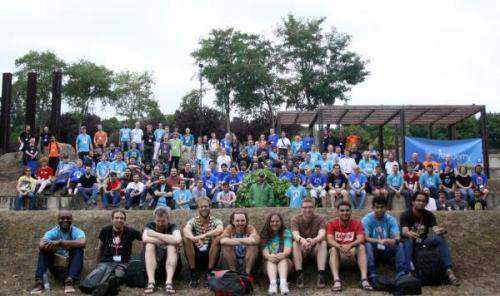
Para que os hagáis una ligera idea de la magnitud del evento, os dejo una imagen de grupo de Akademy 2015 de A Corunya en la que tuve la suerte de participar.
Más información: Akademy 2022
¿Qué es Akademy?
Para los que no lo sepan, Akademy es el evento de la Comunidad KDE que aúna en una gran conferencia todo tipo de simpatizantes de KDE como desarrolladores, diseñadores, usuarios, traductores, promotores. Allí se reunirán a lo largo de una semana para compartir charlas, cenas, ponencias, talleres y, en definitiva, para trabajar juntos.
Es una gran semana que sirve para unir más fuerte los lazos que unen nuestra Comunidad, así como para crear nuevos.