curl, GNOME, KDE Updates Arrive in Tumbleweed
openSUSE’s rolling release Tumbleweed finished off 2021 with multiple snapshots and 2022 is starting off the same by producing nine snapshots so far this year.
The latest Tumbleweed snapshot, 20220112, updated Mozilla Firefox to major version 96.0 and addressed almost 20 Common Vulnerabilities and Exposures. The browser added a new feature for printing that allows users to choose to print only the odd/even pages.The browser now defaults all cookies to having a SameSite=lax attribute to helps defend against one-click attacks. While gnome-desktop had a version bump to 41.3, gnome-shell 41.3 fixed some crashes, improved window tracking and updated translations. GNOME’s window manager mutter 41.3 fixed a mixed up refresh rate in multi-monitor setups and fixed orientation changes on devices with 90 degree adjustments. Command line utility hdparm 9.63 added a patch and has a new --sanitize-overwrite-passes flag. Other packages to update in the snapshot were rdma-core 38.1, libpipeline 1.5.5, rdma-core 38.1, vim 8.2.4063 and wayland 1.20.0.
The entire KDE stack was updated in snapshot 20220111, which brought KDE Gear 21.12.1, KDE Frameworks 5.90.0 and Plasma 5.23.5. Gear 21.12.1 fixed kalarm that had prevented command line actions from running with bad calendar files. Video editor Kdenlive created some default rules for varying frames-per-second clips that are imported. Frameworks 5.90.0 had some changes for the input/output library KIO; it finished PolKit integration and KIO also fixed hidden NTFS mountpoints when /etc/mtab is a regular file. The update of Kirigami in Frameworks 5.90.0 improved consistency with scrolling in Qt widgets and fixed layered navigation buttons. The update of Plasma 5.25.5 fixed bugs involving fetching Flatpak updates in the software management (Graphical User Interface) Discover. Plasma Desktop fixed some settings and handling of X11 and KDE’s Bluedevil package fixed device type detection for Audio/Video devices. Several other fixes were made in KDE’s stack update. There were several other updated packages in the snapshot, but almost all were Python Package Index. One of the other packages to update supports the work-flow of YaST developers; rubygem-yast-rake 0.2.44 added support for multiple Rubocop versions. The other non-PyPI updates were to music player amarok and perl-IO-Socket-SSL 2.073.
The snapshot 20220110 updated curl to version 7.81.0 and Daniel Stenberg’s video lists 16 of his favorite bug fixes. One of those was the enablement of HAProxy support for hyper backend, which is a separate http backend for curl, and another was providing a tool to warn if too many output arguments were found when specifying a number of urls. PipeWire 0.3.43 improved memory usage, fixed some crashes and provided better compatibility with GStreamer based applications. An update of framework gupnp 1.4.2 fixed a memory leak, deprecated some root component and enhanced documentation. The mtools package, which is a collection of utilities to access MS-DOS disks, updated to 4.0.37 and fixed a missing command error in floppyd_io.c. The home media server package rygel 0.40.3 fixed a deadlock on start-up and the 4.4.6 yast2-security package fixed some SELinux requirement. Several other packages were updated in the snapshot.
Xen had some upstream patches arriving in the 20220109 snapshot. It also added a fix in collecting active Virtual Machine config files in the supportconfig plugin xen-supportconfig. GNOME software updated to version 41.3 in the snapshot and removed various cultural sensitivity badges. An update of aws-cli 1.22.28 updated some requirements in the spec file from setup.py. The dleyna-renderer package, which allows clients to discover and manipulate Digital Media Renderers, and its complementary package dleyna-server, removed error logging in versions 0.7.2. An update of yast2 4.4.34 fixed test failures in Ruby 2.5 that was caused by the fix for Ruby 3.0. Other packages to update in the snapshot were libsoup 3.0.4, libstorage-ng 4.4.72, fmt 8.1.1 and more.
The first update of the week for libstorage-ng arrived in snapshot 20220107, which updated translations from Weblate in Japanese, Catalan and Slovak. An update of openssl 1.1.1m prioritised DANE TLSA issuer certificates over peer certificates. An update of GNU Compiler Collection 11 fixes memory corruption and hwdata 0.355 updated PCI, USB and vendor IDs. Fast compression algorithm package zstd updated to version 1.5.1 and rebalanced compression levels to better match the intended speed/level curve; it also made some minor compression ratio improvements for small data. Another package to update in the snapshot was xapps 2.2.8, which mostly provided translation updates.
Gamers who play Assassin’s Creed Syndicate were likely happy to see Tumbleweed’s 20220106 snapshot; the update of 3D Graphics package Mesa 21.3.3 in the snapshot fixed crashes in the game. Mesa and its drivers package fixed build failure with MSVC as well. The update of ImageMagick 7.1.0.19 addressed a hang and possible DoS for certain SVG constructs. The update also improved adjustments of page offsets when resizing an image. Linux’s read-only file system squashfs updated to version 4.5; it added a new option to throttle the amount of CPU and I/O and mksquashfs now allows a no source directory to be specified. Several patches were removed with the update of kdump 0.9.2 and many more patches were added in preparation for openSUSE Leap 15.4. Other packages to update in the snapshot were fmt 8.1.0, vim 8.2.3995, perl-JSON 4.04 and more.
 cabelo
SUSEConnect como usar.
Em alguma situações não encontramos um pacote presente na dependência de um determinado RPM. Abaixo um How To de como utilizar o recurso SUSEConnect em máquinas SLES.
# zypper se libCharLS
Refreshing service 'Basesystem_Module_x86_64'.
Refreshing service 'Containers_Module_x86_64'.
Refreshing service 'Desktop_Applications_Module_x86_64'.
Refreshing service 'Development_Tools_Module_x86_64'.
Refreshing service 'Legacy_Module_x86_64'.
Refreshing service 'Public_Cloud_Module_x86_64'.
Refreshing service 'Python_2_Module_x86_64'.
Refreshing service 'SUSE_Cloud_Application_Platform_Tools_Module_x86_64'.
Refreshing service 'SUSE_Linux_Enterprise_Server_x86_64'.
Refreshing service 'Server_Applications_Module_x86_64'.
Refreshing service 'Web_and_Scripting_Module_x86_64'.
Loading repository data…
Reading installed packages…
No matching items found.
For an extended search including not yet activated remote resources you may run 'zypper
search-packages' at any time.
Do you want to run 'zypper search-packages' now? yes/no/always/never: : yes
Could not search for the package: SUSE::Connect::UnsupportedOperation: Package search is not supported by the registration proxy: Alternatively, use the web version at https://scc.suse.com/packages/
No package found
No exemplo acima o pacote libCharLS2 não foi encontrado nos repositórios configurados no servidor atual. Para equacionar este problema, devemos entrar na URL https://scc.suse.com/packages/ e preencher os parâmetros do ambiente conforme o exemplo abaixo:

Então clique no botão pesquisar e selecione o pacote desejado. No meu caso esta a libCharLS2:

Após esta ação receberemos os comando para respectiva instalação:

Pronto, Basta agora executá-los:
# SUSEConnect -p PackageHub/15.2/x86_64
Registering system to registration proxy https://smt-ec2.susecloud.net

Updating system details on https://smt-ec2.susecloud.net …

Activating PackageHub 15.2 x86_64 …
-> Adding service to system …
-> Installing release package …

Successfully registered system
E agora finalmente o comando zypper in…
zypper install libCharLS2-2.0.0-bp152.3.23
Refreshing service ‘Basesystem_Module_x86_64’.
Refreshing service ‘Containers_Module_x86_64’.
Refreshing service ‘Desktop_Applications_Module_x86_64’.
Refreshing service ‘Development_Tools_Module_x86_64’.
Refreshing service ‘Legacy_Module_x86_64’.
Refreshing service ‘Public_Cloud_Module_x86_64’.
Refreshing service ‘Python_2_Module_x86_64’.
Refreshing service ‘SUSE_Cloud_Application_Platform_Tools_Module_x86_64’.
Refreshing service ‘SUSE_Linux_Enterprise_Server_x86_64’.
Refreshing service ‘SUSE_Package_Hub_x86_64’.
Refreshing service ‘Server_Applications_Module_x86_64’.
Refreshing service ‘Web_and_Scripting_Module_x86_64’.
Warning: The gpg key signing file ‘repomd.xml’ has expired.
Repository: SUSE-PackageHub-15-SP2-Backports-Pool
Key Fingerprint: 637B 32FF 3D83 F07A 7AE1 C40A 9C21 4D40 6517 6565
Key Name: openSUSE:Backports OBS Project
Key Algorithm: RSA 2048
Key Created: Wed Oct 2 13:17:53 2019
Key Expires: Fri Dec 10 13:17:53 2021 (EXPIRED)
Rpm Name: gpg-pubkey-65176565-5d94a381
Building repository ‘SUSE-PackageHub-15-SP2-Backports-Pool’ cache ………[done]
Loading repository data…
Reading installed packages…
Resolving package dependencies…
The following NEW package is going to be installed:
libCharLS2
The following package has no support information from its vendor:
libCharLS2
1 new package to install.
Overall download size: 75.5 KiB. Already cached: 0 B. After the operation, additional 286.1 KiB will be used.
Continue? y/n/v/…? shows all options: y
Retrieving package libCharLS2-2.0.0-bp152.3.23.x86_64 (1/1), 75.5 KiB (286.1 KiB unpacked)
Retrieving: libCharLS2-2.0.0-bp152.3.23.x86_64.rpm ..……………[done]
Checking for file conflicts: …………………………………………….[done]
(1/1) Installing: libCharLS2-2.0.0-bp152.3.23.x86_64 …….………….[done]
E pronto!

 Member
GNU Hello
Al ejecutar el programa GNU Hello simplemente muestra un saludo familiar y amistoso

Si no lo tienes instalado en tu sistema GNU/Linux el software hello, puedes hacerlo con el gestor de paquetes de tu distribución. Después de instalarlo ya podrás ejecutar en una terminal:
hello
Sí, esta es otra implementación desarrollada en lenguaje C, del programa clásico que imprime «¡Hola, mundo!» (si tienes instalado el paquete de traducciones a distintos idiomas) cuando lo ejecutas.
Hoy echando un vistazo por distintos sitios, veo que el paquete hello, ha publicado su versión 2.11 después en este mes de enero del año 2022 de 7 años desde la última versión 2.10, publicada en noviembre de 2014.
De acuerdo, no es un paquete clave, que necesite actualizaciones contínuas, revisiones, ni correcciones de errores, por tanto 7 años, no me parece mucho tiempo.
Pero ¿por qué hay un paquete de software de GNU para un programa tan sencillo como pueda ser imprimir un simple Hola mundo?
Bueno, el propósito de este programa es sobre todo didáctico. Una manera de mostrar los estándares de cómo crear código en el proyecto GNU, además de servir de ejemplo también sobre cómo mantener un paquete GNU.
Es decir, que GNU Hello no incorpora únicamente el clásico código que unicamente imprime en la pantalla el consabido hola mundo, si no que quiere servir de ayuda y ejemplo a un programa mucho mayor que es la forma que se desarrolla en el proyecto GNU.
Instala el paquete, o descarga el código fuente y échale un vistazo. También puedes consultar el man o la página info en tu sistema.
Estudia cómo funciona el código, modifícalo a tu gusto, aporta tus cambios y distribuye si quieres tu versión, es software libre y puedes hacerlo.

Lanzada la beta de Plasma 5.24, pequeñas pero muchas mejoras para un gran escritorio
Una vez finalizado el periodo de mantenimiento de Plasma 5.23 es hora de ir preparando el lanzamiento de la siguiente versión. Es por ello que me complace compartir con vosotros que ha sido lanzada la beta de Plasma 5.24, la próxima versión del escritorio de la Comunidad KDE que nos llega con nuevo fondo de pantalla y novedadesha sido lanzada la beta de Plasma 5.24 interesantes. Es el momento de que esta beta sea probada y que se reporten los errores que se encuentren. ¡No pierdas la oportunidad de contribuir al desarrollo de Plasma!
Lanzada la beta de Plasma 5.24, pequeñas pero muchas mejoras para un gran escritorio
Hoy 13 de enero ha sido lanzada la beta de Plasma 5.24. En esta primera versión liberada del 2022, no apta todavía para el usuario que busquen estabilidad, se ha centrado en que el escritorio de la Comunidad KDE siga mejorando en aspecto, funcionalidades y usabilidad.
En palabras de sus desarrolladores:
Como es tradicional, hoy os traemos la versión de pruebas de Plasma 5.24 de KDE. Plasma 5.24 Beta está dirigida a probadores, desarrolladores y cazadores de errores.
Para ayudar a los desarrolladores de KDE a eliminar los errores y resolver los problemas, instala Plasma 5.24 Beta y prueba las características que se enumeran a continuación (ver anuncio). Por favor, informa de los errores en nuestro rastreador de errores.
La versión final de Plasma 5.24 estará disponible para el público en general el 8 de febrero.

Muchas de sus novedades se han ido desgranando en el blog de Nate Graham, e ncluso ya ha sido presentado su nuevo fondo oficial, pero si queréis saber qué nos espera no dejéis de ver el anuncio oficial donde veréis el ingente número de novedades para Wayland, el lanzador de aplicaciones, Discover, Breeze, plasmoides, Krunner, etc.
Pruébalo y reporta errores

Todas las tareas dentro del mundo del Software Libre son importantes: desarrollar, traducir, empaquetar, diseñar, promocionar, etc. Pero hay una que se suele pasar por alto y de la que solo nos acordamos cuando las cosas no nos funcionan como debería: buscar errores.
Desde el blog te animo a que tú seas una de las personas responsables del éxito del nuevo lanzamiento de Plasma 5.24 de la Comunidad KDE. Para ello debes participar en la tarea de buscar y reportar errores, algo básico para que los desarrolladores los solucionen para que el despegue del escritorio esté bien pulido. Debéis pensar que en muchas ocasiones los errores existen porque no le han aparecido al grupo de desarrolladores ya que no se han dado las circunstancias para que lo hagan.
Para ello debes instalarte esta beta y comunicar los errores que salgan en bugs.kde.org, tal y como expliqué en su día en esta entrada del blog.
Blender を日本語化する
openSUSE にはパッケージで Blender が提供されています。しかし、起動時には英語のメッセージが表示されます。これを日本語化するには以下のようにします。
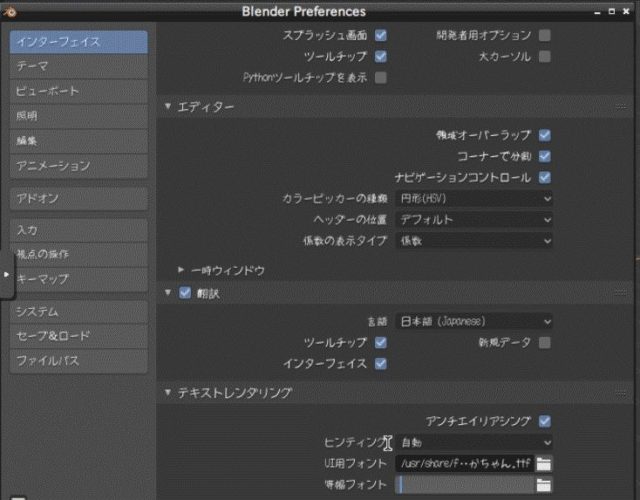
Edit->Preferences 画面を開き、 Text Renderning の所を開き(三角マークを
クリックするとメニューが展開します)、Interface Font に
/usr/share/fonts/truetype/みかちゃん.ttf (画面上では□□..ttf となっています)
を選択して下さい。さらに、Translation の所で、 Language に日本語、
Interface にチェックを入れると日本語化します。

Moving librsvg's documentation to gi-docgen
Librsvg's documentation tooling is pretty ancient. The man page for
rsvg-convert is written by hand in troff, and the C library's
reference documentation still uses the venerable gtk-doc.
As part of the modernization effort, I have turned the man page into a reStructuredText document, and the C API documentation into gi-docgen. This post describes how I did that.
You can read librsvg's new documentation here.
From man to rst
The man page for rsvg-convert was written in troff, which is pretty cumbersome. The following gunk defines a little paragraph and a table:
.P
You can also specify dimensions as CSS lengths, for example
.B 10px
or \"
.BR 8.5in .
The unit specifiers supported are as follows:
.RS
.TS
tab (@);
l lx.
px@T{
pixels (the unit specifier can be omitted)
T}
in@T{
inches
T}
cm@T{
centimeters
T}
mm@T{
millimeters
T}
pt@T{
points, 1/72 inch
T}
pc@T{
picas, 1/6 inch
T}
.TE
Yeah, nope. We have better tools now like rst2man, which take a
reStructuredText document — fancy plain text — and turn it into a
troff man page. I just had to use a command line like
pandoc --from=man --to=rst rsvg-convert.1 > rsvg-convert.rst
and then tweak the output a little:
You can also specify dimensions as CSS lengths, for example ``10px`` or
``8.5in``. The unit specifiers supported are as follows:

   == ==========================================
   px pixels (the unit specifier can be omitted)
   in inches
   cm centimeters
   mm millimeters
   pt points, 1/72 inch
   pc picas, 1/6 inch
   == ==========================================
Much better, right?
I've learned that Pandoc is awesome. Pure magic, highly recommended.
I hope to integrate the man page into a prettier user manual for rsvg-convert at some point. It's no longer a trivial program, and its options allow for some interesting combinations that could use some illustrations and generally more detail than a man page.
From gtk-doc to gi-docgen
I highly recommend that you read Emmanuele's initial description of gi-docgen, which includes the history of gtk-doc, a description of its shortcomings, and how gi-docgen is a simpler tool that leverages the fact that GObject Introspection already slurps documentation from source code and so obviates most of gtk-doc already.
Summary of how gi-docgen works:
-
The C code has documentation comments in Markdown format, with annotations for GObject Introspection. (Note: librsvg has no C code for the library, so those documentation comments actually live in the
.hheader files that it installs for the benefit of C programs.) -
The library gets compiled and introspected. In this step,
g-ir-scanner(1)extracts annotations and documentation from the source code and puts them in theMyLibrary.girXML file. -
You write a small configuration file to tell gi-docgen about the structure of your documentation. Unlike gtk-doc, you don't need to write a DocBook skeleton or anything complicated. Stand-alone chapters can be individual Markdown files, and the configuration file just lists them in the order you want them to appear. Gi-docgen automatically includes all the classes, types, functions, etc. from your code into the docs.
-
... it runs very fast. Gtk-doc was always slow due to xsltproc and complicated stylesheets to turn a DocBook document into browsable HTML documentation. Gi-docgen is much leaner.
Doing the conversion
Unlike the mostly automatic pandoc step for the man page, I
converted the documentation comments to from DocBook to Markdown by
hand. For librsvg this took me a moderately caffeinated afternoon;
it's a little fiddly business, but nothing out of this world.
You can look forward to having good error messages from gi-docgen when something goes wrong, unlike gtk-doc, whose errors I always tended to ignore until the last minute because they were so hard to discern and diagnose.
Some hints:
-
DocBook hyperlinks that looked like
<ulink url="blahblah.html">blah
  blah</ulink>
get turned into[blah blah](blahblah.html)Markdown. -
Gi-docgen allows references to methods like
[method@Gtk.Button.set_child]- see the linking documentation for other kinds of links. -
You can get progressively fancy with introspection attributes.
-
There is no direct mapping between DocBook's extremely granular semantic markup and Markdown conventions, so for example I'd substitute both
<literal>foobar</literal>and<filename>/foo/bar</filename>for `foobar` and `/foo/bar`, respectively (i.e. the text I wanted to show, between backticks, to indicate verbatim text).
Librsvg seemed to include verbatim text blocks in gtk-doc delimited like this:
/**
 * blah_blah():
 *
 * For example:
 *
 * |[
 * verbatim text goes here
 * ]|
 *
 * Etc. etc.
 */
Those can go between ``` triple backticks in Markdown:
/**
 * blah_blah():
 *
 * For example:
 *
 * ```
 * verbatim text goes here
 * ```
 *
 * Etc. etc.
 */
Errors I found
My first manual run of gi-docgen looked like this:
$ gi-docgen check Rsvg-2.0.gir
INFO: Loading config file: None
INFO: Search paths: ['/home/federico/src/librsvg/gi-docgen/_build', '/home/federico/.local/share/gir-1.0', '/home/federico/.local/share/flatpak/exports/share/gir-1.0', '/var/lib/flatpak/exports/share/gir-1.0', '/usr/local/share/gir-1.0', '/usr/share/gir-1.0']
INFO: Elapsed time 1.601 seconds
WARNING: Symbol 'Rsvg.HandleFlags' at <unknown>:0 is not documented
WARNING: Return value for symbol 'Rsvg.Handle.get_dimensions_sub' is not documented
WARNING: Return value for symbol 'Rsvg.Handle.get_geometry_for_element' is not documented
WARNING: Return value for symbol 'Rsvg.Handle.get_geometry_for_layer' is not documented
WARNING: Return value for symbol 'Rsvg.Handle.get_position_sub' is not documented
WARNING: Return value for symbol 'Rsvg.Handle.render_document' is not documented
WARNING: Return value for symbol 'Rsvg.Handle.render_element' is not documented
WARNING: Return value for symbol 'Rsvg.Handle.render_layer' is not documented
WARNING: Return value for symbol 'Rsvg.Handle.set_stylesheet' is not documented
WARNING: Symbol 'Rsvg.Handle.base-uri' at <unknown>:0 is not documented
WARNING: Symbol 'Rsvg.Handle.dpi-x' at <unknown>:0 is not documented
WARNING: Symbol 'Rsvg.Handle.dpi-y' at <unknown>:0 is not documented
WARNING: Symbol 'Rsvg.cleanup' at include/librsvg/rsvg.h:447 is not documented
WARNING: Symbol 'Rsvg.DEPRECATED_FOR' at include/librsvg/rsvg.h:47 is not documented
WARNING: Parameter 'f' of symbol 'Rsvg.DEPRECATED_FOR' is not documented
The warnings like WARNING: Return value ... is not documented are easy
to fix; the comment blocks had their descriptions, but they were
missing the Returns: part.
The warnings like WARNING: Symbol 'Rsvg.Handle.base-uri' at <unknown>:0 is not documented are different. Those are GObject properties, which previously were documented like this:
/**
 * RsvgHandle::base-uri:
 *
 * Base URI, to be used to resolve relative references for resources.  See the section
 * "Security and locations of referenced files" for details.
 */
There is a syntax error there! The symbol line should use a single
colon between the class name and the property name,
e.g. RsvgHandle:base-uri instead of RsvgHandle::base-uri. This
one, plus the other properties that showed up as not documented, had
the same kind of typo.
The first warning, WARNING: Symbol 'Rsvg.HandleFlags' at <unknown>:0
is not documented, turned out to be that there were two
documentation comments with the same title for RsvgHandleFlags, and
the second one was empty — and the last one wins. I left a single one
with the actual docs.
Writing standalone chapters
Librsvg had a few chapters like doc/foo.xml, doc/bar.xml that were
included in the reference documentation; those were a DocBook
<chapter> each. I was able to convert them to Markdown with
pandoc individually, and then add a Title: heading in the first
line of each .md file — that's what gi-docgen uses to build the
table of contents in the documentation's starting page.
Title: Overview of Librsvg

# Overview of Librsvg

Librsvg is a library for rendering Scalable Vector Graphics files (SVG).
Blah blah blah blah.
Build scripts
There are plenty of examples for using gi-docgen with meson; you can look at how it is done in gtk.
However, librsvg is still using Autotools! You can steal the following bits:
Publishing the documentation
Gtk-doc assumed that magic happened somewhere in
developer.gnome.org to generate the documentation and publish it.
Gi-docgen assumes that your project publishes it with Gitlab pages.
Indeed, the new documentation is published there — you can see how
it is generated in .gitlab-ci.yml. Note that there are
two jobs: the reference job generates gi-docgen's HTML in a
public/Rsvg-2.0 directory, and the pages job integrates it with
the Rust API documentation and publishes both together.
Linking the docs to the main developer's site
Finally, librsvg's docs are linked from the GNOME Platform
Introduction. I submitted a merge request to the
developer-www project to update it.
That's all! I hope this is useful for someone who wants to move from gtk-doc to gi-docgen, which is a much more pleasant tool!
openSUSE 15.2 Reached End-of-Life
Users of openSUSE Leap 15.2 will not be receiving security and maintenance updates as the version is now EOL (end of life) as of Jan. 4, 2022.
EOL ends updates for the operating system minor version. Those who continue to use EOL versions will be exposed to vulnerabilities because these discontinued versions no longer receive security and maintenance updates. This is why users need to upgrade to the newer minor release; openSUSE Leap 15.3!
Users can upgrade from 15.2 to 15.3 by downloading the iso image or following the instructions on how to upgrade found on https://en.opensuse.org/SDB:System_upgrade.
For new installations, download openSUSE Leap 15.3 images at https://get.opensuse.org/leap/. The Leap 15.3 release is supported with security patches and updates and is expected to reach its EOL in November 2022. Leap 15.4 is expected to be released in June 2022, according to the roadmap.
Users interested in changing from the point release version to the rolling version can move to Tumbleweed, which provides large daily and frequent updates of all software in the official repositories.
Download it from here and the best way to do the change is to reinstall your system, so take a backup of your /home directory and any configuration files you want to save ( f.e. /etc /var ).

Linux Saloon, the Next Generation of BDLL
Cost of Attrition
What if we could visualise the cost of attrition?
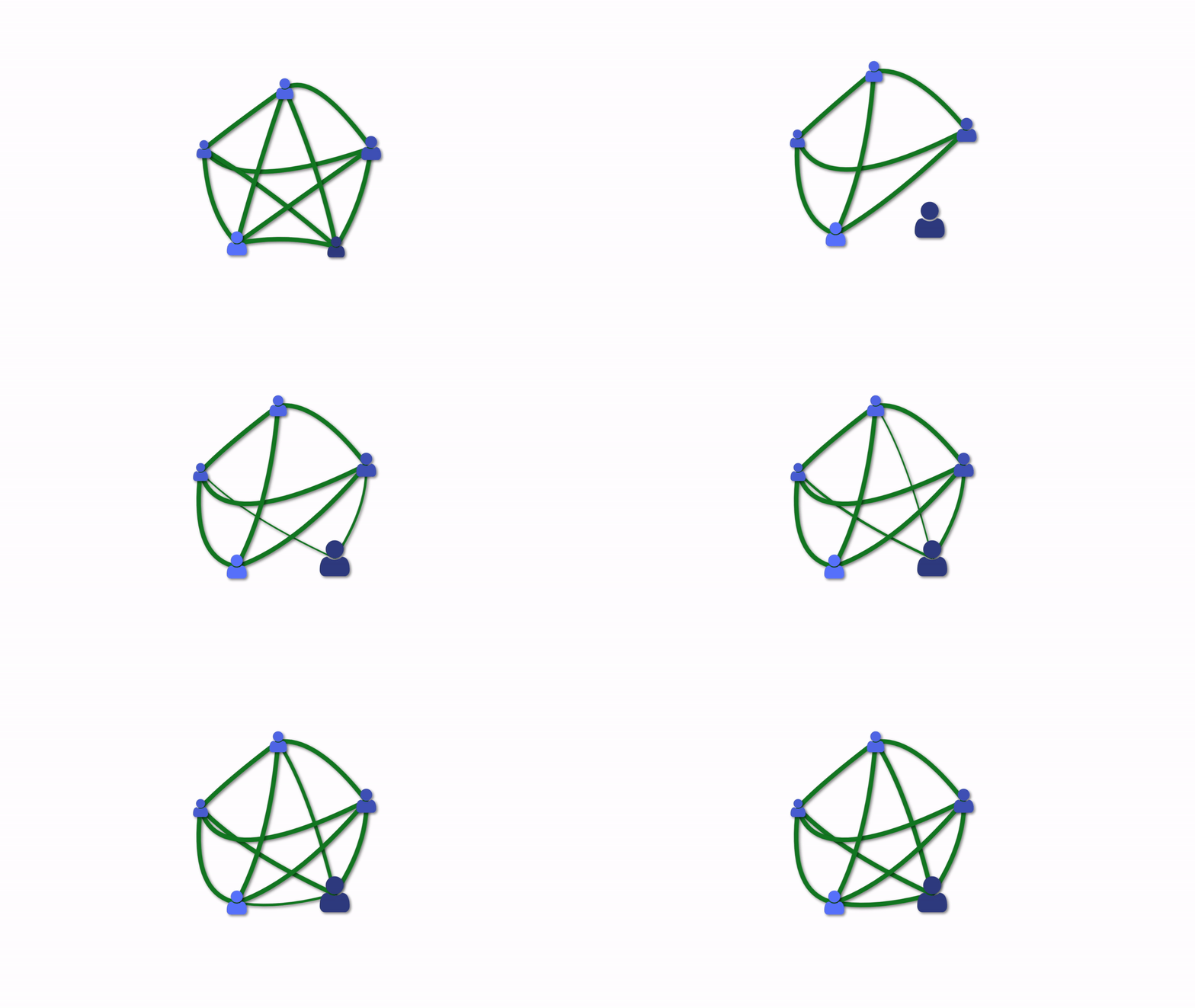
Here’s a team. Someone leaves. We hire a replacement.
We get lucky and manage to find someone more skilled. Looks like we’re better off?
Really when someone leaves we lose all the relationships they had with the rest of the team as well. The team is a diminished more like 40% than the apparent 20% by their loss. It takes longer to rebuild the team than is apparent. Relationships take time.
It’s worse than that. The team probably wasn’t maximally-connected to start with. And it’s not just the interpersonal relationships that matter but the knowledge of tech and domain. A departure can break teams apart and organisational knowledge needs to be rebuilt.
Your organisation probably has multiple teams. Someone leaving your team reduces its connectedness to the rest of the organisation. Increasing the time to recover even with a swift new hire.
Internal mobility is less of a hit to the team’s connectedness due to pre-existing relationships. It also increases the whole organisations resilience by establishing more inter-team relationships.
Teams following the Isolated-individual model of work… (as opposed to collaborative work like pairing and collective ownership) …are particularly brittle & significantly impacted by staff churn.
How would we think about retention if we could visualise the full impact of someone leaving our team?
Beware looking at teams on a spreadsheet. If you have a hiring rate matching attrition rate it might look like the team health is maintained. It’s probably not.
Tracking tenure by team and average tenure in team can be interesting proxy indicators. Teams can be growing but have dropping tenure.
Bear in mind “All models are wrong, some are useful”. Sometimes teams benefit more from fresh ideas than the value of relationships lost in a change. Sometimes gaining someone who helps everyone else in the team form connections at a faster rate can accelerate the team.
This post is also available as a Twitter Thread
Here’s a team. Someone leaves.
— Benji Weber (@benjiweber) January 9, 2022
We hire a replacement.
We get lucky and manage to find someone more skilled.
Looks like we’re better off? [1/10] pic.twitter.com/nSE8wJxElo
The post Cost of Attrition appeared first on Benji's Blog.
Installing the latest syslog-ng on Ubuntu and other DEB distributions
The syslog-ng application is part of all major Linux distributions, and you can usually install syslog-ng from the official repositories. If you use just the core functionality of syslog-ng, use the package in your distribution repository (apt-get install syslog-ng), and you can stop reading here. However, if you want to use the features of newer syslog-ng versions (for example, send log messages to MQTT or Apache Kafka), you have to either compile the syslog-ng from source, or install it from unofficial repositories. This post explains you how to do that.
Read the rest of my blog at https://www.syslog-ng.com/community/b/blog/posts/installing-the-latest-syslog-ng-on-ubuntu-and-other-deb-distributions