
 Member
 baltolkien
No puedo crear tablas en LibreOffice Base – Solucionado
Hace mucho tiempo que no escribo de cómo solucionar errores de las aplicaciones, lo cual es una buena noticia ya que significa que no tengo muchas. No obstante hoy he solucionado un problema que un compañero me ha contado. Básicamente me ha dicho que «No puedo crear tablas en LibreOffice Base», con lo cual he hecho lo de siempre, bucear un poco en Google y encontrar la solución, solo me queda compartirla con vosotros para que no se pierda.
No puedo crear tablas en LibreOffice Base – Solucionado
Afortunadamente en mi colegio se potencia el uso del Sofware Libre entre el alumnado. No por nada todos los ordenadores de la sala de informática utilizan KDE Neon y los portátiles de los alumnos o bien tienen KDE Neon o Antix Linux.
Los problemas son muy pocos y los alumnos lo utilizan sin ningún problema, de tal forma que el profesor de informática del Centro, en su afán de utilizar cada vez más y más Software Libre, ha pensado utilizar LibreOffice Base para explicar las bases de datos.

La sorpresa ha saltado cuando al intentar crear una tabla en un nueva base de datos con LibreOffice Base le ha saltado el siguiente error:
«The connection to the external data source could not be established. No SDBC driver was found for the URL ‘sdbc:embedded:hsqldb’.»
Rápidamente me ha consultado y en minutos hemos encontrado la solución en el siguiente foro de Linux Mint, la cual se resume en los siguientes pasos:
- Asegurarse que el entorno Java está habilitado. Para ello básicamente es ir a: Herramientas-> Opciones ->LibreOffice -> Advanced y comprobar que está seleccionada la opción Java.
- Instalar el paquete libreoffice-sdbc-hsqldb de la forma habitual: abrir una consola y escribir: sudo apt install libreoffice-sdbc-hsqldb
Una vez realizados los dos pasos, cerrar y volver abrir LibreOffice (si estaba abierto) y ya lo tendremos.
Es un error tonto que debería estar resuelto y que voy a ver cómo lo puedo reportar para que esté solucionado de serie.

Digest of YaST Development Sprint 114
Fortunately, Christmas is around the corner and the year 2020 is coming to an end. But the YaST team is not thinking about going on holidays yet. Quite the contrary, we have been working on a broad range of topics as usual. So let’s have a look at some of them.
Polishing the Cockpit Wicked Module
At the end of the sprint, we released a new version of our Cockpit Wicked module. This release does not include big changes but a set of bug fixes and small improvements. Actually, at this point, we have decided to shift our focus from adding features to polishing the module as much as possible.

As part of this new focus, we have asked our usability experts how to build a better user experience. Additionally, we have started the process to make the module available for translation in our Weblate instance to get it properly localized.
On the other hand, the initial research for the Cockpit Transactional Update module is over. We are now working on documenting our requirements to resume the development work soon.
Better Support for tmpfs in the Partitioner
While introducing the new storage stack in SLE 15, we decided to drop support for creating tmpfs
entries in the /etc/fstab using AutoYaST. After all, systemd is already taking care of handling
such file
systems.
However, our users want this behavior back and we are now introducing proper handling in YaST for
tmpfs file systems.
As a first step, we added support in the partitioner to manage those entries. Please, beware that
YaST will only take care the devices listed in /etc/fstab. Any tmpfs file system created by
systemd or any other mechanism is out of our scope.
By the way, we already started to work on AutoYaST support, so stay tuned if you are one of those users missing this feature.
Open Discussion: Easy Way to Change Installer Settings
For quite some time, there has been a feature request to allow changing the installer settings at runtime. However, we are still unsure how it should look and which use cases we should cover.
The discussion is still ongoing, but we have opened a GitHub issue to discuss it further. So, if you feel you can help, feel free to join the conversation.
But That’s Not All
As usual, we have been working on many more things. So let’s select a few of them that you might find interesting:
- Fix detection of para-virtualized guests in Kdump (yast-kdump#118.
- Fix the product selection when using the full media (yast-installation#895).
- Move from Travis to GitHub Actions. It is still a work in progress, but the most relevant repositories have already been adapted. Check the yast2 repository if you want to see an example.
- Better detection of Btrfs subvolumes prefix (yast-storage-ng#1168).
What’s next?
We have just started the last sprint of 2020. We will slow down our work around our Cockpit modules because we feel that it is time to listen to others to decide what’s next. But we plan to work on many different things, like the storage layer, LibYUI, the installer reconfiguration feature… So if you are curious about what we can achieve during this sprint, let’s meet here in around two weeks.
Memasang GitHub CLI pada openSUSE
Apa itu GitHub CLI? GitHub CLI adalah fungsi GitHub di baris perintah, berupa pull request, issue, dan konsep GitHub lainnya ke terminal di tempat Anda bekerja dengan git dan kode Anda. Jadi sehabis mendorong kode ke repo, kita bisa langsung membuat pull request tanpa perlu kembali ke peramban, begitu juga ketika membuat issue, dan lain sebagainya. GitHub CLI ini dibangun untuk mengurangi context switching dari terminal ke peramban dan sebaliknya. Menarik bukan.
Cara memasang di openSUSE (baik Leap maupun Tumbleweed) cukup dengan menjalankan tiga perintah berikut, yaitu menambahkan repo, menyegarkan repo, lalu memasang paket GitHub CLI.
sudo zypper addrepo https://cli.github.com/packages/rpm/gh-cli.repo

sudo zypper ref

sudo zypper install gh
Mudah bukan? Selamat mencoba

Mojolicious, PHP, grep update in Tumbleweed
Half a dozen openSUSE Tumbleweed snapshots have been released since last week’s blog update for Geekos’ favorite rolling release.
Six packages were updated in the most recent 20201202 snapshot. An updated keyring was signed and obsolete documentation macros were removed in the update of mtools 4.0.26, which is a collection of utilities to access MS-DOS disks from GNU and Unix without mounting them. The timing and password encrypting/decrypting package python-scrypt updated to version 0.8.17 and added additional test vectors from Request for Comments. Another PyPI package python-atpublic updated from version 1.0 to version 2.1.1; the package dropped Python 3.4 and 3.5 and added Python 3.8 and 3.9. Someone was excited because the package also fixed the doctests to run and pass, which was highlighted with an exclamation point in the changelog - congrats. The other packages to update in the snapshot were fcitx-qt5 1.2.5, libmodulemd 2.10.0 and perl-Types-Serialiser 1.01.
The first snapshot to arrive this month was 20201201. Three YaST packages were updated; the update of yast2-installation 4.3.22 fixed the full media product selection during the setup. Fingerprint reader package fprintd provided proper hotplug support and authentication now requires a new print to enroll with the 1.90.4 version. Other packages to update in the snapshot were the gaming library for game controllers libmanette 0.2.6, libyui-qt-pkg 2.48.5 and the real-time web application framework perl-Mojolicious 8.66.

The 20201130 snapshot updated php 7.4.13, which brought several bug fixes including a fix for OpenSSL that had an OCB mode failure. The second update of the Linux Kernel came in the snapshot; the 5.9.11 kernel fixed the arm64 handling of the erratum 1418040 that had prevented a CPU from onlining. The universal messaging library zeromq updated to version 4.3.3 and fixed a Denial-of-Service Common Vulnerabilities and Exposures on CURVE/ZAP-protected servers by unauthenticated clients.
ImageMagick 7.0.10.43 arrived in the largest snapshot of the week - 20201129. The image creator, editor and modifier provided better support for TIFF YCbCr photometric and added support for the FilmLight FL32 image format. The bugfix release for GNOME updated several GNOME 3.38.2 packages including the personal management application evolution, calculator, control center, gnome-desktop, maps and gnome-music, which provided a fix for new songs retrieval when they are added and fixed a playlist sorting crash. Improvements were made to the user manual in the 3.38.1 gedit update. Another text editor, vim, fixed some popup failures in the 8.2.2039 update. Flatpak 1.8.3 made the in-memory summary cache more efficient and fixed an authentication error and authentications that were getting stuck in a loop. Other packages to update in the snapshot were autoyast2 4.3.63, dconf-editor 3.38.2, libostree 2020.8 and vala 0.50.2.
A new major version of Mozilla Firefox arrived in snapshot 20201127. Firefox 83.0 is getting faster and improves page load performance by up to 15 percent, page responsiveness by up to 12 percent, and reduced memory usage by up to 8 percent, according to the project’s release notes. Command-line utility grep 3.6 fixed the GREP_OPTIONS environment variable to no longer affect grep’s behavior. The jhbuild package, which is used to building collections of source packages, updated to version 3.38.0+3. Command line pdf converter qpdf fixed the handful of integer overflows in version 10.0.4 and libX11 bumped up from a 1.6 to 1.7 version because of new Application Programming Interfaces.
Snapshot 20201125, which arrived after last week’s blog was released, brought an update to the 3D graphics package Mesa 20.2.3, the 5.9.10 Linux Kernel, Node.js 14.15.1, Qt 5.15.2 and python-h2.
Agradecimientos públicos Akademy-es 2020
Ya han pasado casi dos semanas desde la finalización del evento que ha llenado mi mente este último mes, y es el momento de realizar los agradecimientos públicos por el éxito de la Akademy-es 202º0. Espero no olvidarme de nadie.
Un evento como que KDE España ha realizado el fin de semana del 20 al 22 de noviembre no es posible sin la voluntad y el esfuerzo de mucha gente, la cual ha trabajo de forma altruista simplemente buscando la divulgación de un proyecto como KDE.
Es evidente que yo mismo he dedicado tiempo de mi vida para Akademy-es, preparando incluso la última charla del evento, pero como he dicho no he sido el único y creo que es de recibo dedicar una entrada agradeciendo a todo el mundo que ha participado en él.
Agradecimientos públicos Akademy-es 2020
El orden no es más que el que me viene a la cabeza a la hora de redactar la entrada, ya que creo que todas las personas de esta lista son igual de importantes.
Y empezaré dando las gracias a los asistentes porque sin ellos Akademy-es 2020 no hubiera tenido sentido y ver a tantas personas en el chat, interactuando entre ellas y jugando con la pizarra me ha llenado de alegría y ha justificado el esfuerzo realizado. La presencia de los asistentes garantiza que otra Akademy-es en línea está garantizada si las circunstancias así lo reclaman.

Voy a continuar con la parte técnica y dar las gracias a Kenny Coyle y al equipo de los SysAdmin de la Comunidad KDE que nos han ofrecido no solo una plataforma estable sino que también una formación express para que todo haya salido a las mil maravilla. La seguridad adquirida al utilizar Big Blue Button, una gran software para webconferencias libre, ha subido miles de enteros.
No puedo olvidar agradecer todos el trabajo a los organizadores del evento José Millán, Rubén Gómez, Antonio Larrosa, Adrián Chaves y a Albert Astals por su dedicación en forma de reuniones, de charlas en Matrix y Telegram, de correos electrónicos y, al final, en presentadores del evento. Como decía un conocido «Todo a escote sale barato» y el trabajo conjunto de todos ellos han facilitado mucho que todas las charlas han salido rodadas.
Evidentemente, no hay evento sin ponentes y estos han sido de altura. No puedo estar más agradecido de haber podido contar con Dani Gutierrez, Adrián Chaves, Víctor Suárez, Marelisa Blanco, Andrea Brandariz, Jorge Lama, Juan Febles, Aleix Pol, Ángel Obregón, María del Carmen Fernández, Ramón Villaverde, Antonio Larrosa, Albert Astals Cid, Voro Mataix, Ritxi, Julián Moyano, Iyán Méndez Veiga, Ancor, González, Rubén Gómez, Camilo Higuita, José Millán, Alejandro López, Álex Fiestas y Baltasar Ortega (un servidor).

También, como no dar las gracias a Juan Febles y a Yoyo Fernández por ayudarnos en la promoción realizando un vídeo audio con ffmpeg que después ha sido utilizado por otros promotores y así dar un poco de vida al evento. De esta forma, además de a Juan y a Yoyo cabe agradecer el esfuerzo de Dani Gutiérrez, Paco Estrada, Lorenzo el atareao, José Picón de Somos Tecnológicos por su cuñas sobre Akademy-es 2020.
Y, para finalizar, quiero agradecer a Rosanna García, amiga y compañera de mi Centro Educativo la realización del póster del evento (que he reutilizado para hacer un buen número de modificaciones) y que haya puesto su hermosa voz en 4 vídeos promocionales.

Como veis, no son pocas las personas que han participado en el éxito de este evento, que nos ha cargado de pilas y que nos ha dado confianza para que esto no sea más que un suma y sigue en la realización de este tipo de eventos.
¡Nos vemos en Akademy-es 2021!
Proxmox VE のCTでXは動くのか
結論から先に書きます。Proxmox VEのLXC コンテナでX をぅこかすことは出来ませんでした。
コンソールとしてSPICEクライアントやxterm.js も指定できるので、出来るかなと思ったのですが、そうは問屋が卸しませんでした。
Xはインストール出来ます。しかし、xinit で起動してみると、 /dev/tty0 がないと言ってきて起動しません。確かに、/dev/ 配下を見ると、
ls -l
total 0
crw–w—- 1 root tty 136, 0 Nov 20 10:10 console
lrwxrwxrwx 1 root root 11 Nov 20 10:03 core -> /proc/kcore
lrwxrwxrwx 1 root root 13 Nov 20 10:03 fd -> /proc/self/fd
crw-rw-rw- 1 nobody nobody 1, 7 Nov 11 08:28 full
lrwxrwxrwx 1 root root 25 Nov 20 10:03 initctl -> /run/systemd/initctl/fifo
lrwxrwxrwx 1 root root 28 Nov 20 10:03 log -> /run/systemd/journal/dev-log
drwxrwxrwt 2 nobody nobody 40 Nov 20 10:03 mqueue
crw-rw-rw- 1 nobody nobody 1, 3 Nov 11 08:28 null
crw-rw-rw- 1 root root 5, 2 Nov 20 2020 ptmx
drwxr-xr-x 2 root root 0 Nov 20 10:03 pts
crw-rw-rw- 1 nobody nobody 1, 8 Nov 11 08:28 random
drwxrwxrwt 2 root root 40 Nov 20 10:03 shm
lrwxrwxrwx 1 root root 15 Nov 20 10:03 stderr -> /proc/self/fd/2
lrwxrwxrwx 1 root root 15 Nov 20 10:03 stdin -> /proc/self/fd/0
lrwxrwxrwx 1 root root 15 Nov 20 10:03 stdout -> /proc/self/fd/1
crw-rw-rw- 1 nobody nobody 5, 0 Nov 15 23:26 tty
crw–w—- 1 root tty 136, 0 Nov 20 10:03 tty1
crw–w—- 1 root tty 136, 1 Nov 20 10:03 tty2
crw-rw-rw- 1 nobody nobody 1, 9 Nov 11 08:28 urandom
crw-rw-rw- 1 nobody nobody 1, 5 Nov 11 08:28 zero
となっていて、/dev/tty0 がありません。そこで以下を試してみました。
- /dev/console を /dev/tty0 に ln しようとしたのですが、
Invalid cross-device link エラーで駄目 - ln -s でやってみたのですが、xinit を動かしたときに
parse_vt_settings: Cannot find a free VT: Inappropriate ioctl for device
エラーで駄目 - mknod tty0 c 136 0 でデバイスファイルを作ろうとしたのですが、
operation not permitted
エラーで駄目
でした。これで行き止まり。
ちなみに、他のディストリビューションも見てみましたが、結果は同じ。そもそも tty0 がないところから同じでした。
というわけで、残念ながらコンテナ内でXを動かすのには失敗しました。

Logitech K400+ Keyboard Water Spill Repair
Bpytop on openSUSE | Terminal
Plasma Bigscreen sigue su desarrollo
Me complace compartir con vosotros que Plasma Bigscreen sigue su desarrollo a buen ritmo lanzando la segunda beta para Raspberry Pi 4. La Comunidad KDE es realmente asombrosa.
Plasma Bigscreen sigue su desarrollo
El proyecto Plasma Bigscreen sigue su desarrollo y se complace en anunciar el lanzamiento de una nueva imagen beta para el Raspberry Pi 4. Los aspectos destacados de la versión
- Kernel y firmware actualizados: La imagen ahora incluye el Kernel y Firmware de la rama del kernel de la Raspberry Pi versión 5.4.y, Esta actualización trae varias correcciones para los dispositivos USB que no funcionan en la imagen anterior y también añade soporte completo para las nuevas placas.
- Soporte de Armhf: aunque arm64 parece ser la tendencia, aun tenemos soporte para un sistema base armhf. Desde la próxima versión también habrá una versión armhf disponible para descargar.
- Base actualizada a Neon Focal: La imagen ha sido re-basada a KDE Neon Focal 20.04 trayendo todas las últimas mejoras, actualizaciones de aplicaciones y actualizaciones de seguridad de KDE Neon.
- Mycroft Core Release 20.08: ¡Mycroft ha sido actualizado! Mycroft-Core enviado en la imagen está ahora basado en la última versión 20.08 de la rama de desarrollo de mycroft, mejorando no sólo el tiempo de inicio de los servicios de mycroft, sino también varias otras mejoras menores notables.

- Soporte para KDE Connect: Plasma Bigscreen ha añadido soporte para KDE Connect KCM e Indicador permitiendo el emparejamiento de sus dispositivos KDE Connect con Plasma Bigscreen y habilitando el plugin de bigscreen en KDE Connect le permitirá navegar por la interfaz de bigscreen usando sólo su teléfono.
- Varias mejoras y correcciones para las aplicaciones de voz: Esta versión cuenta con una habilidad dedicada a la plataforma Bigscreen que implementa más de la API de la GUI de Mycroft para darle una experiencia de aplicación de voz más fluida. Adicionalmente, la última imagen beta también incluye nuevas habilidades instaladas por defecto/aplicaciones de voz como PeerTube y todas las habilidades por defecto de mycroft actualizadas a su rama 20.08.
Más información: Beta 2 Image Release For Raspberry Pi 4
¿Qué es Plasma Bigscreen?
Para resumir, el proyecto tangible de Plasma Bigscreen (y digo tangible porque ya lo puedes tener en tu televisor) es la unión de varias tecnologías libres:
- Las increíbles Raspberry Pi, un proyecto que proporciona el hardware necesario para que funcione el resto del Software. Con menos de 50 € puedes tener tu pequeño PC con el que trastear y conectar donde quieras: un monitor, una pequeña pantalla, un televisor moderno e, incluso, con un televisor con entrada RCA.
- El proyecto MyCroft AI, un software que convierte tu pequeña Raspberry Pi en un asistente de personal controlado por tu voz.
- El Software de la Comunidad, que con su concepción camaleónica y sus propiedades de escalibilidad, se puede adaptar a nuevos formatos de visualización y control.

Proxmox VEのLXCでopenSUSEを使う
手軽な仮想化環境 Proxmox-VE は、LXC を使ったコンテナ環境も用意されています。コンテナ環境では、kernel は 仮想化環境のベースOSのものを使いますが、ユーザランドはopenSUSE のものが使われます。この記事を書いている時点で openSUSE 15.2 相当のコンテナ環境があったので使ってみることにしました。
openSUSE 15.2 のコンテナ環境は、Proxmox VE 標準で用意されていますので、それをWebインタフェースから選択するだけでダウンロード、インストールができます。
インストール完了後は、パッケージの総数は181個でした。見てみましたが、最低限の動作をするために必要なものだけしかない状態です。ssh,sshもないですし、yastも入っていませんでした。ほとんど何も出来ないと行っていいでしょう。/ ディレクトリも 213M しか使っていませんでした。必要最低限のユーザランドを一気に入れてしまうFreeBSDよりまさらにコンパクトです。さすがにzypper は入っていましたので、パッケージの追加は出来ます。
そこで、まずは zypper update を行ったのち、openssh を入れ、さらに yast (パッケージとしてはyast2) を入れてみました。
yast を入れた直後の画面は図1のようになります。
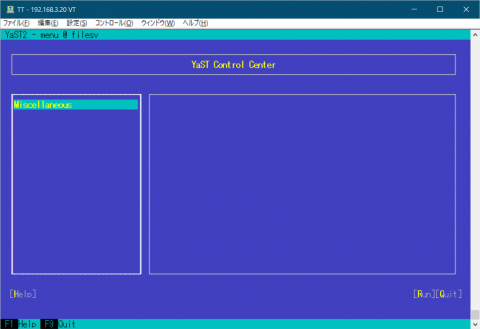
何もないですね。この時点では、yast2-ycp-ui-bindings, yast2-perl-bindings,yast2,yast2-core,yast2-xml,yast2-logs,yast2-ruby-bindings,yast2-hardware-detection,yast2-pkg-binding というものしか入っていません。 yast のサブメニューに対応するパッケージを何も入れていないため、何もないわけです。
そこで、他のサーバを参考にしつつ、yast パッケージを入れてみることにしました。取りあえずはSamba サーバにしたいため、yast2-samba-server を入れることにしました。すると、yast2-samba-client を含め、関連するパッケージが42個も入りました。
続いてSamba本体のパッケージ Samba を入れます。ここでも40パッケージが追加されました。
さて、Sambaをyast で設定するためには少し準備が必要です。useradd でユーザの追加、共有ディレクトリの準備とアクセス権の設定をします。また、pdbedit でSamba用ユーザの登録をします。その後に yast で Sambaの設定をします。しかし、起動すると、図2のように cups を無効にするかどうかを聞いてきます。
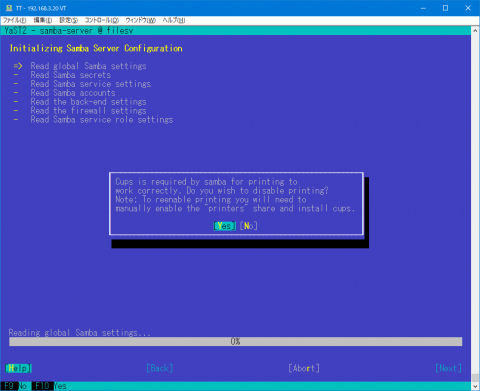
今はSamba経由で印刷することはほぼ皆無なので、最初から無効にしておいてもいいんじゃないかと思うのですけどね。
さて、一通り設定が終わり、Sambaを起動しようとしたのですが、smbdがなぜか起動しません。ログを見ると、
ERROR: failed to setup guest info.
と言うエラーが出ていました。これはSambaが使うゲストユーザの定義がないということでした。調べて見ると、普通OSをインストールしたときには、nobody というユーザが作られているのですが、このLXC環境では入っていなかったのでした。そこで、uid 65534,gid 65533 の nobody を作りました。これでsmbの起動はOKとなりました。