
 Member
 lowks
lowksPackaging python packages in opensuse
This package made the packaging of Python packages on OpenSuSE brain dead easy by doing all of the heavy lifting, creating a sample spec file that really needs very little editing. Install py2pack, and follow this guide, http://en.opensuse.org/openSUSE:Packaging_Python#The_fast_and_automated_way and put that together with the great openSuSE build service and you will have a great time packaging which is usually a thankless job no one wants to do.
Update:
Wow the ruby packaging method is about the same too: http://en.opensuse.org/openSUSE:Packaging_Ruby
OBS 2.2.72 released, switch to apache and SSL as default
We just released OBS 2.2.72, another alpha release for OBS 2.3. The most significant change to former alpha snapshots is the switch to apache. We do so for a number of reasons:
- Getting a maintained base again for our default httpd
- Using mod_rails (passenger) is more flexible then the static setup before
- Optimizations are possible via additional modules (more about that later)
We think that some bugs like the invalid occassional empty replies by the api server are solved via this switch as well.
The OBS 2.2.72 appliance is already comming with apache setup. Please note that we use also SSL by default, a default SSL CA is created on bootup and becomes part of your data partition.
In case you use the packages outside of the appliance, you need to do some configuration steps. But don’t worry, a apache vhost file comes with the packages already and only a few steps need to be done, the README files should reflect this already.
lighttpd setups should still work, but please note that lighttpd is running with an own user id (“lighttpd”) and the default is now the generic “wwwrun” user for some directories.

KDE 6 Roadmap: The Desktop Is Dead
Did that get your attention? Good, it was supposed to. Now get back to making KDE 4 rock in whatever way you are able and resist the temptation to put 'KDE 5' in your blog title to get some clicks. KDE 4 is not going anywhere in the foreseeable future because GNOME just increased their major release number.

Calling hackers who care about Android+Banshee
Unfortunately my Android phone broke completely (don't ask me the details...) so I cannot work on the patch anymore. Anyone wants to continue the work?
If yes, go ahead and ask me anything you want, I'm usually in irc://irc.gnome.org/banshee with the "knocte" nickname, or you could also ask the question on the channel if I'm not there, there are usually awesome contributors there that will try to help. If you haven't ever coded for banshee, check the Contributing page first.
BTW, kudos to all the people involved in the Banshee v.2.0 release!
Gnome 3 Launch Party MadLab Manchester April 10th 2011

Feedback from MadLab Gnome3 Launch, a talk was given by a Gnome Developer on the latest and greatest features of gnome3, however it was also mentioned that it only works on Intel 3D graphics cards at the moment, due to the closed source nature of the NVidia drivers as well as the ATI events these cards are not supported.

On a more general note the attendees were general linux and FreeBSD Users one user was from ArchLinux, 2 users were from Ubuntu (although one - the presenter was disgruntled that as of ubuntu 11.04 Unity is default, gnome 2.x as backup for users not happy with unity and from ubuntu 11.10 gnome fallback will be dropped completely. Other users represented Debian, Linux Format Magazine and Manchester Linux User Group.
I gave out old 11.3 Promo DVD's and I had and introduced the concept of the Retail Boxes. Comment was made that Fedora and openSUSE only exist to serve Redhat and SLED - open source distributions which exist to serve as beta software for their enterprise cousins.
I argued that openSUSE was more than just a launch platform for enterprise systems, and whilst I cannot argue for Fedora I would doubt they would accept that claim also. I stated that through the retail boxes my aim was to get openSUSE available in high street computer shops as well as online.
Discussion was made that Microsoft pressurize retailers to include Windows on their computers, that a real opportunity was last after the release of Windows Vista to target disgruntled windows users through NetBooks.
Comments were also made that HP have announced they will be shipping WebOS PC's where all documents are stored online and all applications are launched online so no operating system will be required. Is the age of the OS (Windows or Linux) dead regardless so there is little or no point in launching any kind of legal claim against Microsoft for shipping oem windows.
Many users were dissatisfied with both Gnome 3 and Unity I suggested that instead of promoting Ubuntu for those new to Linux they should now seriously consider promoting openSUSE instead. Those interested took Live DVD's and promised to take a look.
It was argued also that Novell and RedHat provide more developers into Gnome than Canonical have ever done. Ubuntu may have brought a lot of positives into Gnome in terms of desktop users but this is likely to change as Ubuntu switches to Unity.
Further from a developers point of view Canonical's submission agreement is quite vague in its wording, and if followed to the letter could result in Canonical using code in corporate versions, without the permission of the developer and all rights being transferred to Canonical's ownership by default.

WTF reduction
What it basically does is a bit of what I call WTF reduction: you will no longer get a confusing message like "For property 'Foo' expected 'Bar' of type 'Bar' but got 'Bar' of type 'Bar'" when unit testing your entities' properties.
AFAIK the next release will include this, and will be the first one to link to the new version of NHibernate, 3.0, which I've found that works very well.
New era GNOME 3.0
Looking forward to contribute to 3.x release cycles and i hope i'll be here for GNOME 4.0. Special thanks to everyone that made GNOME 3.0 possible.
See you soon :)

GNOME3 Live image 1.0.0 released - It is about time

just in time for GNOME 3.0 release, I'm please to announce GNOME 3 Live Image version 1.0.0 release.
As you might expect, this release is built with GNOME 3.0.0. Other features, compared to latest image release :
- radeon KMS should be fixed (it was preventing GNOME Shell to start since version 0.3.1)
- speech-dispatcher is used for speech synthesis (ie Orca)
- tracker is installed on the image
- more fonts are installed by default
As always, you can download the image from http://gnome3.org/tryit.html
For openSUSE 11.4 users, we will soon make a stable repository available with GNOME 3.0, watch this space for more info ;)

As a side note, I'd like to thanks my employer (Novell) and my managers who allowed me to work on GNOME 3 for weeks fulltime.
Enjoy.

Banshee 2.0 is here!
We are thrilled to announce the release of Banshee 2.0! It's the culmination of six months' work by 36 developers and dozens of translators, documenters, bug reporters, and testers. It is a stable release, the successor to Banshee 1.8.
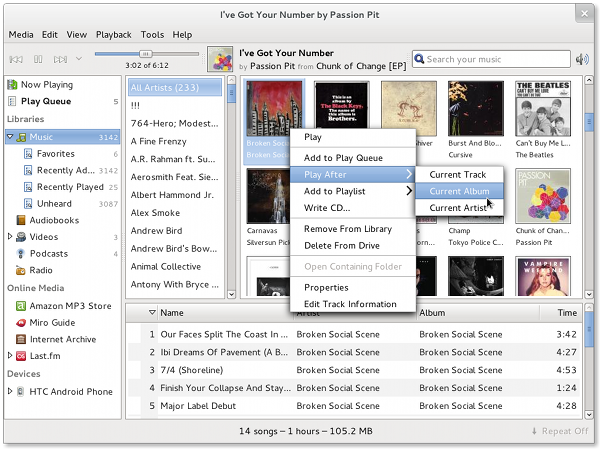
New Features:
- Artist/Album Browser Track Actions
- Play After Queue Options
- Sleeker UI, Less Wasted Space
- Video Subtitle Support
- Lots of new devices supported
- Amazon Cloud Player download support
- Hundreds (277, to be exact) of bugs fixed, and dozens more minor enhancements!
View the release notes for much more information, or head straight to the download page.
The Banshee community has come a long way in the last six months.
- We now support Windows in addition to Linux and OS X. Our Windows installer has been downloaded by 12,729 unique IPs.
- We are donating $1,200 USD per month to the GNOME Foundation — that's over $15,000 annually, or 5% of GNOME's 2009 budget.
- And Ubuntu decided to make us their default music player, joining the ranks of openSUSE and Foresight Linux.
Congratulations and many thanks to everybody who made all this possible! If you want to learn more about Banshee, how you can contribute, get in touch, get help, etc, head over to our website.

Versionitis
The voting on how to do the versioning is over and the “old school” has won by 55 per cent (of 98 participants). Thanks to all that participated in the two votes and the discussion around the topic.
As Coolo said in on the project list, we’d like to make a small change to the numbering:
We will not have a .0 release but only .1, .2, .3 release. Since we have releases in three months, the November
release is always the .1 release, the July release the .2 and the March release the .3.
So, the plan is that the next release will be called openSUSE 12.1 and launched on the 10th of November, 2011! Two years later – on the 14th of November, 2013 – we will then have the openSUSE 13.1 release.
So, the next four releases are called:
- November 2011: openSUSE 12.1
- July 2012: openSUSE 12.2
- March 2013: openSUSE 12.3
- November 2013: openSUSE 13.1
Detailed results for logged-in openSUSE members are available at the connect poll page and I have reproduced them here as well:
- A: “old school”: Like currently but only counting the right number until 3:
55% (54 votes) - B: “Fedora style”: Just integers:
29 % (28 votes) - C: “Ubuntu style”: YY.MM:
16 % (16 votes)
This is also consistent with the results of the first public voting.
Note that openSUSE does not have a major and minor numbering, even if it seems so. There is right now no difference in any way between what we would do for openSUSE 11.4 or 12.0 or 12.1 – and no sense to speak about openSUSE 11 or openSUSE 11 family. We also had in the past no process on how to name the next release (when to increase which parts of the number).
I think this new versioning is still consistent with the old one but also an improvement since it’s now clear that we change the first digit every two year. The first poll showed that half of our users prefer a date based versioning and the other a consecutive numbering. So, depending on your point of view, you can see this as a mixture of both or as consecutive numbering 
So, time now to make openSUSE 12.1 a great release!