
 Member
 jimmac
Even Mo’ Pixels
To keep the habbit alive, I continue to do a daily pixel routine, now covering almost all of the GNOME Circle apps.


I’ve been practicing the art of animation a little too in an effort to promote GNOME Circle on Twitter and Mastodon. Presenting all these GIFs would probably not be kind to Planet GNOME readers though. Perhaps I could compose a video in the future (no GIF support in Blender, strangely!). Keep grinding your (pointless) skills, kids!
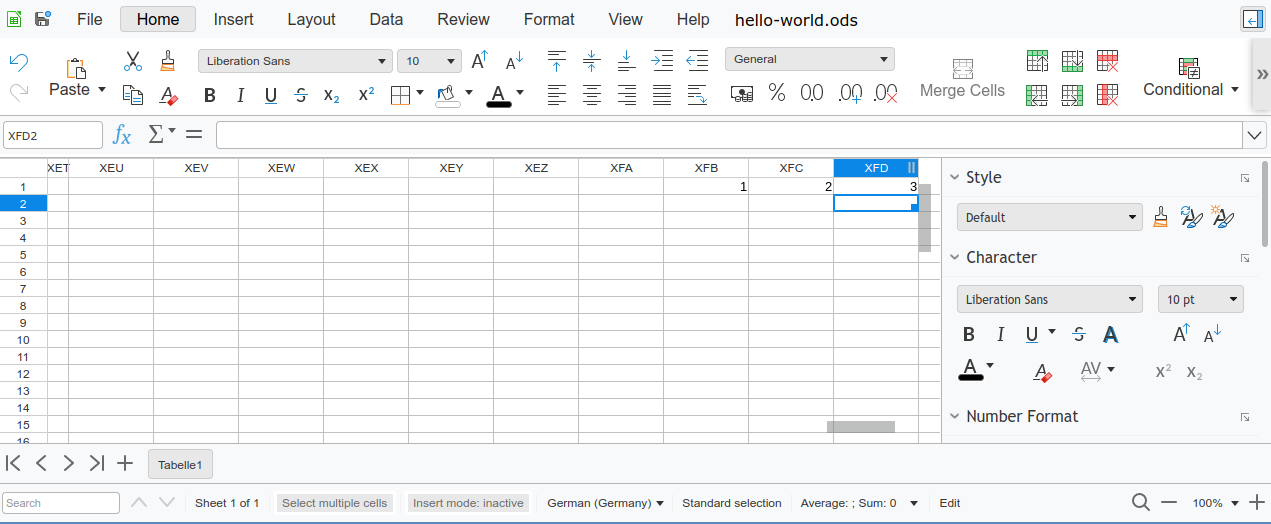
16384 columns in Collabora Online
After the work to support 16384 columns in LibreOffice Calc I have also made sure that the feature works also in Collabora Online, thanks to the funding of NGI.
This project has received funding from the European Union’s Horizon 2020 research and innovation programme under grant agreement No 871498.

Since the Calc core is the same, the underlying functionality works just like in LibreOffice. But the online functionality presented some additional challenges that needed handling, as having more cells in a spreadsheet may mean more data sent over the network, slowing things down. There definitely used to be problems with large spreadsheets, as the tiled rendering used by Online in fact was already limited to 500000 rows compared to 1048576 rows of the desktop version (in fact, git history shows that this started at only 1000 rows initially and then was continually raised over the time as things improved). So together with raising column count to 16384 I have raised this to the normal 1048576 rows as well.
While working on this, one of the problems I needed to handle was a rather unusual one - some automated tests were failing because of timing out. Only with debug builds, because they of course do more checks compared to optimized release builds. And the problem turned out to be how some tests checked resulting spreadsheets after some operations. Since testing Calc running in a browser is more complicated than testing the desktop version, what the tests did was to select a large number of cells (e.g. one entire row), paste that to the clipboard and then the clipboard data was present in browsers HTML data, so the testing framework could test it and verify it is as expected. And this failed with unoptimized debug builds because even though the spreadsheet was almost empty, the unoptimized code checked every cell involved and together it added up enough to exceed the test timeout. Ironically enough, a significant portion was spent in code that was trying to optimize the size of the clipboard data. So I needed to improve the tests and optimize handling of unoptimized code, as strange as it may sound.
Now with hopefully all performance problems solved, Collabora Online 22.05 should support these spreadsheet sizes just as fine as the desktop version.

Plasma, Gear, Frameworks update in Tumbleweed
This week’s openSUSE Tumbleweed snapshots had several KDE packages updated and an update affecting scripts related to grep.
In addition to some changes with YaST affecting grep, the rolling release had snapshots updating Plasma, Gear and Frameworks in that order.
Snapshot 20220914 is finishing testing and the snapshot could be released before this article is published, which would make this week another full week of snapshots if the testing passes openQA.
Frameworks 5.98.0 arrived in snapshot 20220913. The update deduplicated color loading codes with KConfigWidgets and Kirigami had a fix for a potential crash in imagecolors. Frameworks also delivered a lot of additions and fixes to KTextEditor. There were some fixes of inconsistencies in the completion config tab and KTextEditor enabled the clipboard history with non read-only. An update of fetchmail 6.4.33 removed an upstream patch and a wrapper script for HTMLDOC was added for use with Flatpak because the snapd version was broken. Audio format flac 1.4.0 added a FMA instruction set extension to speed up audio for x86_64 CPUs. There is also now a set of files available to test whether a FLAC decoder implements the format correctly. The update of libstorage-ng 4.5.44 fixed the resizing of Linux Unified Key Setup and did some Czech translations. Also updated in the snapshot was the 4.5.4 versions of yast2-bootloader and yast2-kdump.
Just a few packages were updated in snapshot 20220912. Caching proxy package squid 5.7 fixed a regression and a handful of bugs. The package now supports OpenSSL 3.0. An update of the smartcard middleware library pcsc-lite 1.9.9 made some minor improvements and improved the log from the smartcard daemon to log the return code in text instead of hex. A fix to a missing comma in the JSON output of tree 2.0.4 was made and yast2-trans had multiple translations updates for German and Czech.
Device mapper package multipath-tools had its second update of the week in snapshot 20220911. The other package to update in the snapshot was the font drawing library libXft 2.3.6, which fixes a regression in 2.3.5 for dimension-length checks.
The 20220910 snapshot focused on a VERY IMPORTANT update to autoyast2 4.5.4, which replaced egrep with grep -E. This is important to Tumbleweed users to pay attention to as the package replaces obsolete egrep with grep -E. Both egrep and fgrep are deprecated in favor of grep -E and grep -F and a deprecation warning output can break output-parsing scripts. This grep -E change also were listed in yast2 4.5.13, yast2-printer 4.5.2 and yast2-scanner 4.5.1 version updates. The kernel-source updated to 5.19.8. The Linux Kernel had a fix for a memory leak for virtual multilayer switch Open vSwitch. The kernel added a Rosewill USB adapter dongle to the device tables and most of there fixes were related to Bluetooth in this kernel update. Other packages to update in the snapshot were a Plymouth 22.02.122 version, gnome-browser-connector 42.1, ibus-table 1.16.12 and more.
KDE applications were updated in snapshot 20220909 with the update of Gear 22.08.1. Updates to video editor Kdenlive fixed a broken paste clip if trying to paste an invalid clip. The package also made sure that tasks are properly terminated upon closing and had a fix for an incorrect lock that could cause corruption. Some logic and internationalization fixes were made in KMail. News on the starting page was disable with KDevelop as the section is currently unmaintained. Network Time Protocol (NTP) package chrony improved stability with hardware timestamping in its 4.3 version update; it also improved the filter option to better handle missing NTP samples. Some changes with the yast2-core 4.5.4 and yast2-hardware-detection 4.5.1 updates are important for Tumbleweed users becasuse these packages replaced obsolete fgrep with grep -F; egrep and fgrep are both deprecated in favor of grep -E and grep -F. There is a deprecation warning output that can break output-parsing scripts, so be careful Tumbleweed users. Another package to update in the snapshot was multipath-tools.
KDE users received the update of Plasma 5.25.5 in snapshot 20220908, which seems to address a few touchy topics. This bugfix version disabled the Plasma Desktop drag and drop for touch; it conflicted with drag/flick scrolling. The drag and drop was deemed less important than scrolling or opening the context menu for touch. Some brightness actions were changed with PowerDevil and configuration modules for Plasma Workspace now considers the GTK theme setting when computing the default state. A problem with scrolling animations was also fixed in the gtk4 4.8.0 package update. The snapshot also improved the handling of OpenType-font features with the toolkit. Another package to update in the snapshot was Mozilla Firefox 104.0.2. The package fixed a bug making it impossible to use touch or use a stylus to drag the scrollbar on pages. Other packages to update in the snapshot were ipmitool 1.8.19.0, libssh 0.10.4, yast2-network 4.5.6 and more.
Working Hybrid
I worked from home all my life, or at least that’s what I thought. Recently I learned that what do is actually called “hybrid” work. I do most of my work from home, however I also regularly visit the office. I can work a lot more efficiently at home, so, I work from there. Once a week I’m at the office where I do not progress that well with my tasks. Still, I find these visits very important.

This is a follow-up post to my working from home blog from last week.
Meetings
When I started working at my current workplace more than a decade ago, I had a saying that “I only work four days a week for Balabit”. When someone asked me what I do on the fifth work day, I said that “I go to the office for a full day of meetings.”. At that time I considered any meetings a waste of time, taking time from doing actual work.
As a first step I learned that meetings can actually be useful. What I work on between meetings, the main targets of the next software release for example are all decided in meetings. I need to participate to take part in the decisions. Of course I still consider that many meetings could easily be replaced by a few e-mails. However, I quickly remove those from my calendar. There are topics however, that are not easily discussed in e-mail threads. Talking with interested participants in real-time can speed up the discussions and lead to a decision quicker.
In person
The pandemic also taught me that meeting people in person regularly is important as well. Yes, virtual meetings are just as efficient as IRL meetings. In some ways even better, as during less interesting topics you can catch up with your e-mails without disturbing others. But normally meetings have a few fixed topics, and when the discussion is finished or the meeting time is over, people leave and do so with a lot less wasted time. Or is it really wasted time?
Virtual meetings can completely fulfill their jobs. However, many of the best discussions and ideas are born after meetings, in the kitchen or around the water cooler. These are informal discussions where there is no formal agenda, no fixed participants list, just a few random people meeting without any planning. Rushing back to your desk or avoiding the office completely makes these random encounters impossible.
Going hybrid
Many people – including me – are (a lot) more efficient when working from home. That is where work can be done. In the office it is a lot less efficient. Meetings, people talking around you, lots of interruptions. Why do I still say that visiting the office regularly is very important? Because you can meet random people in person. Why is meeting random people is important?
-
In regular meetings people talk to close colleagues. You do not see outside your silo. In the kitchen you might run into members of other teams, join discussions with higher management, or the other way around. This can help to break down silos, listen to different views of the same problems.
-
In an informal discussion people are more open to share why a problem frustrates them. If the other side better understands a problem and why is it frustrating, there is a better chance to resolve it quicker.
-
Even when starting to talk about the weather with someone you just met at the coffee machine, the discussion can easily lead to something useful from the work point of view.
-
Learning about a common hobby with your colleague can bring you closer together, and gain you more attention from the colleague even when discussing work.
These random in person encounters in the office can create tremendous value. Working from home is more efficient in most cases, that is how most people in IT can work through their task lists systematically with minimal interruptions. However, random discussions in the office can break down silos, facilitate quicker problem solutions and even lead to groundbreaking new ideas. This is why in most cases hybrid is better than both in office or full remote.
Happy Hours
If you really cannot get to the office regularly, for example because you moved far and away while remote work was mandatory during the pandemic, you should still visit the office every once in a while. A good occasion is the Happy Hours in the office, when people stay in the office after work and have some great discussions next to a hamburger or other fine food. You can even meet some of the otherwise full-remote colleagues on these special evenings. These events also help team bonding which is especially important when team members rarely see each-other in real life. And, of course, the informal discussions have all the benefits I listed earlier.
What do you think?
Of course, in a more strict interpretation, hybrid means that everyone works where it is the most efficient. From this point of view, the kind of office day I describe is just socializing. In my view going to the office with an open mind and talking to random people you meet there is beneficial, even if you cross out less tasks from your to-do list on office days. These discussions open new perspectives and can be huge productivity boosts, even if somewhat unpredictable. So, it even fits the stricter definition of hybrid: you spend part of your work hours in the office to be more efficient: probably not always on the day you are in the office, but in the long run.
What do you think? You can reach me on Twitter and LinkedIn.

PETSCII Robots on TheC64 Maxi or Mini with a SNES Controller

Request Page Redesign - Round Two
Nightly syslog-ng container images
The syslog-ng team started publishing container images many years ago. For quite a while, it was a manual process, however, a few releases ago, publishing a container image became part of the release process. Recently, nightly container images have also become available, so you can test the latest features and bug fixes easily.
The syslog-ng images are still available under the Balabit namespace on the Docker hub. Balabit was bought by One Identity almost five years ago, and we stopped using the old company name years ago. However, there are many scripts, blogs and even books that feature this location, so changing the location would cause problems for many people. Not to mention, that moving to a new location would reset the download counter :-) Close to 50 million pulls over the years!
From this blog you can learn about the various container images the syslog-ng team provides. You can find basic information about how to use the syslog-ng container image at https://hub.docker.com/r/balabit/syslog-ng, where you can learn how to use your own syslog-ng configuration or open ports for syslog-ng.

syslog-ng logo
You can read the blog at https://www.syslog-ng.com/community/b/blog/posts/nightly-syslog-ng-container-images
openSUSE Tumbleweed – Review of the week 2022/36
Dear Tumbleweed users and hackers,
As we are used to by now, Tumbleweed is kicking and rolling. 7 snapshots in a week would be nothing surprising. Unfortunately, this week we ‘only’ reached 6 snapshots. Number 7 was discarded – not for having issues, but the next snapshot passed so quickly through OBS that it was ‘ready for testing; before openQA could even finish the previous run. Not something we see very often. In any case, no harm done: you just needed an extra day of patience to get some of the updates.
The 6 snapshots published were called 0901, 0903, 0904, 0905, 0906, and 0907 and delivered these changes:
- Linux kernel 5.19.7
- libssh 0.10.3
- SQLite 3.39.3
- NMap 7.93
- Mozilla Thunderbird 102.2.1
- librsvg 2.55.1
- SETools: no longer recommend python3-networkx, which pulled in way too much, incl. pandoc
- NetworkManager 1.40.0
- Flatpak 1.14.0
- GCC 12.2.1
- Libvirt 8.7.0
In the future, near or far, I predict these changes to reach Tumbleweed:
- Mozilla Firefox 104.0.2
- KDE Plasma 5.25.5
- GTK 4.8.0
- Mozilla Thunderbird 102.2.2
- LibreOffice 7.4.1
- libxml 2.10.2
- Linux kernel 5.19.8
- KDE Gear 22.08.1
- grep 3.8: declares egrep and fgrep as deprecated. Switch to grep -E resp grep -F
- util-linux 2.38.1: this also brings a massive package layout change, which will probably take some time to settle. It’s part of the distro bootstrap and we have to be careful to not blow it out of proportion
- fmt 9.0: Breaks ceph and zxing-cpp
- gpgme 1.18: breaks libreoffice
- libxslt 1.1.36: breaks daps
Leap Micro 5.3 Beta Available for Testing
Leap Micro 5.3, which is a modern lightweight host operating system, is now available for beta testing on get.opensuse.org.
The beta version is only expected to be available on openSUSE’s website for a couple weeks before it quickly transitions to a release candidate.
Leap Micro is an ultra-reliable, lightweight and immutable operating system that experts can use for deployments; it is well suited for decentralized computing environments as well as edge, embedded, and IoT deployments. Developers and professionals can build and scale systems for uses in aerospace, telecommunications, automotive, defense, healthcare, hospitality, manufacturing, database, web server, robotics, blockchain and more.
The host-OS has automated administration and patching, so auto-updating gives users a persistent bootable system for their container and virtualized workloads.
Leap Micro has similarities of MicroOS, but Leap Micro does not offer a graphical user interface or desktop version. The OS is based on SUSE Linux Enterprise and Leap rather than a variant of Tumbleweed, which MicroOS bases its release on. The biggest changes to the newer version are NetworkManager as a new default and related tooling like Cockpit plugin, ModemManager, wpa_suplicant and addition use for Amazon ECS. There is a shorter cold boot time (shorter timeout) and the use of jeos-firstboot for post deployment configuration (root password, etc.) for those who don’t use ignition or combustion.
One of the packages related to Leap Micro for developers is Podman. Podman gives developers options to run their applications with Podman in production and the upgraded 3.4.2 version brings new pods support for init containers, which are containers that run before the rest of the pod starts.
Large development teams can add value to their operations by trying Leap Micro and transitioning to SUSE’s SLE Micro for extended maintenance and certification.
Testers can file a bug against Leap Micro 5.3 on bugzilla.opensuse.org.
Users should know that zypper is not used with Leap Micro, but transactional-update is used instead. Documentation from Leap Micro 5.2 can help users who have questions about running this modern OS, which targets edge computing.
openSUSE Leap Micro has a six-month lifecycle.
To download the ISO image, visit get.opensuse.org.
Tumbleweed Ends Continuous Streak, Keeps Rolling
The Tumbleweed continuous daily-release streak ended last week with a new record of 26 snapshots, but openSUSE’s rolling release doesn’t appear to have slowed down in any way with the frequency of snapshots that continue to roll.
Snapshot 20220829 broke the streak, but this week continued to fast forward with several snapshots and package updates.
Before highlighting those snapshots,GNOME 43 might need some love before making it into a Tumbleweed snapshot. Please read the tweet below and chat with the team on https://matrix.to/#/#gnome:opensuse.org if you are interested.
The @gnome 43 release candidate is packaged up in @openSUSE's GNOME:Next, which is our unstable branch. The extensions haven't been tested. Looking for people to test. Chat at https://t.co/iEBQH4ZRt9 for more info. pic.twitter.com/nTJuOkZ6ae
— openSUSE Linux (@openSUSE) September 7, 2022
The latest snapshot to be released was 20220907. The update of gnome-bluetooth 42.4 has its Application Programming Interface now export the battery information for all Bluetooth devices listed in UPower. Files and scripts for MicroOS were updated with microos-tools 2.16. An update of libsoup 3.0.8 had mumerous improvements to HTTP/2 reliability and fixed an http proxy authentication with a default proxy resolver. SVG rendering library librsvg updated to version 2.55.1 and is experimenting with giving librsvg an even-odd versioning; odd minor versions will be considered unstable and even minor versions will be considered stable. This should be fun! A few other packages updated in the snapshot, which including kernel-firmwarel 20220902 and yast2-vpn 4.5.1 and more.
The Linux Kernel updated from version 5.19.2 to 5.19.7 in snapshot 20220906. There were a few btrfs fixes and changes along with amdgpu driver updates in Kernel. An update of userspace-toolset package lvm2 2.03.16 had some segfault fixes, added several patches and fixed the loss of deleted message on thin-pool extension. A change for virtual reality was made with a Plymouth 22.02.122 update because displaying a boot screen on VR headsets isn’t necessary. Or is it? Text editor vim 9.0.0381 fixed some crashing, flickering and a Clang static analyzer that gives warnings. Updates were also made to sqlite 3.39.3 and other packages in the snapshot.
Just two packages updated in snapshot 20220905. Network Mapping tool nmap 7.93 was released to commemorate Nmap’s 25th anniversary. Congrats! The tool upgraded several libraries and ensures Nmap builds with OpenSSL 3.0 while using no deprecated API functions. The package also fixed a bug that prevented it from discovering interfaces on Linux when no IPv4 addresses were configured. The other package to update was Thunderbolt 3 device manager bolt 0.9.3. The update created a work around glib.
A bit more than a handful of packages were update in snapshot 20220904. The packages update in the snapshot were AppStream 0.15.5, git 2.37.3, libstorage-ng 4.5.43, libzypp 17.31.1, zypper 1.14.56) and gc 8.2.2. The update of git corrected some regression and made some git fsck improvements. openSUSE’s zypper made sure up respects solver related command-line interface options.
The update of btrfs arrived in snapshot 20220903. The filesystem update provides some optional support for LZO and ZSTD compression. The update also brought some compatibility with glibc 2.36. An update of GNU Compiler Collection 12.2.1+git416 had some recently backported fixes from trunk and had some changes for armv7l architecture. Pixel encoder and color-space converter package babl 0.1.96 dropped some patches and fixed a crash on non-aligned data for Single Instruction, Multiple Data (SIMD). Other packages to update were libvirt 8.7.0, lsscsi 0.32, upower 1.90.0 and several RubyGems.
The first snapshot since the streak was broken was snapshot 20220901. This snapshot updated curl 7.85.0. Contributions from 79 people were made in the new versions. A Common Vulnerability and Exposure was fixed in the release. CVE-2022-35252 was introduced in curl 4.9 and allowed a “sister site” to deny service to siblings. The release also added Transport Layer Security 1.3 support. An update of NetworkManager 1.40.0 can now restart DHCP if the MAC changes on a device. Some internationalization and localization changes were also made with the network package. An update of Flatpak 1.14.0 improved support for transferring files between two local devices known as sideloading. That software deployment and package management utility also added a package configuration for libcurl to enable the new HTTP backend. Other packages to update in the snapshot were ncurses 6.3.20220820, grilo 0.3.15, mariadb 10.8.3, a kdump git update and more.