
 Member
 CzP
CzPThe syslog-ng Insider 2022-09: 3.38; SQL; disk-buffer; nightly;
The September syslog-ng newsletter is now on-line:
- 3.38.1 released, 4.0 almost feature complete
- syslog-ng Store Box SQL source
- Why is my syslog-ng disk-buffer file so huge even when it is empty?
- Nightly syslog-ng builds for Debian and Ubuntu
It is available at https://www.syslog-ng.com/community/b/blog/posts/the-syslog-ng-insider-2022-09-3-38-sql-disk-buffer-nightly

syslog-ng logo

Calling an Expert | Three Commodore 64s Back from the Dead
Working From Home
The first week of the COVID lockdown, back in March 2020, a journalist friend of mine started a Hungarian Facebook group to share work from home experiences. As I have worked from home all my life (except for two weeks), I wrote a long post about my experiences and thoughts. 2.5 years later, my post still receives some occasional likes, and someone even quoted from it – without naming the source :/ You can read the English version of my original Facebook post below.

I would not call myself an expert on remote work, but as I have been working from home for the past 20 years, I will share some of my experiences.
To be more precise, it started 25 years ago. As a student job, I helped running one of the first web servers of Hungary from home, late in the evenings, in my free time.
Later, as a PhD student, I only traveled to the university campus (in a small town, close to Budapest) when I really had to. Essentially, I was there only when I had to attend or give a lecture. I did my research experiments when I had to be in Gödöllő anyway.
After graduating from university, I worked from home for a small US-based company. I never met my boss while working there and met only one of my colleagues at a conference in Brussels. I only met my boss seven years later, when I gave a talk at a conference in Washington, D.C.
These days, I am still predominantly working from home. I go to the office once a week. That’s when I have my English lesson, team meetings, and so on. (Editor’s note: this is called a hybrid work method nowadays)
And now, here is my list of WFH experiences, which of course might differ from your experiences:
-
Working from home is difficult without motivation in your job, and it is difficult to stop when you are motivated :-) I belong to the latter group: most of my work I would do as a hobby as well. This means that most of the time, it is difficult to stop working and switch to other tasks. If you have minimal motivation, or nothing at all (other than your salary), you most likely need to be in the office and experience peer pressure to be be able to work.
-
Self-determination. It does not mean that you do not discuss your task list with your line manager, of course. However, if based on these discussions, you cannot work on your own, prioritize your tasks, and manage your time, working from home will be difficult for you. On the other hand, if you can present what you would like to work on (and why is it important for the company), it also helps you work on interesting challenges.
-
You are part of the team, even at home. If you do not feel like you are, home office is not for you (or it will be a lot more difficult, at least). I guess it also has to do with being extroverted or introverted. For introverts, working from home is easier, as they even require regular alone time. I belong to this category as well.
-
Communication. No matter where you are working from (a park, the top of a mountain, or the sea shore), your team relies on you, and you can rely on your team. During work hours, you must be accessible, just as if you were in the next room. Unless it is a really critical situation, communication should be asynchronous. What does that mean? Phone or WebEx should be a last resort. Asynchronous communication means that you react quickly, but not necessarily immediately, to incoming questions or requests, without interrupting your current task. During my university years, we used e-mail communication. At the US-based company, we used IRC. At my current workplace, we currently use Teams, but previously we also used Hangouts and Slack as well. Distance must not be a communication barrier. (Editor’s note: asynchronous communication is practically any kind of chat)
-
Humor, stress reduction. These belong with communication, but it is worth giving them an extra emphasis. When you are in the office, you can have great discussions over coffee / tea / cigarette (well, this last one is not for me), laugh at jokes, or reduce stress through talking. This must also work online. We have some dedicated Teams channels for these kind of discussions. However, we do not mind if our meetings have a few funny moments as well.
I guess there are many other WFH topics, but these came off the top of my head.
In the past 2.5 years, most people were forced to work from home for shorter or longer periods of time. Many kept on working from home even after return to office (a.k.a. RTO) became possible. I have talked to quite a few people about WFH recently, and I think most of my points are still just as valid today. What do you think? You can reach me on Twitter and LinkedIn.

YaST Development Report - Chapter 8 of 2022
Time for another development report from the YaST Team including, as usual, much more than only YaST. This time we will cover:
- The fix of an elusive YaST bug regarding the graphical interface
- Initial handling of transactional systems in YaST
- A general reflection about 1:1 management of transactional systems
- Some improvements in the metrics functionality of Cockpit
Let’s take it bit by bit.
Hunting YaST Rendering Issues Down
Over the last year or so, we got some reports about the graphical interface of YaST presenting rendering issues, specially on HiDPI displays and on openQA. The reporters provided screenshots that showed how some widgets were apparently drawn on top of the previous ones without an intermediate cleanup, so the screen ended up displaying a mixture of old and new widgets that were very hard to read.
We were unable to reproduce the problem and we tried to involve people from different areas (like graphic drivers maintainers, virtualization experts or X11 developers) to track the problem down with no luck… until now! We finally found where the bug was hiding and hunted it down.
See the pull request that fixes the issue if you are interested in a technical description including faulty HiDPI detection, unexpected Qt behavior and QSS style sheets oddities. It also includes a screenshot of the described (and now fixed) problem.
YaST on Transactional Systems
And talking about YaST and known problems, you may remember from our previous post that we identified one very visible issue with the on-demand installation of software when using YaST (containerized or not) in a transactional system like the future ALP. Such systems prevent the installation of new packages during run-time, so an extra reboot is always needed before using the new software.
We explored several options to make YaST work as smooth as possible in transactional systems, like performing all the modifications, including packages installation and configuration changes, in a single transaction with a final reboot at the end of the process. But we found it too risky since it implies working on temporary system snapshots that are not a fully accurate representation of how the managed system will look after the reboot.
Finally we implemented the solution that is shown in the screenshot below. For the time being, if YaST detects it’s running in a transactional system so it cannot install the missing packages and continue, then it will simply ask the user to install the packages and reboot.
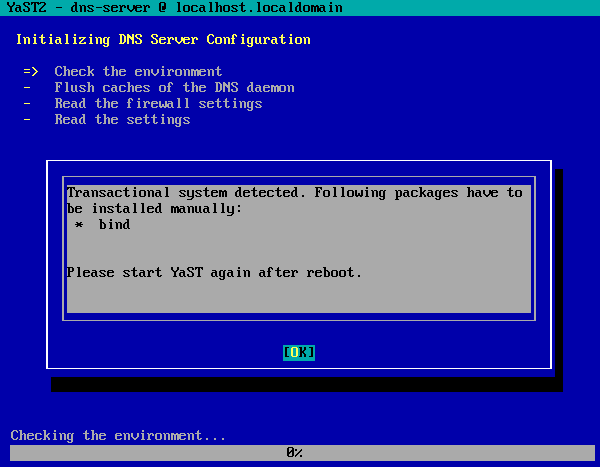
With that, YaST does not longer look broken on transactional systems (unsuccessfully trying to install packages when it doesn’t make sense) but the adopted solution is just a first approach that we will likely improve in the future.
Beyond YaST: On-Demand Installation on Transactional ALP
The described challenge with package management and transactional systems is not exclusive of YaST. We actually have a similar problem with Cockpit and its metrics functionality. So we decided we needed to gather some opinions to find the most adequate and consistent solution for ALP and other transactional systems.
As starting point, we wrote this document describing the situation and presenting some open questions. The feedback gathered so far from members of the ALP Steering Committee suggests we should improve YaST to go further into assisting the user in the process of installing the packages and rebooting the transactional system. The same applies to Cockpit, but that may be more problematic since it’s not aligned with the current vision expressed by the Cockpit developers in that regard.
We are always open to receive more comments and opinions. If you have any, you know how to reach us. ;-)
Better Cockpit Metrics on ALP
And talking about the metrics functionality of Cockpit, we also took the opportunity to polish its
behavior on ALP. And we did it by fixing nothing ourselves. :-) We just diagnosed the problems and
reported what was wrong in the pcp package
and in Cockpit. Both issues are fixed
now by their corresponding maintainers and future ALP pre-releases will offer a more pleasant
Cockpit experience out-of-the-box.
See You Soon
We keep working on YaST, especially on the installer security policies described on our previous report, on improving the Cockpit and the YaST user experiences with ALP and on several other topics we will report in the following weeks, as soon as we have tangible results to show.
Meanwhile we encourage you to get involved in openSUSE development and promotion and to stay tuned for more news. Have a lot of fun!
openSUSE in 2022 | Continues to be Awesome
openSUSE Tumbleweed – Review of the week 2022/35
Dear Tumbleweed users and hackers,
We all knew the day would come – and after 26 daily snapshots were released, 0830 wanted to break that. It turned out that libxml 2.10.x is not entirely ABI compatible with the previous 2.9.x we had in the tree (depending on configure parameters given; IMHO such symbols should have a specific version for those options, allowing to require feature sets). Snapshot 0831 is a very large one: as we checked in glibc during this week, coupled with this ABI break, we decided to let OBS decide what all needs a rebuild (with glibc which usually is everything). In total, we released 5 snapshots this week (0826, 0827, 0828, 0829, and 0831).
The most relevant changes in these snapshots were:
- Meson 0.63.1
- Shadow 4.12.3
- Grub2: revert to a version from 2 months ago without the various TPM patches: they turned out to cause a lot of trouble (and are being further reworked in the devel project)
- Mozilla Firefox 104.0
- Mozilla Thunderbird 102.2
- glibc 2.36
- Make: Add support for job server using named pipes
The staging projects are testing these upgrades and changes:
- Linux kernel 5.19.6
- util-linux 2.38.1: this also brings a massive package layout change, which will probably take some time to settle. It’s part of the distro bootstrap and we have to be careful to not blow it out of proportion
- Mozilla Thunderbird 102.2.1
- GCC 12.2
- fmt 9.0: Breaks ceph and zxing-cpp
- libxml 2.10.2: breaks xmlsec1
- gpgme 1.18: breaks libreoffice
- libxslt 1.1.36: breaks daps

Tumbleweed Continues Release Streak
Tumbleweed’s continuous daily release streak has reached an astounding 26 snapshots.
The streak of openSUSE’s rolling release continued this week and packages like glibc, ibus, Mozilla Firefox and sudo all received updates.
Will the streak continue beyond snapshot 20220829? Users should know soon.
Snapshot 20220829 provided package updates for AppArmor and libapparmor3.0.7. The new versions fixed the setuptools-version detection in buildpath.py. The Man pages for Japanese made some improvements with the man-pages-ja 20220815 update. The tree 2.0.3 update provided multiple fixes for .gitignore functionality and fixed a couple segfaults.
The 20220828 snapshot had ten packages updated. Among the updated packages were ibus 1.5.27, which enabled an ibus restart in GNOME desktop and disabled XKB engines in Plasma Wayland. The update of webkit2gtk3 2.36.7 fixed several crashes and rendering issues as well as addressed a Common Vulnerabilities and Exposure related to Apple’s use of the package. The Python web framework and asynchronous networking library python-tornado6 6.2 enabled SSL certificate verification and hostname checks by default and its Continuous Integration has moved from Travis and Appveyor to Github Actions. Another package to update in the snapshot was font handler libXfont2 2.0.6. The new version fixed some spelling and wording issues. It also fix comments to reflect the removal of legacy Operating System/2 support.
A new major version of the Mozilla Firefox browser arrived in snapshot 20220827. Firefox 104.0 addressed multiple CVEs to include an address bar spoofing to disguise a URL; another fixed an exploit that showed evidence of memory corruption and the possibility to running arbitrary code. The update of the GNU C Library added major new features; glibc 2.36 added process_madvise and process_mrelease functions. Support for the DT_RELR relocation format was added and socket connection fsopen and many other sorting features were added. VMware’s open-vm-tools 12.1.0 package, which enables several features to better manage seamless user interactions with guests, fixed a vulnerability that allowed for local privilege escalation; it also had a fix for the build of the ContainerInfo plugin for a 32-bit Linux release. A few RubyGems like rubygem-faraday-net_http 3.0.0, rubygem-parser 3.1.2.1 and rubygem-rubocop 1.35.1 were also updated in the snapshot.
A total of three packages were updated in snapshot 20220826. The simple PIN- or passphrase-secure reader pinentry updated to 1.2.1; the package improved accessibility and fixed the handling of an error during initialization. The package update also made sure an entered PIN is always cleared from memory. Its graphical user interface pinentry-gui was also updated to the 1.2.1 version. The shadow package, which converts UNIX password files to the shadow password format, updated to version 4.12.3. It fixed a 9-year-old CVE. CVE-2013-4235 fixed the time-of-check time-of-use race condition when copying and removing directory trees. The package also updated and fixed some Spanish and French translations.
A minor update to sudo 1.9.11p3 arrived in snapshot 20220825. The update fixed a crash in the Python module with Python 3.9.10 on some systems and AppArmor integration was made available for Linux, so a sudoers rule can now specify an APPARMOR_PROFILE option to run a command confined by the named AppArmor profile. The sudo package also fixed a regression introduced in 1.9.11p1 that caused a warning when logging to sudo_logsrvd if the command returned no output. That regression was never released in a Tumbleweed snapshot. An update of the open-source disk encryption package cryptsetup updated to 2.5.0. This new version removed cryptsetup-reencrypt tool from the project and move reencryption to an already existing cryptsetup reencrypt command. Other packages to update in the snapshot were gnome-bluetooth 42.3, device memory enabler ndctl 74, yast2-tune 4.5.1 and more.

Search API Endpoints, Fully Documented
Happy birthday, Linux! Here are 6 Linux origin stories
The 31st birthday of the Linux #kernel was yesterday. For this occasion some opensource.com contributors (including me) shared how we got started with Linux. Lots of nice memories :-)
The article is available at https://opensource.com/article/22/8/linux-birthday-origin-stories
flower
openSUSE Tumbleweed – Review of the week 2022/34
Dear Tumbleweed users and hackers,
This week, Tumbleweed made the impossible possible: we have published 8 daily snapshots in just 7 days. Of course, the timing was a bit on our side: the snapshot that started building yesterday went so quickly through build and QA that it already managed to be published. In any case, the daily streak continued all along (now at 22 – a new all-time record).
The snapshots were numbered 0818 through 0825 and contained these changes:
- debuginfod: The package now recommends debuginfod-profile, which contains the configuration and URL to the server. Your gdb experience should be much smoother. If bandwidth is an issue when debugging, you can uninstall/block debuginfod-profile.
- timezone 2022c: We’re coming close to the dates where countries switch summer to winter time, and as usual, some countries change their rules
- KDE Gear 22.08.0
- Linux kernel 5.19.2
- Systemd 251.4
- Xen 4.16.2
- Mesa 22.1.5 & 22.1.7
- Boost 1.80
In stagings, we are busy preparing these updates and changes:
- Meson 0.63.1 (0826+)
- Shadow 4.12.3 (0826+)
- Mozilla Firefox 104.0 & Thunderbird 102.2
- Glibc 2.36: all build issues have been resolved. Final spring towards openQA results
- fmt 9.0: Breaks ceph and zxing-cpp
- Make: Add support for job server using named pipes. A few packages have been observed not to be parallel build compatible with this