
 Member
 _Marcus_
Christmas
As for work... Since December 10:
- We released openSUSE 111!!!11!elf1 (since every says openSUSE 11 to openSUSE 11.0 a little bit freedom here).
2 hours later we started releasing security updates for it, complete with delta support etc.
7 security updates after 24 hours.
- Slow down for Christmas break... Over Christmas break we of course do not close the SUSE and
throw the keys away, but most developers are on holidays. We are of course checking E-Mails
and reacting on critical issues. So far no critical issues yet.
- Wine 1.1.11 released, RPMs as usual on the buildservice.
But now I am on vacation, spent a week at my parents place, helped dig up the forest of grandma for planting new trees, eat lots of food, tried showing the Nintendo Wii to my family (so far no one has played with it, only the husband of my sister), and sleeping long and general relaxing.
What I did in OSS stuff:
- You can now dump and configure most of the Nikon D70s properties. (also used by the other Nikons). So every aspect that can be remote controlled is (will be) remote controllable with a nice interface. Also planned for the other Nikon DSLRs.
- Fixing the KDE4 camera:/ ioslave and configuration module. Still ingoing, but the kcontrol module was completely broken at least due to some automagic conversions run over it.
The kioslave troubles seem related by yet more semantic changes in KIO behaviour. I rewrote parts of kio kamera already to make it less prone to such unclear behaviour, not yet finished / committed.

On open source software and technical support: the reality
Is 2009 The year of "supported open source" Do you agree or disagree ?
I have to admit having worked on both sides of the fence the biggest trend we are now experiencing on web related project requirements is the shift to "supported open source technology"...
The days of 6 figure plus licence fees are now over "phew" our clients thankfully quote...
Old versus New
Interwoven / Vignette versus Alfresco / MySource Matrix ?
Salesforce versus Sugar CRM ?
Documentum / Trim versus Alfresco / Sharepoint Integrated CMS's
What are your thoughts fellow CM Professionals ? Don't just take my word for it... http://cmswatch.com/Feature/189
I read some interesting opinions below, such as this one from Tony Wasserman:
To me, the issue here is adoption and use of open source software by companies and governments for activities that are essential to their businesses. One of the key corporate criteria for that type of software acquisition is availability of long-term 24x7 support, including service level agreements for problem resolution. These CIO's and other decision-makers just don't accept the idea that they can post their issues on a forum and that someone will post a reply. They want a toll-free telephone number to call with the assurance that someone knowledgeable will answer and address the issue.
For example, while small companies and the technically knowledgeable will download and install the Drupal CMS (and its underlying components), the corporate buyer, by contrast, will go to Acquia, gladly paying for support. As a better example, many of the installations of open source software in corporate environments are being done through consultants and system integrators, such as Wipro, Infosys, Accenture, and IBM.
So now the next question is whether the demand for open source software will increase in 2009. For that, I would give a qualified "yes". Startups have been building their companies on open source software for most of this decade, and will continue to do so, but they are not spending a lot of money on support, consulting, and training services. Developers in companies of all sizes have also long used open source software packages and libraries, including Eclipse, NetBeans, JBoss, MySQL, and hundreds of others, again without much money changing hands.
For enterprise applications, companies have already made substantial investments in existing proprietary software from Oracle, SAP, Microsoft, and other vendors, so it is hard for them to justify replacing it. The enterprise opportunities for open source come with new applications, and with growing companies that need these applications.
So I think that there will be growing revenue in 2009 for the system integrators providing open source support and services, as well as some money for the vendors of commercialized open source products, such as Zenoss, Groundwork, and other infrastructure packages. I think that the growth for the application packages is probably a little further out, though I would make an exception for OpenOffice.org , which has already seen a lot of acceptance.
Or this one from Glenn A. Curry:
Tony brings up an interesting issue. That of access to tech support. But our experience has been that the tech support available from commercial software manufacturers is in many cases worse than nonexistent. Not all have 24x7. And even if there is someone that answers the phone, there typically is little value in talking to them.
In trying to resolve software issues for our customers, we are most often given answers like "just keep reinstalling it till it works". Or they want security settings reduced because their interface is sloppy. Or they just flat give bad answers. The extremely poor level of phone support so often found is incredible. The battle required to move up the chain to someone that actually has a clue is frustrating and costly to the customer as they have to pay for our time while on the phone.
e.g. we spent days dealing with Sage on a Peachtree upgrade. Their solution (besides the before mentioned "just keep reinstalling it, that usually makes it work eventually") was to run as administrator all the time to get around a security problem. Eventually we found the problem and solved it with some port mapping. It was a common problem based on discussions on techie sites. AFAWK it is still a problem for them. We sure are not going to tell them how to fix THEIR bad software design for free. And noe one there had a clue.
And I won't even begin to list the massive Microsoft tech support nightmares.
Just because a company claims 24x7 tech support, does not mean it has an actual usable value.
So, without trying to be devil's attorney, I gave my opinion:
I think Tony and Glenn raise good points about support, but I would like to arise a third point, that maybe contrasts with them. The issue is not about support itself, but about what does "support" mean in open source software:
1) Yes, in open source, there's no monopoly about technical support, and this is always a good thing, except for the cases in which it can be seen wrongly as bad quality, because:
a) It may happen that there's no company behind an open source project, just one or some developers, and it's a bit awkward to ask them for support if they're not professionally gathered in some way. Besides, if the developer base is so small, it's going to be difficult to find another company which gives you support if they don't know much about the product.
b) It may happen that the developer-base is spread around many companies (for example: OpenOffice, the Linux kernel), so the company that needs support is normally confused as to which one is the best one to request support. This is awkward to a company which normally considers a product to come from "just one company".
2) Propietary software may mean a monopoly in regards to technical support but, let's face it: many incompetent people working inside companies just prefer some provider to blame if something goes wrong: "we're stuck in this issue because Oracle (or put you're favorite propietary software company here) technical support sucks", and it's not their fault anymore. If they had chosen an open source software solution, they may be accused of:
a) Not choosing the best provider for technical support.
b) Not fixing the issue themselves, since, if you have the code, it's just a matter of time to solve it, right?
Well, just trying to be realistic. Of course I advocate open source (I work on it on a daily basis), but just wanted to give some clues about why it's not getting the success it should have.
In general, the (2) point and (2a) in particular, is very similar to the reason why still incompetent but huge companies survive on the market: I've heard many cases of people just buying Oracle or Accenture because they're the most expensive. If all goes wrong, it's impossible they would be accused of selecting the wrong provider if they selected the most expensive one, right?
UPDATE 16-FEB-2008: Even though the above given problems about choosing open source solutions, here's a nice guide to try to overcome them: Convincing Management To Approve Free Software.
Merry xmas!
I'm spending my xmas night with my parents and then (when they fall sleep) i will be with my friends eating, drinking and drinking until the sun rises. It's a tradition here. I'm feeling very happy for this day i hope the best for everyone!
PS: I got a gift from my parents, a Emporio Armani Code perfume, my favorite.
PS2: Cleaning some bugs at GNOME bugzilla and submiting new 2.25 packages for opensuse.
Happy xmas!
Enlightenment LiveCD
Ladies and Gents!
Glad to announce the third release of unofficial Enlightenment LiveCD based on our brand new OpenSUSE-11.1.
Download page
‘Welcome’ notes (PDF)
Please visit the download page to see the details and try the mirror provided by Yandex.ru. Read the Welcome.pdf before you pop the disk into the PC/Qemu/etc.
Along with this “release” we made another ‘iso’ which has less software but carry the proprietary ATI/NVIDIA drivers and all components to build and install them for your PC. Instruction is here:
‘Development’ release
Disk has a kernel sources, gcc, make and other ‘user unfriendly’ packages – thet’s why it’s a ‘development’ one.
The brief changelog comparing to the old ‘release’:
- all EFL applications now use the default themes. This allowed to save some valuable spase and provide additional software (like the latest ‘linuxdcpp’ with multithreading download capability)
- ‘SCIM‘ is included and ready to support the wide spectrum of international locales (added upon request from our Japanese colleagues)
- operations with any external and internal volumes/storages under ‘User’ via hal+dbus+udev. You’re welcome to explore the amazing E17’s module ‘places‘ which allow an ordinary user to control and monitor all volumes on-the-fly
- EFL/Enlightenment is build in OBS from svn revision 38164 (dated 20081215)
- ~/bin folder has some nice scripts inside and we hope to provide much more useful tiny utilities next time
- ‘Wicd‘ is set as a default network configuration utility (instead of ‘Exalt‘ which is now in a heavy development). If you’re not happy with it – just use the default ‘NetworkManager’.
- ‘jwm‘ is added as an example of a WM which could be configured in and out (man jwm). It’s very good for an old PC’s (along with ‘E16‘). We tested the disk with a 128 RAM – works…
- and the most interesting feature – is a ‘0install‘ technology, which allow you to build your own ROX-Desktop from scratch (internet connection is required). The result is very close to ‘GoboLinux’ – just click on ‘ROX-Filer‘ menu entry (Applications -> System -> File Manager -> ROX-Filer)
Some new applications added like ‘Tracker‘, ‘Edje_viewer‘, etc., init routine adjusted and several other tricks performed to prepare yet another general-purpose Linux LiveCD. Below is a link to the small gallery of a screenshots:
Exactly what you get by default. Unfortunately they can’t express the feel of E, which is “…like people say, amazing.” Mirror is updating right now and the new version soon will be there (hope so).
As usual we’re glad to receive your feedback.
Acknowledgments:
Enlightenment Development Team and Enlightenment Community
OpenSUSE Build Service Team
OpenSUSE KIWI Team (schaefi, cyberorg, pzb, cgoncalves – THANKS!)
Stalwart, thanks for the hosting!
Packman Team
Novell
Jan Engelhardt
and all the others, who helped to make it (Engineers, Developers, Users, Maintainers…)
Thanks!
Regards,
SOAD team
YaST Qt4 Stylesheet Editor
YaST uses style.qss located in /usr/share/YaST2/theme/current/wizard by
default. If you want YaST to use a different style sheet (e.g. the style shown
while installation) you can set the $Y2STYLE environment variable:
Y2STYLE=installation.qss /sbin/yast2 disk
I’ve added a new hotkey to YaST which allows to modify the style sheet on
runtime. Pressing [Ctrl] + [Shift] + [Alt] + [S] in a YaST module opens the Stylesheet Editor. Now you can load a style sheet and modify its style rules.
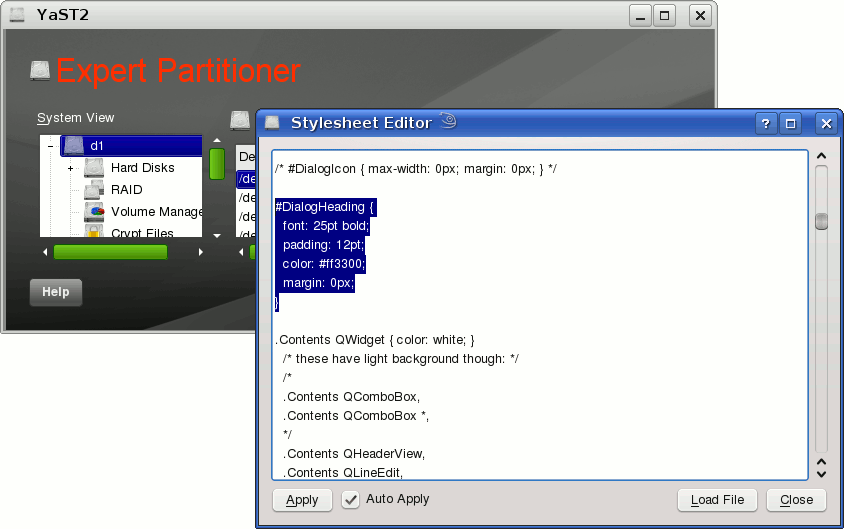
The Stylesheet Editor can be very usefull when you want to design your own style for the YaST Qt4 UI.
This feature will be available in openSUSE 11.2. If you want to use it now all you need is yast2-qt version 2.18.2. You can find the latest version here:
http://download.opensuse.org/repositories/home:/tgoettlicher/openSUSE_Factory/
Gettext Variables
Well, it turned out that i forgot about one more variable, the LANGUAGE. This defines a language preference list and takes higher priority that LANG, or LC_* variables. Mine was set to en_US (i don't know why, though) :O(
So the fix for me was either to unset the LANGUAGE variable, or include sk in its value. Read more about this variable here.


openSUSE 11.1 has been released!

openSUSE 11.1 just got released a few seconds ago!
The openSUSE Project is proud to announce the release of openSUSE 11.1. The openSUSE 11.1 release includes more than 230 new features, improvements to YaST, major updates to GNOME, KDE, OpenOffice.org, and more freedom with a brand new license, Liberation fonts, and openJDK. This is also the first release built entirely in the openSUSE Build Service.Get a copy of it by downloading via http://software.opensuse.org, or if you want an original copy order the openSUSE 11.1 Retail Box for only 59.95 EUR/USD. With the supported version of openSUSE you not only get a complete end-user documentation, installable media for x86 and x86 64-bit systems, plus 90 days of end-user installation support, but you also will be contributing by giving some money to the openSUSE project itself!
Read the full announcement: openSUSE 11.1 Released!
Digg it: http://digg.com/linux_unix/openSUSE_11_1_Released
Best Way to Download openSUSE
For most people, downloading traditionally looks like this:
- looking at a traditional, more or less static mirror list, and picking a mirror

- trying the mirror and see that it is too slow, outdated, or not reachable
- looking at the mirror list again, and picking another mirror
- downloading with a web browser or FTP program
- restarting a failed download, after loosing network connection for some reason
- ditching the download because it never finishes, starting from scratch from another mirror
- finally having a completed download, but for some reason it doesn’t install…
- finding the MD5 sum and manually verifing the download
- finding it broken and don’t know whether to start from scratch, repair the download with rsync, …
- scratching head… and be frustrated

Manually proceeding like pictured above is no longer needed, nowadays. At least not with openSUSE.
All you need is a Metalink client. This is a wonderful technology that fixes all the above issues, and makes downloading “just work”. A Wikipedia article explains how that is achieved.
The openSUSE download server fully supports this technology, by using MirrorBrain. Mirrorbrain is a download redirector and metalink generator which is open source and supports all advanced Metalink features. Features as embedding of Torrent links, verification hashes, cryptographical signatures and transparent negotiation, so that no separate links are needed on our web sites. Most of these features were added during the course of 2008.
There is a number of Metalink client programs out there. There is a FireFox extension called DownThemAll which works in FireFox on all platforms. There is aria2, a commandline program which is the most powerful of all of them. Our wiki has a list with more clients. I tend to recommend aria2, because it is the most powerful one. It is very simple to use, nevertheless.
aria2 deserves special notice, because it has the full support for all goodies that one might think of. These include:
- downloading from several mirrors at the same time (so it also makes you faster)

- automatically noticing mirror problems, and resuming from other mirrors
- simultaneously downloading via Peer-to-Peer (BitTorrent)
- error checking for transferred data is not only done in the end – but already during downloading. Each part of the file which has arrived is already checked, and if it’s found to be broken, it is scheduled to be refetched from another mirror.
- creating a local *.asc file which contains the cryptographical signature which can be used to verify the authenticity of the file
- automatically noticing if a server supports metalinks (if not, it will just act as “normal” download client)
- being robust against all sorts of network failures
- avoiding head-scratching of its user

Both aria2 and MirrorBrain are “location aware”, and work together to select mirrors that are as close to you as possible. In addition, mirrors known to be more powerful are assigned more users.
What else do you need to know? Not much. The command that you run to download an image is as simple as:
aria2c http://download.opensuse.org/distribution/11.1/iso/openSUSE-11.1-DVD-i586.iso
(For some other clients, you need to append “.metalink” to the URL.)
Note, aria2 tries to maximize utilization of your Internet connection for download bandwidth. This is wanted for most people, but it may be unwanted if you want to use the connection for other work, or if you are in a company with shared Internet access. In that case, use acia2’s -C command line option to limit the number of simultaneous servers being used.
Special note for Torrent users: you don’t need to bother downloading Torrent files. Aria2 does this automatically… since the Torrent link is embedded in the Metalink!
If you want to see what the magic behind all this is, look at http://download.opensuse.org/distribution/11.1/iso/openSUSE-11.1-DVD-i586.iso.metalink with an editor. You’ll see an XML file containing everything that the Metalink client needs. This file transfers the knowledge of the download server (and mirror database) to the client. With this knowledge, the client is enabled to work its way to a successful download even under adverse circumstances. In contrast, a traditional HTTP redirect to a mirror does convey only extremely minimal information – one link to one server, and there is no provision in the HTTP protocol to handle failures, or to add checksums that make problems detectable. An Internet Draft documents the Metalinks.
Many thanks to Tatsuhiro Tsujikawa for aria2!
This technology would be even easier to use, when web browsers would implement native support for it. Let’s hope that we will see that in the future. The technical challenges are solved and the way is paved. Ask your favourite browser vendor for it today…!
And since this is so powerful, we intend to employ it for other downloads as well — those done by the openSUSE package management tool, YaST respectively zypper. A prototype for this is available in openSUSE 11.1. Please test it – it is enabled by installing aria2 and setting ZYPP_ARIA2C=1 in the environment.
Christmas cards already
Next day I met my other friend who dragged me to a posh cafe. At some point we started talking about knitting. That might be a sign of us getting old or let's say mature. Somehow it worries me.
The first Christmas card arrived in my letter box. Now I'm panicky. Besides not having bought all Christmas cards yet I couldn't find the current addresses of my friends. When this is sorted out town is awaiting me with a million people in every shop where I have to find some presents. Christmas time should be quiet and soothing. It is nerve-racking instead. At least there's no time to indulge into the winter depression.